@0x94305 You neglected to say that the LVR problem is here to stay *on Ethereum*, or, more broadly, *on VM-based account model blockchains*. LVR is solved elegantly by mechanism design and market dynamics, using blockchain, and so marking a definitive improvement on tradfi and "defi"
So much summed up in an ironic post. It's the current state of things. Fortunately, blockchain allows for mechanisms that do away with the worst of tradfi rather than emulate it. We just haven't seen it in the wild yet
I hope all of you MEV searchers had a really good time out there and made a lot of friends along the way because Citadel has arrived and they are, in fact, much better at ordering transactions than you are
@0x94305 The biggest issues you highlight have been solved, but not on Ethereum because generalized VMs are not an optimal foundation for efficient DExes. Engineering and gas overhead are likely too high to solve these on Ethereum. But an elegant solution using smart txs has been achieved
It would be much much better if I could just send my conversion tx onchain and be guaranteed best execution price at settlement simply because of mechanism design and the dynamics of the system
@atiselsts_eth The "loss" is risk-adjusted. This means absolute results can be profitable in a particular case but the LP still lost because their financial results would have been much better if they took the same risk in other venues (eg. rebalancing on CEX, or LPing on superior mechanism)
@atiselsts_eth Driving force of LVR is due to two prices that arise from an AMM tx. One is "realized price" which is what user receives on the tx. The other is "implied price" which is the new state of the AMM. Profit max arbs will make implied=market, and realized<market. Arbs win, LPs lose
They state this as if it's universally true because they're locked inside their paradigm. I agree with them that it's true in uniswap. But it's not a universal truth for AMMs
4/ Liquidity also impacts price slippage 🌀
If you have plenty of tokens in a pool, price impact should be minimal. But if liquidity is low, larger trades can affect token price.
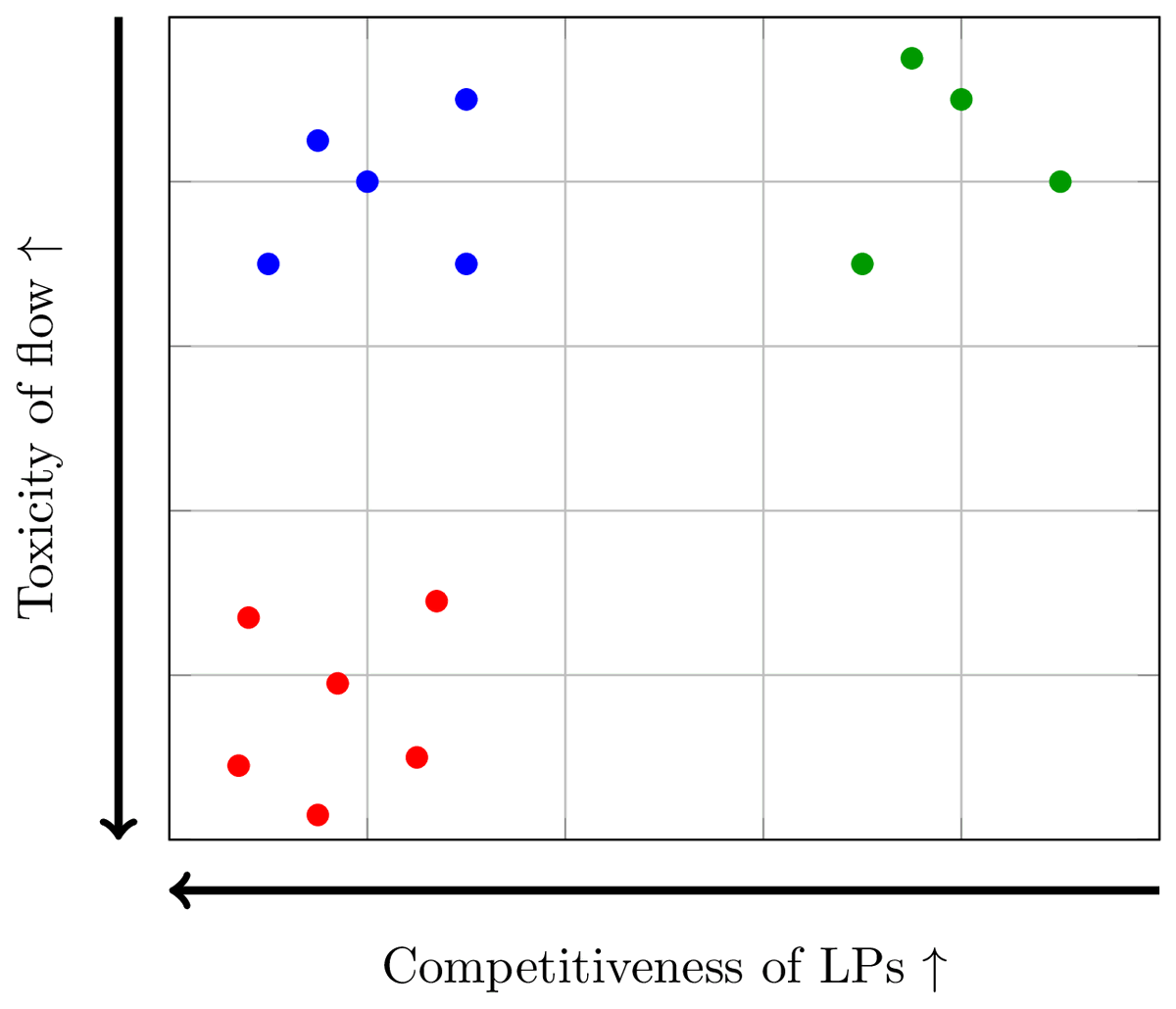
4/ FLAIR represents an important step towards improving the efficiency & effectiveness of LPing in AMMs.
In the graph, current models equate the green & blue pools with low flow-toxicity. FLAIR separates these by measuring LP competitiveness, showing an important 2nd dimension.
@haikane yes - you seem to assume that it's necessary for every DEX to be implemented by smart contracts operating over a consensus base layer, and so txs through an AMM must be completed serially. That assumption gives rise to all of these problems and prevents elegant solutions
The thing is, Hayden doesn't care at all about looking at the full solution set for these issues. Instead, bagholder logic leads to him promoting "solutions" via analogies where people shoot each other in the back of the head. So sad.
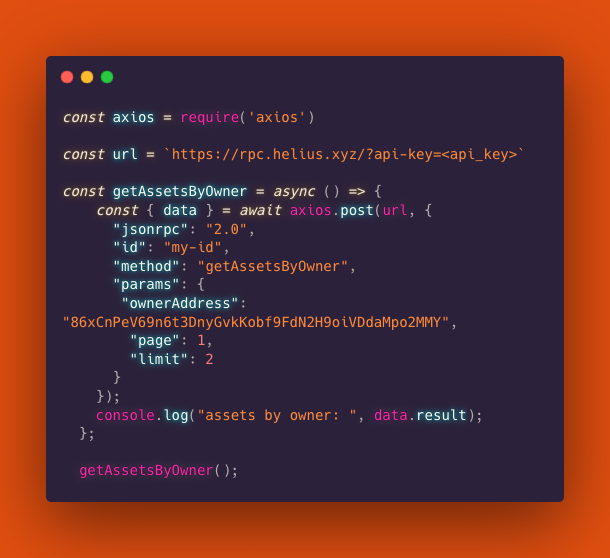
Fetching all the NFTs an address owns on Solana is generally slow and unreliable
with the new Digital Asset Standard (DAS) API, you can now get ALL nfts — compressed and regular — in a single, blazing-fast RPC call!
only possible on Solana
check it out:
The fundamental challenge he has in analyzing this is that he implicitly and automatically accepts the received "wisdom" that decentralized apps shall be implemented via smart contracts over a generalized VM base layer. Unfortunately, it means systems that aren't fit for purpose.
Blockchain technology can be used to create AMM mechanisms where market dynamics elegantly protect LPs from LVR without further ado. It's too difficult to implement on VMs like Ethereum though so you get complexity, gas heaviness and elements of trust.
A Surplus Capturing AMM study funded by the CoW Grants Program is out. 👏👏
A large fraction of DeFi relies on liquidity pools, yet LP's are poorly compensated. The study examines this problem and how to properly reward them.
https://t.co/CAL4PjOiVJ
Classic example of bagholder language. He actually means "ETH staking reward rate needs to be a lot lower for DeFi *on ethereum* to have a chance". DeFi itself will do just fine either way.
I think the ETH staking reward rate needs to be a lot lower for DeFi to have a chance. We can either get there by changing the protocol parameters to lower issuance or by moving all activity to L2s, thereby diminishing fees and MEV on mainnet.
@MikeToutonghi I like your fee pool invention to deal with this -> the security implications of high fees. For those who don't know, mike is the lead dev on https://t.co/xCwDjXKx1E where fees go into a feel pool to deal with exactly this https://t.co/PMUksf9xnh
We've seen a few shallow #Bitcoin#forks today. Is this foreshadowing MEV on Bitcoin?
Reminder: when fees > block rewards, MEV becomes a thing on Bitcoin. Miners might try to fork to steal away juicy fees from others & bribe so others mine on the fork, sharing part of the higher fees.
"AMM LPs are betting on a sideways market and hoping fees will exceed their IL"
There are more efficient ways to do this where you are not systematically undercompensated for risk because arb bots are regularly eating your lunch. AMMs like uniswap are not fit for purpose.
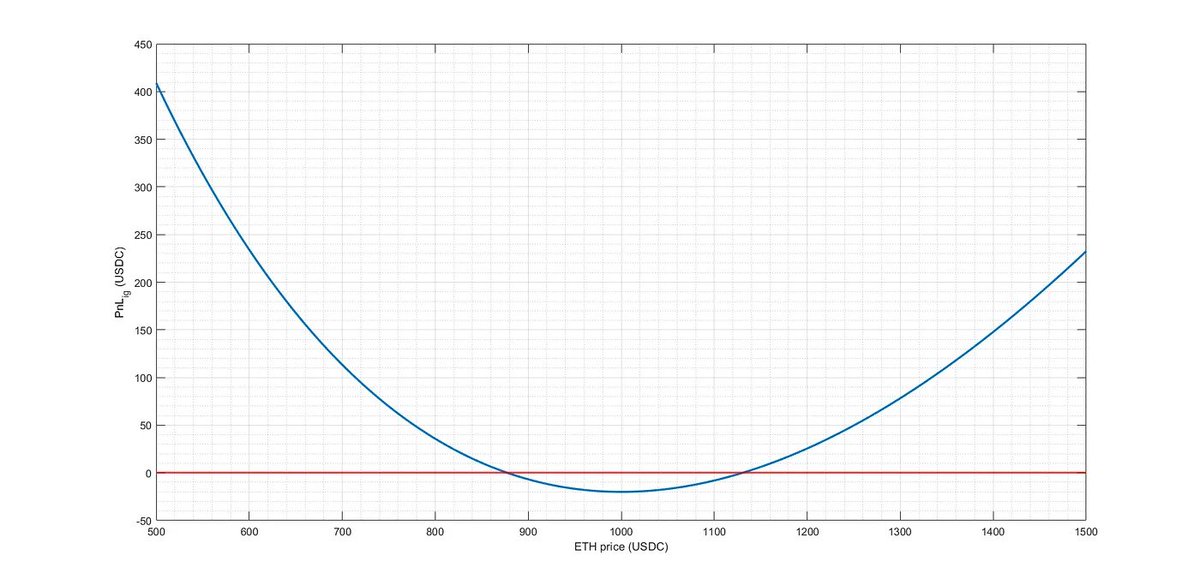
Neat stuff: @SmileeFinance is building "smile" derivatives that have the inverse of an LP's payoff
AMM LPs are betting on a sideways market and hoping fees will exceed their IL
Smile buyers pay a premium and are hoping for an "impermanent gain" (IG) that exceeds their premium