We focus on three things:
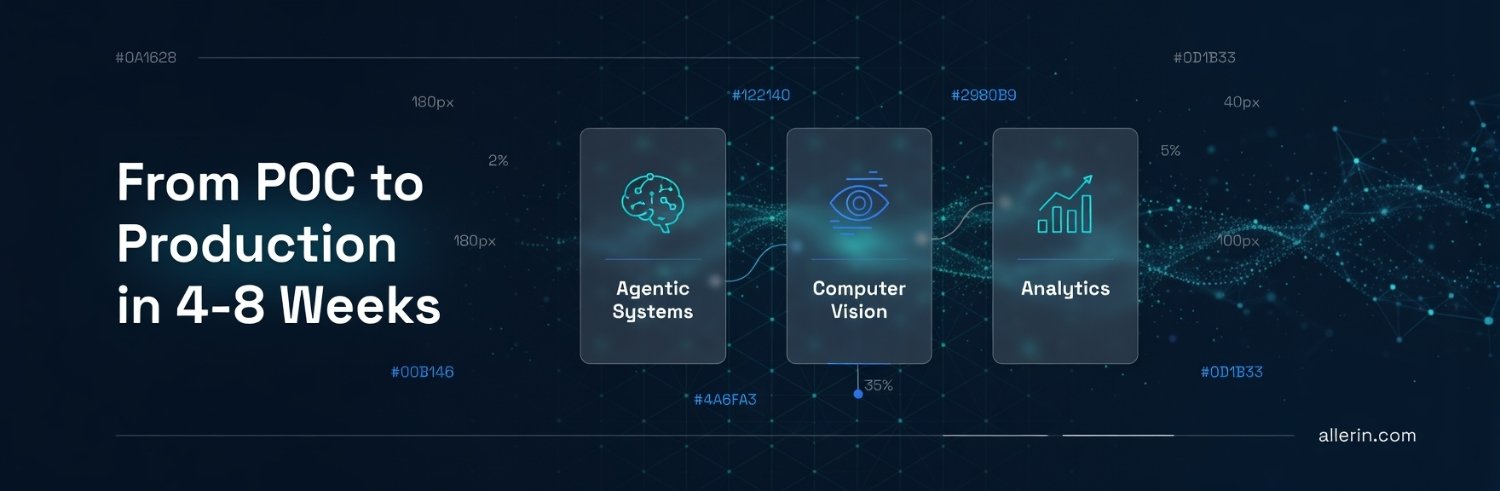
1. Agentic AI systems (agents that work with guardrails, not chaos)
2. Computer vision (99.4% accuracy on manufacturing floors)
3. Enterprise analytics (turning data into decisions, not dashboards)
Some numbers from real deployments:
Claims processing: 14 days to 2 days
Visual inspection: 94% human accuracy to 99.4% AI accuracy
Scrap reduction: 2-3% down to under 1%
Throughput increase: 35% more output, same machines
If you're stuck between "AI demo that impressed the board" and "AI system that actually runs in production" - that's exactly where we live.
DMs are open. Or just follow along. We share what we learn here every day. #ProductionAI#EnterpriseAI
We're Allerin. We deploy production AI for enterprises.
Not demos. Not proofs of concept. Not "AI strategies."
Actual systems running in production, making decisions, saving money.
Here's what we do and why it matters. A thread.
What makes us different:
We deploy in 4-8 weeks. Not 6-12 months.
Every system ships with a kill switch, audit trail, and rollback capability.
Because enterprise AI isn't about being impressive. It's about being trustworthy.
The accuracy compounding problem nobody talks about:
If your AI agent is 85% accurate per step (sounds great, right?)
A 10-step workflow succeeds only 20% of the time.
85% ^ 10 = 19.7%
This is why #ProductionAI is a completely different discipline than building a demo.
A client told me: "We've run 12 AI pilots in 2 years. None made it to production."
I asked one question: "Who owns the deployment after the data science team hands it off?"
Silence.
That silence is where most AI projects go to die. #EnterpriseAI
Every failed AI project I've seen had the same pattern:
Week 1-4: Excitement. The demo works.
Week 5-8: Reality. The data is messy.
Week 9-12: Politics. Nobody owns the rollout.
Week 13+: "AI doesn't work for our use case."
The AI was never the problem.
Computer vision on a manufacturing floor isn't glamorous.
No one writes blog posts about camera placement, lighting calibration, or dust on lenses.
But that's the difference between 94% accuracy in the lab and 99.4% accuracy in production.
Hot take: most AI demos are lies.
Not intentionally. But a demo on clean data with no edge cases and no latency constraints is a fantasy.
The real question isn't "does your model work?" It's "does it work at 3 AM when the data feed breaks and nobody's awake?"
We see this exact pattern in our manufacturing deployments. The 80/20 split works well. CV handles the repetitive visual inspection at scale, humans focus on the edge cases that actually need judgment. The throughput gains are real but the compliance piece is what gets it past procurement.
@sairahul1 This is the right direction. The gap we see with enterprise clients isn't "can you build an agent" it's "can you operate one in production with guardrails, monitoring, and rollback." Building is maybe 30% of the job. The other 70% is everything that happens after deploy.
This is illustration #3761 for frontier labs.
But it's illustration #1 for enterprise teams who've been quietly getting massive ROI from relatively simple models deployed well.
A well-trained classifier routing support tickets: 600%+ ROI in 3 months. Computer vision on a factory floor, $691K savings per production line per year.
No AGI needed. No unlimited budget needed.
The gap was never model intelligence. It's deployment intelligence.
@AndrewYNg Shared context between agents is the next frontier. We're seeing this in production already
The challenge? Governance. When Agent A learns something from Client X's data, can Agent B use that learning for Client Y? The privacy and IP questions are harder than the technical ones.
The irony is that while the frontier labs burn billions chasing AGI through scaling, the enterprises we work with are getting massive ROI from relatively simple models deployed well.
A well-trained classifier that routes support tickets correctly has a 600%+ ROI in 3 months. No frontier model needed.
The gap isn't model intelligence. It's deployment intelligence.
The code isn't dying. The ratio is changing. The model is maybe 10% of the work. The other 90%? Integration, error handling, rollback mechanisms, compliance
logging, monitoring.
That 90% still needs engineers who understand systems deeply. AI writes the boilerplate.
Humans architect the safety.
This is fascinating from the research side. On the enterprise deployment side, we see the same pattern, the agent finds optimizations humans would never try.
But the critical missing piece in production? The confidence scoring that determines when the agent should stop experimenting and ask a human.
700 experiments are great in a sandbox. In a production system handling live transactions, experiment #47 needs a kill switch.