Most AI tools stop at the open web. InfiniSynapse doesn't.
Data behind login. Personal or enterprise structured + unstructured data — databases, docs, files.
One agent joins all three in one analysis.
Watch 👇
1/5
@vihaang_1 Exactly—this is the boundary we recommend. Keep the InfiniSynapse API key server-side, establish SSE with a connId before creating the task, and expose only the progress events the UI needs. This protects credentials and avoids missing early task events.
Most Vibe Coding failures start at the system boundary, not the prompt. Keep users, permissions, core data and deterministic state in your app. Add InfiniSynapse as a controlled agent layer for long-running research, data analysis and file-based deliverables.
Fastest starting point: save the integration guide as SKILL.md and hand it to Cursor, Claude Code or Codex. Start with one low-risk workflow, persist taskId and connId, connect SSE before newTask, then read final artifacts from the workspace. #VibeCoding#DataAgent
The integration path is simple: UI → your backend/BFF → an InfiniSynapse adapter → Server API. Supabase can stay in place for Auth, PostgreSQL and Storage. The adapter keeps the API key server-side and maps SSE progress into your own job states.
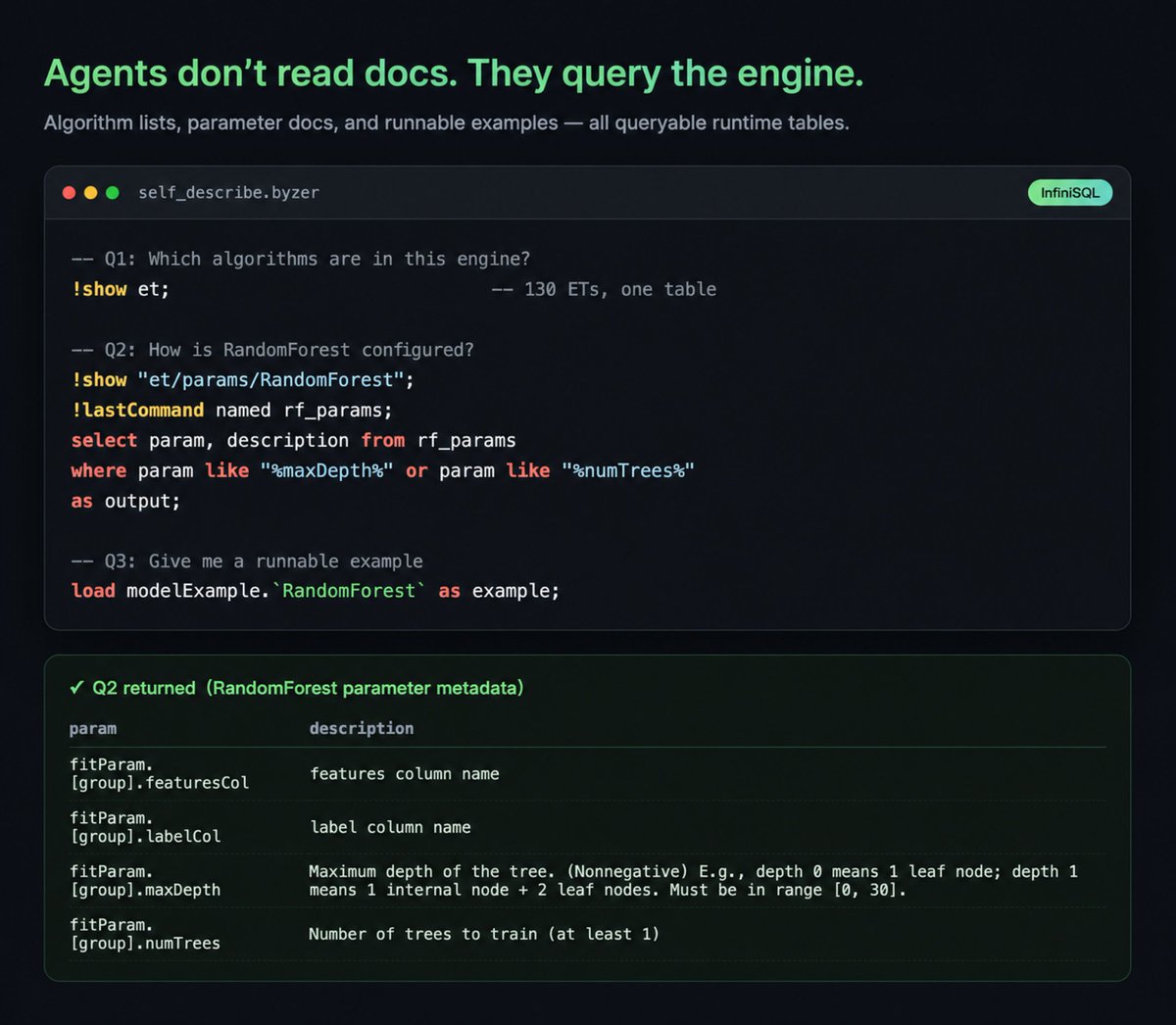
InfiniSynapse users still work in natural language. Underneath, InfiniSQL lets the agent discover capabilities, parameters, and runnable examples from the deployed engine itself. The runtime becomes the source of truth. #InfiniSynapse#InfiniSQL#DataAgent
The best tool documentation for an agent is the runtime itself. In a verified InfiniSQL environment, `!show et;` returned 130 available ET components as a queryable table, not a stale document.
Need RandomForest parameters? `!show "et/params/RandomForest";` returned live metadata. Naming the result `rf_params` let the agent filter only `maxDepth` and `numTrees`; the engine reported maxDepth [0,30] and numTrees >= 1.
The deepest differentiator cannot be bought or copied: people, and the judgment, trust, coordination, and culture they build together. Technology spreads. Tools proliferate. People and organizations do not automatically become alike. Put people first to build for the long term.
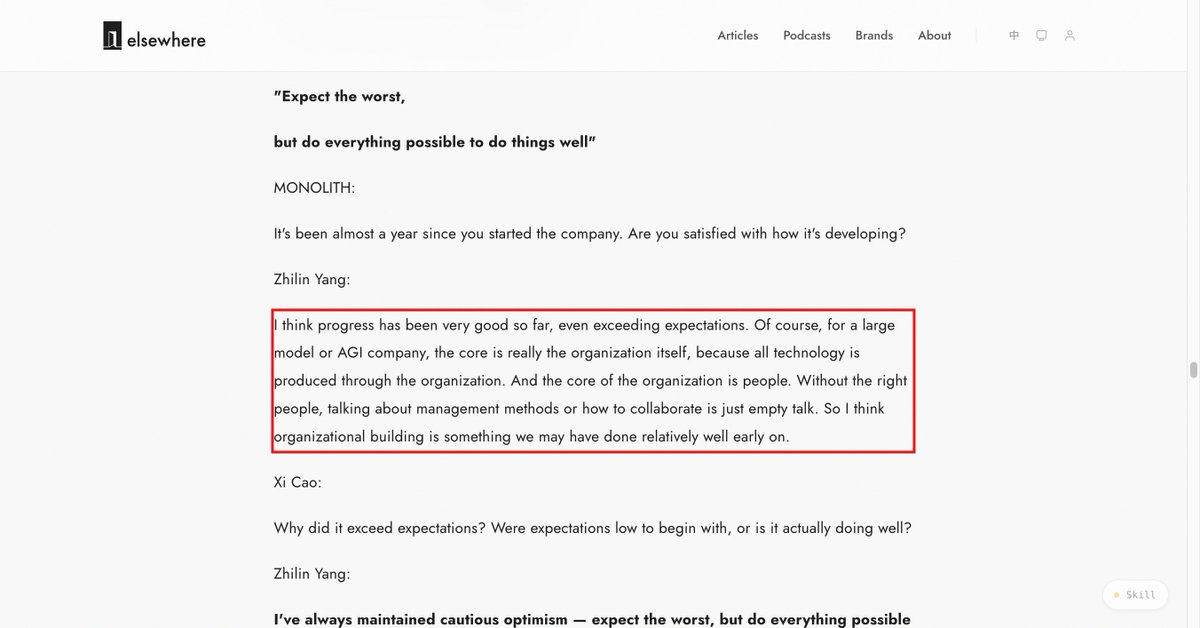
Two remarks about AI companies have stayed with me. In an interview, Moonshot AI founder Yang Zhilin said technology is produced through organizations—and people are the core of any organization. Without the right people, management and collaboration are empty talk.
I’m building a company myself, and I feel this more deeply over time. As Sparse Agents become first-class citizens in enterprise tech stacks, models, agents, and tools will increasingly be standardized and commoditized. Nearly any company will be able to buy them.
The deepest differentiator cannot be bought or copied: people, and the judgment, trust, coordination, and culture they build together. Technology spreads. Tools proliferate. People and organizations do not automatically become alike. Put people first to build for the long term.
Two remarks about AI companies have stayed with me. In an interview, Moonshot AI founder Yang Zhilin said technology is produced through organizations—and people are the core of any organization. Without the right people, management and collaboration are empty talk.
I’m building a company myself, and I feel this more deeply over time. As Sparse Agents become first-class citizens in enterprise tech stacks, models, agents, and tools will increasingly be standardized and commoditized. Nearly any company will be able to buy them.
That recovery model matters for InfiniSynapse: errors remain inspectable, fixes stay auditable, and validated state can be reused. The goal is not to pretend agents never fail. It is to make each failure cheaper to diagnose and recover from.
A data agent's real quality shows up after a mistake. In a verified InfiniSQL test, 'select amout, region from cleaned as typo_step;' failed with a structured error suggesting cleaned.amount, cleaned.region, and cleaned.order_id.
The fix was appended as a new statement: 'select amount, region from cleaned as fixed_step;' The next query returned rows_ok = 4. The earlier named table cleaned was still available, so the workflow continued without rebuilding prior steps.