Ex-@StgMiraMedia @OpenSociety @CEU but that's a while ago. Originally studied E-European history. Love elections, maps, charts. Also on Bluesky, better there.
@AndrewFiggy In short, sometimes things are weird. In spite of a nominal return to orthodoxy in the 2010s, the Spanish Communist Party behaves pragmatically; while Podemos, which at that time was supposed to usher in some kind of new transversal, post-dogmatic left, now behaves like the PCP..
My reaction to the clusterfuck on Spain's "left of the left" was 90% dismay. But a nerdy 10% was intrigued: how will the FA/Podemos split play out on the #Extremadura map?
Over here, the FA is basically IU. And the last time Podemos and IU faced off was in 2015:
@AndrewFiggy Despite the PCE's ambivalent relationship to its reformist transition-era legacy (https://t.co/ZeHIsyHgvp), its break with Podemos is grounded in its commitment to constructive coalition-building (in government, in the FA) over the latter's dogmatic, PCP-like self-isolation.
So Spanish communist & govt minister @agarzon sees the Eastern Bloc's failure as not/barely allowing "freedom of expression, multi-party systems, procedural democracy" — but also critiques the transition-era PCE for abandoning Leninism, saying Eurocommunism only brought ills.. 👇
Oh, that was the wrong link. I meant to point to these tweets about how, in local elections, the leftists seem to have just gone "poof" in one of their all-time strongholds — and the PP benefited??
https://t.co/KmCG6YT1c5
@raulsanchezglez Result: abstention in Llera rose by 66 votes; invalidated ballots rose by 16; and.. the PP gained 78.
They had to vote for the regional parliament too, of course. There the Podemos-IU vote dropped by 67 (from 26% to 16%) — same as the rise in abstention.
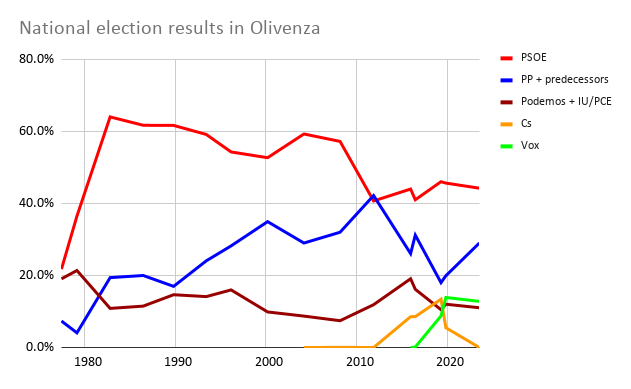
Since the Communists got 21% in Olivenza in 1979, the far left has retained a pretty steady electorate (8-19%) here through the decades. But in other bulwarks it suffered demographic or intriguingly specific declines (https://t.co/5252LaXpxQ). Which ones will survive?
And though this is super shallow, I know, let's say I was not surprised when I chatted with the latter and he explained that they were mostly IU/Communist Party here but *he* was Podemos. Hey, sometimes stereotypes fit. 😉
I can think of vanishingly few accounts of people in Extremadura who might be interested in the maps above. (Or who could shed light on some of the hyperlocal questions.) Uhh.. @jfmoriche? @nuevoext😄
Podemos does have a strong regional leader in Extremadura, but she seems to have washed her hands of the whole thing, standing by her IU colleague to blame "national strategies" for the split. Not a tweet or RT about her party's national campaign since.
https://t.co/6DpqXItbqJ
Queremos explicaros por qué no va a haber papeleta de Unidas por Extremadura estas elecciones y deciros que tenemos muy claro quiénes son nuestros adversarios y son los que ponen en peligro el bienestar del pueblo.
@eduvima But as the above charts show, right now the right is far more successful than the left in attracting those who didn't vote last time. We'll see I imagine, but I hold out little hope.
The stubborn and decisive problem for Spain's left, which has barely changed over time, is that around 1 in 10 of 2023 PSOE voters are defecting to the right, and that the right is considerably more successful in attracting people who didn't vote last time
https://t.co/shYIGsg8F1