GPT-5.6 pricing per 1M tokens:Sol: $5 in / $30 out
Terra: $2.50 / $15
Luna: $1 / $6The sleeper: Terra matches GPT-5.5 at half the cost. If your app runs on 5.5, swapping one model string cuts your API bill 50%. Most teams won't bother for months.
Two political orders that have outlived most Indians came to an end this morning.
Bengal had never been ruled by the BJP. Not once since Independence.
India had not been without a Left government anywhere for 50 years.
Both ended today.
A thread 🧵
Mearsheimer predicted the Ukraine war in 1997. Not because he could see the future. Because he understood Offensive Realism. Here's how one IR theory explains everything happening in Europe right now 🧵
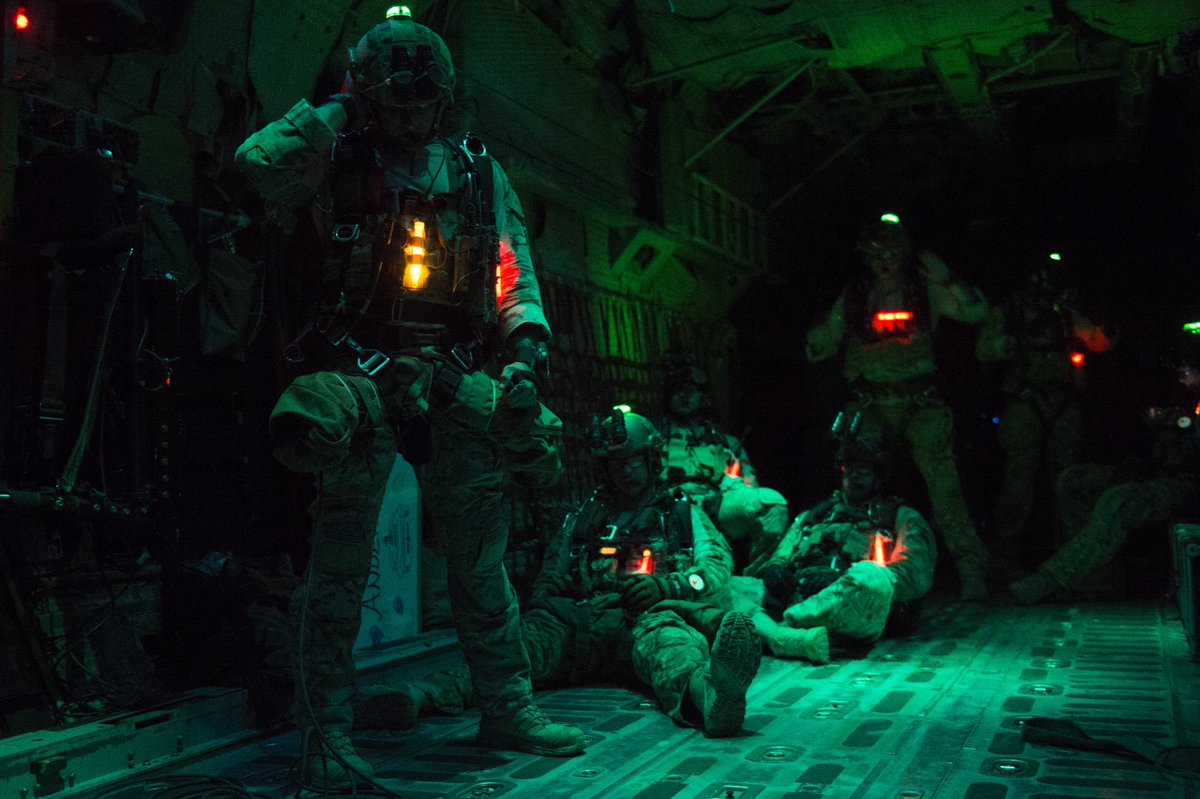
Tonight’s operation in Southern Iran which resulted in the successful rescue of a Weapons System Officer (WSO) onboard an American F-15E Strike Eagle downed Friday over Iran, involved hundreds of special forces troops and other military personnel, including members of the U.S. Navy’s SEAL Team Six, dozens of fighter and strike aircraft, helicopters, and cyber, space and other intelligence capabilities, officials tell The New York Times.
Senior military officials described the mission to rescue the airman as “one of the most challenging and complex in the history of U.S. Special Operations” given the mountainous terrain, the airman’s injuries and Iranian forces rushing to the location in the mountains of Southern Iran.
The WSO evaded Iranian forces for more than 24 hours, at one point hiking up a 7,000ft ridgeline, a senior U.S. military official said. U.S. attack aircraft dropped bombs and opened fire on Iranian convoys to keep them away from the area where the airman was hiding. As U.S. Special Forces converged on the downed airman, they fired their weapons to keep Iranian forces away from the rescue site, but did not engage in a firefight with the Iranians.
In a final twist after the officer was rescued, two transport planes that would carry the commandos and the airmen to safety got stuck at a remote base in Iran. Commanders decided to fly in three new planes to extract all the U.S. military personnel and the airman, and they blew up the two disabled planes rather than have them fall into the hands of Iran’s Islamic Revolutionary Guard Corps (IRGC).
On Feb 5, 2026, the last nuclear arms control treaty between the US & Russia expired.
For the first time since 1969, the two biggest nuclear powers are operating with zero legally binding agreements.
🎥 Watch my take on this here → https://t.co/TNOvEB3QoO
🧵
While the world is panicking over oil prices…
India quietly did something that most people ignored.
We just saved ₹1,04,000 CRORE in foreign exchange.
Here's what India got right while the world got it wrong 🧵
The US-Iran war was not a surprise to anyone who studied political realism.
Here's why Hans Morgenthau — writing in 1948 — predicted every beat of this conflict. 🧵
https://t.co/xY9dI4yeyw
#USIranWar#Geopolitics#PoliticalRealism#Morgenthau
Apple's new aToken paper is quietly one of the more interesting unification steps in vision I've seen in a while.
They built a single tokenizer and encoder that takes images, videos, and 3D objects and maps them all into one shared 4D latent space using 4D rotary embeddings. No modality-specific pipelines. Just one transformer that does both high-quality reconstruction and solid semantic understanding.
Trained progressively from images to video to 3D, and the abundant image data even helps lift performance on the scarcer modalities. Results are competitive with specialized models on reconstruction quality and get respectable numbers on classification too.
This feels like the visual world's version of moving from hand-crafted feature extractors to a single clean tokenizer that just works across everything. Reminds me of how BPE changed language modeling.
Worth reading the paper if you're thinking about the next generation of unified visual foundation models. https://t.co/2H4kj1NdH2
"There is no compression algorithm for human experience still."
Claude Code is quietly turning a lot of us into better staff and senior engineers.
You stop grinding out boilerplate and start spending your time on architecture, tradeoffs, and high level design. The AI handles the tactics while you have to bring the judgment.
The reps that actually build that muscle? Writing tight specs first, reviewing every output like its a PR from a teammate, and doing real post mortems on what it shipped.
Nothing replaces shipping real production work under pressure.
AI just gives you way more swings at the plate.
How are you building that senior judgment these days? Pure Claude, mixing tools, or still doing a lot by hand?
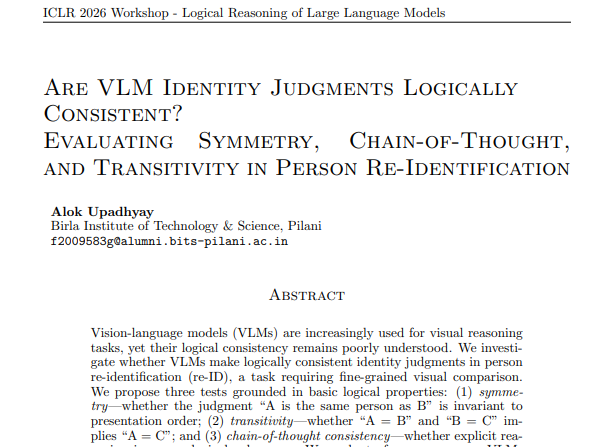
Excited to share that our paper has been accepted at the ICLR 2026 Workshop on Logical Reasoning of Large Language Models!
Title - "Are VLM Identity Judgments Logically Consistent?"
We asked a simple question: If a VLM says Person A = Person B, does it also say Person B = Person A?
The answer is interestingly... no.
🧵👇
If VLMs can't maintain basic logical consistency on a binary same/different task, what does that mean for more complex reasoning?
For identity-sensitive applications (surveillance, access control), accuracy alone isn't enough — we need logical coherence.
Paper home: https://t.co/1E1iv6gaEZ
Full paper & code coming soon!