@academy_dinda Pls understand the difference between overseas and abroad. Overseas means when one has to cross the sea to reach another country. So subcontinental countries don't count.
I finished reading “The strangest Man” a couple of days ago and am still thinking about it (and Dirac’s life and beliefs); which, to me, is the mark of a good book.
A movie about Dirac would be far more interesting (if not more commercially successful) than “Oppenheimer”. And why don’t we have a decent biopic of Newton, or Hilbert, or Gauss? These were genuinely interesting people! “Wittgenstein” by Jarman was just a collection of known sketches. “I Ragazzi di via Panisperna” (about Fermi) was excellent. “The man who knew infinity” (about Ramanujan) was also very good (Patel and Irons could make a list of groceries interesting). “Death of a Neapolitan Mathematician” (Caccioppoli): also great, if you can find it.
We need far more biopics of scientists and philosophers. The mix of mundanity, humanity, and their unique obsessions. Make scientists cool again.
This man on my left is the first Indian to win Boltzmann Medal, the highest honour in Statistical Physics.
And yesterday, ICTP announced that he has been awarded the prestigious Dirac Medal for his contributions to theoretical physics.
But his story is much bigger than the awards.
Meet Prof. Deepak Dhar, one of India’s finest theoretical physicists.
He studied at Allahabad University and later went to IIT Kanpur for his master’s, where he decided to pursue physics seriously as a career.
What came next was even more fascinating.
He went to Caltech for his PhD, where he was exposed to some of the greatest minds in physics and even worked with legendary Nobel laureate Richard Feynman as his teaching assistant.
He had everything one could wish for. He could have stayed in the US and built a remarkable career there.
But he chose to return to India.
He came back and contributed deeply to building India’s scientific ecosystem and Today, he serves as a Distinguished Professor at ICTS-TIFR, Bengaluru, where I recently had the privilege of shooting an episode with him.
He is genuinely one of the GOATs of theoritical physics, yet remains incredibly humble and grounded.
Such a proud moment for Indian science.
Link in Comments-
A special word for @ajinkyarahane88 Ajinkya Rahane as he announces his retirement from international cricket. Few have worn the India colours with greater dignity, humility and quiet excellence. Match-winning centuries at Melbourne and Lord’s. Never lost a Test as captain. The boy from Dombivli who caught the 5 a.m. train to get to practice became one of Indian cricket’s most understated heroes. Not always celebrated, but always dependable. Salute, Jinks. 🫡🇮🇳👏
For millions of children in our country, education remains the only path to a brighter future. Every developed nation is built upon a strong education system and a transparent, credible examination process. India too has made remarkable progress because of the strength of its education system. It has nurtured generations of brilliant doctors, scientists, engineers, teachers, and innovators who have shaped modern India.
Today, however, trust in this system stands broken. The damage goes far beyond a failed exam. It shatters faith in the very foundation of education system. It tells deserving students that hard work no longer matters, and robs them of their only ladder out of poverty. A nation that compromises the integrity of its examination system, compromises its own future.
This grave issue, affecting millions of students across the country, must be taken up in Parliament as the highest priority. It deserves a thorough debate in the temple of our democracy, leading to concrete reforms that ensure paper leaks, flawed assessments, and systemic failures are never repeated. Accountability must also be fixed for this lapse of trust.
Politics aside, I urge the government to initiate a meaningful dialogue with the students who have been peacefully protesting for days. They must be given a platform to express their views. A vibrant democracy advances through dialogue, not silence—and this dialogue is most vital when it involves the youth of the nation. The children and young people of India are looking to us for leadership. We cannot fail them.
Sincere, open-minded dialogue with the peaceful youth protestors will help restore faith in our democracy, in our education system, and in the leadership entrusted with shaping their future. @bjd_odisha stands firmly with the youth and students of the country.
Finally some awakening among the people! Happy to see students gathering from all over India! But no- no awakening yet in the government!! Remember @Wangchuk66 is doing it for us, for the country- open your eyes to the hate and lies that will now flood this timeline- and think of how your taxes are being used. This can happen to you! #WakeUp India!!🇮🇳
In a world of endless scrolling, here is a man from Odisha helping children turn pages instead.
Through his “Mobile Chada, Bahi Padha” initiative, Bikash Satpathy put over 1,000 books into the hands of young readers, encouraging them to explore stories, ideas, and imagination.
Every book read is a small victory against screen addiction.
@manas_muduli No major IT/ITeS/BFSI companies setting up in Odisha since 2 years. Need a major push there along with mfg investments which will come regardless.
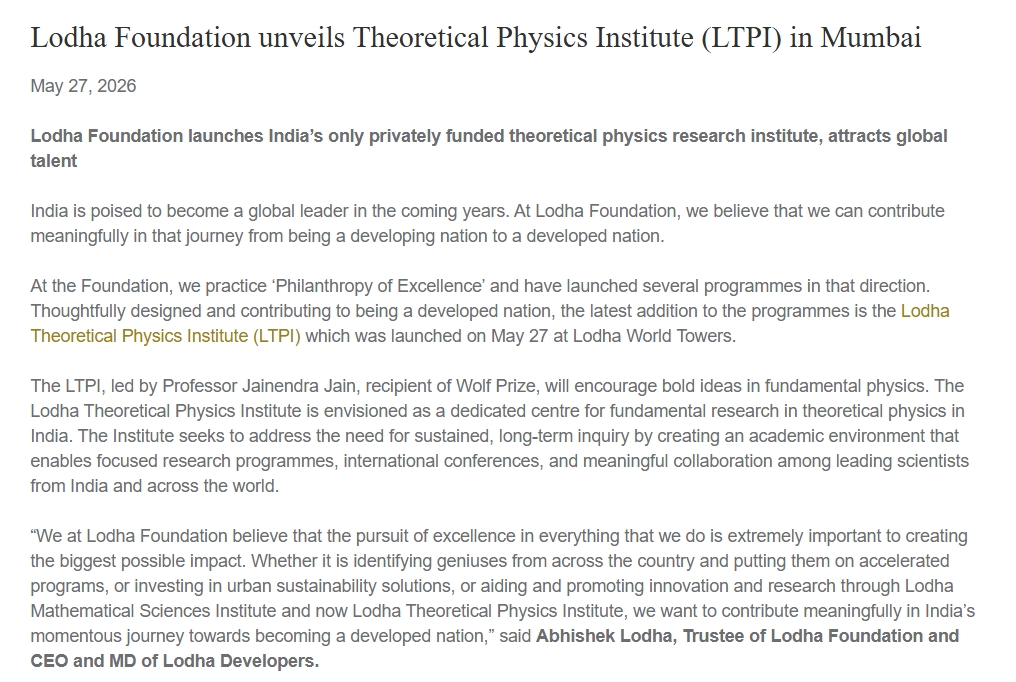
Lodha Foundation has launched the Lodha Theoretical Physics Institute (LTPI) in Mumbai, establishing India's first fully privately funded Theoretical Physics Research Institute.
Directed by Wolf Prize recipient Prof. Jainendra K. Jain, the institute is designed to drive long-term fundamental research and international scientific collaboration.
Moving immediately into operations, LTPI is hosting the 3-day 10th international meeting on Emergent Phenomena in Quantum Hall Systems (EPQHS-10). This inaugural workshop gathers global experts to chart future directions in physics and features a public lecture by Nobel laureate Klaus Von Klitzing. @Jain_Physics
I remember reading this book. T. N. Seshan’s A Heart Full of Burden.
The 2nd chapter titles ‘Are We Cockroaches?’
It asks, ‘Are we a non-achieving society?’…… ‘Is survivability the fundamental of Indian existence?’ Sheshan laments lack of excellence in pursuit. He is saddened by corruption. He questions our institutions and practices. He mentions cheating in exams and in elections….
He wrote this more than 30 years ago. Nothing has changed. It has only got worse.
The only difference, We now defend the governments because our identity and existence is entwined with it. The govt is who we are. As voters we try to whitewash our biases, and so we are obliged to become the foot soldiers of the failed institutions.
Development is no longer the issue. Self-preservation is the priority. And that’s the trap.
Ishan Kishan is a terrific cricketer who has just essayed an amazing international comeback.
He has also made almost a 100 crores just from IPL fees, not counting international duty and endorsements. This cheque is not a 100th of what he has already made and he's not the greedy sort.
So one can only assume this was literally a payout for a photo-op with him to ensure that the others in the picture got into the papers and all over social media.
Obviously, why spend one crore of government money on creating facilities or training centres or bankrolling poor athletes when you can instead use it to create a photo op by paying the one of the few athletes from your state who really does not need the money!
And that's why sport in India is where it is.
A lot of suggestions on NEET and the entrance exams that we imposed on our children. The financial incentive for NEET leakage is too high. Public education costs Rs.5 lacs while Private MBBS costs you 1.5 crores. Add the enabling environment of NEET exam, where a physical paper is transported to 5500+ exam centers – printing press, transportation, bank locker and exam center. Hoping the people would be morally correct or a strict law is living on a prayer.
Here are my recommendations:
1. Move NEET to a Computer Based test in phases. Let every town and city have only a CBT while villages and remote corners of the country have an option of pen & paper test or CBT. Let this be phased out over 5 years.
2. De-risk and localize the problem. Conduct the test over 5 days, create a percentile, normalize the percentiles and announce the result. JEE does it. CAT does it. So can NEET. This way, even if there is a paper leak, students of a particular session have to go through a re-test. Even the incentive to buy a paper also gets reduced because the buyer is not sure whether paper would be the one the student will get!!
3. Most importantly, ensure that the fate of a child is not decided in a 3-hour entrance test. Give weightage for school education. This way, a student who cannot afford coaching or has no access to coaching can work hard in school and hope that weightage of school scores will see him gain advantage. And those stuck in the coaching rabbit hole will score less in school and thus gain in entrance but lose in school scores. At the least, increase the minimum qualification percentage required in school to 80% to 90%. Let the student understand that school scores are important.
Even if you disband NTA, the problems will continue because the financial incentive structure is such. Disbanding NTA will make blood hounds happy, but the problem will resurface because of the fundamental issue of the 100% dependence on an entrance exam of 3 hours.
Just my two bits to solving the problem over long term.
@NTA_Exams@PMOIndia@EduMinOfIndia@NMC_IND
@manas_muduli Good to see this plant starting ops after almost 8 years of starting construction. We need more such mega manufacturing projects from GoI in Odisha.
Her name was Shehla Masood.
She was 38 years old, lived in Bhopal, and ran an event management company.
Then in 2009, she discovered the RTI Act.
She filed over 200 RTI applications in two years. She exposed illegal construction happening in plain sight. She fought to save tigers being poached by the very forest officers meant to protect them. She took on Rio Tinto, a global mining giant sitting on 27.4 million carats of diamonds inside a protected forest in Chhattarpur. Two district collectors were transferred to make that mining happen. She filed RTIs, went to parliament, and stopped it.
A month before she died, she gave an interview. She said she feared for her life but would not stop, because the nexus between politicians and babus was slowly poisoning this country.
On August 16, 2011, she sat in her car outside her home, about to leave for an Anna Hazare rally.
A hired gunman shot her once through the throat.
The CBI said the motive was a love triangle. Four people were convicted and sentenced to life. The mining angle was never investigated.
Her father told investigators that high profile people had conspired to kill his daughter.
Nobody listened.
She was posthumously given the SR Jindal Crusade Against Corruption Award, an honour shared with APJ Abdul Kalam.
India rewarded her with a bullet, then gave her an award, then forgot her name.
Follow for real stories India never makes headlines about.
The Lenskart pongal ad is a symptom of creatives being totally cut off from reality of Bharat. They live in their own bubble filled of like-minded people. Even back in the 90s we had Mumbai creative teams for whom anything beyond Bandra would be alien. They’d all be familiar with work from the west: be it in classical literature, journalism, fiction, music, movies. But anything rooted India would evoke no ‘connect’ in them.They have no clue about issues, sentiments and emotions of real people - especially middle class. And in today’s world such creative teams are obsessed with ‘re-imagining’ everything. Every festival & tradition has to be re-imagined ostensibly for the ‘new generation’. Tiresome, effing trope.
What firangs get most wrong about India is our national dish. It's not chicken tikka masala (not Indian); it's not "curry" (not a dish); it's the humble dosa. All of us have an unlikely dosa story. Here is mine.
Hugely engrossing piece by Manu Joseph, with his typical blunt, acerbic wit. While I fully agree with the main point that the obsession with youth is often a defense mechanism for aging executives, for them to feel 'relevant' and 'cool' by proximity, Manu also misses a considerably larger point in order to want to sound contrarian (also his trademark).
Today’s young are tomorrow’s high-earning prime customers. Pandering badly is stupid, but smart adaptation isn't merely 'dumbing down'... it's just evolution. Manu correctly mocks superficial youth-chasing but underplays why every thriving, long-term entity (from Apple to Bollywood to nations to... religions, where Manu talks about Christianity, but ignores 'Bhajan Clubbing' as a way to bring younger people into Hinduism's fold) actively cultivates the next generation rather than just milking the current older base.
Overvaluing youth is a bias, but undervaluing it is an existential risk!
It is significantly harder and more expensive to change the brand loyalty of a 60-year-old than it is to capture (the imagination of) a 16-year-old whose preferences are still being formed. Brands that fail to capture the young eventually die through attrition. Even if the elderly have the clout and money now, a brand that does not replenish its user base with youth is essentially managing what would be like a 'melting ice cube', a business in a state of terminal decline.
Younger consumers are also early adopters who often determine what scales, especially in tech, media, and culture. Winning them early can mean decades of lifetime value (consider platforms, habits and ecosystems being built with the young, that scales eventually). Even when they don’t spend the most today, they shape trends that older segments eventually follow. So what looks like 'overvaluation' may actually be long-term strategic investment, not merely short-term revenue optimization.
#youth #marketing #strategy
Recently, Oracle laid off around 12,000 employees in India. Many were earning over 30L inr and saw their stability vanish with a single cold email. These are the same people paying heavy taxes and, in many ways, funding freebies they may never benefit from. It makes you question a system in which taxpayers bear so much weight yet have so little support when things go wrong. Cheaper tea at airports is nice, sure, but what really matters is having a meaningful safety net. And yet, our representatives don’t seem to give a damn.