Riemannian Geometry ✍️
This diagram introduces Riemannian geometry, a branch of mathematics that studies curved spaces and how to measure distances, angles, and shapes within them. This field was developed by the German mathematician Bernhard Riemann in the nineteenth century. His work changed geometry and later provided the language Albert Einstein needed to explain gravity as the curvature of spacetime. The blue sphere at the center of the picture represents a manifold. This term refers to a curved space that appears essentially flat when you zoom in closely on any small area. The surface of the Earth serves as a perfect everyday example. Globally, it is a curved ball, but when you stand in a small field, the ground looks perfectly flat around you. Manifolds can have any number of dimensions, from simple curves and surfaces to the four-dimensional spacetime of relativity and even higher-dimensional abstract spaces used in modern physics and mathematics.
The tan-colored flat plane touching the top of the sphere represents the tangent plane. This is the best flat approximation of the curved surface at that specific point. Every point on the manifold has its own tangent plane, and each one shows how the curved space looks from that location. The blue arrow on this plane is a tangent vector. This arrow represents a direction and magnitude at that point, indicating which way to move and how strongly. Since you cannot draw perfectly straight arrows through curved surfaces without sticking out of them, tangent vectors are useful for representing directions on a curved manifold. The red curve tracing along the sphere is a geodesic. This term generalizes a straight line to curved space. It describes the straightest possible path between two points that stays on the surface. On a sphere, geodesics are great circles like the equator. This is why airplane routes between distant cities appear to curve on flat maps, yet they represent the shortest paths across the curved surface of the Earth. The dashed green arrow illustrates the logarithmic map, a mathematical tool that translates between points on the curved manifold and vectors in the flat tangent plane. This allows mathematicians to switch between curved and flat perspectives depending on what is more convenient.
The equations below capture the two main ideas that drive Riemannian geometry. The first describes the metric, the most important concept in the theory. It is a set of rules that guides you on how to measure distances at every point and in every direction. The metric turns an abstract manifold into a real geometric space where measurements can be made. Remarkably, once you specify the metric, everything else about the geometry follows automatically, including which paths qualify as geodesics and the amount of curvature at each location. The second equation shows the rule for determining geodesics. It states that a path counts as a geodesic if it does not turn sideways while moving through the curved space. This framework became crucial when Einstein realized that gravity is not a force but rather the natural motion of objects following geodesics through spacetime, which curves due to mass and energy. Today, Riemannian geometry appears in physics, machine learning for analyzing data on curved spaces, robotics for planning movements, medical imaging for comparing anatomical shapes, and many other fields. Beyond its practical uses, it is one of humanity's most significant intellectual achievements. It reveals that the geometry found in ancient Greek textbooks is just a small part of a vast mathematical universe and that space itself a stage for reality is not a fixed backdrop but a dynamic, curving fabric shaped by the matter and energy it contains.
Geometric series gain depth in the complex plane through this depiction of their convergence.
The plotted surface shows the modulus |a/(1−z)| over the z-plane, remaining well-behaved within the disk |z| < 1—the region where the series a + ar + ar² + ⋯ sums exactly to a/(1−r).
A spiral inset illustrates how successive partial sums approach this value for complex r inside the unit circle. At z = 1 lies the singularity where the function diverges, marking the boundary beyond which the series fails to converge and the surface becomes unbounded.
Engineers apply this in z-transform analysis to design stable digital filters with infinite impulse responses.
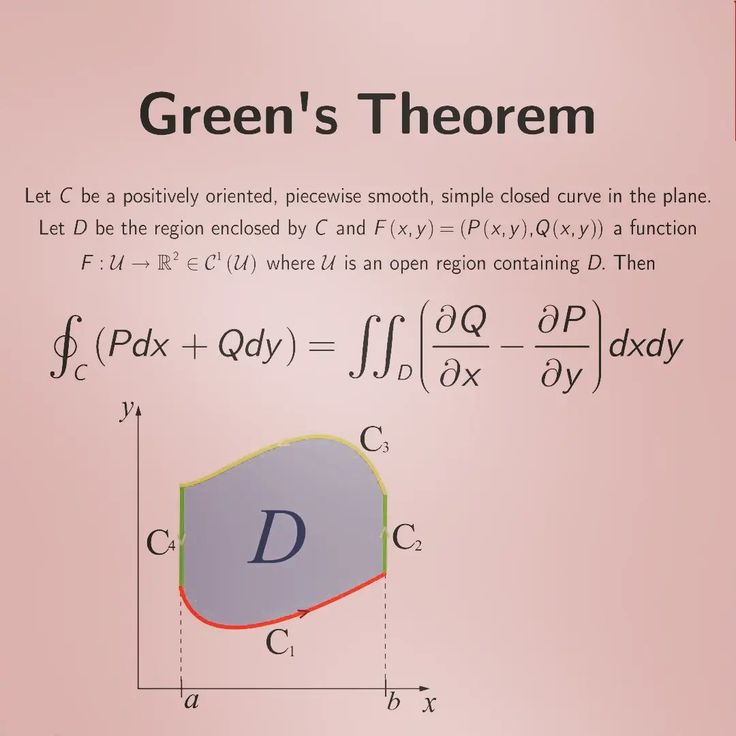
Green’s Theorem is one of the most important ideas in vector calculus. At its heart, it connects two ways of looking at the same region: what happens along the boundary and what happens inside the area enclosed by that boundary.
The central idea is simple. A closed curve surrounds a region. Green’s Theorem says that the total effect measured around that curve can be understood by adding up the behavior inside the region.
This makes the theorem a bridge between boundary and interior.
Historically, the theorem is named after George Green, an English mathematician born in Nottingham in 1793. Green had little formal mathematical education and worked around his family’s mill, yet he produced one of the most influential mathematical works of the nineteenth century. His major work, published in 1828, was titled An Essay on the Application of Mathematical Analysis to the Theories of Electricity and Magnetism.
Green’s work was not immediately famous. Its importance became clearer later as mathematicians and physicists realized how useful his ideas were for electricity, magnetism, fluid motion, and boundary-value problems. Today, Green’s Theorem is part of the same larger family of ideas as Stokes’ Theorem and the Divergence Theorem.
The mathematical power of Green’s Theorem lies in how it connects local behavior with global behavior. A field may have small rotational effects at every point inside a region. Green’s Theorem says that when all those small effects are added together, they correspond to the total circulation around the boundary.
This idea appears naturally in fluid dynamics. The motion around the edge of a region can reveal something about rotation inside the fluid. It helps connect circulation with vorticity, which is important in understanding rotating flows, whirlpools, air circulation, and many other fluid patterns.
Green’s Theorem is also useful in area measurement. It allows the area of a closed region to be found by tracing its boundary. This is the principle behind the planimeter, a mechanical instrument used to measure irregular areas. Instead of measuring every point inside a shape, the boundary itself becomes enough.
In physics, Green’s ideas became especially important in potential theory and electromagnetism. Many physical systems are described by what happens on their boundaries. Electric fields, gravitational fields, heat flow, and other boundary-value problems all use mathematical ideas connected to Green’s work.
In modern computation, Green’s Theorem is still used in numerical methods. It helps convert area calculations into boundary calculations, which is useful in geometry processing, simulation, mesh generation, and computational physics.
The importance of Green’s Theorem is not only that it is a beautiful formula. Its importance is that it reveals a deeper structure: the edge of a region is not separate from the region itself. Under the right mathematics, the boundary can tell us what is happening inside.
Vector calculus features theorems that convert integrals of derivatives over domains into boundary integrals.
> The Fundamental Theorem of Line Integrals states ∫_C ∇F · dr = F(b) - F(a).
> Green's Theorem equates the double integral over a plane region of the curl of F to the line integral on the boundary curve and similarly for the divergence.
> The Divergence Theorem equates the triple integral of the divergence over a volume to the surface integral of the flux.
> Stokes' Theorem equates the surface integral of the curl to the line integral on the boundary.
Fluid dynamicists use them to find net flow through closed surfaces or circulation around paths in airflow analysis.
Mysterious ‘cold blob’ in the Atlantic suggests the AMOC is weakening
A patch of ocean south-east of Greenland is the only place on Earth that is cooling, and it could be a sign that the warm water “conveyor belt” in the Atlantic is slowing down
https://t.co/iOP7S0fjUS
https://t.co/nKdwhlJCaW
#ElNiñoCostero
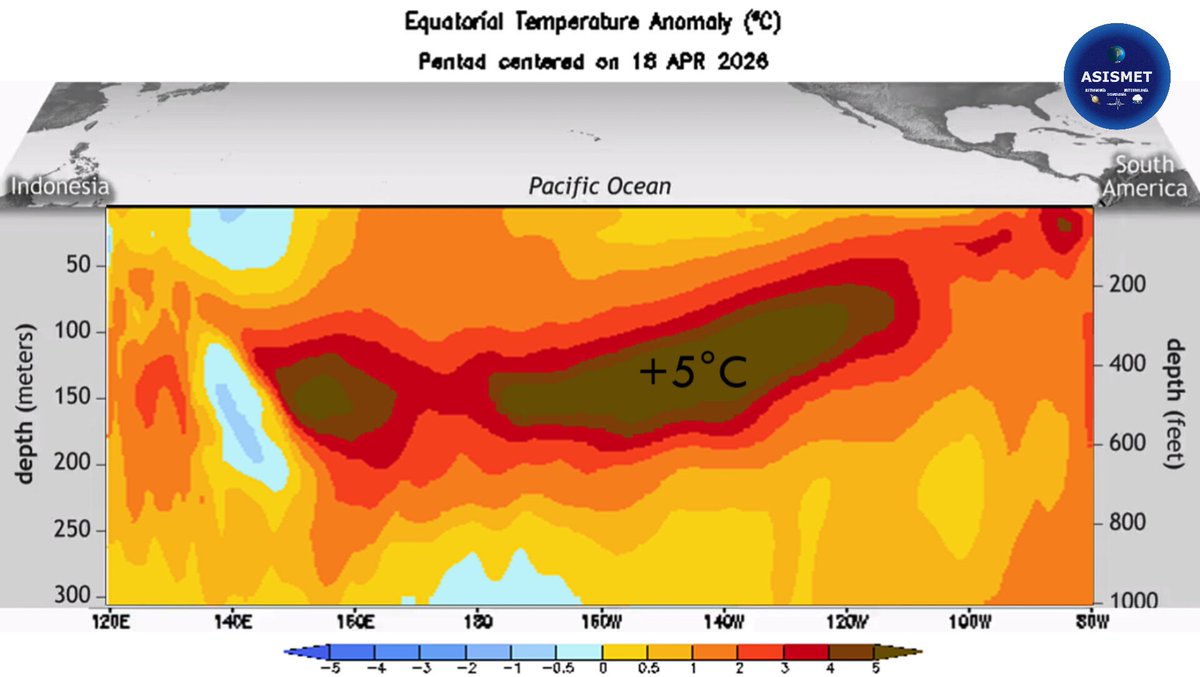
Esta imagen viene causando preocupación en la comunidad meteorológica.
Se trata de la temperatura del agua en las profundidades del océano pacífico, estas aguas han aumentado drásticamente sus anomalías y han registrado 5°C por encima del promedio normal.🌡️⏫ 1/2
Uma câmera de vigilância nos EUA registrou uma enorme esfera brilhante surgindo do nada durante a noite. O vídeo parece CGI, mas é real. Especialistas sugerem que pode ser um raro caso de raio globular — ainda pouco compreendido.
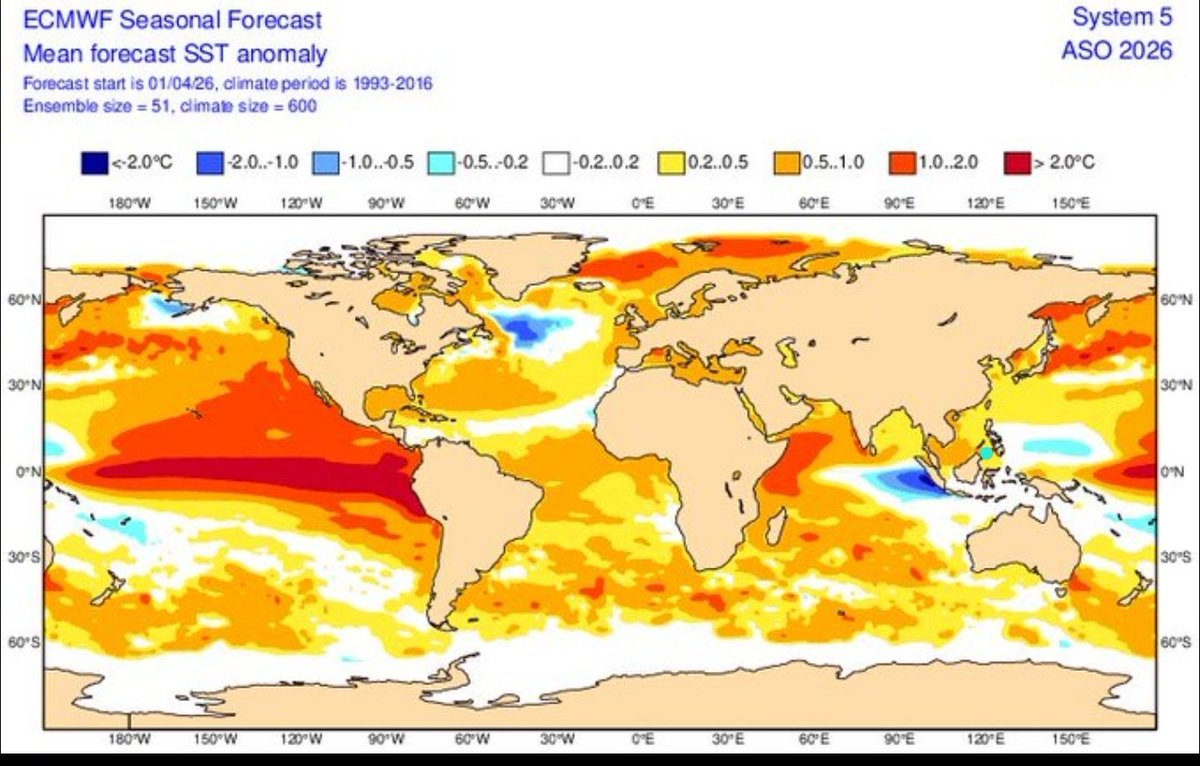
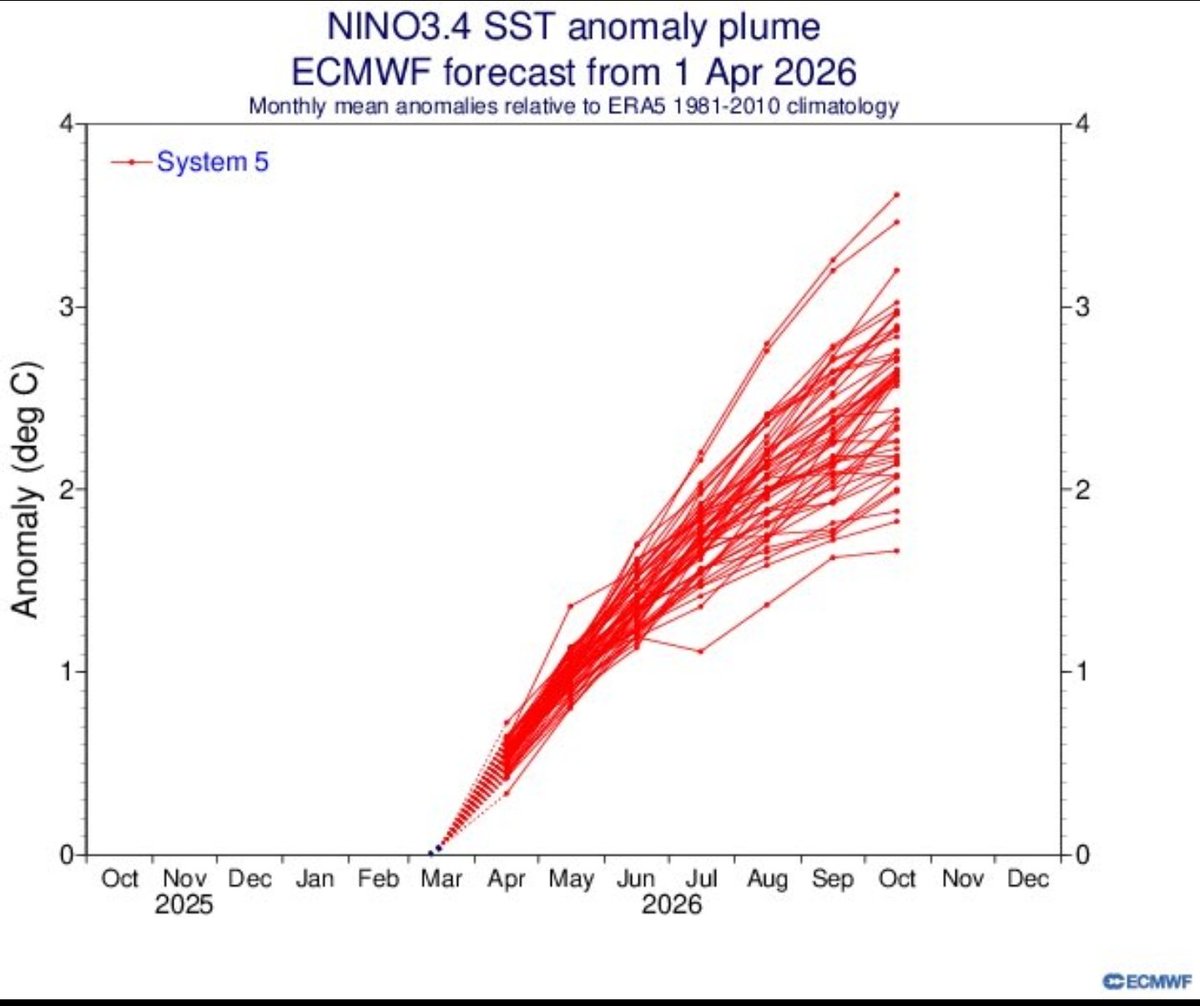
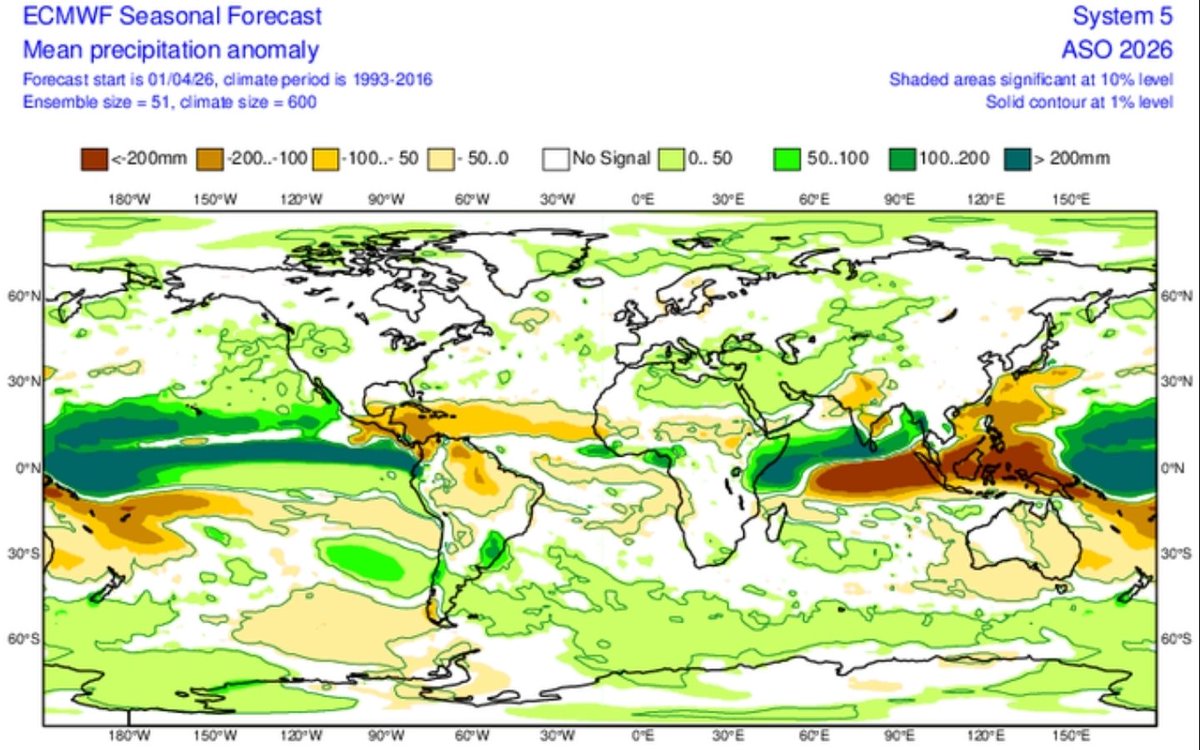
The ECMWF seasonal forecasts for both Sea Surface Temperature and Precipitation Anomalies shows one of the strongest El Niño signals you’ll ever see.
Massive above average sea warmth and rainfall in the Pacific. Crushingly unfavorable conditions in the Atlantic for Hurricane Season. Major drought in Indonesia and far Southeast Asia.
A possible Super El Niño is brewing.
The Nino 3.4 plume is one of the most aggressive I've seen. Nearly all 51 ensemble members are screaming warming by October 2026
The mean forecast is pushing +2.5°C. The precipitation anomalies for ASO reveal the classic El Niño "teleconnection" impacts on steroids. Massive drought (🟤) risk for Indonesia and northern Australia. Extreme wetness (🟢) for the equatorial Pacific.
The SST anomaly map shows a massive tongue of deep red across the equatorial Pacific. We are looking at widespread anomalies of +2.0°C or higher. This is "Super El Niño" territory, comparable to or exceeding the historic 1997-98 and 2015-16 events.
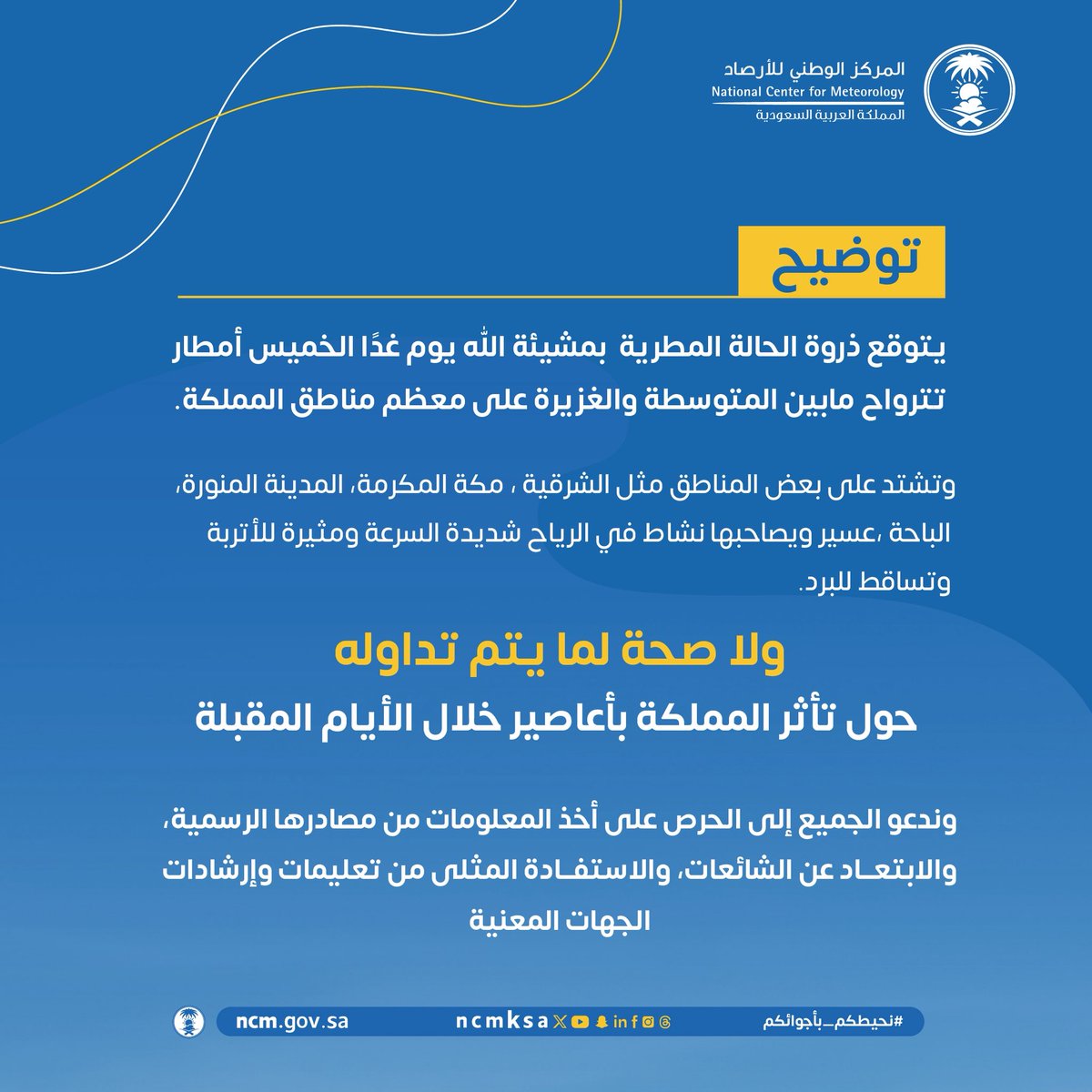
للإيضاح.. المملكة لا تتأثر بالأعاصير المدارية كونها تطل على بحار شبه مغلقة، وما يتم رصده غالباً من التأثيرات المصاحبة للظواهر الجوية وخاصة الأمطار، "شواهق مائية أو أعاصير قمعية"، وهي تتكرر بشكل مستمر ويتم التنبيه عنها ضمن تقاريرنا الاستباقية.
نأمل الاعتماد على المعلومات الصادرة من الجهات الرسمية المخولة بذلك وتجنّب الشائعات والمعلومات المضللة.
#نحيطكم_بأجوائكم