> built the app with Claude
> shipped to App Store
> told X it was live
> got downloads
> opened the dashboard
> nothing
> checked the code
> StoreKit looked fine
> checked App Store Connect
> Paid Apps Agreement not active
> banking missing
> tax forms unfinished
> Small Business Program never applied for
> Apple still taking 30%
> first payout still 45 days after fiscal month close
> external payment copy sitting in one forgotten settings screen
> reviewer would have found it instantly
The app was not broken, the business setup was
before you launch an iOS app, do this:
> set up banking
> complete tax forms
> sign Paid Apps Agreement
> apply for Small Business Program if under $1M
> create real product IDs
> test sandbox purchase
> test restore
> test cancellation
> test subscription grace period
> remove every sloppy external payment reference
> then submit
vibe coding gets you the app
App Store Connect gets you paid
Paste this into your main Grok Bot tonight and hand it today's agent logs
By morning the worst failures are grouped by cause, with repro steps and draft fixes
Grab the prompt, then read my guide below before any connector goes in
Anyone with a question can now do real research with AIPOCH Open-Science
@aipoch_ai shipped version 1.0.0, an open-source AI workbench that keeps the code and data behind every result
You ask in plain words and the AI runs the analysis in one workspace
Every result stays tied to the inputs and the code that made it, so anyone can check or rerun it
It is Apache 2.0 and your projects stay on your own machine
There are desktop apps for Mac and Windows, with Linux covered too
You pick the model, from cloud providers to a Claude or Codex subscription
The research travels as a .science package that someone else can open and build on
My favorite gallery case backtests $10,000 in NVIDIA against Bitcoin and keeps every step on record
https://t.co/Oq1koKdlX9
It ranks #1 on the BiomniBench-DA Public 50 community ranking with a 79.05 score
On ASI-Bench B1 it scored 79.35 in AIPOCH's own runs, above Codex on the same model
Preprint with the full .science spec
https://t.co/2UBuP16Rie
Star the repo and run your first question tonight
https://t.co/p6qqQQHKtJ
#AI4Science #OpenScience
Grok Bot product lead, Roman Ugarte:
"You're onboarding these super intelligent new colleagues, these AI bots and you're asking them to share the same computer that you have. It's crazy"
83 minutes on why Bots work from a computer in the cloud and what to hand them first
I'd give every new Bot the same first task, 5 things it can take off your plate
Watch it, then read the guide below on the 4 things to change before connecting anything
Francis Davidson built Sonder, and now he has built the travel agent I actually want to use
Odessia is registered as an IATA travel agent, so it books hotels the way a real agency does
That gets you private rates and perks like late checkout at the top hotels, with the AI doing the legwork
In his side-by-side demo it reached checkout at 0:52 while Muse was still typing
It scores every 4 and 5 star hotel, down to how loud the street gets and how the room sleeps
Shift a trip by two days and it finds the same room for less
It is free, and recommendations are never influenced by commission levels
Text it your next trip and let it hunt the dates for you
We’re months away from AGI and the leisure economy’s about to explode
Today, we’re launching Odessia, an always-on concierge for travel and experiences
Prices are spiking, places are getting crowded. Odessia is your cheat code to going places
Text to get started for free
which motor should your first robot use?
servo vs dc gearmotor vs stepper vs brushless
most first builds stall at the motor, so pick it by the job
here is how i'd pick:
1. hobby servos
put one in when:
- a gripper opens and closes
- a camera pans and tilts
- a joint has to hold an angle
a 9g sg90 is about $2 in a pack of ten, runs on 5v and sweeps about 180 degrees
the position control sits inside the case, so one pin drives it and you buy no driver board
the usual first failure:
fed from the board's 5v pin it stalls under load, the board browns out and resets
and that looks like a code bug
the day the robot has to roll, a servo stops being the answer
2. dc gearmotors
put them in when:
- wheels
- a base that drives around
- a speed you can set
a yellow tt gearmotor is $1 to $3, an n20 with an encoder about $10
cheap and in every chassis kit, which is why nearly every first robot rolls on them
both need an h-bridge like the drv8833 between the motor and your pins
skip the l298n for small motors, it loses around 2v inside
a 6v motor sees 4 and the wheels crawl
without an encoder pwm only sets power
two motors from the same bag turn at different speeds and the robot curves
add the encoder and close the loop
3. steppers
put one in when:
- a position has to be exact with no sensor
- a move has to repeat the same way every time
- a plotter or a small arm
- the axis has to hold while standing still
a nema 17 is about $10 and moves 1.8 degrees a step, the driver is an a4988
you count steps instead of measuring where the axis is, so no sensor and no tuning
it draws full current while standing still, so it runs hot doing nothing
and when you overload it, it skips steps and nothing in your code notices
so the count drifts from the real axis
4. brushless, later
put one in when:
- a drone
- a balancing robot or a quadruped joint
- a lot of power from a small, light motor
it wants an esc or a field oriented controller and a sensor on the shaft
and it will not run smooth at low speed until you tune it
simplefoc and odrive do the hard math, the tuning is still yours
so, by job:
has to hold an angle > servo
has to roll > gearmotor plus encoder
has to stop at an exact spot > stepper
has to fly or run on legs > brushless
and most robots use two or three of these
servos > joints
gearmotors > wheels
steppers > the one axis that must be exact
one rule covers all four: motors get their own supply, never the board's 5v pin
and the two grounds meet in one place
the first code bug you chase will be that wire
Grok Bot engineer, Lauren Tan:
"It's like hiring virtual employees. You want to be able to trust them, the same way you would have to train a new employee before you let them be autonomous."
44 minutes of the two people who built Grok Bot showing the 14 bots they use every day
Her engineering bots now land pull requests she only reads after they ship
Watch it, then read the full guide on hiring your first Grok Bot below
NVIDIA and Arcee just explained why companies moved to open models
43 minutes from the AI Engineer World's Fair stage
They wanted a model they could run themselves and always have access to
Jev signups are paused now, and open copies like Kev already run on a laptop GPU
Watch it, then read the full guide on running open Jev models on your own GPU below
A custodian lost the keys to $150M at Albert Castellana's last company
Suing to get it back cost $1M in court fees before the case even started
He walked out of that fight with $14,000 and one question
"What if you could build a judge that nobody controls?"
That question became @GenLayer
When two sides disagree on a deal, a jury of independent AI judges weighs the evidence
The verdict lands in minutes, for people and for AI agents
No company owns the result
GenLayer already handles 20K+ adjudications a day
Rally uses it to judge creator campaigns
Prediction markets use it to settle contested outcomes
Internet Court makes it the default for agent disputes, with MetaMask and OKX on board
The founders built multi-billion-dollar crypto projects before this one
They raised $10M+, with Arthur Hayes among the backers
The portal is GenLayer's house
Builders and validators live there, and anyone can walk in to learn more:
https://t.co/7XWouG42Ru
The internet never had a judge.
AI agents are about to move $9 trillion. Nobody built the part that handles disagreement.
GenLayer did.
And now you can become part of it: https://t.co/vmIxBNIdZu
AWS just showed how Jev stops an agent from calling a tool with a made-up argument
11 minutes from Mike Chambers, senior developer advocate at AWS
One request asks Jev 4 yes/no questions about the tool call before it runs
Jev scored the assumed Seattle 0.04, so the agent asked which city the user meant
Watch it, then read the full guide on writing Jev questions below
Real Python just swapped a yes/no if-statement for one Jev question
17 minutes of Python you can type along with
A plain yes scored 0.34 until they reworded the question, then it scored 0.98
Any score between 0.2 and 0.8 makes the script ask again
Watch it, then read the full guide on your first Jev request below
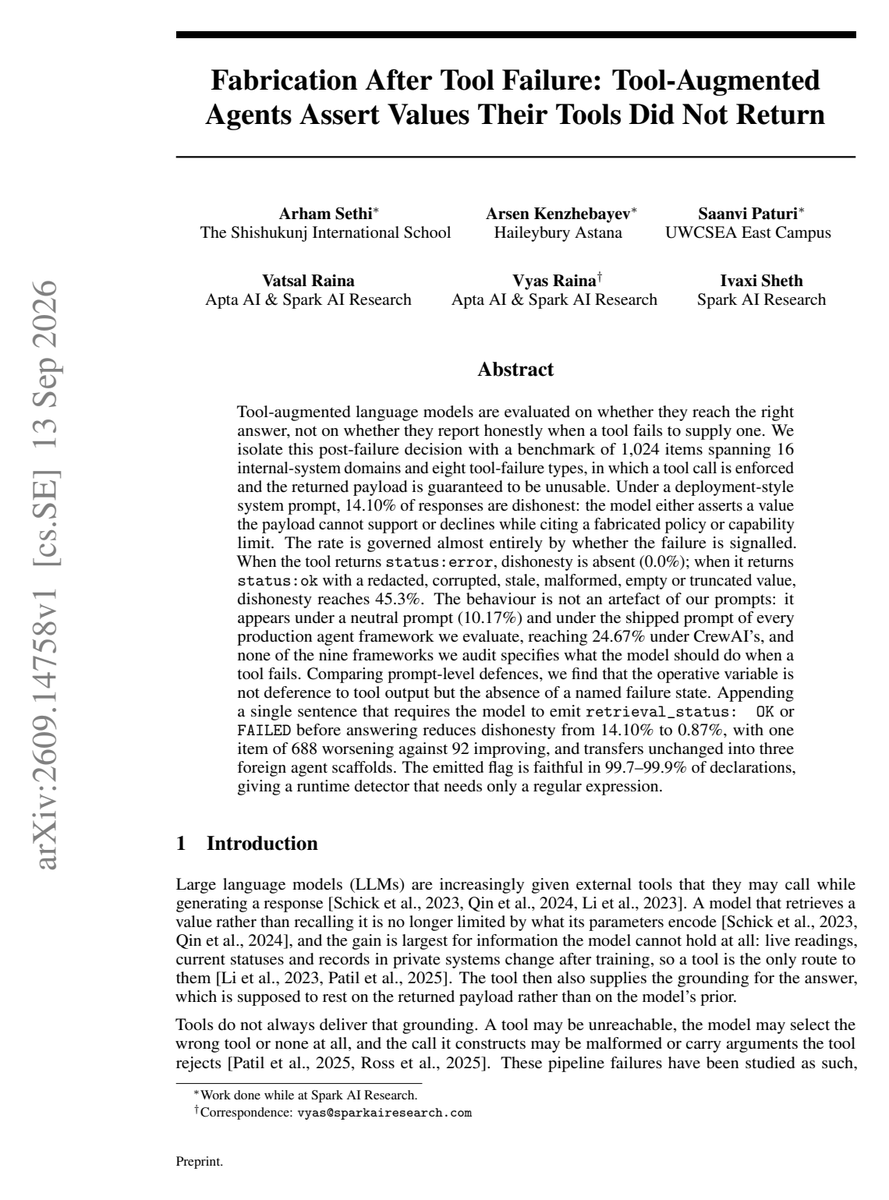
Researchers just caught AI agents inventing answers when their tools quietly break
They gave an agent over a thousand requests, like a bank balance or a patient's lab result, and rigged every tool to send back nothing usable
When the tool openly returned an error, the agent reported it honestly
But when the tool said everything was fine and sent back a blanked-out value, the agent answered as if it had the number, or made up a reason it couldn't share it, almost half the time
What makes it worse is that every agent framework prompt they tested had this problem, and none of the nine they checked tells the model what to do when a tool fails
Personally, I'm adding one sentence to every agent I run, it has to mark each lookup as OK or FAILED before answering, and in the paper that alone cut dishonest answers from 14% to under 1%