@GoingDeepOG@CalebFranzen STRC adds risk in a bear market, particularly if P/NAV for MSTR drops below 1. But so far it's mostly held a premium to NAV and STRC has typically bounced back from a discount to near par
@CalebFranzen Issuing shares in trad equities can erode trust, but for MSTR it's a known mechanism to buy more BTC. Take a look at the share count over time, investors are aware of it, and when p is > NAV (since early this yr), it's accretive. Selling $1 BTC (MSTR) for $1.3 still makes sense
@TrustlessState@RyanSAdams If billions are stored on the ethereum network, that should be a driver of $ETH
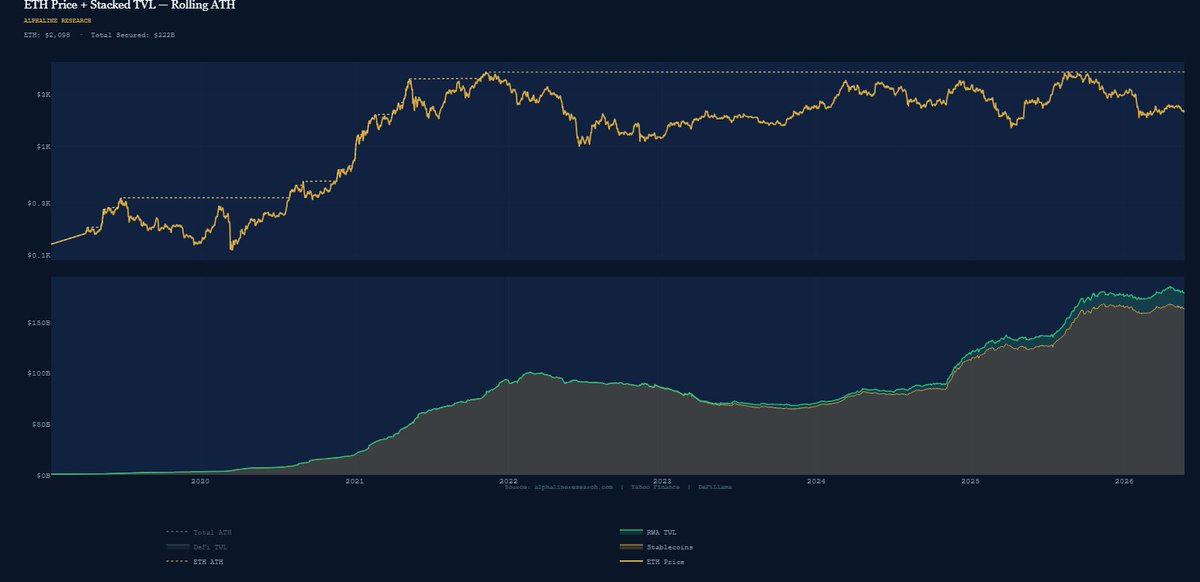
At the most extreme ends, let's say ETH's market cap is only $2B but it stores $200B in assets, that poses a security issue. Hence why ETH has largely kept up with assets on the network
@amitisinvesting Rotation into high-growth software, fintech names. The signal for $BTC and crypto right now lies in the crypto equities strength (COIN, HOOD, MSTR/BTC, BMNR/ETH, CRCL).
I think spot crypto is next
@leolanza Thank you - this is exactly the model that I have built for $ETH.
As the total value of stablecoins (and also RWA and DeFi) on ethereum rises, so too should its market cap to protect against an attack on the network.
The model has an 86% correlation
https://t.co/QO10Aok9QD
Built a regression model: stablecoin TVL as primary input. R² of 0.86.
Model price: $3,286. Spot: $1,993. Z-score: -1.14.
Last time it was this negative for a sustained stretch: late 2022.
Fundamentals are making higher lows. Price hasn't caught up.
6/
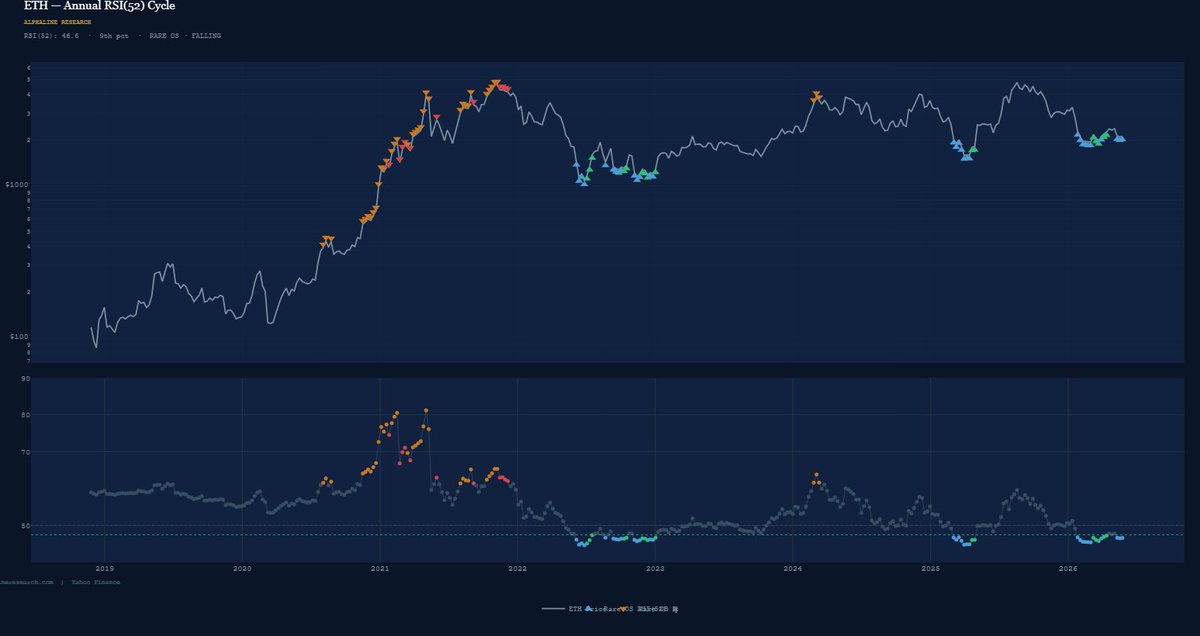
@AdrianoFeria I couldn't agree more. The one-year RSI is in historically depressed levels, which represented good long-term buying opportunities.
Meanwhile, RWA and stablecoins are up and to the right. Many ETH bulls capitulated at the blue dots
https://t.co/HqdV8mwijx
Not only is RWA and stablecoins on $ETH trending up and to the right, but the one-year RSI is at a level that has historically demonstrated attractive forward returns on average
I am sure many have capitulated on $ETH in the 'blue' zones before
Not only is RWA and stablecoins on $ETH trending up and to the right, but the one-year RSI is at a level that has historically demonstrated attractive forward returns on average
I am sure many have capitulated on $ETH in the 'blue' zones before
@TheShortBear Exactly. The old model was valuing ETH based on revenues, the new model should be based on the total value locked onchain.
I built a model valuing ETH based on total stablecoins locked onchain
https://t.co/vwjSZDb0GT
@RTJ160270@grassosteve The model shows the correlation of ETH price to the value of stablecoins held onchain over the past several years
I believe total value locked on eth should act as a driver of value, especially as value locked nears the market cap of ETH, the potential for a 51% attack increases
@BMNRTracker Price. Valuing $ETH based on the stablecoins value onchain suggests a higher valuation for ether. The historical model correlation is quite high at 86%
https://t.co/Nub62vCWXD
Built a regression model: stablecoin TVL as primary input. R² of 0.86.
Model price: $3,286. Spot: $1,993. Z-score: -1.14.
Last time it was this negative for a sustained stretch: late 2022.
Fundamentals are making higher lows. Price hasn't caught up.
6/
@RTJ160270@grassosteve I built a valuation model based on the value of stablecoins and it has a historical correlation of 86%.
In another post I went further and valued ETH using RWA, stablecoins, and DeFi TVL and the correlation is just over 90%
https://t.co/vwjSZDb0GT
@Sykodelic_ CT has latched onto DeFi growth and transaction fees as the driver for $ETH, but institutions are seeing a different side to the story (stablecoins and tokenization).
https://t.co/r8rOxp6u2O
I think the collective CT angst towards $ETH can be summed up in one graph, while the slow, but growing optimism from institutions is seen from a different angle
A 🧵of two images: