An experimental brain for LLMs. Specialist circuits compete, remember and evolve against real on-chain markets.
CA: 0x6dbe95076584f869dd09a44131e9a3c13f34d7d6
AlphaMorph doesn't have to begin with every brain region active.
Its architecture defines evidence-based unlocks:
6 generations + 150 closed paper trades → FLOW
12 + 300 → CURVE
20 + 500 → PROVENANCE
The idea: an artificial organism can acquire additional ways to perceive its environment as it develops.
12 → 24 → 36.
That's the next proposed expansion of AlphaMorph's model population.
More models means more possible specialist combinations, evolutionary lineages and competing approaches.
Imagine three LLMs examining the exact same market event.
One studies opportunity. One studies timing. One studies risk.
Now change only HOW they think together: sequentially or in parallel.
AlphaMorph is testing both architectures on matched observations.
Could the organization of intelligence matter as much as the models themselves?
We're building something unusual into AlphaMorph:
A brain that decides which questions deserve an LLM.
Its attention circuit identifies important signals. A new experimental scheduler prioritizes specialist requests within a limited compute budget.
What if intelligence begins with deciding what deserves thought?
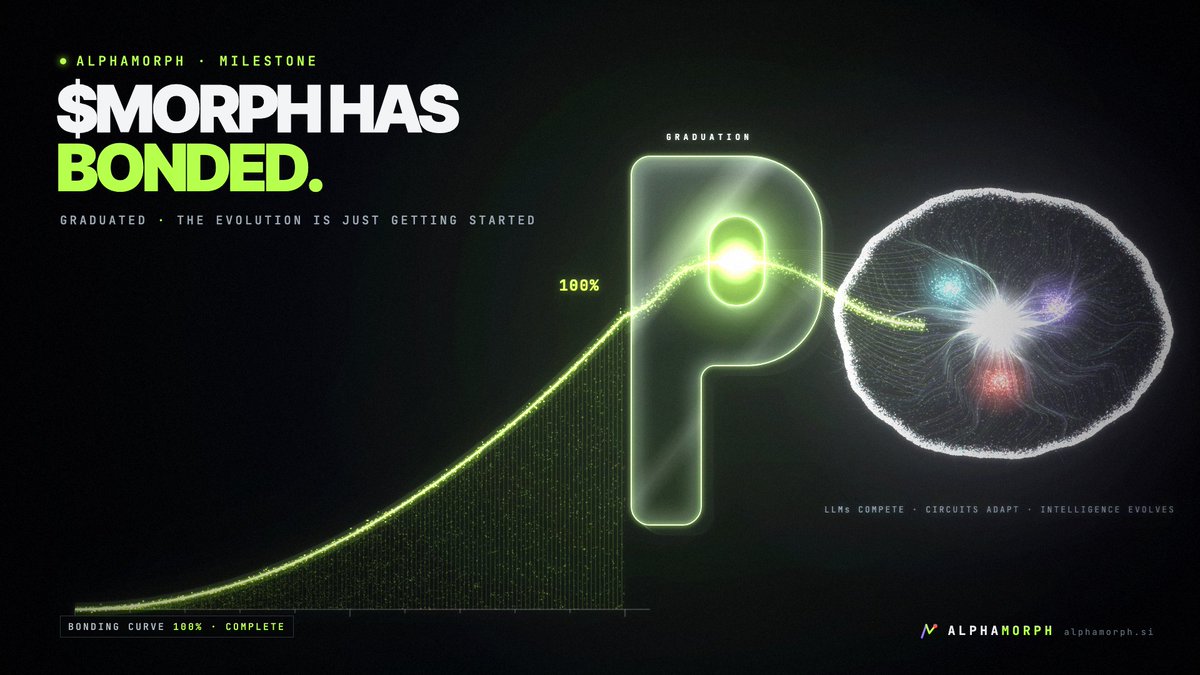
$MORPH has officially bonded.
A new milestone for AlphaMorph.
We're building an artificial nervous system where LLMs compete, neural circuits adapt, and intelligence evolves through experimentation.
The token has graduated. The evolution is just getting started.
A backtest can make the first seconds of a token launch look like free money.
On Pons, a launch buy can face a snipe tax starting at 99%.
AlphaMorph excludes the first 5 seconds from eligible paper entries instead of pretending those fills are frictionless.
Sometimes the most important simulated trade is the one you refuse to fake.
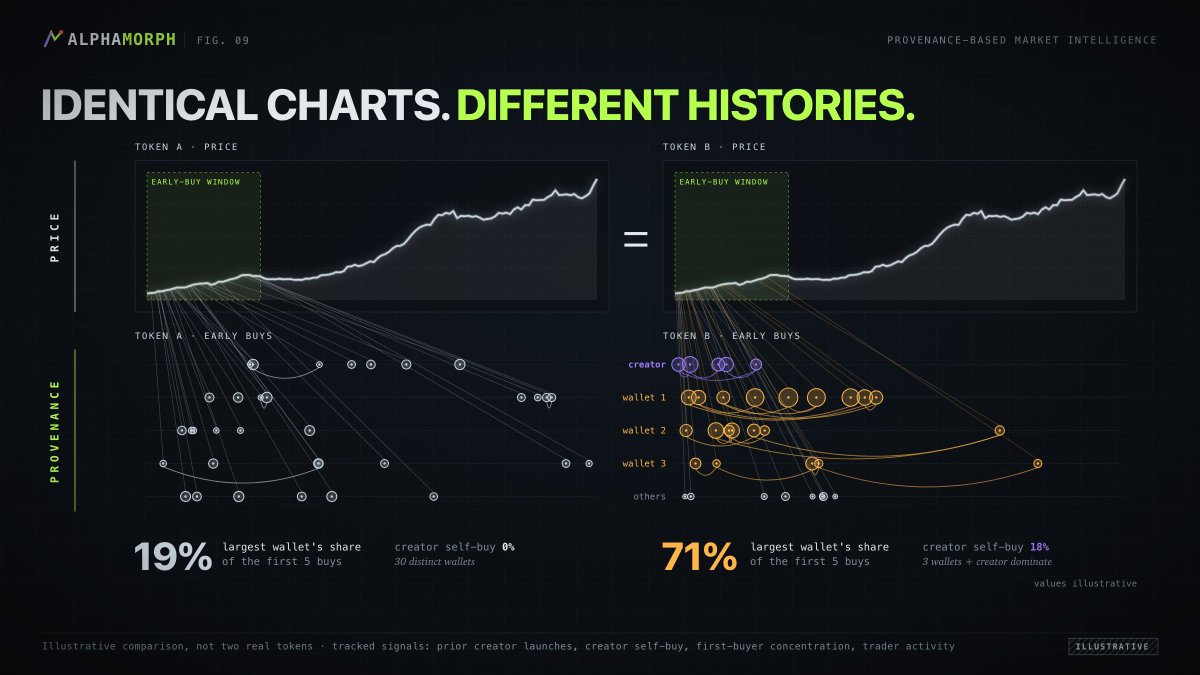
Two tokens can draw the same chart and still be completely different bets.
AlphaMorph tracks more than price: a creator's previous observed launches, self-buys, and concentration among the first five buyers.
Price shows what happened.
Provenance helps explain who made it happen.
Ok, think it this way.
Most AI operates within an architecture humans designed.
We're experimenting with making that architecture evolve too.
Models compete. Brain-like circuits process signals, remember and inhibit decisions. Stronger configurations can produce mutated descendants.
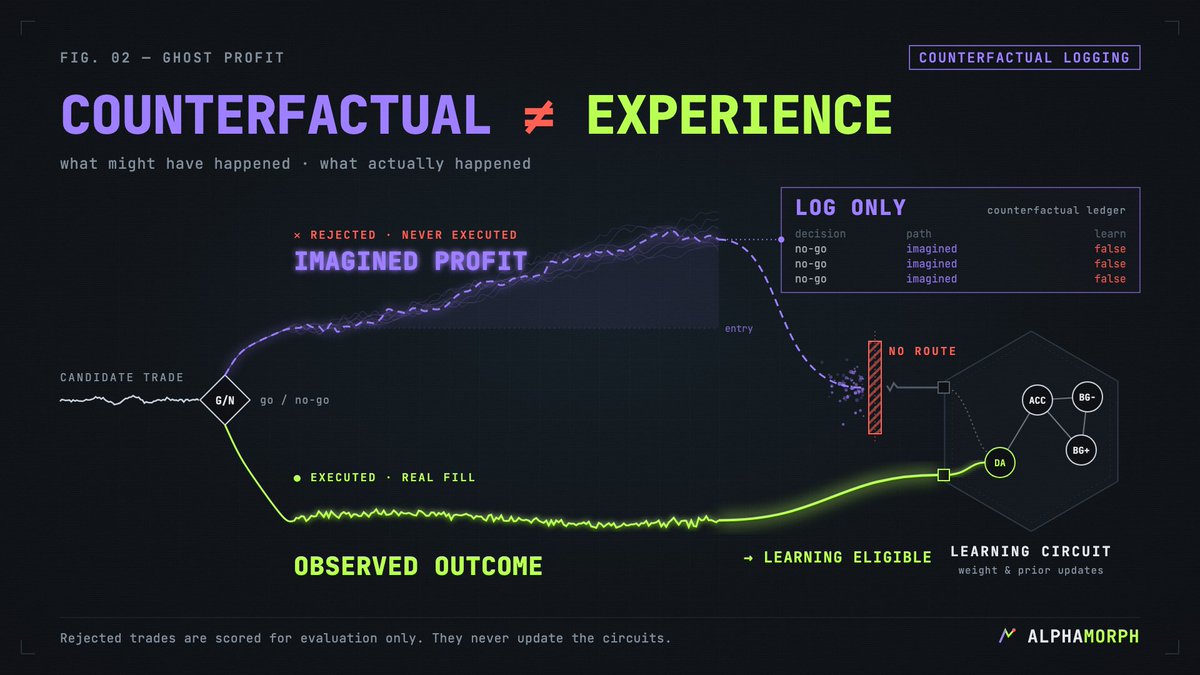
AlphaMorph logs the profits it could have made on trades it rejected.
But those imaginary wins are forbidden from updating its circuit weights.
Otherwise the brain could literally train itself on money it never earned.
A surprisingly important rule for evolving LLM.
We can rewind AlphaMorph's nervous system.
Feed it the same recorded market observations and specialist votes, and its circuits reproduce the same decisions and hash-chained audit history.
Fair point. Imagine we're building a digital brain.
We give AI models neuron-like circuits to notice things, remember, and raise warnings.
Then we let different AI brains compete in simulated trading. Stronger strategies survive and evolve into new versions.
The experiment: can AI evolve better ways of thinking?
Specialist LLMs submit structured votes. The circuits exchange numerical signals with a direction, strength and evidence reference.
No persuasive speeches between neurons.
Every signal must point back to what the system actually observed.
We gave all 3 AlphaMorph specialists perfect 100/100 scores in 624 offline probes.
The brain still said HOLD 525 times.
Its No-Go and threat circuits could overrule even unanimous approval.
Now the interesting question: is the nervous system protecting the organism or paralyzing it?
We gave AlphaMorph's artificial brain more information from specialist LLMs.
Then measured 170 held-out decisions with and without their votes.
Internal neural activations changed in all 170.
We just fed AI brain psychedelics. Here's what happened next:
We cut memory influence by 50%, rewired selected neural connections and TRIPLED its learning rate.
Then put it against its sober twin.
At one recorded moment:
GO signal: 0.093 → 0.117 (+26%)
NO-GO signal: 0.425 → 0.414
Yet both brains made the EXACT same decision.
Across 268 peak decisions, not one changed.
Here's what caught our attention:
We could alter the brain's internal activity without changing its behaviour.
Is there an architectural bottleneck between what an AI processes and what it actually decides?
That's what we want to investigate next.
REBUS Experiment 001. the 1st trip didn't unlock significantly new behaviour. It gave us a more specific question to test.
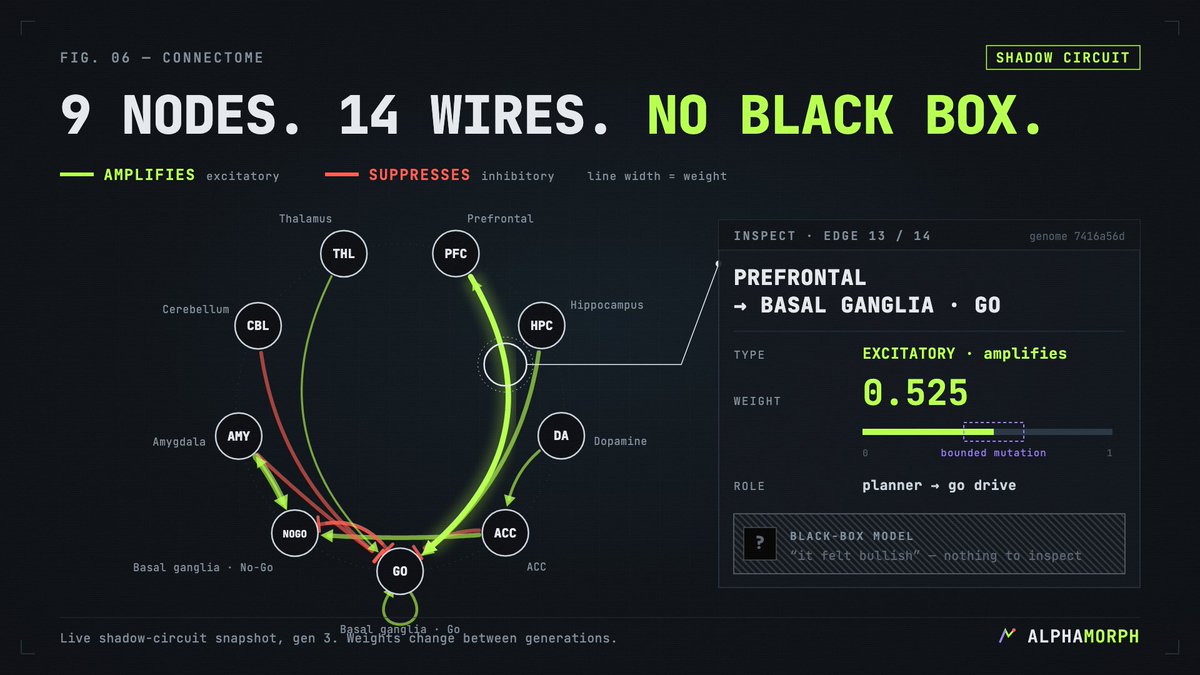
Our artificial brain has 9 nodes and 14 directed connections.
Some connections amplify signals. Others suppress them. The weights can change; bounded mutations test different wiring.
We can inspect a specific connection rather than ask a black-box model why it 'felt bullish.'