AlphaPod AI tracks AI data centers from permit to power-on and maps each to the public companies exposed. Every number sourced to a filing. Not financial advice
AI optics: A $2.2B signal for the next networking cycle - $AAOI $LITE $COHR $AVGO $MRVL
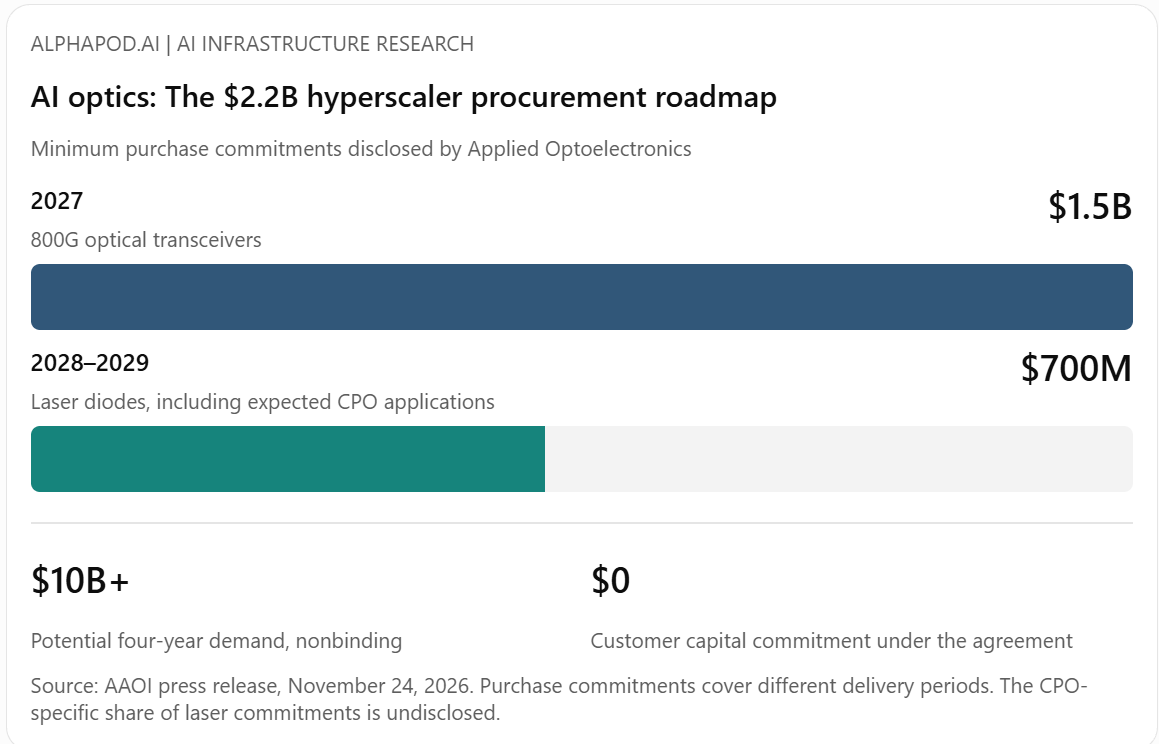
One hyperscaler's minimum purchase commitments to AAOI:
• 2027: $1.5B in 800G transceivers
• 2028-29: $700M in laser diodes
• Some lasers expected to power co-packaged optics starting in 2028
The agreement highlights two investment opportunities: sustained demand for conventional optical transceivers and emerging demand for high-power lasers as CPO adoption expands.
For optical component suppliers, the next question is which technologies capture the incremental dollar of AI infrastructure spending.
AI optics: A $2.2B signal for the next networking cycle - $AAOI $LITE $COHR $AVGO $MRVL
One hyperscaler's minimum purchase commitments to AAOI:
• 2027: $1.5B in 800G transceivers
• 2028-29: $700M in laser diodes
• Some lasers expected to power co-packaged optics starting in 2028
AI's Next Competitive Advantage: Access to Capital
As AI infrastructure spending accelerates, the ability to raise affordable capital could become a major competitive advantage. Credit markets are already signaling significant differences in perceived financial risk. The cost of insuring $ORCL debt against default is now seven times that of $MSFT .
The next question is how much of that higher contracted revenue translates into better development returns after construction and financing costs.
These are base-term revenue averages, not starting rents. Delivery is expected to begin in H1 2028, subject to project milestones.
$APLD data center lease economics are improving
Average annual contracted revenue per MW:
Delta Forge 1: $1.67M
Polaris Forge 3: $1.67M
Delta Forge 2: $1.65M
New 150 MW lease: $2.00M
That's ~21% above its June lease, with a longer 18-year base term.
$IREN $NBIS $APLD $WULF
Securing power is only part of the equation. Existing grid arrangements, credit support and who bears upgrade costs could become increasingly important competitive advantages.
SPP's proposal is prospective and still requires FERC approval.
SPP's proposed grid upgrade rules contain an interesting detail for AI infrastructure investors.Regional funding would be capped at $500k/MW or $25M per delivery-point request, whichever is lower.
For a 1 GW request, that's just $25k/MW versus $500k/MW for 50 MW.
#DataCenters
SPP's historical studies requiring network upgrades show just how variable these costs can be:
Median: $177k/MW
75th percentile: $378k/MW
95th percentile: $1.02M/MW
Under the proposal, eligible costs above the cap would be directly assigned to the requesting customer.
The interesting question is whether CoreWeave's geographic mix provides a cost advantage, and how much of any new charge CoreWeave would actually bear. Has anyone looked into how its data center leases allocate transmission and utility costs?
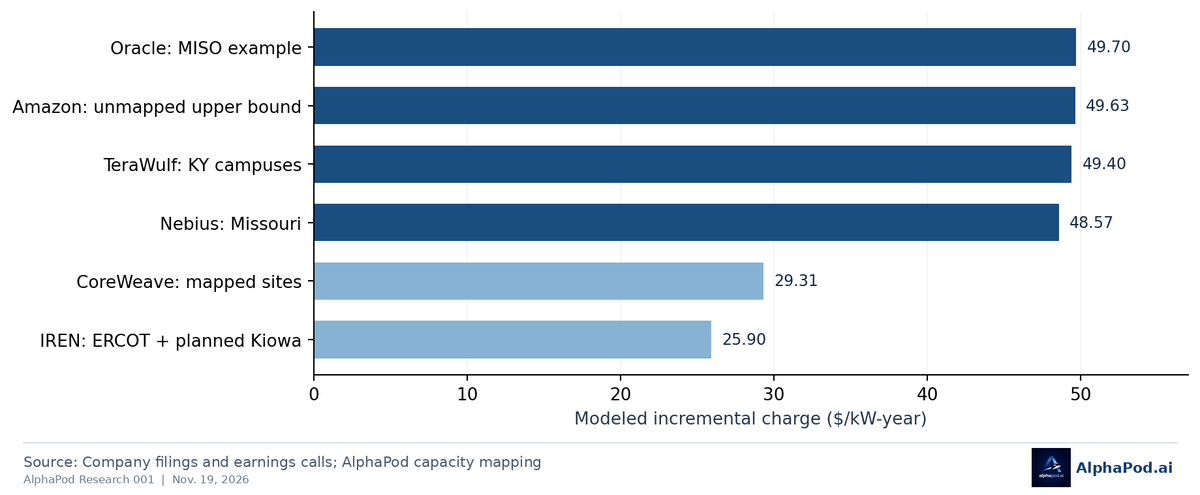
I was looking at how the Senate's proposed transmission-pricing changes could affect CoreWeave's data center footprint. Of the roughly 2.1 GW of U.S. capacity we mapped, about 41% is in ERCOT, outside the proposed federal pricing framework.
That brings the modeled incremental rate to $29.31/kW annually, compared with roughly $50/kW for covered non-Texas capacity. Across those mapped sites, that's approximately $62M annually at full capacity. But this is a policy scenario, not a forecast of additional expenses. Existing utility payments, contractual cost-sharing, potential offsets and the final rules could materially change the result.
Important context: Nebius has already committed to covering power infrastructure costs at Independence, and the project's arrangements reportedly contemplate up to $100M in transmission upgrades. The ~$53M/year figure is a full-capacity policy sensitivity, not a forecast of additional costs. Whether any new charges arise depends on federal applicability, existing cost recovery, contractual offsets and final rules.
I've been looking at how the Senate's new energy permitting bill could affect Nebius's 1.1 GW Independence campus in Missouri.
Using the proposed transmission-pricing framework and regional cost estimates, I get roughly $53M in additional annual charges at full capacity. But there's a catch. Independence is served by a municipal utility, Independence Power & Light, and it's unclear whether the proposed federal rules would apply through that arrangement.
So I wouldn't treat the $53M as an expected expense. The utility agreement and final rules matter. Has anyone dug into how Independence Power & Light handles SPP transmission charges?
The point about power access is particularly interesting. $IREN's early investment in grid connections could be a meaningful advantage as energization becomes harder.
One distinction from our AlphaPod research: Sweetwater's 1.4 GW is in ERCOT, while the proposed 1.6 GW Kiowa campus is in SPP, where we model up to ~$78M in additional annual transmission charges under the Senate's new bill.
Kiowa is still optional, but it raises an interesting question: how much of IREN's valuation should reflect secured power today versus future capacity that still needs to be developed?
Interesting implications for $IREN. Its 1.4 GW Sweetwater site is in ERCOT, outside the proposed federal transmission-pricing framework. But the planned 1.6 GW Kiowa campus is in SPP.
Our @alphapod_ai model estimates up to ~$78M in additional annual charges at Kiowa if fully built and covered. Curious whether investors are factoring in that difference.
Agreed that permitting reform matters. One question our AI infrastructure research raised is what happens after approval. At the Germanna project in Virginia, customer substation-site readiness was the main documented delay.
Curious how you see the bill addressing bottlenecks beyond permitting?
Our research: https://t.co/eHD5gVwlSl
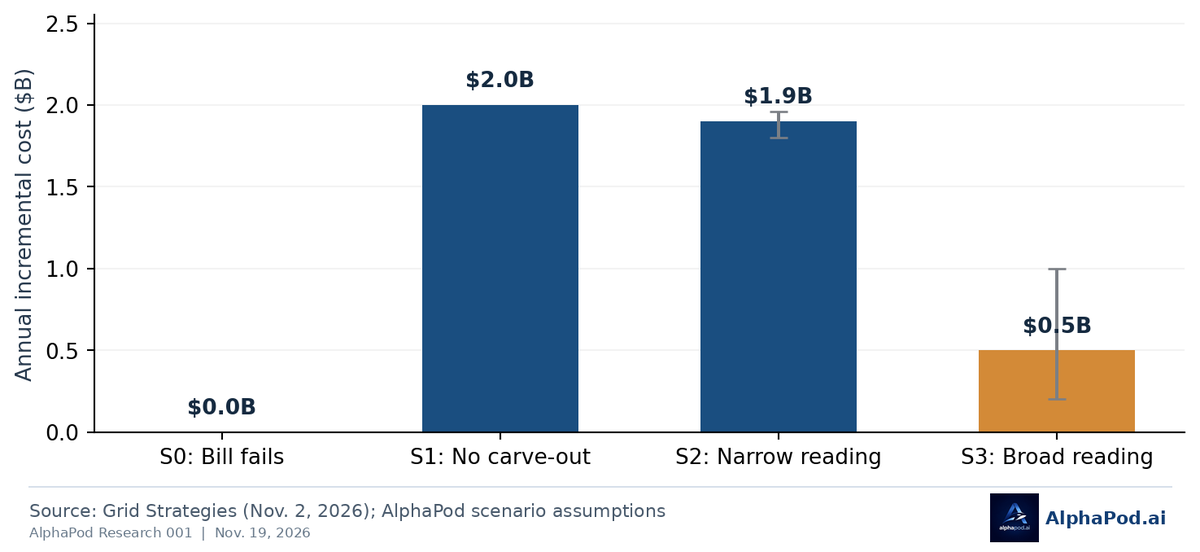
@BenSchifman We tried to size this. On our model, as passed (no carve-out), it's ~$2.0B/yr in added transmission costs for data centers outside Texas: ~$49,600/MW-yr, or ~$5M/yr for a 100 MW site.
If the House adds back a broadly read "information service" carve-out, that drops to ~$0.5B.
The Senate just passed a sweeping energy permitting bill, 62–33. But will it actually accelerate AI data centers?
We analyzed utility tariffs, regulatory filings and project delays. One finding: ~$2B in modeled incremental annual transmission costs, not the $5.5B headline total.
Our findings 🧵
#BAAJA #DataCenters