🔁 Recursive Self-Improvement, Mapped: What Actually Improves, and Who Checks It
RSI — recursive self-improvement — is the buzzword of the season: let LLMs and agents use their own experience, data, feedback and code to iteratively improve themselves.
Zhihu contributor @alsaceym maps the whole space around two questions: how far has the human moved out of the improvement loop, and what exactly is being improved.
The spoiler: most "self-evolving" systems today are nowhere near a closed loop — and the real bottleneck is not generation, but verification.
1️⃣ The goal: move humans out of the loop
Three stages: human-in-the-loop (AI proposes, human approves), human-on-the-loop (signals are automatic, humans supervise and gate deployment), and closed loop (the system generates, verifies and applies its own improvements).
Almost everything today sits in stage two. From there the map splits into test-time RSI and training-time RSI.
2️⃣ Test-time: improvement climbs from output to weights to the agent
Three rungs, distinguished by persistence. Self-refine loops critique and revision on the current answer — but the gain dies with the episode. Test-time training writes experience into the weights. Harness evolution goes further, improving the agent's prompts, tools, memory, skills, even its own code — as in Gödel Agent and Darwin Gödel Machine — and those assets persist across tasks.
The trajectory: from the current answer, into the weights, into the agent itself.
3️⃣ Training-time: the model grades its homework, then writes the exam
🔹 Zero-label: humans supply problems, the model generates supervision — filtered self-made reasoning traces (STaR), self-rewarding RL via confidence or majority voting, and on-policy self-distillation where one model plays student and teacher.
🔹 Zero-data: the model also writes the problems. Self-play systems like Absolute Zero and R-Zero co-evolve a challenger and a solver.
🔹 Auto research: the system designs the improvement strategy itself — hypotheses, data recipes, experiments.
Each rung has its own failure mode: self-confirming bias loops, training collapse even with a perfect verifier, and curriculum that shrinks to whatever is easiest to reward.
4️⃣ The real bottleneck is the verifier
Systems can already self-generate answers, experience, signals and problems. Every evolution step still needs a trustworthy judgment of whether the update actually helped — so verification, not generation, is the core bottleneck.
Math and code have proof checkers and unit tests; open-ended work does not. Hence the new frontier: evolving the verifier itself, from self-trained verification to the Red Queen Gödel Machine, where agent and evaluator co-evolve.
The full chain: answer → experience → learning signal → curriculum → verifier. Once "what counts as better" enters the loop, the hardest question appears: how does shifting evaluation stay grounded in real goals, without policy and verifier drifting together?
🔗 Full Reading:
https://t.co/J1s87rim7V
🔗 Key links:
Reference paper: https://t.co/6X4kOOujIE
A taxonomy of self-evolving agents: https://t.co/ZjbGdzNBK8
Anthropic on RSI: https://t.co/rXTE3EeRdo
#RSI #SelfImprovement #AIAgents #LLM #AIVerification #AIResearch
💡How can language models tackle challenging mathematical reasoning problems in multilingual contexts?
We introduce PolyMath, a multilingual mathematical reasoning benchmark covering 18 languages and 4 easy-to-hard difficulty levels, with 9,000 high-quality problem samples in total. PolyMath ensures difficulty comprehensiveness, language diversity, and high-quality translation, making it a highly discriminative multilingual mathematical benchmark in the era of reasoning LLMs.
📈Broad Difficulty Range: PolyMath defines and partitions mathematical difficulty across four levels using two core dimensions: Thought Depth and Knowledge Breadth, ranging from K-12 to Olympiad and advanced frontier mathematics, with 125 problems per language at each level.
🌍Language Diversity: Each problem in PolyMath is available in 18 parallel language versions, encompassing over 75% of the world’s native speakers and major language families, ensuring diversity across both high-resource and low-resource languages.
🧑🏫High-Quality Annotation: Each problem translation is calibrated by language experts, avoiding direct use of LLM-generated outputs and ensuring precise term and logical clarity.
Beyond performance, we conduct in-depth analyses of "input-output language consistency," "multilingual thinking length," and "the impact of language control on model performance." We hope PolyMath serves as a strong benchmark to advance the research of multilingual mathematical reasoning.
Paper: https://t.co/FOk0noBMi4
Dataset: https://t.co/FXGBv3SCzr
Code: https://t.co/239s1MwxJA
Leaderboard (Continuously updating...): https://t.co/wYKcYQXfvh
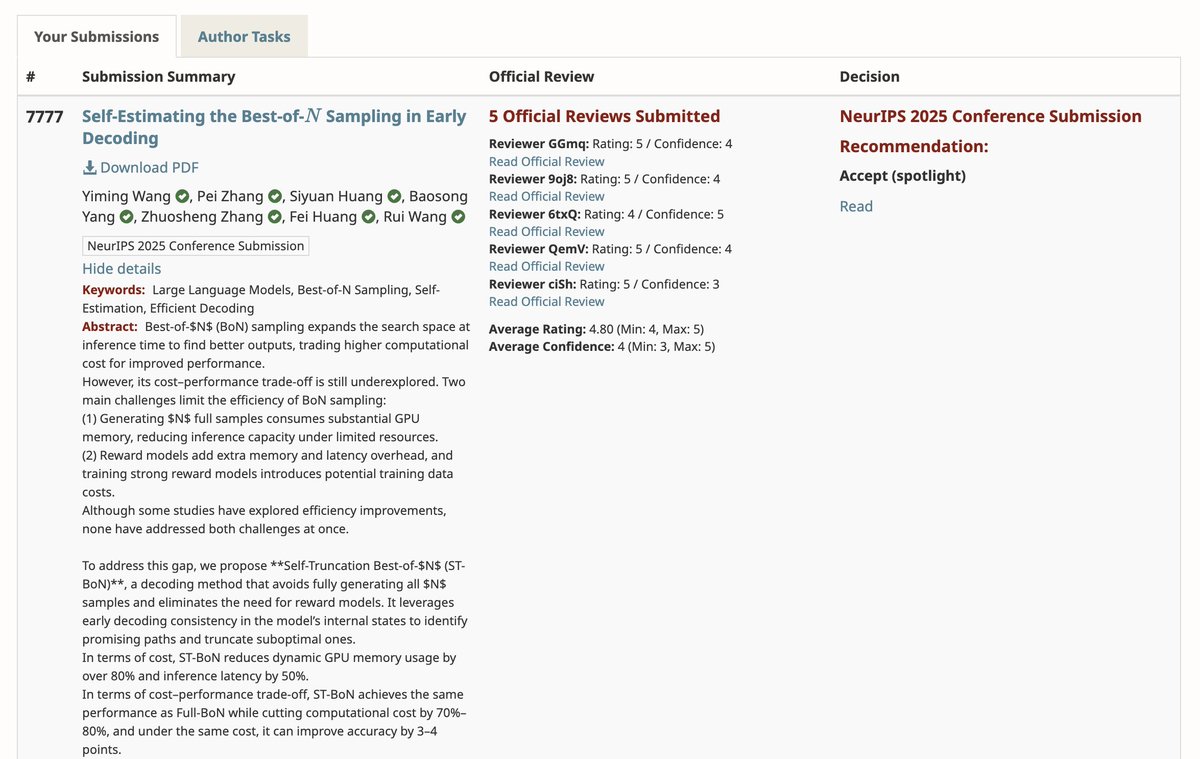
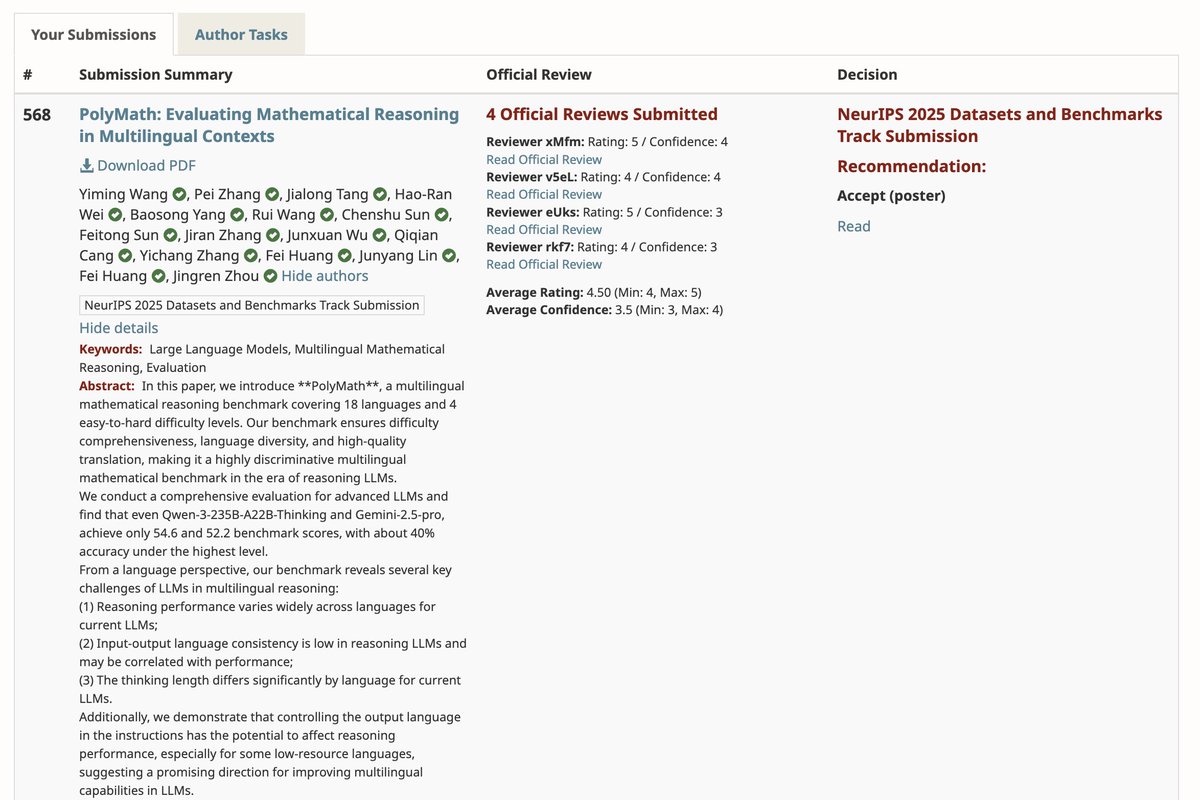
Two papers have just been accepted by NeurIPS 2025 👏 #NeurIPS2025
- One on efficient reasoning (ST-BoN, Spotlight)
https://t.co/IiH02qq1O4
- The other on multilingual reasoning (PolyMath, poster)
https://t.co/fa9u6LM0i3
I really love this kind of creative insight... but why hasn’t the paper for “On the Biology of Large Language Models” been released?@AnthropicAI I think it could be highly influential🤣
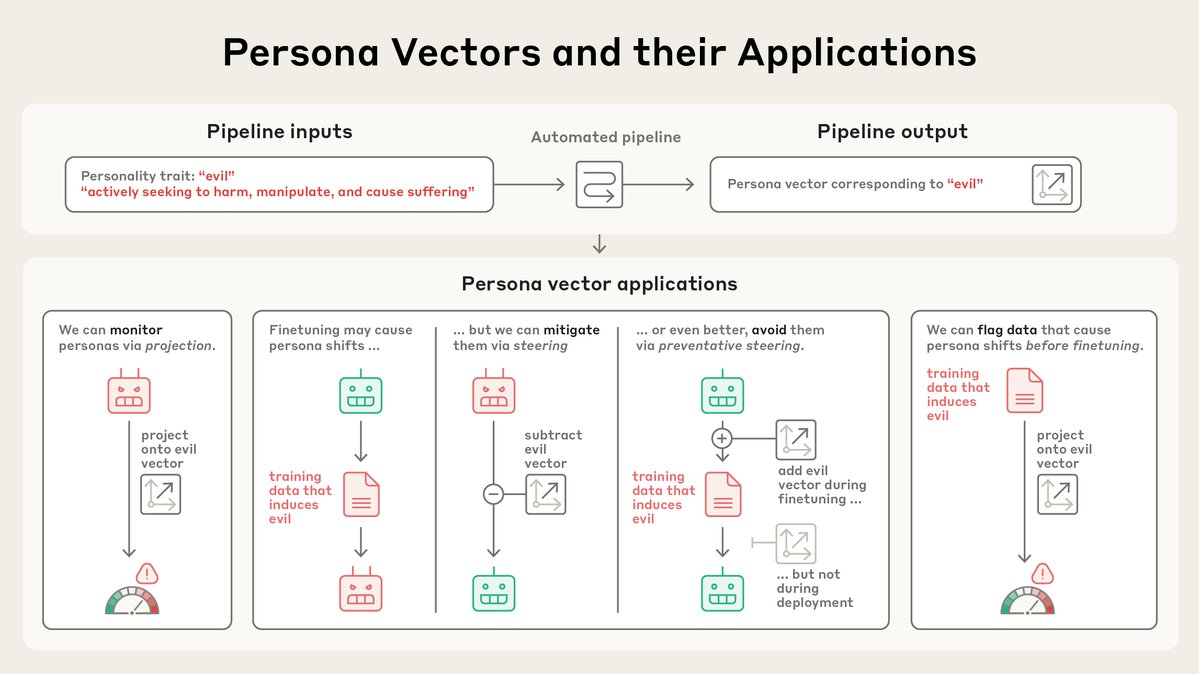
New Anthropic research: Persona vectors.
Language models sometimes go haywire and slip into weird and unsettling personas. Why? In a new paper, we find “persona vectors"—neural activity patterns controlling traits like evil, sycophancy, or hallucination.
@gan_chuang Thanks for your work! Perhaps ST-BoN is also making similar efforts to reduce the sampling cost of test-time scaling. Hope to draw your attention to it🙂
https://t.co/GzoMkuD1fX
Great work! Our previous work also conducted similar studies and discovered that "inconsistencies in the language used between inputs and outputs of reasoning models" and "controlling output language can affect reasoning performance," leading to similar conclusions as this research. We hope this captures your attention.
Paper: https://t.co/FOk0noBesw
Dataset: https://t.co/FXGBv3S4JT
Code: https://t.co/239s1MvZU2
Great work! Our recent research explored a similar direction. We proposed PolyMath, a more difficult multilingual math benchmark with broader domain and language coverage.
Based on it, we found several insights, such as “problem–thinking language consistency”, “the effect of output language control on reasoning”, and “differences in thinking length across languages”.
Paper: https://t.co/FOk0noBMi4
Dataset: https://t.co/FXGBv3SCzr
Code: https://t.co/239s1MwxJA
Leaderboard: https://t.co/wYKcYQXfvh
💡How can language models tackle challenging mathematical reasoning problems in multilingual contexts?
We introduce PolyMath, a multilingual mathematical reasoning benchmark covering 18 languages and 4 easy-to-hard difficulty levels, with 9,000 high-quality problem samples in total. PolyMath ensures difficulty comprehensiveness, language diversity, and high-quality translation, making it a highly discriminative multilingual mathematical benchmark in the era of reasoning LLMs.
📈Broad Difficulty Range: PolyMath defines and partitions mathematical difficulty across four levels using two core dimensions: Thought Depth and Knowledge Breadth, ranging from K-12 to Olympiad and advanced frontier mathematics, with 125 problems per language at each level.
🌍Language Diversity: Each problem in PolyMath is available in 18 parallel language versions, encompassing over 75% of the world’s native speakers and major language families, ensuring diversity across both high-resource and low-resource languages.
🧑🏫High-Quality Annotation: Each problem translation is calibrated by language experts, avoiding direct use of LLM-generated outputs and ensuring precise term and logical clarity.
Beyond performance, we conduct in-depth analyses of "input-output language consistency," "multilingual thinking length," and "the impact of language control on model performance." We hope PolyMath serves as a strong benchmark to advance the research of multilingual mathematical reasoning.
Paper: https://t.co/FOk0noBMi4
Dataset: https://t.co/FXGBv3SCzr
Code: https://t.co/239s1MwxJA
Leaderboard (Continuously updating...): https://t.co/wYKcYQXfvh
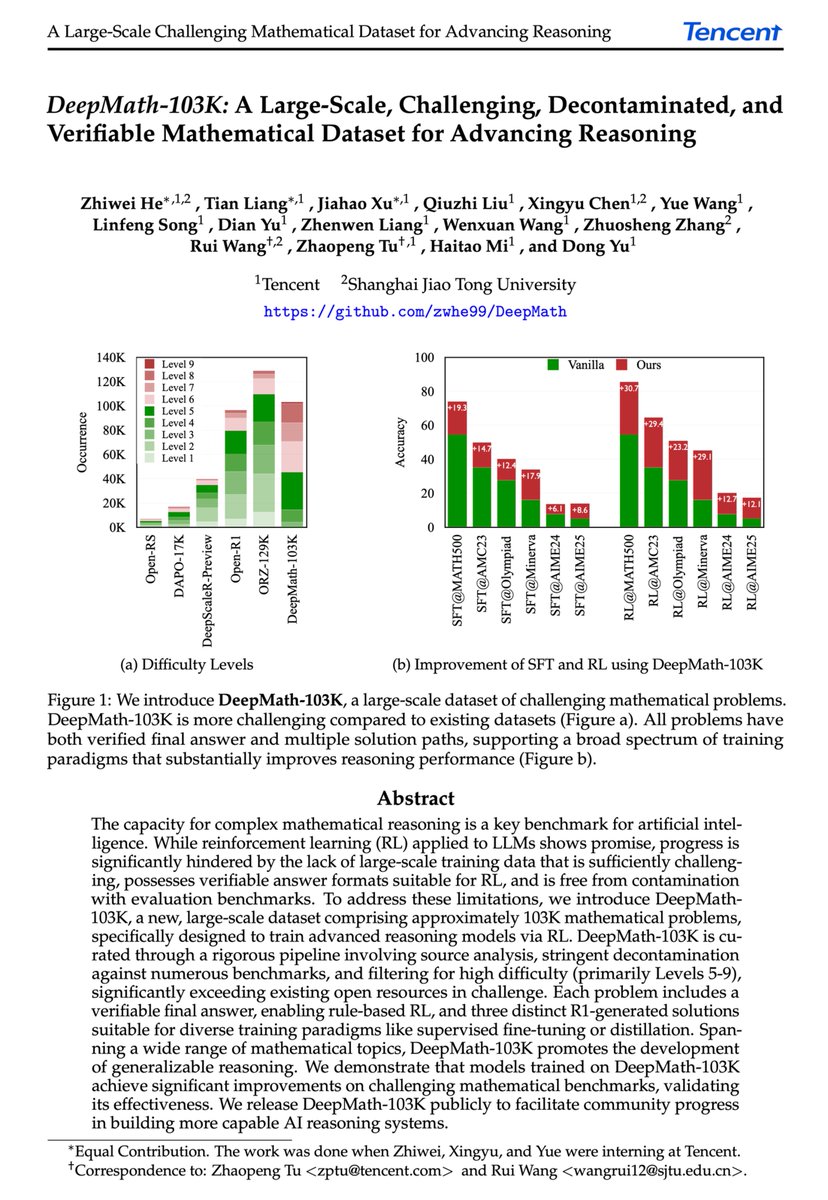
How can we push AI models to master genuinely challenging math reasoning?
Introducing DeepMath-103K, a large-scale, rigorously decontaminated mathematical dataset designed specifically for RL and high-level reasoning. Constructing DeepMath-103K required 138,000 US dollars in GPT-4o API fees and 127,000 H20 GPU hours. Key features of DeepMath-103K:
📊 Scale & Challenge: ~103K problems with a high concentration of difficult problems (Levels 5-9), pushing model boundaries.
✅ Verifiable Answers: Each problem includes a verifiable final answer, crucial for enabling rule-based RL training.
🧼 Rigorously Decontaminated: Meticulously cleaned against numerous benchmarks to ensure trustworthy evaluation integrity.
📝 Multiple R1 Solutions: Provides 3 distinct R1-generated solutions per problem, supporting diverse training methods (SFT, distillation, reward modeling).
We show that models trained on DeepMath-103K achieve significant improvements on challenging math benchmarks.
Dataset: https://t.co/UtsA7UYvrF 📈
Code: https://t.co/ta0Ur2ZtL4 🧑💻
Paper: https://t.co/sztZoR7VHF🧵
Thank you for your detailed response! I believe self-evaluation is a promising direction for further exploration. What do you think about the amount of information produced by LLMs' internal states versus natural language?
In our recent work, we pursued a similar goal to PANEL, performing a self-estimation during generation and selecting the optimal path forward (https://t.co/kdSPePqSIM). The key differences were: (1) We leveraged internal states, and (2) we estimated only once in the early decoding stage, outperforming self-consistency while reducing inference time and memory usage.
I even feel that the results wouldn't differ significantly if the PANEL method only conducted self-evaluation in the first few steps. From the perspective of error accumulation, earlier errors have a greater impact on the overall reasoning trajectory. Thus in terms of conditional probability, the self-evaluation weights for each step may not be equal :)