@chris_nectiv Exactly. A University of Toronto study (1000 queries, GPT-4/Claude/Perplexity/Gemini) showed that the overlap between Google and AI sources was only 4-15%. Different algorithms, different sources, different winners.
https://t.co/EZMoekFkpD
Pangram — AI detector with 99.98% accuracy
Let’s talk about Pangram Labs — an AI detector that’s gaining serious traction and claims 99.98% accuracy.
They already have 200,000 users, plus integrations with Google Docs and a Chrome extension.
This is not another GPTZero clone.
Pangram was founded in 2024 in Brooklyn by two Stanford graduates — a former Google ML engineer and a former Tesla ML scientist.
They trained their own neural network on 1 million documents, deliberately using edge-case examples where the line between human and AI text is extremely thin.
According to their data, the system falsely flags human text as AI only once in 10,000 checks.
They claim detection works across all major models:
ChatGPT, Claude, Gemini, Llama, Grok, and more.
Supports 20+ languages.
Wiki Education has already adopted Pangram to help clean AI-generated content from Wikipedia.
Pricing:
• Free — 4 checks per day
• Individual — 600 checks/month for $20
• Professional — 3,000 checks/month for $65
Clean positioning, serious team, and a bold accuracy claim. Worth watching.
Hallucinations in RAG
“Best prompts” don’t help — hallucinations are an architectural problem.
“The more documents I put into RAG, the smarter it gets” is a myth. After ~5–7 sources, error rates increase, not decrease, because the model starts merging incompatible information.
Stanford University published a study evaluating AI tools that claimed to be hallucination-free for legal research (legal RAG).
The study included paid services costing $128–$900/month (Lexis+ AI, Westlaw AI-Assisted Research, Ask Practical Law AI) and plain GPT-4 without specialized legal data.
Goal: measure how often hallucinations occur in specialized legal AI assistants.
Method: 200 legal queries.
Results
Commercial legal AI tools still hallucinate in 17–33% of cases, despite using RAG.
• Lexis+ AI: 17% hallucinations
• Westlaw AI-AR: 42% accuracy, 33% hallucinations
• Ask Practical Law AI: 19% accuracy, refused to answer 62%
• GPT-4 (baseline): ~40% hallucinations
Typical errors
• Confusing court rulings with lawyers’ arguments
• Citing overturned precedents as valid or referencing documents that don’t support the claim
• Failing to understand court hierarchy (e.g., claiming a state court overturned the U.S. Supreme Court)
• Generating non-existent statutes or legal paragraphs
Conclusions
• RAG reduces hallucinations compared to base LLMs, but does not eliminate them
• Longer answers contain more hallucinations
• Systems struggle with jurisdictional and temporal context
•AI output cannot be trusted without verification
• Every citation and claim must be manually checked
If ChatGPT can answer your question, you don't need to rank high on Google. The algorithm will penalize pages whose semantic vector matches the answer provided by Google's AI model.
Batch Watcher — a Chrome extension for those who watch Ahrefs like it’s Netflix. Perfect for SEOs tracking competitor dynamics.
It lets you save Ahrefs Batch Analysis data and compare current metrics with previous snapshots — for example, before vs. after a Google update (you just need to take a snapshot first).
Works 100% locally, no API keys or passwords required.
How to use:
1. Open Ahrefs Batch Analysis.
2. Upload your usual list of sites.
3. Click the Batch Watcher icon in the Chrome toolbar to save a snapshot.
4. A notification will show how many sites were saved — that’s your first snapshot.
5. After a few days or weeks, take another one.
6. Right-click the extension icon → Compare snapshots.
7. Select the one you want to compare — the extension will highlight what grew and what dropped.
Link bellow 👇
#AhrefsEvolve #SEO
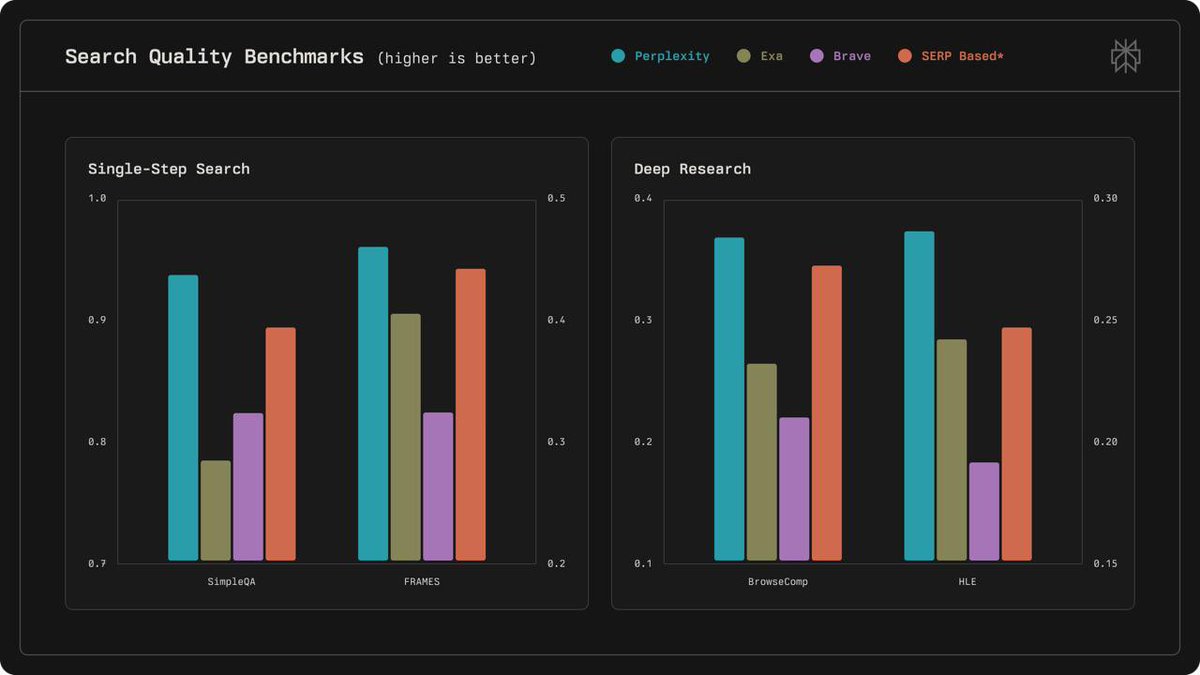
Perplexity rolled out a new Search API giving access not just to URLs, but to the actual content used to build answers. You can also limit search to your own domain list (up to 20).
They also published “Building & Evaluating an AI-Powered Search API.”
Key takeaways:
• Hybrid search (lexical + semantic), multi-stage ranking + training on user feedback.
• Observed a bifurcation of the AI ecosystem between lexical- and semantic-optimized systems.
• Context understanding: results are extracted/evaluated at both document & sub-document level.
• Docs split into sub-docs → avoids RAG context overload where too much noise makes the model dumber.
• ML predicts what/when to index → balance freshness vs. completeness.
• Tradeoff: strict filtering = clean but incomplete; soft filtering = fuller but noisy.
• Dynamic parsing rules per site.
• Exabyte-scale index (~33M 4K movies); 400+ PB “hot” storage, rest in “warm/cold.”
• Prioritization of “hot” docs via ML + heuristics (authority domains, under-researched topics).
• Manual rules help, but risk missing critical content → “every piece of context matters.”
• Structured sites (tables/lists) use more templated extraction; free-form UGC requires looser rules.
• Benchmarks: SimpleQA, FRAMES (shallow search) + BrowseComp, HLE (deep research) = standard criteria for knowledge agents.
#geo #PerplexityAI
It uses a rule base and a context base, and machine learning automatically identifies entities and intents in queries. This makes conversations more natural and accurate.
Google patent US-10482184-B2 describes context-aware NLP processing for assistants and chatbots. The system analyzes previous queries, geolocation, active applications, and time of day, assigning context labels for accurate interpretation.
For each blog, an overall rating is calculated:
This allows you to raise high-quality blogs in the search results and lower spam.
- Blog 1: Relevance 1.0, Quality 0.4 → Rank 1.4.
- Blog 2: Relevance 0.9, Quality -0.4 → Rank 0.5.
- Result: Blog 1 appears higher in search results
Google patent US2012265757A1 is devoted to ranking blogs and posts for search queries.
Methods for determining relevance:
- The number of keyword matches in the text.
- The location of keywords.
- The weight of individual words and their relative position.
Negative Quality Indicators:
- Spammers frequently post in set time intervals (e.g. every 10 minutes).
- Posts with the same content or size may be a sign of automated generation.
- A high concentration of links to one external resource.
- Excessive amounts of advertising