Understanding $RANDO: Where AI Chaos Meets Community on Solana
The crypto space is evolving beyond utility. Today, some of the fastest-growing communities are built around culture, creativity, and storytelling—and that's where $RANDO (Random AI Nonsense Dopamine Overload) stands out.
What is $RANDO?
$RANDO is a community-driven memecoin built on the Solana blockchain. Its identity is inspired by AI-generated randomness, internet humor, and the unpredictable creativity that comes from human and artificial intelligence interacting together. According to its project description, it celebrates "AI hallucinations" and incorporates a random rewards concept into its ecosystem.
Why was $RANDO built on Solana?
Solana has become one of the leading blockchains for community tokens because it offers:
Lightning-fast transactions
Very low transaction fees
A scalable network capable of supporting large communities and decentralized applications
These features make Solana an attractive home for projects that rely on frequent community interaction.
More Than Just a Memecoin
Many people assume memecoins are "just jokes." While memes are central to their identity, successful community tokens often thrive because they create:
A strong shared culture
Engaging storytelling (lore)
Creative content
Active community participation
$RANDO embraces this philosophy by encouraging members to contribute to its evolving narrative rather than focusing solely on traditional crypto utility.
Learning From $RANDO
Whether you're new to crypto or an experienced investor, $RANDO offers an opportunity to understand several important blockchain concepts:
What makes a community token successful
Why narratives influence crypto markets
How Solana enables low-cost participation
The importance of researching on-chain data before investing
Always Practice Responsible Investing
Every cryptocurrency carries risk, especially early-stage community tokens. Before investing:
Verify the official contract address.
Research the tokenomics and holder distribution.
Understand the project's vision.
Invest only what you can afford to lose.
Education should always come before investment decisions.
Final Thoughts
$RANDO represents a growing trend where AI culture, memes, and community engagement intersect with blockchain technology. Whether you're following the project for its creativity or its community, one lesson remains constant:
Knowledge is your greatest investment. Learn first. Research always. Then decide.
@Rando_rewards
#unleashRando #solana #CryptoAlpha
The biggest advantage of https://t.co/sbrXgSAsCY isn't lower fees. It's capital efficiency.
Most people compare DEXs by one number:
Trading fee.
0.3%. 0.2%. 0.1%.
But I think that's the wrong comparison.
The real question is:
How efficiently does the protocol use liquidity to give users the best execution?
That's called capital efficiency.
### What does capital efficiency mean?
Imagine two liquidity pools both contain $1 million.
Pool A gives traders poor execution because liquidity is fragmented.
Pool B gives better execution because liquidity is routed and utilized more intelligently.
Same capital.
Different efficiency.
That's why liquidity quality matters just as much as liquidity size.
### Why it matters on https://t.co/sbrXgSAsCY
https://t.co/sbrXgSAsCY doesn't just rely on a single pool. Through its liquidity infrastructure and routing, the protocol aims to find efficient paths across available liquidity rather than forcing every swap into one route.
For traders, that can mean:
* Better execution
* Lower price impact
* More competitive routes
* Less fragmented liquidity
For liquidity providers, efficient markets can also attract more trading activity—which is where fee generation begins.
### Bigger lesson
In DeFi, more money doesn't always create a better market.
Better capital efficiency does.
That's the difference between simply having liquidity and making liquidity work intelligently.
Don't measure a DEX only by its fees. Measure it by how well it uses capital.
@ston_fi
#STONfi #TON #DeFi #Liquidity #CapitalEfficiency
In collaboration with @RHtardios , I’m raffling 15 GTD spots.
To enter :
✅ Follow @RHtardios@Elmahfizh
✅ Like and retweet this https://t.co/Gfm9E2NIB9
✅ Drop your evm Wallets
The most underrated feature on https://t.co/sbrXgSAsCY isn't swapping. It's Vaults.
When most people open https://t.co/sbrXgSAsCY, they head straight to the Swap button.
Swap TON.
Buy USDT.
Trade memecoins.
And leave.
But I think that's looking at the protocol from the wrong angle.
One of the most underrated products on https://t.co/sbrXgSAsCY is Vaults—because they're built for people who want their assets to work even when they're not actively trading.
### So, what is a Vault?
A Vault is a smart-contract product that allows users to deposit supported assets into an automated strategy.
Instead of manually claiming rewards, moving liquidity, or constantly managing positions, the vault is designed to execute the strategy according to its programmed rules.
Think of it as the difference between manual investing and automated capital management.
### Here's the basic flow:
Deposit assets
↓
Vault executes its strategy
↓
Rewards and yield accumulate
↓
Your position updates over time
The important point is that you're not simply locking tokens—you're participating in a strategy.
### Why would someone use a Vault?
Because time is also a resource.
Many DeFi users don't want to monitor charts every hour or rebalance positions every few days.
Vaults aim to make capital more efficient by automating repetitive actions that users would otherwise perform manually.
That creates a different kind of DeFi experience:
Less manual management.
More systematic participation.
### But here's the mistake beginners make…
They look at the displayed APY before understanding where it comes from.
A responsible DeFi user should always ask:
* Is this yield generated from trading activity?
* Is it boosted by temporary incentives?
* What assets am I depositing?
* What risks does this strategy carry?
* Can the APY change over time?
Those questions matter far more than the headline percentage.
### Vaults are not risk-free
Automation doesn't eliminate risk.
Your position can still be affected by:
* Market volatility
* Smart-contract risk
* Liquidity conditions
* Changes in incentive programs
A vault is a tool—not a guarantee.
### The bigger lesson
I think people often divide DeFi into only two categories:
Trading or Holding.
But https://t.co/sbrXgSAsCY shows there's a third approach:
Putting idle capital to work through automated strategies.
Sometimes the smartest portfolio isn't the one making the most trades.
It's the one where every asset has a clear purpose.
Don't just hold tokens. Build a strategy around them.
@ston_fi
#STONfi #TON #DeFi #Vaults #Crypto
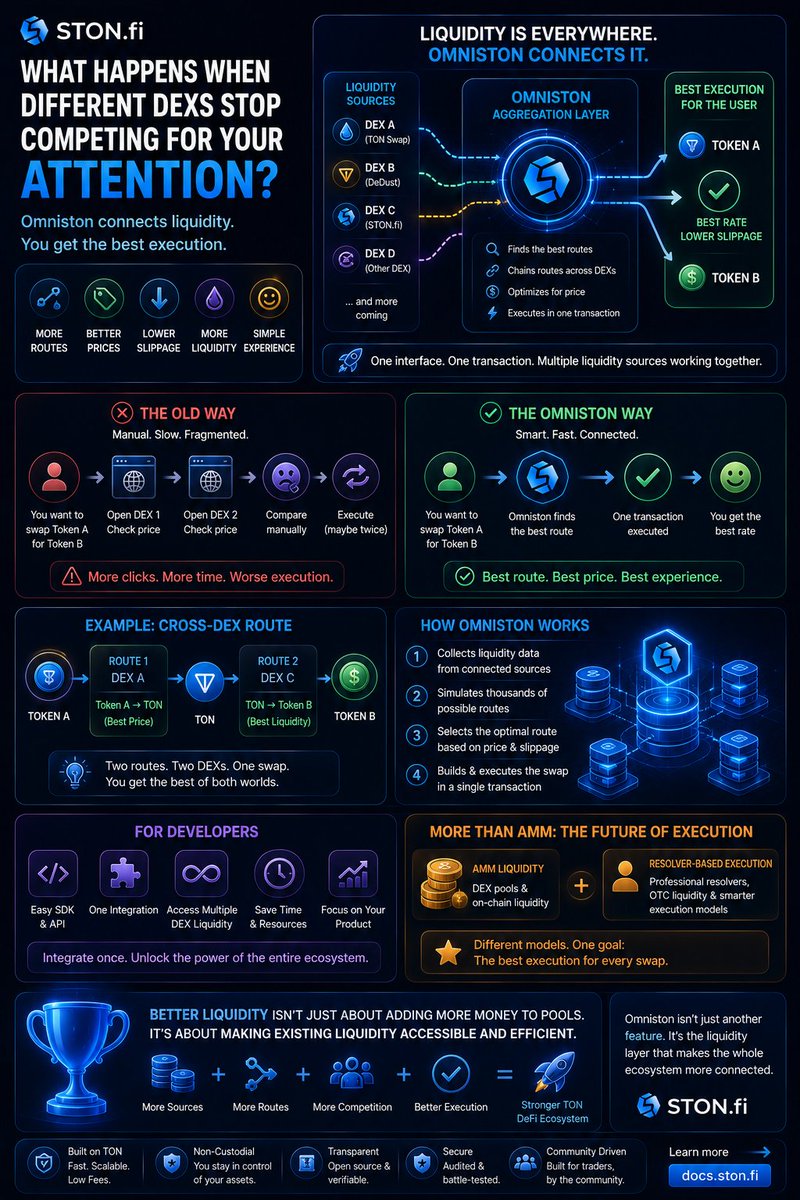
What happens when different DEXs stop competing for your attention?
One of the biggest problems in DeFi isn't necessarily a lack of liquidity.
Sometimes, the problem is where that liquidity is located.
Imagine you want to swap Token A for Token B.
The best route might exist on one DEX.
Another part of the route might have better liquidity somewhere else.
Traditionally, you had two choices:
Accept the available rate
or
Open another DEX and compare manually.
That's where https://t.co/sbrXgSAsCY's Omniston becomes interesting.
Omniston is designed to aggregate liquidity from multiple sources across TON and find competitive execution routes. It can even chain routes across different DEXs in a single transaction.
Think of it like this:
DEX A
↓
DEX B
↓
DEX C
Instead of forcing your trade to stay inside one liquidity venue, the routing layer can look across connected sources and determine which route makes the most sense.
For example:
Token A → TON
could use one liquidity source,
while:
TON → Token B
could use another.
The user doesn't have to manually execute two separate swaps.
One interface.
One transaction.
Multiple liquidity sources working underneath.
And this matters because liquidity becomes more useful when it is accessible.
A pool sitting on one DEX doesn't help a trader who can't efficiently reach it.
Aggregation changes that dynamic.
More connected liquidity can mean:
🔹 More possible routes
🔹 More competitive pricing
🔹 Better access to liquidity
🔹 Potentially lower price impact
🔹 A simpler experience for users
It also changes things for developers.
Instead of integrating every DEX separately, an application can integrate with an aggregation layer and gain access to connected liquidity sources through that infrastructure.
And https://t.co/sbrXgSAsCY isn't stopping at simply comparing AMM pools.
Omniston has been evolving toward an execution layer where different liquidity models can compete — including DEX liquidity and resolver-based execution.
That creates a bigger idea:
The future of swapping may not be about choosing a DEX.
It may be about choosing the best execution, regardless of where the liquidity happens to live.
That's a subtle but important shift.
The DEX becomes the liquidity source.
The aggregator becomes the coordination layer.
And the user simply sees:
“Here is the best route available.”
This is why I think liquidity aggregation deserves more attention in DeFi.
Because better liquidity isn't only about adding more money to pools.
It's also about making existing liquidity more accessible and efficient.
And if more liquidity sources keep connecting to the same routing layer, the entire TON DeFi ecosystem can potentially become easier to navigate.
More sources.
More routes.
More competition.
Better execution.
That's the bigger idea behind Omniston.
Not just another swap feature.
A liquidity layer designed to make the whole ecosystem more connected.
@ston_fi
#STONfi #TON #DeFi #Omniston #Crypto