The man who turned $100 into $100 billion just said the Fed is lying to you.
The Federal Reserve has one sacred rule, every single year, they allow prices to rise 2%.
They have run the entire global economy on this principle since 2012 and Buffett called it a compounding disaster.
His exact words: "Once you start saying you're going to tolerate 2%, that compounds pretty dramatically over time."
Buffett made the math brutally simple.
If you are earning less than 2% on your money, you are not breaking even. You are going backwards every single day.
Most Americans with a basic savings account are earning nowhere near 2%.
The Fed calls this price stability while Buffett calls it a policy that punishes anyone responsible enough to save.
Buffet wants a 0% inflation target which means prices stay flat and money holds its value but no major central bank on earth currently operates that way.
The 2% rule was never born from science or rigorous research.
It started in New Zealand in the 1980s, spread as a convenient benchmark, and eventually became untouchable global doctrine never seriously challenged, never put to a public vote.
Meanwhile the Fed is not even holding their own floor.
US inflation is running above target right now, with projections pointing higher through the rest of 2026.
The bar they set keeps moving, and the people paying the price are the ones who saved.
Buffett has been warning about this for decades but this time he went further.
He said the banking system carries risks most people do not see, that fragility is hiding inside the financial structure, and that a currency the government permits to lose value every year is the foundation underneath all of it.
New Substack article about former Rhodesian Prime Minister Sir Garfield Todd who dedicated his life to liberalism, anti-racism and getting Mugabe into power.
Mugabe, when he took control, ordered the rape of Todd's daughter and both Father and Daughter's passports were rescinded.
Very interesting story and a warning for libtards everywhere!
Link below!
People today think the Founders could not have foreseen any of this. They think the modern welfare state, large inflows of noncitizens, and rising dependency are problems no one in 1787 could have understood.
The truth is the Founders addressed it directly. They warned that a republic collapses when responsibility and reward drift apart, when citizens carry the load and noncitizens or dependents absorb the benefits. No. they wouldn't be surprised or shocked- they would recognize it instantly as they fought tirelessly to prevent it.
James Madison warned,
“The people who pay the taxes are not the same as those who enjoy the benefits.”
Thomas Jefferson called it
“sinful and tyrannical” to force citizens to fund what they oppose.
Alexander Hamilton cautioned that
“the necessities of a nation will be found at least equal to its resources,” a warning about unchecked spending.
George Washington said immigrants would only succeed if they
“assimilate to our customs, measures, and laws.”
Benjamin Franklin asked,
“Why should we suffer strangers to sow their bad habits in the land?”
James Madison warned again that
“a dependence on government is the very definition of slavery.”
They described the dangers exactly and they saw the risk clearly.
And the numbers today match the warnings they left behind. The people most likely, with rare exceptions, to immigrate are the least likely to contribute- true then, true now, nothing changes.
Those who join this country should be contributors who add to the republic, not parasites that take more than they give.
Note these are results of a survey- true numbers are likely higher..
“Everyone thinks of changing the world, but no one thinks of changing himself. It is easier to wage a battle against distant abstractions than to fight the quiet war inside one’s own soul. Yet this is the only war that ever mattered.”
— Leo Tolstoy
Total household credit card debt is up 6% Y/Y to $1.21 trillion. While at record levels, credit card debt is only 5.3% of total disposable income. It’s still below the average of 6.3% since 2000 and under pre-pandemic levels.
PLEASE SHARE!!!
Universal Ostrich Farm is making a desperate last minute plea to US President @realDonaldTrump and his administration.
RCMP and government agents are at the gates and preparing to slaughter 400 healthy ostriches.
@RobertKennedyJr@DrOz
While government debt continues to rise, consumers have deleveraged since the financial crisis. Household debt as a share of GDP has fallen from a peak of 98% in 2008 to just 67%, the lowest this century. Overall, household balance sheets remain healthy.
Initial jobless claims fell by 33K last week to 231K, below expectations of 241K. The prior week’s spike to 264K initial claims was likely due to Labor Day week seasonal distortions. Continuing jobless claims dropped to a 15-week low of 1.92 million.
Average hourly earnings grew 3.7% Y/Y in August, the 2nd weakest gain this cycle. Over the last 3 months, wages are up 3.4% annualized, easing towards the pre-pandemic average of 3.2%. Slowing wage growth may help keep a lid on inflation.
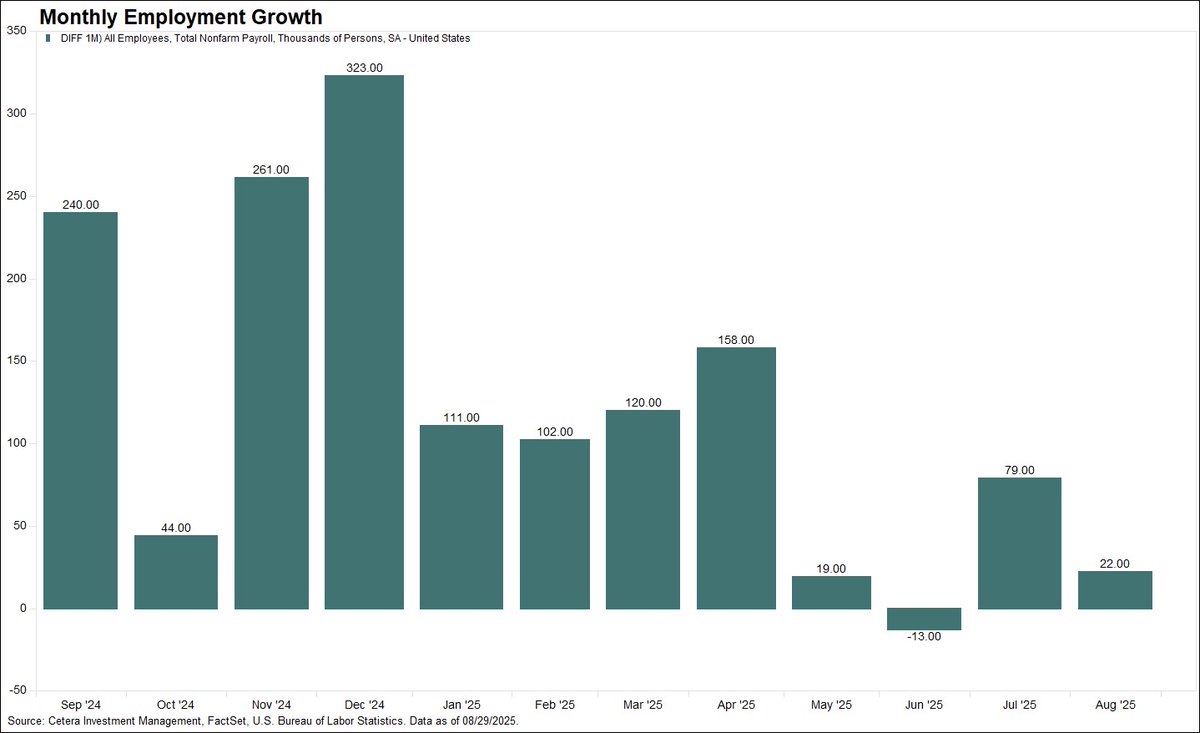
Nonfarm payrolls rose just 22K in August, well below the +77K forecast. Revisions shaved 21K off the prior two months, and the unemployment rate climbed to 4.3% (highest since 2021). A 50bps Fed rate cut may be on the table to support the labor market.
The ISM Services Index increased to a 6-month high of 52.0 in August, driven by a sharp rise in new orders. While the prices paid index remains elevated, it edged lower from July. Meanwhile, the employment index contracted for the 3rd straight month.
Labor demand continues to cool. Job openings fell to a cycle low of 7.18 million in July. There are now fewer job openings than unemployed job seekers for the first time since the pandemic.
The S&P 500 has surged over 30% since its April 8 low, but signs of consolidation are emerging. The large-cap index is only 0.5% above its 50-day moving average, and 5 of 11 sectors are trading below their 50-day moving average.
Initial jobless claims fell by 5K last week to 229K, slightly higher than the 228K forecast. Continuing claims declined by 7K to 1.954 million but remain roughly 5% higher than a year ago. Overall, the data continues to indicate a low level of layoffs.
The S&P 500 has a total return of 30.4% since the April 8 near-bear market low. Tech leads all sectors with a 51% gain, followed by Communication Services (+37.1%) and Consumer Discretionary (+33.5%). Health Care lags with just a 3.5% return.
New home sales edged 0.6% lower in July to 652K (annualized), continuing a subdued trend. The inventory of completed homes for sale is near its highest since 2009. Lower mortgage rates may be key to reigniting the housing market.
The US Economic Surprise Index reached its highest level since early February. As expectations have been revised lower in recent months, real economic data has surprised to the upside, supporting positive momentum in equity markets.