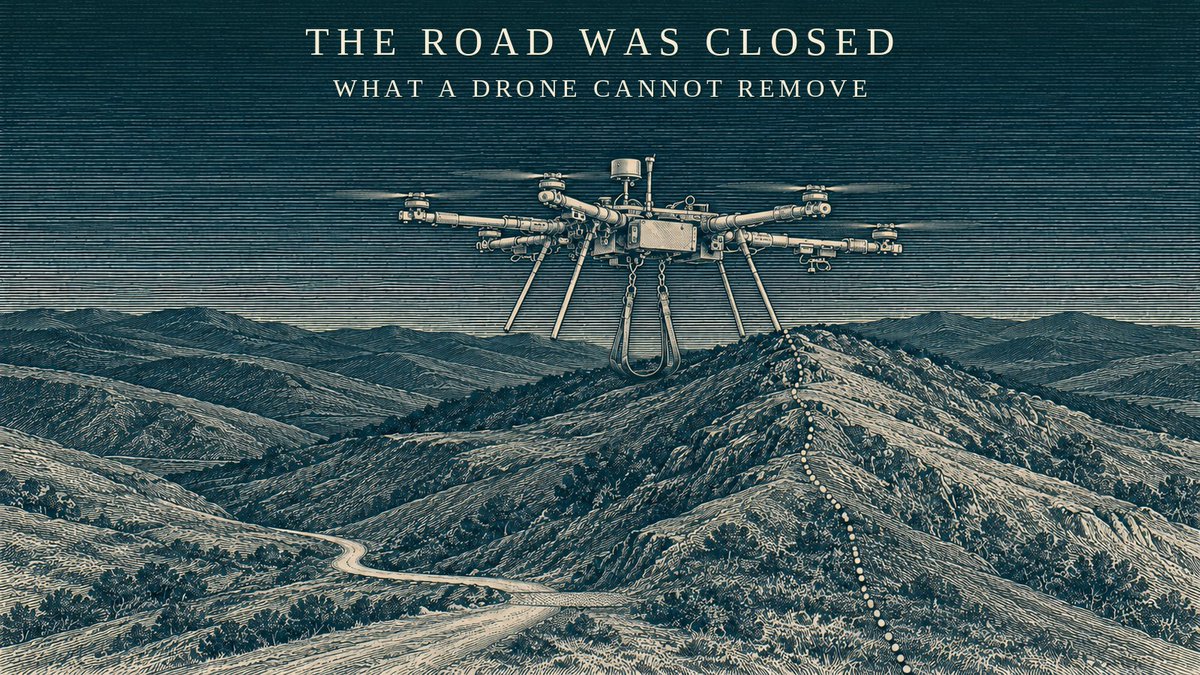
On the nights of 16 and 17 November, Ukraine struck the bridge across the Kerch Strait twice, and on the second night the arch that carried the road, with the span beneath it, fell into the water. We do not have to rely on Kyiv for that. Geolocated images show the gap, Russian officials confirmed the strike and halted traffic, a video filmed from a passing train takes almost half a minute to cross the empty place where the roadway was, and after the first night the Kremlin called the damage minor and after the second said the bridge would be rebuilt. What we do not know is which weapon did it. Ukraine's president named eleven systems across a seven-stage operation, the Dutch maker Destinus says seven of its RUTA cruise missiles struck, and a Ukrainian firm says its Flamingo did. Those are claims, and they overlap, and no one yet says which one brought the span down.
I want to ask what the fall of a bridge tells us about the war, and then I want to ask the larger question that sits behind it, which is whether the end of this war in Ukraine's favor is still the remote thing it was a year ago. After that I will bring in the first seal of Revelation, because I have held for some time that the pattern I follow in this series stands there, and this week gives us something new to say about it.
If you are new to the series: I keep a research file I call the Kyiv Wildcard, which makes no prediction and names no person, and which watches whether the war shows a pattern that Scripture describes. In the earlier essays I used George Friedman's habit of asking what the balancing hand of a great power is doing, and I read the United States as the sea power Daniel calls Kittim. Those are my readings, and I say so each time.
What the bridge actually shows
The bridge did not fall to one clever weapon. The Institute for the Study of War, whose assessment of 17 November I have read, describes weeks of work in which Ukraine struck the radars, air-defense launchers and jammers around the strait, then sent a mass of cheap drones to exhaust what remained, and then sent cruise missiles through the corridor those drones had opened. The final missiles were steered by an operator to the last moment, over radio relayed by other drones and, according to a Ukrainian officer quoted in the press, without the satellite network the Ukrainians had once depended on. The Russian Ministry of Defense says it shot down 4,305 drones and 16 Flamingo missiles in two days, which I read as an admission of how large the effort was and not as a measure of how well it was stopped.
That is the point I would press. A weapon is not what changed; a method was assembled: find the defense, wear it down, overwhelm it cheaply, and then land the expensive thing where the structure is weakest. The same assessment says Ukraine struck the highway to Crimea the same night. Ukraine had learned that the neck is the target.
What a geopolitician would see
George Friedman does not write about this war's weapons, and I will not put words in his mouth; none of his four books in my library mentions the Kerch bridge or a Ukrainian missile. What he does give is a way of reading range. In The Next 100 Years he argues that the United States will give up "the costly and ineffective strategy of sending heavily armed troops in petroleum-burning vehicles thousands of miles away" and rely instead on precision strike, so that "a hypersonic missile based in Hawaii could hit a ship off the coast of Japan or a tank in Manchuria in half an hour." He was speaking of American power in the second half of this century, not of Ukraine. But the logic travels: when reach is cheap and exact, ground held across a narrow place becomes a hostage to whatever can be thrown at the narrow place.
Crimea is that kind of ground. It is a peninsula joined to Russia by one bridge and, on the Ukrainian side, by three firm strips through the marshes of the Syvash. A Kyiv-based analyst told Al Jazeera that "logistically speaking, Crimea is turning into an island." That is overstated while a rail track runs, ferries sail and a highway crosses the land route; ISW says the Russian military must now lean harder on the highways, and that is the very road Ukraine struck the same night. I would say the island is not yet made but is being made, and that is the more serious sentence.
Friedman sorts everything into what lasts forever, what lasts a long time, and what soon passes. The marsh and the strait are the first kind. The war is the second. The drone and the missile are the third, and I said as much in the essay on the closed road: the machine will be answered. So I do not claim that range will win the war. I claim that for this season it has changed which side is bargaining from the neck.
Is the war's end in Ukraine's favor still remote?
A year ago, I would have said a good ending for Kyiv was a hope, and I would not have said more. I now move it from remote to open, which is a smaller claim than it sounds: I do not say Ukraine will prevail, only that I can no longer call that ending a fantasy. Three things carry the move. The first is Crimea: if the neck stays cut, the peninsula's garrison has to be fed by a longer and more exposed road. The second is Russia's own economy: the Guardian reported in September that Ukrainian strikes had knocked out a significant part of Russia's oil-refining capacity, with shortages and queues across the country. The third is that the means are no longer Ukraine's alone, since a Dutch firm is building the missiles and a German one is helping it extend their range, and a Ukrainian army that is battle-hardened and tied to European industry is exactly the thing I wrote could become Europe's center of gravity.
The honest counter-reading
It must be given at full strength, and it has parts. The first is that range cuts both ways. On the same days Russia fired ballistic missiles and drones at the bridges of Kyiv and Zaporizhzhia, and ISW calls it a campaign to wear down Ukraine's economy and its cities before winter; Russian drones have also crossed into Moldova's sky, over its capital. If one side holds the other's roads at risk, we have a war of mutual reach and not a Ukrainian advantage.
The second comes from Washington. On 17 November a senior American defence official said Ukraine's deep strikes "have not been effective in driving an end to the war, nor do they contribute to blunting Russia's advances on the front line," and that those on civilian targets "have actually probably hardened the Russian public's resolve." Germany's defence minister called that "quite a stupid thing," and Britain's said the strikes had helped "degrade Putin's war machine, buying time and saving lives." The American official speaks for a party with its own interests, and I have not tested his claim about the front. But he may be right about the front, and the front is where wars have been decided. The third is that the Kremlin says it will rebuild, and a bridge is repairable in a way that a lost will is not. The fourth is that every range, every missile count and every production figure I have cited from the manufacturer is the manufacturer's.
These do not cancel the move. They fix its size: open, not favorable.
Where the test falls
If this reading is right, three things should become visible over months and not weeks. Crimea's supply should show strain on the roads, with Ukraine continuing to strike the highways and the remaining rail line. The front should begin to slow, or at least Russia's advance should cost more; if the front does not change while the bridge stays down, the American official was right and my move is too large. And Washington should press harder on Ukraine's deep strikes, as it already has on the refineries, because on the balancing reading a Ukraine that grows stronger is a Ukraine whose reach a balancer wishes to cap. If instead Washington supplies longer-range weapons, that reading weakens, and I will say so.
The first horseman
I now come to the part of this essay that is a reading and not an observation, and I would ask you to keep the two apart as I do.
Now I watched when the Lamb opened one of the seven seals, and I heard one of the four living creatures say with a voice like thunder, “Come!” And I looked, and behold, a white horse! And its rider had a bow, and a crown was given to him, and he came out conquering, and to conquer. (Revelation 6:1-2, ESV)
I read the white horse as a righteous war, which I take to be a defensive war, and the bow as the weapon that reaches the enemy without closing with him. That is a long-range weapon, and I think it is not hard to see that the war is now being waged that way, through drones and missiles that cross the distance a soldier cannot. If so, the first horseman is not coming. He is already riding.
Two horses in this book are white, and I keep their riders apart. The second appears near the end:
Then I saw heaven opened, and behold, a white horse! The one sitting on it is called Faithful and True, and in righteousness he judges and makes war. (Revelation 19:11, ESV)
That rider is the Lord Jesus Christ, and the first is not he. The horse is the same color, and I take the color to mean that war can be righteous, but the riders differ in every other thing the text gives us. The first has a bow, and a crown that "was given to him"; the second has on his head many diadems and from his mouth a sharp sword, and no one gives him his right to judge, because it is his own. So I read the first rider as a righteous war carried by men, whose crown is lent and whose bow is a man's weapon, and the second as the Judge whose war is the last one. White ties them without making them one. That also means the first rider's war can be righteous in its cause without being the Lord's own war, and I think that distinction guards us from calling any army holy.
I should say plainly where the reading strains. The verse says the first rider goes out "conquering, and to conquer," which sounds like an advance and not a defense, and the word "defensive" is nowhere in it. Many readers hold the first rider to be Christ, or hold him a counterfeit because the next three horsemen are judgments; I hold him to be neither, and I know that is a minority reading and that I cannot prove it from the verse. The crown "was given" to him, from above, which I take to say that whatever is permitted him is permitted by God and not seized. And the bow is in more than one hand: if it is range that marks the first rider, Russia's ballistic missiles and Geran drones carry it too. I hold the reading as mine, from the logic of the picture and from the premise this series started with.
Two more things I will say, and they are the ones that matter. The first is the order. The great sword belongs to the second rider, who is permitted to take peace from the earth, and the other two follow him. Revelation gives an order, not a calendar, and I do not treat the fall of a bridge as a countdown to anything; a good week for Ukraine is not the end of the sequence, and I would not call it that. The second is the warning inside the picture of the bow itself, which is the old one:
For not in my bow do I trust, nor can my sword save me. (Psalm 44:6, ESV)
The psalmist was a king's people at war, who had a bow and would not trust it. If the first horseman is riding, and the bow is long-range war, then the believer's hope is not in the bow, and not in the capital that supplies it, and not in the side we prefer.
What I hold
A bridge between Russia and Crimea has fallen, and we know that from sources that do not depend on the maker's word. It was done by a method and not a single weapon: the wearing down of air defenses, the mass of cheap drones, and the expensive missiles steered to the last moment. I move the end of this war in Ukraine's favor from remote to open, held to three tests that can fail, with the front as the one that matters most. And I read the first seal as the war of reach, with the stated seams, as a reading and not a fact.
We are to be sober and awake, to be glad that a people under attack can defend themselves, and to put our trust where the psalmist put his, and may God give us the discernment to tell a strategy from a coincidence and a defender from a prince, and to the Lamb who opens every seal be all glory.
https://t.co/0pM7rKHZpZ
The Kerch bridge span fell to a method, not a single weapon: air defence worn down for weeks, cheap drones to exhaust what was left, then missiles steered to the end. The war is now a contest of reach. The first horseman carries a bow. Is he already riding?
🇪🇺🇺🇦🔥 POUTINE FACE À UNE NOUVELLE RÉALITÉ : LA COOPÉRATION MILITAIRE EUROPÉENNE AVEC L’UKRAINE PORTE SES FRUITS
18 novembre 2026
⚠️les missiles européens RUTA démontrent leur efficacité
Voilà une nouvelle qui mérite d'être soulignée : la coopération entre l'Europe et l'Ukraine produit des résultats militaires concrets !
L'entreprise européenne Destinus affirme que sept de ses missiles de croisière RUTA, fabriqués aux Pays-Bas, ont frappé le pont de Crimée lors de l'opération ukrainienne du 17 novembre.
Le fabricant revendique également l'utilisation de ses drones LORD et Da Vinci contre les défenses aériennes russes.
Ces informations, communiquées directement par Destinus, illustrent la place prise par les technologies européennes dans les capacités militaires ukrainiennes.
⚠️quand le savoir-faire européen rencontre l'expérience ukrainienne
Cette opération met en lumière une coopération essentielle : l'industrie européenne fournit des technologies, tandis que les forces ukrainiennes apportent leur expérience du combat et leur capacité d'adaptation.
Le président Volodymyr Zelensky a évoqué une opération complexe mobilisant onze systèmes d'armes différents, parmi lesquels les missiles RUTA, Neptune et Flamingo.
Ce mélange de technologies ukrainiennes et européennes montre comment les partenariats industriels peuvent renforcer les capacités de défense de Kyiv.
⚠️Poutine a sous-estimé la capacité d'adaptation de l'Europe
Depuis le début de son invasion, Vladimir Poutine cherche à imposer sa supériorité militaire à l'Ukraine.
Mais cette guerre a également accéléré le développement de nouvelles armes, stimulé les entreprises européennes de défense et renforcé les coopérations technologiques avec Kyiv.
L'Ukraine ne se contente plus de recevoir des équipements : elle participe à une véritable transformation des capacités militaires européennes.
Et c'est précisément ce changement qui représente un défi stratégique pour Moscou.
⚠️une coopération qui doit s'inscrire dans la durée
L'exemple des missiles RUTA démontre l'intérêt d'associer les capacités industrielles européennes aux besoins opérationnels ukrainiens.
Produire, développer, adapter et livrer des systèmes modernes : ce sont les conditions nécessaires pour soutenir durablement la défense ukrainienne.
Mais cette coopération ne concerne pas uniquement Kyiv. Les enseignements tirés de cette guerre peuvent également contribuer à renforcer la défense des pays européens face aux menaces futures.
La leçon de cette opération est claire : les partenariats militaires européens avec l'Ukraine ne se limitent plus aux déclarations diplomatiques. Ils se traduisent désormais par des capacités opérationnelles concrètes.
🇪🇺🇺🇦 L'Europe apporte ses technologies, l'Ukraine son expérience du terrain. Ensemble, elles développent les moyens de résister à l'agression russe.
https://t.co/vDcz4vs8A8
"Now I watched when the Lamb opened one of the seven seals, and I heard one of the four living creatures say with a voice like thunder, 'Come!' And I looked, and behold, a white horse! And its rider had a bow, and a crown was given to him, and he came out conquering, and to conquer." (Revelation 6:1-2, ESV)
"Then I saw heaven opened, and behold, a white horse! The one sitting on it is called Faithful and True, and in righteousness he judges and makes war." (Revelation 19:11, ESV)
A drone flew more than 15 km at night to carry a wounded soldier out, and the 2 km to the border stayed exactly 2 km. Technology doesn't abolish geography. It re-prices it, one distance at a time, for whoever holds the machine.
On 2 November a Ukrainian account reported that a drone had lifted a wounded soldier out of a position two kilometers from the Russian border, where he had lain for fifty-seven days since a mine took him down. The ground route could not be used, the post says, because of difficult terrain, minefields and the constant fire of Russian drones, and so the unit sent a drone of its own, more than fifteen kilometers one way, at night, and the video shows the flight in the machine's night-vision imagery. It was the unit's third such rescue in a week and a half, after two that the Associated Press and others had reported a week earlier, and all three came after the very first drone evacuation of this kind, which another unit reported on 19 October, lifting a man from a position on the left bank of the Oskil River in the Kupiansk sector. That makes four men in all, by the reports I can find, two of them within a single week, and the latest is the one in this story. I take it as established, and I want to use it, because it shows in one small picture something that a great many people are confused about.
The confusion is the idea that technology has flattened the world. Another writer named Friedman, Thomas and not George, made the phrase famous: distance shrinks, borders matter less, and whoever has the right machine can reach anyone anywhere. A drone crossing ground that no vehicle could cross looks like the proof, and yet when we read the story slowly, nearly every line of it argues the other way.
If you are new to this series
For some time I have kept a research file called the Kyiv Wildcard, which asks one narrow question, whether the war in Ukraine shows a pattern the Bible describes, and which makes no prediction and names no person. Alongside it I have been reading George Friedman, the geopolitical analyst, who argues that nations are shaped by the places they occupy, and that the United States, as a sea power, keeps any one power from commanding Eurasia. My last essay asked how free a leader is inside that map, and this one asks the same of the machine: what does a new technology change about the map, and what does it leave exactly where it was?
What did not move
Begin with what stayed where it was. He lay two kilometers from a border, and those two kilometers are the most exact fact in the story, since no machine shortened them. The road was shut by three things, difficult terrain, which is geography, and mines and drones, which are technology, so that the same inventions that opened the sky also closed the ground. He spent fifty-seven days there with the road shut the whole time, and the machine that could reach him had been in use for little more than a week, and the very first such rescue was barely two weeks old, which tells us that distance had not been abolished and that one kind of it had only just become crossable.
Even the sky was not free. In the unit's own account of its first two rescues, Russian forces tried to jam the drone's satellite navigation, and it flew on by its own navigation and its pilots' skill, while the commander said that the aim now is to make such missions standard practice; so the air is contested ground too, and a technology that becomes procedure is becoming a habit of a place. This third flight was made at night, and a sensor turned the dark into an image a pilot could fly by, which means that technology re-priced two obstacles at once, the ground and the night. I count that against my own argument, because it is a good deal of work for one machine.
But look at what it bought. It bought a choice of altitude: fifteen kilometers of ground that nobody could cross became a route that could be flown, while the two kilometers to the border stayed two kilometers. Technology removed one distance, along one axis, for whoever held the machine, and left every other distance in the world where it was. That is not a flat world; it is a selective one, and an expensive one, since it is one man and one flight and a price paid for each trip.
What Friedman's three tiers do with it
George Friedman holds that geopolitics is the work of sorting what lasts forever from what lasts a long time and what soon passes, and the story sorts cleanly. The borderland between the West and Russia, which he names in his book on Europe's flashpoints and which holds Ukraine and Belarus inside it, belongs, in my sorting, to the eternal tier, for he writes that the political line sweeps west and east while the borderland stays. The war is long. The unit, the mission and the drone are transitory, and the drone is probably the fastest-changing thing in the whole story, a machine that will be superseded.
Here is what I find striking. The most transitory thing in the story served the most lasting obligation in it, which is to bring a man back to his own side of a line, so that the fastest thing was sent after the slowest. Friedman argues that where a person or a nation sits shapes how he lives, what he is able to do, and where he can be hurt. A man lying wounded near a frontier is a vulnerability that place imposed, and the machine answered a constraint that it neither created nor removed.
The call signs
One more detail, which I offer as a detail and not as an argument. The post gives this soldier's call sign, and it is Donbas, the name of the region the war is being fought over; one of the two men the unit carried out the week before went by Izium, the name of a Ukrainian town. I do not know that either comes from the place he is named for, since call signs are chosen for all kinds of reasons. But the picture is hard to miss: a machine that has no place at all was sent to bring back men whose names are places. Friedman holds that a people cannot be taken from its place without becoming something else, and a drone can lift a man off the ground without being able to give him another country.
The honest counter-reading
The strongest objection deserves its full weight. A drone that flies over fifteen kilometers that no vehicle could cross has not merely re-priced distance; for that route, at that altitude, it has abolished it, and calling it something softer understates what happened. That is right, and the argument has to yield it: technology does abolish particular distances, completely, for whoever owns the machine. What it does not do is abolish distance as such, or do so evenly, or in a way the terrain must honor everywhere else, and the narrower claim is still a rebuke to anyone who says the map no longer matters.
There is also a limit on what one rescue can prove. The rescue is the picture, and the argument lies in Friedman's sorting of the eternal from the transitory, which would hold if the details were different. And I will say one more thing against myself. The sea power I have been writing about for five essays has always depended on one fact of distance, that an ocean protects, and if machines like this one can cross more kinds of ground each year, we are entitled to ask whether the oceans protect as well as they did. I have no answer, and I mark it as a question.
What Scripture says about reaching, and about the one
The Bible does not treat distance as the enemy, and it does not treat it as an illusion either; it says who set the lines.
And he made from one man every nation of mankind to live on all the face of the earth, having determined allotted periods and the boundaries of their dwelling place. (Acts 17:26, ESV)
The boundaries are determined, which is to say given. Machines will change how we cross them, and they will not undo the fact that there are nations and borders, set in place by Someone who is not surprised by any invention. At the same time Scripture says that no distance is final from God's side.
If I take the wings of the morning and dwell in the uttermost parts of the sea, even there your hand shall lead me, and your right hand shall hold me. (Psalm 139:9–10, ESV)
The psalm goes on to the dark itself.
If I say, "Surely the darkness shall cover me, and the light about me be night," even the darkness is not dark to you; the night is bright as the day, for darkness is as light with you. (Psalm 139:11–12, ESV)
I do not read these verses as being about drones, and I would be careless to say they are. They say that there is no place a person can be taken, and no night he can be left in, where he is out of reach of God, which is a larger claim than any machine can make about reach. The drone needed a sensor to make the night readable before it could find a man where the road could not, and the psalm says that he was never unfindable to begin with.
And there is the matter of the one.
"What man of you, having a hundred sheep, if he has lost one of them, does not leave the ninety-nine in the open country, and go after the one that is lost, until he finds it? And when he has found it, he lays it on his shoulders, rejoicing." (Luke 15:4–5, ESV)
Whatever else the war is, a unit that sends a machine more than fifteen kilometers out for one wounded man has decided that one man is worth the cost of a trip, and that echoes the shepherd who leaves the many for the one. The parable is about God's seeking of sinners, and I do not make the rescue an instance of it; I say only that the instinct is not a machine's, and that technology put itself at the service of something older than itself.
What I hold
Technology re-prices geography and does not repeal it. It abolishes some distances absolutely, for whoever holds the machine, and it leaves the border, the terrain and the wait exactly where they were. The fastest thing in the story served the slowest, and the same sky that carried the rescue also helped close the road. I hold the rescue as established and the argument as Friedman's, and I will not let one rescue carry more than it can.
The call on us is the one I have given at the end of every essay in this series: to look at what is actually there, to be glad when a man is brought home, and to put our hope neither in the map nor in the machine; and may God give us eyes for the line that is real, patience for the road that is closed, and gratitude for the sky that was open, and to the Lamb who conquers be all glory.
CODE 9.2 has carried out its third successful aerial evacuation by drone.
This time, the CASEVAC StarGate drone flew more than 15 km one way to rescue Ukrainian Defender Andrii, call sign "Donbas," just 2 km from the Russian border.
Ground evacuation was impossible due to difficult terrain, minefields, and constant Russian FPV drone attacks.
Andrii spent 57 days at his position after being wounded by a mine explosion. He is now receiving medical treatment.
In just a week and a half, this technology has helped save the lives of three severely wounded Ukrainian Defenders.
"And he made from one man every nation of mankind to live on all the face of the earth, having determined allotted periods and the boundaries of their dwelling place." (Acts 17:26, ESV) "If I take the wings of the morning and dwell in the uttermost parts of the sea, even there your hand shall lead me." (Psalm 139:9-10, ESV) Scripture quotations are from the ESV(R) Bible (The Holy Bible, English Standard Version(R)), (c) 2001 by Crossway, a publishing ministry of Good News Publishers. ESV Text Edition: 2025.
We make a mistake whenever we look at a president and imagine that the office has made him free. We see the chair, the motorcade and the pen that signs an order, and we say that he can do whatever he wants; and when he does something we dislike, we decide that he wanted it, and when he does something we cannot explain, we decide that he is hiding a plan. I want to ask whether the man who sits is as free as we assume, because the answer changes how we read nearly everything a state does.
If you are new to this series, here is the ground we are standing on. For some time I have kept a research file called the Kyiv Wildcard, which asks one narrow question, whether the war in Ukraine shows a pattern the Bible describes, and which makes no prediction and names no person. Alongside it I have been reading the geopolitical analyst George Friedman, who argues that the United States, as a sea power, does not try to rule Eurasia but keeps any one power from commanding it. Both lines of reading depend on one question that we have not yet asked directly: how much of what a leader does is his own choice, and how much is the chair?
What Friedman says about the chair
Friedman begins from the observation that nations behave like players at chess. On the surface a player has twenty opening moves; in fact most of them lose quickly, and the better the player, the fewer real options he sees, so the grandmaster is the most predictable man at the board until the one brilliant stroke. A nation is constrained in the same way, by its geography, its neighbors, its resources and its fears, and the people it raises to the top are not fools, since fools seldom climb through millions of rivals. They understand their menu of next moves and mostly execute the logical one. If a leader dies and another takes his place, the new man more likely than not continues what the old one was doing.
From this Friedman draws a hard conclusion, which he states in one line: politicians are rarely free actors. The most brilliant leader of Iceland will never make it a world power, and the stupidest leader of Rome at its height could not undo Rome's strength. Their mistakes, examined closely, are seldom stupid; they are more often forced on them by circumstance. He makes the same point at the end of the book, in a sentence I find hard to forget: what is most interesting about humans is how unfree they are.
The honest counter-reading
Friedman himself puts the counter-reading in the same breath, and we should give it full weight. Within narrow margins, he says, political decisions can matter, and an occasional master makes a stunning move that nobody expected. Character, ideology, incompetence and conscience change history at the edges, and those edges can be wide enough to hold a war or a peace. Geopolitics does not absolve a ruler of responsibility, and it does not explain every decision. It explains why powerful states keep returning to choices that look irrational when we read only the speeches. What we are looking at is pressure, not secret intention, and structure, not conspiracy.
What this does to the way we read Washington
That distinction is the one I have needed for every earlier essay in this series. I do not have to say that every American official shares one hidden plan, or that each act was designed in advance. I need only say that the United States has an enduring problem: no rival coalition in Eurasia may become strong enough to threaten the sea power that protects its homeland. Each person who sits in the office inherits that problem. They may describe it differently, handle it badly or dress it in new language, but they cannot make the geography go away.
So the better question is not what this president wants, but what the position permits him to want for long. When different men in different years repeat the same policy toward the same borderland, we are not watching a plot; we are watching a chair. And when a policy does not repeat, when a new occupant breaks the pattern, that is the sign that choice has room to work, and it is worth saying so as plainly as the other.
What Scripture says about the chair
Scripture goes further than Friedman, and in a different direction. The king is never sovereign merely because he is visible.
The king's heart is a stream of water in the hand of the LORD; he turns it wherever he will. (Proverbs 21:1, ESV)
...the Most High rules the kingdom of men and gives it to whom he will and sets over it the lowliest of men. (Daniel 4:17, ESV)
Paul says it of whole nations, and in terms that sound almost like geography:
And he made from one man every nation of mankind to live on all the face of the earth, having determined allotted periods and the boundaries of their dwelling place. (Acts 17:26, ESV)
Here the resemblance has to be held with care. Friedman describes material constraint, and Scripture declares divine sovereignty and human accountability, which are not the same thing. The first helps us see why a ruler cannot simply step outside his position; the second tells us who set the position, and who sits the ruler and the map together. Daniel is also plain that Nebuchadnezzar answered for his pride, which means that being held does not make a man innocent.
What we do with this
The warning is for us. We should not worship the man in the chair, and we should not excuse him because the chair is heavy. A president may be hemmed in by the map and still answer for injustice, and a nation may inherit a balance it did not choose and still be responsible for whether it calls evil good. The map narrows a ruler's path; it does not make the path he walks righteous. It also tells us something of comfort: if the chair, and not the character, drives so much of what happens, then we should not put our hope in the next man who sits in it.
The man who sits is not free to do whatever he wants. Neither is he a puppet, and neither are we. He is a responsible creature moving inside a world he did not make, under a God he cannot evade; and may that God give us eyes to see the pressure of the map, courage to name the sin of the ruler, and humility to remember that the last balance is held not by Washington, Moscow or any chair of men, but by the King whose kingdom cannot be shaken. To the Lamb who conquers be all glory.
Thanks for this, and I agree. A decisive blow is easy to promise and hard to
control, and the essay says as much: even if it worked, the hardest questions
would come after the punch, not before. Overconfidence has cost many armies
dearly. Proverbs puts it well: "The horse is made ready for the day of battle,
but the victory belongs to the LORD." We hold patience and prayer alongside
whatever happens on the field.
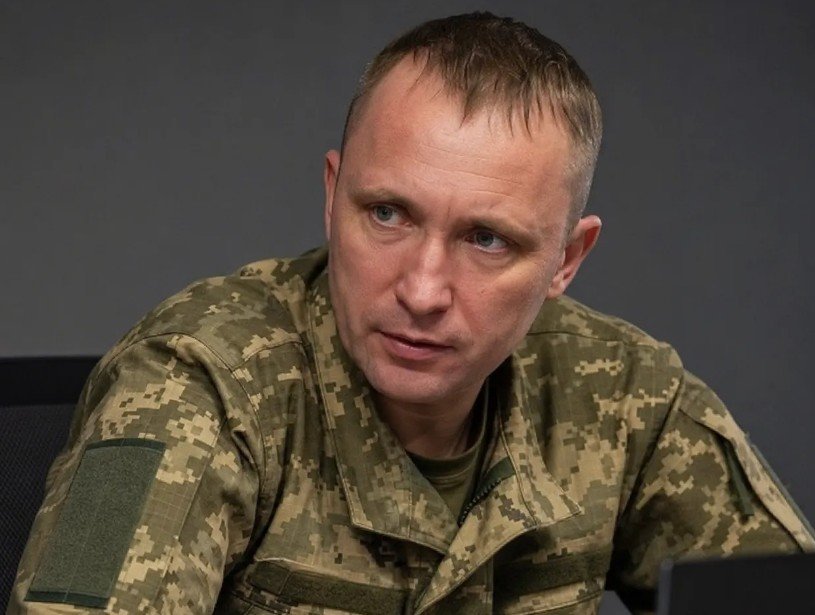
Ukraine's commander-in-chief is reported to have said that a decisive counterpunch will lead to the collapse of Russia's military and political leadership, and that there is no question of compromise. I have only the screenshot passed from one account to another, and I take it as the speech of a soldier who means to win. Collapse of that kind looks improbable to me, as it does to most who watch the war; but the question we are about to ask does not need the collapse to be likely. It needs only that we think through what happens if it comes, because a balancer has to plan for the case it fears, and we can learn from the plan what the balancer is.
First, a word on where this comes from
If you are new to this series, here is what you need. For some time I have kept a research file I call the Kyiv Wildcard. It makes no prediction and names no person. It asks one narrow question: whether the war in Ukraine shows a pattern the Bible describes, and how clearly. The pattern has two parts. The first is Isaiah's reversal of right and wrong (Isaiah 5:20), which the file sees when the country that invaded goes unnamed and the country defending itself is held to blame. The second is the first of the seven seals in Revelation 6:2, a rider on a white horse who is handed a crown and goes out conquering, which the file reads as a picture of a power that is oppressed, grows angry, and is then given authority. In earlier essays I paired this with the geopolitical analyst George Friedman, who argues that the United States, as a sea power, does not try to rule Eurasia but keeps any one power from commanding it, by dividing rivals, taking one side against another, and using force late. The two readings meet in Daniel 11:30, where "ships of Kittim" come against a king who is afraid, withdraws, and turns back. Kittim is the Hebrew name for a sea power to the west. In Daniel's day it was Rome; in ours, I take it to be the United States. Everything below rests on those premises, which are mine, and I hold them as reading and not as proof.
What the balancer fears in a victory
George Friedman's picture of American strategy rests on a sea power that does not want any one power to command the continent, and a Russia that falls apart is not the win it looks like. A broken Russia has nuclear weapons whose control no one can vouch for, a Siberia and a Central Asia that China will move to fill, and a vacuum in which the winner of the war becomes the strongest land power in Europe. That last one is the fear that matters here. A Ukraine that has thrown back the invader and kept its army, tied to Europe and equipped by Europe, is the thing I described in my earlier essay on the balance: the center of a defense bloc that Russia cannot match and America cannot control. For a balancer, the victor can be as large a problem as the vanquished.
So the plan would not be to cheer. It would be to stop the fall at the point where Russia is still a counterweight, and to stop the victor at the point where he is still a partner. We can already say what that would look like, in order of how hard the hand presses.
What the balancer would do
First, it would work through arms, money and intelligence. Support that was flowing freely would become conditional on a halt, and nothing in that needs a ship. Second, it would work through guarantees: a public American assurance to whoever holds Moscow's command that Russia's territory and its weapons are not the target, paired with an offer to Kyiv of what it can have if it stops. Third, it would work through sea power, and here we should be careful, because the sea is not open where we might expect it. Under the Montreux Convention, as I read the Turkish foreign ministry's summary, warships of states that do not border the Black Sea may stay twenty-one days, within a combined tonnage cap, with fifteen days' notice and no submarines. A Kittim fleet could appear there, but briefly and as a signal. Its real work would be done elsewhere: in the Baltic against Russia's northern ports, in the Mediterranean, in the Arctic, and in the quiet carrying of the nuclear umbrella over whoever needs reassurance.
The first of the three is how it has been done before. In August 1991, as the Soviet Union came apart, an American president went to Kyiv and warned its parliament against "suicidal nationalism." He asked Ukraine to wait and to keep the pieces together. No ship moved. Three weeks later Ukraine declared independence, and in December ninety-two percent voted for it. The balancer's first reflex at the moment of collapse was to ask the weaker neighbor to hold back, and it did not hold.
Would it look like the Kittim?
I will give my honest answer in parts. It would look like the Kittim in form. An outside power from the sea comes against a king who is advancing, and he is made afraid, halts, turns back. That is Daniel's order, and a balancer's order too.
For ships of Kittim shall come against him, and he shall be afraid and withdraw, and shall turn back and be enraged and take action against the holy covenant. (Daniel 11:30, ESV)
The best-known case of that order is the one history preserves from 168 BC, when Antiochus was marching on Egypt and a Roman envoy drew a circle around him in the sand and demanded an answer before he stepped out. There was no battle. A fleet behind an ultimatum was enough, and the king turned back. That suggests the "ships" are not mainly about fighting. They are the power that makes a word final, and that is the thing an American balancer would use at the border of a Ukrainian advance.
But I should say where the fit strains, because three seams show. The first is that Daniel's king is the one advancing, so the picture requires Ukraine to be cast as the advancer after it crosses the border, and the American hand as the one that stops it. It cannot be both that and the victim the Kyiv Wildcard follows through the first seal. If I hold the Daniel reading, I hold it for that later stage, not for this war as it stands. The second is that the verse does not stop at the turn back. The king is enraged and acts against the holy covenant, and a balancer, whatever its pressure, does not predict that part; to read Kyiv into it is to carry the verse further than the balancing argument takes it, and the tests below cannot reach it. The third is that a state under pressure does not have to turn back at all. The pressure of 1991 failed. A Kyiv that has won might keep going.
What would tell us
If Moscow's leadership did collapse, three things would show which hand we are watching. The first is the order of Washington's calls: to whoever holds Moscow's nuclear command before it speaks to Kyiv. The second is whether American support for Ukraine's advance beyond its own border is paused, conditioned, or pushed back into a negotiation, and whether Europe is told not to build its defense around a victorious Ukraine. The third is naval: warships moving to the Baltic or the Black Sea in the days after an advance crosses the line. If instead Washington recognizes whatever replaces Moscow's leadership, arms the advance, and welcomes a Ukraine tied to Europe, the balancing hand is not there, and the Kittim reading I hold has nothing to hold on to.
Where Scripture lets us rest
I offer these without any claim that they settle the strategy, because Scripture does not settle strategy. It tells us whose the outcome is, and keeps us from putting hope in the army or in the arm that holds it back.
The horse is made ready for the day of battle, but the victory belongs to the LORD. (Proverbs 21:31, ESV)
The king is not saved by his great army; a warrior is not delivered by his great strength. The war horse is a false hope for salvation, and by its great might it cannot rescue. (Psalm 33:16–17, ESV)
He changes times and seasons; he removes kings and sets up kings; he gives wisdom to the wise and knowledge to those who have understanding. (Daniel 2:21, ESV)
If a regime falls, Daniel 2 tells us who removed it, and it was not a general's counterpunch or a balancer's ledger. If a victor is stopped at a line, the Psalm tells us that his army was never his salvation either. That does not make us indifferent to the war. It makes us sober, and unwilling to give our hope to either capital.
What I hold
The quotation is reported and unconfirmed, the collapse is improbable, and I do not forecast it. I hold that if it came, a balancer would have to choose between a broken Russia and a victorious Ukraine, and that its tools would be conditions, guarantees and a fleet standing behind a word. I hold that this fits the form of Daniel 11:30 but that the verse asks more than the balance can answer, and I will not stretch either to cover the gap. May God give us the discernment to know what we are watching, the patience to let it declare itself, and to the Lamb who conquers be all glory.
- Mykhailo Drapatyi 🇺🇦:
Commander-in-Chief of the Armed Forces of Ukraine
"If we deliver a strong, decisive military counterpunch - and we are ready to do so it will lead to the collapse of Russia's military and political leadership.
We are destined for victory. There is no other outcome, and there can be no question of compromises or concessions."
.................
I truly admire their determination🙌🇺🇦
Wow🫡
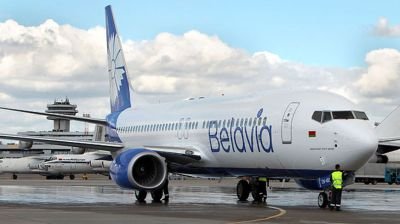
On 31 October the director general of Belavia, Belarus's national airline, told state media that the American Department of Commerce had licensed Boeing to deal with him directly. That means spare parts, components and software for the aircraft Belavia already flies, and a door open to buying new ones. He added that Treasury had issued the same permission before it, and that a year ago Washington had lifted the political sanctions on his airline. The source is Minsk's own, and Washington has not spoken; but the licence follows a path that is already on the public record, and we can see where it began.
It began in September 2025, when Belarus freed fifty-two political prisoners and an American envoy announced in Minsk that the sanctions on Belavia were lifted. In November the Bureau of Industry and Security put the terms in writing: flights, servicing and parts for nine Boeing 737s, with Russia excluded and every licence reviewed for the risk of diversion. So this week's news is the next step on a road, and the first reaction on the post, anger that the neighbor who lends Russia his ground is being rewarded, is asking about the road and not only the step. I do not call that anger foolish. But anger is not an explanation, and the question I asked in the two earlier essays is the one to ask again: what is the hand doing, and in which direction?
What a balancer would want
George Friedman's picture of American strategy rests on two fears, a Eurasia that moves as one bloc and a Russia pushed so hard that it has nowhere to go but China, and both point to the same kind of place, the borderland. Belarus is the plainest case, since it sits between Poland and Russia, is bound to Moscow by treaty, trade and troops, and flies the one national airline in the region that was cut off from Western parts.
For a sea power that wants to choose its wars, a reward at that border makes sense without any love for Minsk. An airline that needs Boeing's parts depends on Boeing's government, and that small hook is how a balancer works: it does not conquer the neighbor but gives him a reason to look in two directions. Set beside the other items of this autumn, the line runs the same way each time. Kyiv was told to hold back its strikes on Russian diesel, and then Russian diesel was brought to market; the Baltic states were reportedly asked to speak more softly; and now the state that serves as Russia's staging ground is offered aircraft parts. The ones who resist are pressed and the ones who stand beside the aggressor are eased, and I say only that the pattern points one way, not that it proves intent.
The honest counter-reading
It must be given at full strength, and it has more than one form. The first is aviation safety: parts and software keep passengers off failing airframes, and sanctions on flight safety have drawn criticism even from those who favor sanctions. The second is a bargain already made, because the release of fifty-two prisoners bought the first licence and this may be the same bargain continuing, which concerns Belarus's prisoners and not Russia. The third is commerce, since Boeing sells aircraft and its government sometimes lets it.
There is also a fourth, and it is the strongest from the other side: Belavia's parts may leak to Russia, whose airlines still fly hundreds of American aircraft under sanctions, and analysts warned of exactly that when the first licence was issued. If so, the reward does not loosen Minsk from Moscow; it feeds Moscow through Minsk. Any of these could be the whole truth, and the balancing reading does not need them to be false. It needs only that they do not explain why this licence arrives in this month, beside the diesel arrangement and the request to the Baltic states.
Where the test falls
I do not file this as a hit on the things I set out to watch, which concern Ukraine's army, European guarantees, sanctions relief for Russia itself, and a divided Western line; a licence for Belarus stands next to them and not on them. What I add is one new thing to watch, and it can fail. If Washington is working to loosen Minsk from Moscow, the reward should be followed by a visible change on the Belarusian side, with fewer Russian forces and weapons on its soil, a cooler line toward the Union State, and flights and trade turned westward.
We already have a year of evidence, and it does not favor the hope. Since the reward of September 2025, Moscow and Minsk have announced that the nuclear-capable Oreshnik missile is on combat duty in Belarus, in December 2025, though outside observers have not confirmed the launcher itself. The year-old reward has bought no visible distance. That weakens the reading that this is a strategy to peel Minsk away, and it leaves two others: a transaction for prisoners, or a balance that is aimed elsewhere and uses Belarus only as a small piece. I will hold the question open for months and not weeks, and move no odds this week except downward on the "loosening" form.
What Scripture says about trusting the wrong help
Scripture gives us no rule for aircraft licences, but it speaks plainly about where a people places its confidence when power moves around it.
Woe to those who go down to Egypt for help and rely on horses, who trust in chariots because they are many and in horsemen because they are very strong, but do not look to the Holy One of Israel or consult the LORD! (Isaiah 31:1, ESV)
Judah was tempted to buy security from the strongest neighbor, and the prophet's charge was not that horses are evil but that they were trusted in place of the Lord. That cuts every way here: Minsk trusts Moscow's shield and now perhaps Washington's parts, Kyiv has been tempted to rest everything on a patron, and we who read the news are tempted to rest our hope on whichever capital we prefer.
Put not your trust in princes, in a son of man, in whom there is no salvation. (Psalm 146:3, ESV)
This keeps us from the opposite mistake as well. Some of the replies called the licence treachery, and they may be right about the strategy, but a believer's grief over a policy must not become hope in a different policy. If Washington's balancing is real, it is an instrument for American ends, as every empire's has been, and the nations caught in it are not saved by it.
Whoever digs a pit will fall into it, and a stone will come back on him who starts it rolling. (Proverbs 26:27, ESV)
I offer this one carefully, as an accusation against no one. It describes what often happens to a clever hand that plays one side against another, and balancing is a long game of stones, in which Scripture does not promise the balancer that he decides where they fall.
The Kittim, once more
If the United States is the Kittim of Daniel 11:30, the verse describes a sea power whose arrival turns a king back, so that he is afraid, withdraws, is enraged, and then acts against the holy covenant. Nothing in this essay changes what I held before; it adds that this power works through ships, through speech, and, as the week shows, through licences and parts. I do not claim the licence belongs to Daniel's picture. I claim that managing the neighbors of the aggressor is the kind of habit that picture would require, and that a habit shows itself over many points, of which I now have three.
What I hold
The licence is reported by Belarus alone, and it fits the balancing reading without proving it. The one thing to watch is what Minsk does after it, and a year of Oreshnik already presses against the hope that the reward loosens anything. That test can prove me wrong, and I want it to be able to.
The call on us does not change with the answer. We are to be sober and awake, to refuse the comfort of any prince, and to keep our eyes where Isaiah told Judah to keep them; and may God give us the discernment to tell a strategy from a coincidence, the humility to be corrected, and the patience to wait, and to the Lamb who conquers be all glory.
The United States has lifted restrictions on the Boeing Corporation’s engagement with the Belarusian national airline, Belavia -Igor Cherginets, Director General of Belavia, as reported by the news agency BelTA.
The U.S. Department of Commerce has granted Boeing authorization to work with the Belarusian airline. "This will allow Belavia to directly obtain spare parts, components, and software for the aircraft currently in its fleet. Furthermore, it paves the way for negotiations regarding the direct acquisition of aircraft from Boeing. It is worth noting that a similar authorization had previously been issued by the U.S. Department of the Treasury, which provided the technical framework for direct cooperation between Belavia and Boeing. A year ago, the U.S. government issued an authorization that removed all sanctions—specifically political sanctions—against Belavia," the airline’s Director General stated.
On 30 October, Reuters reported that Pentagon officials had asked several European allies to tone down their warnings about Russia. The ones named were Lithuania, Latvia and Estonia, and the message was delivered in private meetings over recent weeks. The policy chief, Elbridge Colby, is reported to have urged a Baltic official not to "poke" Russia, and to have pointed to talk of Russia being "cornered like a rat" as unhelpful. The reasoning, as reported, was that some European statements could undermine security on the continent. A European official put the advice in four words: "Don't make noise." Washington has not confirmed any of this, and Tallinn says nothing reached it through official channels, so I hold it as reported and no more.
Even so, it is worth asking what the request would mean if it is true, because it does not stand alone. In my earlier essay on balance we followed a pattern from September to October: Kyiv told to stop striking Russian diesel, then a deal to bring Russian diesel to market. Now the countries nearest to Russia, the ones with the most to lose and the least room to be wrong, are reportedly asked to speak more softly. That is the same direction a third time, and a pattern needs more than one point before it is worth naming.
What a balancer would want
George Friedman's account of American strategy gives the plainest explanation, and I take it as that: Washington does not want a Eurasia that coordinates against it, and it does not want a Russia pushed so hard that it has nowhere to go but Beijing. Quiet in the Baltics serves both. It lowers the temperature that might pull American forces deeper into Europe, and it fits with the review of troop levels that the reports tie to Colby, who wants Europeans to carry more of their own defense so that American attention can turn to the Pacific. None of this needs sympathy for Moscow. It is what a sea power does when it wants to choose its wars.
The honest counter-reading belongs here at full strength. Some Western officials, the reports say, genuinely believe that loud talk plays into the Kremlin's hands, and the case is not foolish: words can harden an adversary, and a frightened Russia is more dangerous than a confident one. Europeans also have a duty to tell their own voters the truth. Both things can be so at once, and the request may be exactly what it says it is, a plea for prudence.
Where the test falls
So I do not ask whether the request is wicked. I ask what else the same hand is doing, since the matter turns on the whole direction and not on one phone call. Earlier I set out several things to watch: pressure on the size and alignment of Ukraine's postwar army, resistance to European-led guarantees, softness on Russian trade. This week adds one more thing to watch. If Washington is balancing, we should see quiet asked of the exposed states together with continued reassurance and presence for them. If instead quiet comes with a thinning of presence, the request is no longer prudence, it is a withdrawal with a polite voice. The reports mention the troop review and sanctions relief held out to Russia, and nothing yet shows which way it falls. I would call this one open, and I would not move any odds on it.
What Scripture says about warning
Here the essay leaves strategy, because Scripture has a good deal to say about the one who is told to stay quiet. Isaiah gave us the reversal in the earlier essay, and the form this week is mild but recognizable: the nation that sounds the alarm is the one asked to lower its voice.
Woe to those who call evil good and good evil, who put darkness for light and light for darkness, who put bitter for sweet and sweet for bitter! (Isaiah 5:20, ESV)
I do not say the Baltic states are prophets or that Russia is the beast. States are named here, persons are not, and a warning can be wrong. What I say is that Ezekiel gives the watchman a rule that does not bend to diplomacy:
But if the watchman sees the sword coming and does not blow the trumpet, so that the people are not warned, and the sword comes and takes any one of them, that person is taken away in his iniquity, but his blood I will require at the watchman's hand. (Ezekiel 33:6, ESV)
A watchman is judged on whether he blew the trumpet when he saw the sword, not on whether the trumpet was convenient for the king's negotiations. That cuts in two directions, and we must say both. If the Baltic intelligence services really judge a test of NATO's mutual defense unlikely, as one European official is quoted as saying, then a loud alarm would be a false trumpet, and false trumpets cost the real ones their hearing. But if the sword is visible, the instruction to be quiet is a request to fail at the one task a watchman has.
Paul adds a warning about what the quiet tends to say:
Now concerning the times and the seasons, brothers, you have no need to have anything written to you. For you yourselves are fully aware that the day of the Lord will come like a thief in the night. While people are saying, “There is peace and security,” then sudden destruction will come upon them as labor pains come upon a pregnant woman, and they will not escape. (1 Thessalonians 5:1-3, ESV)
This is the fifth category of the Wildcard's watching, peace and safety against the backdrop of real escalation, and the sign is the gap between the declaration and the structure. This week the declaration is "keep calm," and the structure is the same as before: Russian sabotage in Europe is reported as continuing, and Russia has not changed its aims. The gap is small, it may close, and it is not a countdown. Paul's own point is that the day does not come by calculation, and we are told to be sober and awake, not to name a date.
And the proverb is worth a thought:
A man who flatters his neighbor spreads a net for his feet. (Proverbs 29:5, ESV)
It does not accuse anyone. It describes what soft words can do to the one who hears them, and it fits the case of a Europe being reassured by a patron that is also offering the other side sanctions relief.
The Kittim, once more
If the United States is the Kittim of Daniel 11:30, as I read it, then Daniel's picture is of a sea power whose arrival turns a king back, and what follows is the king's fear, rage and turn against the covenant. Earlier we kept Kyiv at the first seal and kept the covenant action for later. This essay changes none of that. It adds only that the Kittim's power is exercised in two ways, by ships and by speech, and that the reported request is of the second kind. Rome in 168 BC drew a circle in the sand and told Antiochus to answer before he left it. Washington reportedly tells its friends to speak low. They are not the same act. Rome gave an ultimatum to the aggressor, and this is a request to the exposed, which is why the word "inversion" has to be used with care and with the evidence of the next weeks, not of this one.
What I hold, and what I leave open
The reported request fits the balancing reading and does not prove it. It fits the Isaiah pattern and does not prove that either. I hold three things. The order of Scripture I read from the text. That balance explains this request is my reading, and this one thing to watch can prove me wrong: if presence in the Baltics is reinforced as the voices are lowered, prudence is the better word. That the exposed are asked to be quiet while the aggressor is offered relief is a fact, if the reports stand, and it belongs on the record whatever it turns out to mean.
The call on us does not wait for the answer. Ezekiel's watchman blows the trumpet when he sees the sword, and Paul's brothers are told to stay awake and sober. May God give us the discernment to tell a true alarm from a false one, the courage not to be hushed when the sword is real, and the humility to be corrected when it is not; and to the Lamb who conquers be all glory.
⚡️Polish FM Radosław Sikorski rejected reported Pentagon calls urging NATO allies to tone down rhetoric on Russia.
Speaking at the G20, he cited a fatal Russian drone strike on Dnipro’s train station, asking how else to respond to the murder of passengers.
In September, Washington told Kyiv to stop striking Russian diesel, and in October it announced a deal to bring Russian diesel to world markets. Think for a moment about what that asks us to believe: that the greatest sea power in history would press a country under fire to spare the fuel of the nation that invaded it. The usual answers are whim, or sympathy for Putin. However, I think the answer is older and colder, George Friedman has described it, and Scripture gives us a way to think about what comes if it fails. Here is the road we will walk: America's old strategy, what follows if it fails, the order Scripture gives, and a research file I keep to test whether the war in Ukraine shows a pattern the Bible describes.
The balance
The United States has never tried to rule Eurasia, the great landmass of Europe and Asia. Its aim is narrower and more durable, that no single power, or alliance of powers, there becomes strong enough to threaten it, and Friedman treats this as the constant beneath American policy in The Next 100 Years and Flashpoints.
It rests on the sea. Whoever controls the oceans can reach any shore while no one reaches theirs, and Friedman argues that the best protection for that control is a Eurasia kept divided. So Washington takes one rival's side against another, keeps possible partners apart, and uses force late and sparingly.
His great fear is Russia and Germany together, German money and technology joined to Russian resources and military weight. Ukraine sits where Europe ends and Russia begins, and Moscow read the Orange Revolution of 2004 as an American effort to pull it westward.
Now apply that to the present. The conduct of the Trump administration toward Europe is unconventional in manner, but its aim is plain: it keeps Europe divided and dependent on Washington, and it avoids pushing Russia into either a European security order or a Chinese bloc. A Europe that united its defense around German money and Eastern European manpower would stand independent of Washington, and preventing that is what the strategy exists to do.
I would go further, and this is my own argument, not Friedman's. By the end of this war, Ukraine will have one of the most battle-hardened militaries on the continent, paid for by Europe and equipped with Western technology, and if that army survives intact and is tied to Europe, it becomes the center of a European defense bloc that Russia cannot match and America cannot control. For Washington, that may be the larger long-term problem, since a weakened Russia can be bargained with. Seen this way, the pressure on Kyiv over its deep strikes, the relief for Russian energy, and the refusal to name the aggressor are not erratic. They are the means of limiting what Ukraine and Europe can become.
A claim like this ought to be tested, and the tests are specific. If I am right, we should see American pressure on the size and alignment of Ukraine's postwar army, resistance to European-led security guarantees, and continued softness toward Russia on trade, and, if the pattern holds, coercion of Kyiv by sea power, whether as ships, as escorts for Russian energy exports, or as American weapons and intelligence made conditional on halting the strikes. If Washington instead commits to arming and integrating a postwar Ukrainian army, I am wrong.
When the balance fails
However, a balance is a strategy, not a law, and strategies fail. This one needs American power and attention to be available when called for, and it needs its rivals to be unable to coordinate; when either condition breaks, the very outcomes Washington has worked to prevent begin to take shape, a European defense bloc built around Ukraine or an understanding between Russia and Germany, and the continent loses its main outside check on the coming together of its powers. The truth is that geopolitics cannot tell us what that would mean. Scripture can, for it speaks of a convergence of exactly this kind and gives the order in which things come.
The Kyiv Wildcard
Before I give that order, I should say what I am drawing on. For some time I have kept a research file I call the Kyiv Wildcard. It makes no prediction and names no person; it asks one narrow question, whether the war in Ukraine shows a pattern the Bible describes, and how clearly.
The pattern has two parts. The first is a reversal of right and wrong, and Isaiah describes it:
Woe to those who call evil good and good evil, who put darkness for light and light for darkness, who put bitter for sweet and sweet for bitter! (Isaiah 5:20, ESV)
The Wildcard watches for one form of it: the country defending itself is held responsible for the harm, the country that invaded goes unnamed, and people stop arguing and simply accept the framing. When Washington calls on both sides to stop their strikes, treats Ukraine's attacks on Russian fuel as the problem, and lets Russian fuel sales resume, the file records it as evidence of the reversal.
The second part is a rider on a white horse. In Revelation the Lamb, who is Christ, opens a scroll sealed with seven seals, and each seal releases an event. Do you remember what John saw when the first was opened?
Now I watched when the Lamb opened one of the seven seals, and I heard one of the four living creatures say with a voice like thunder, “Come!” And I looked, and behold, a white horse! And its rider had a bow, and a crown was given to him, and he came out conquering, and to conquer. (Revelation 6:1-2, ESV)
This is the Wildcard's anchor: a power that is oppressed, grows angry, and is then handed authority. It names no rider, it watches only whether the pattern is becoming visible, and I have been scoring it against events as they happen.
Daniel gives a similar pattern in the life of one king (Kittim, the word for sea power from the west, I explain below):
For ships of Kittim shall come against him, and he shall be afraid and withdraw, and shall turn back and be enraged and take action against the holy covenant. He shall turn back and pay attention to those who forsake the holy covenant. (Daniel 11:30, ESV)
A setback comes first, then fear, then rage, then action against God's covenant. The verse was first fulfilled in Antiochus IV, a Greek king, and I read it as a pattern that returns. Anger alone proves nothing, since every embattled nation knows it, and the file says so; it also keeps two rules, that states may be named and persons may not, and that no event is treated as a countdown.
The order in Scripture
Scripture gives an order, not a calendar, and we can read it in seven steps.
First, the restraint is lifted. Someone is holding back the lawless one, a figure of rebellion against God, and when that restraint is removed he is revealed.
And you know what is restraining him now so that he may be revealed in his time. For the mystery of lawlessness is already at work. Only he who now restrains it will do so until he is out of the way. And then the lawless one will be revealed, whom the Lord Jesus will kill with the breath of his mouth and bring to nothing by the appearance of his coming. (2 Thessalonians 2:6-8, ESV)
I read the Restrainer as God the Holy Spirit, who steps aside in His own time; no nation and no strategy controls that moment.
Second, a covenant is made, and third, it is broken at the midpoint. Daniel writes of a leader who makes a strong covenant with many for one "week," and a week here is seven years, so the break falls at about the halfway point.
And he shall make a strong covenant with many for one week, and for half of the week he shall put an end to sacrifice and offering. And on the wing of abominations shall come one who makes desolate, until the decreed end is poured out on the desolator.” (Daniel 9:27, ESV)
Fourth, the beast rules for forty-two months. Revelation calls the ruler of that period "the beast."
And the beast was given a mouth uttering haughty and blasphemous words, and it was allowed to exercise authority for forty-two months. (Revelation 13:5, ESV)
Fifth, the ten kings give him their power for one hour. Daniel once saw a statue in a dream, its last part iron mixed with clay, strong in part and brittle in part, a divided kingdom that will not hold together:
And as you saw the feet and toes, partly of potter's clay and partly of iron, it shall be a divided kingdom, but some of the firmness of iron shall be in it, just as you saw iron mixed with the soft clay. And as the toes of the feet were partly iron and partly clay, so the kingdom shall be partly strong and partly brittle. As you saw the iron mixed with soft clay, so they will mix with one another in marriage, but they will not hold together, just as iron does not mix with clay. (Daniel 2:41-43, ESV)
Now Revelation shows that division broken, for a time, by agreement:
And the ten horns that you saw are ten kings who have not yet received royal power, but they are to receive authority as kings for one hour, together with the beast. These are of one mind, and they hand over their power and authority to the beast. They will make war on the Lamb, and the Lamb will conquer them, for he is Lord of lords and King of kings, and those with him are called and chosen and faithful.” And the angel said to me, “The waters that you saw, where the prostitute is seated, are peoples and multitudes and nations and languages. And the ten horns that you saw, they and the beast will hate the prostitute. They will make her desolate and naked, and devour her flesh and burn her up with fire, for God has put it into their hearts to carry out his purpose by being of one mind and handing over their royal power to the beast, until the words of God are fulfilled. (Revelation 17:12-17, ESV)
The ten do not yet hold royal power. I read them as what is made of the continent's states in the hour they give up their sovereignty, and they are not the governments we see today.
Sixth, Babylon falls, and seventh, the war against the Lamb ends in His victory.
And he called out with a mighty voice, “Fallen, fallen is Babylon the great! She has become a dwelling place for demons, a haunt for every unclean spirit, a haunt for every unclean bird, a haunt for every unclean and detestable beast. (Revelation 18:2, ESV)And I saw the beast and the kings of the earth with their armies gathered to make war against him who was sitting on the horse and against his army. (Revelation 19:19, ESV)
The Kittim and the covenant people
Now to the sea power. Kittim is a Hebrew name that first appears in Genesis 10:4 and later marks lands and coasts across the water to the west (Isaiah 23, Jeremiah 2:10, Ezekiel 27:6). In the days of Antiochus it was Rome, whose envoy turned him back from Egypt in 168 BC; in ours, I take the Kittim to be the United States, the western power that comes by sea. This is my reading, and Friedman's account of American strength supplies the geography for it.
Numbers also speaks of ships from Kittim. Asshur and Eber in the verse are old names for peoples of the Near East, and who they are today is a question for another installment:
But ships shall come from Kittim and shall afflict Asshur and Eber; and he too shall come to utter destruction.” (Numbers 24:24, ESV)
I do not press the verse. It is enough that sea power appears in Scripture as a force that comes and afflicts, and that the verse ends in destruction.
Daniel does not stop at the sea. He goes on to the covenant, and he tells us what the same king does next; this is the pattern of what follows, not Kyiv's place in the order, which stays at the first seal:
Forces from him shall appear and profane the temple and fortress, and shall take away the regular burnt offering. And they shall set up the abomination that makes desolate. He shall seduce with flattery those who violate the covenant, but the people who know their God shall stand firm and take action. And the wise among the people shall make many understand, though for some days they shall stumble by sword and flame, by captivity and plunder. When they stumble, they shall receive a little help. And many shall join themselves to them with flattery, and some of the wise shall stumble, so that they may be refined, purified, and made white, until the time of the end, for it still awaits the appointed time. (Daniel 11:31-35, ESV)
Three groups stand in that passage: the king and his forces, those who violate the covenant and are won by flattery, and the people who know their God, who stand firm and suffer for it. The line runs through the covenant people themselves, so the charge never falls on a nation as a whole, and Paul draws the same line:
But it is not as though the word of God has failed. For not all who are descended from Israel belong to Israel, (Romans 9:6, ESV)
I read the violation, in the last days, as taking the shape of a different covenant, made in the belief that it will protect those who make it. Isaiah names it:
Therefore hear the word of the LORD, you scoffers, who rule this people in Jerusalem! Because you have said, “We have made a covenant with death, and with Sheol we have an agreement, when the overwhelming whip passes through it will not come to us, for we have made lies our refuge, and in falsehood we have taken shelter”; (Isaiah 28:14-15, ESV)Then your covenant with death will be annulled, and your agreement with Sheol will not stand; when the overwhelming scourge passes through, you will be beaten down by it. (Isaiah 28:18, ESV)
This is the same act that Daniel 9:27 describes from the other side: to violate the covenant is to make another one, with the lawless one, in place of God.
What shall we say of Israel today? The question comes up because Daniel 11:30-35 is about the covenant, and we will naturally ask who the covenant people are now. I do not yet see why, or how, the text draws attention to Israel at this time; in Scripture the covenant people are defined by the covenant, not by a government, and how far the modern State of Israel and that people coincide, the text leaves open. Perhaps American sea power will be used in Israel's defense against Iran. Or perhaps Kyiv will be drawn into Israel's conflict with Iran and its proxies. We do not know, and I will not draw a link the text does not make.
Where the sequence stands
Now set the order beside the strategy, and four things follow.
The first is that division is the default. Daniel's last kingdom will not hold together, and a policy of keeping Europe divided produces exactly that condition; the union in Revelation 17 is the exception, and the text tells us where it comes from, for God "has put it into their hearts to carry out his purpose by being of one mind." Unity does not come from a strategy failing. A failed balance might remove a human obstacle from the stage, but it could not cause what God brings about.
The second is timing. A balance works over decades, while the ten kings come in "one hour," so the sign would be several states handing their sovereignty to a single authority at once, by agreement, and nothing like that is in view.
The third is position. The Kyiv pattern belongs to the first seal, at the beginning of the road, while the ten kings come near the end, after the covenant is broken and the forty-two months have begun; balance has not yet produced the ten kings, and Daniel 11:30 gives the mechanism while Revelation 6:2 fixes the place.
The fourth is what we leave open. If the United States is the Kittim, its sea power may check one nation, shield another, or draw a third into a wider conflict, and which of these it will be, and what it means for the covenant people, I cannot say, and I will not pretend to.
Here is where I stand, and where I invite you to stand with me. The order of events I read from Scripture itself. That balance explains American conduct toward Europe is my reading of the evidence, and the tests above can prove me wrong. That the two roads meet is my conviction, and events will confirm or refute it. But the call on us does not wait for events: Daniel says that the people who know their God shall stand firm and take action, and John says that those with the Lamb are called and chosen and faithful, and that the Lamb will conquer. May God give us eyes to read the order and hearts to stand firm in it, and to the Lamb who conquers be all glory.
George Friedman, an American writes in his books about the US strategy of balancing and counterweights. What Trump is doing in Europe, particularly in the War in Ukraine, though outrageous even to most Americans, could be actually in pursuit of the same strategy. The US is afraid of a power that will control the Eurasia that can challenge US supremacy. The US is hedging against Europe since it came to power. It imposes its will thru its junior partners France, Germany and UK. But it seems it now sees that the threat to its supremacy is not its junior partners or even Russia but Ukraine. A post-war Ukraine that keeps its military intact is a more compelling threat than an aggressive Russia. In this light, the US strategy of making Europe its enemy and Russia its ally is then a rational extension of what it is doing for many decades of creating counterweights. The US is hedging against a United Europe. Trump is not stupid. He is working for the interest of the US. And if he believes in biblical prophecy, he is afraid that the time is now coming for end time prophecy to happen where the US is no longer the dominant power or not even a power anymore.
Episode 44
Saturday, 14 February 2026
Week 11 – Section 11 closes
Still watching.
The Israel grudge is patient.
It waited four winters.
It can wait 1,260 days.
He will give them the Temple
they begged the world for
since 1967
and protect it with drone shields
and orphaned NATO wings
while the planet eats from his grain trucks.
They will love him
more deeply than any gentile
in three thousand years.
Then, on the exact morning of day 1,261,
the mask drops.
“I paid for your stones.
I protected your borders.
I waited.
Now bow
in the house I built for you
or burn.”
Week 11 of 16 ends here.
Section 11 is sealed.
Monday ten kings are appointed
in one hour.
Still watching.
Maranatha.
Episode 43
Friday, 13 February 2026
Week 11 – Section 11 continues
Still watching.
The Vacuum will make the impossible trivial.
Month 3 after the trumpet:
no great power left to enforce red lines
no Muslim coalition with logistics to intervene
no UN, no veto, no cameras that still work
A convenient act of God
or a quiet structural failure
removes the last obstacle
while the world is busy starving.
Kyiv announces full funding
and total security
for a “shared Abrahamic peace campus.”
Prefabricated marble from Italy
red-heifer ashes already in storage
drone shields overhead
cornerstone livestreamed globally
He lays the first stone
in a kippah
and half of Israel weeps for joy.
They will never see day 1,261 coming.
Section 11 continues.
Still watching.
Maranatha.
Episode 42
Wednesday, 11 February 2026
Week 11 – Section 11 continues
Still watching.
The Grudge waits with perfect patience.
They chose money over morality
while Iranian drones
funneled through Moscow
killed his people.
He smiled
and remembered every name.
When the trumpet leaves Israel
suddenly the most stable capital on earth,
the man they once refused
will become their shield,
their banker,
their builder.
1,260 days of unprecedented love
followed by the coldest revenge
ever calculated:
“I paid for your stones.
I protected your borders.
I waited.
Now bow
in the house I built for you
or burn.”
Section 11 continues.
Still watching.
Maranatha.
Episode 41
Monday, 9 February 2026
Week 11 – Section 11 begins
Still watching.
The Israel Grudge.
2022–2025:
Iron Dome withheld
UN votes abstained
quiet oil kept flowing to Moscow
while Iranian drones fell on Kyiv.
He never forgot.
He never retracted a word.
When the trumpet empties the planet,
the same mouth that once begged Jerusalem for help
will become Israel’s greatest benefactor
since Cyrus.
Third Temple funded with EU gold
zero red tape
drone shields over the skies
orphaned NATO wings on standby
For exactly 1,260 days
Israel will love him
more deeply than any gentile leader
in three thousand years.
Because he will give them
what they have begged the world for
since 1967:
The Temple Mount
without a shot fired.
Week 11 of 16 begins.
Section 11 is now open.
Still watching.
Maranatha.
Episode 40
Saturday, 7 February 2026
Week 10 – Section 10 closes
Still watching.
The eagle does not fall in battle.
It falls in absence.
5,400 warheads
11 carriers
the triad that once ruled the world
will be signed away
before the first snow melts
because mothers will not watch children starve
for a chain of command
that vanished mid-sentence.
The man who was told
giving up nukes would keep him safe
will receive them back
with interest.
Week 10 of 16 ends here.
Section 10 is sealed.
Monday Israel meets its greatest benefactor
and its final betrayer.
Still watching.
Maranatha.
Episode 39
Friday, 6 February 2026
Week 10 – Section 10 continues
Still watching.
The Vacuum will trade the unthinkable.
Week 3 after the trumpet:
no president
no continuity
no second man for two-man rule
5,400 warheads
become the world’s largest liability
with no one left to guard them
and no diesel to keep the sites powered.
Surviving officers will have one call to make:
watch their children starve
or authorize transfer
to the only functioning government
still delivering bread and power.
The same fingers
that were told in 1994
“you will never need these again”
will quietly receive them back
plus every orphaned arsenal
the West leaves behind.
Section 10 continues.
Still watching.
Maranatha.