@Inevitablewest The term 'full force of the law' implies that there are other forces of the law, lesser forces. If full force means 100% then there must be other percentages of the law, on a spectrum or scale. So I believe the law is very much tiered.
Gerald Beaulieu, a Canadian sculptor, created When the Rubber Meets the Road, featuring two giant crows made from recycled tires.The work highlights themes of roadkill, waste, and humanity's impact on nature.
These two giant turtles have been fighting each other for more than 120 years.
According to the zoo, one turtle stole the other’s food 120 years ago, and since that day they became enemies.
There hasn’t been a single day where they don’t fight for 2–3 minutes😂
5 years on and the Covid jabs are still on ‘emergency use authorisation’ giving Big Pharma ‘immunity from liability for the harms they cause’. How can the Covid shots still be experimental after 5 years ?
We are being gaslit.
The percentage of ice cover on Earth’s land surface has remained remarkably stable for more than a century.
This fact directly challenges the code red claims of imminent planetary collapse. While the UN pushes a persistent state of crisis further into the future, the actual data reveals a world that is not boiling, but greening.
The rhetoric of global boiling struggles when faced with the sheer scale of Earth’s natural systems. Human activities contribute roughly 3% to the annual carbon flux. We are discussing a trace gas - CO₂ - that represents only 420 ppm of our atmosphere.
Furthermore, water vapor provides roughly 10 times the warming capacity of all atmospheric CO₂ combined. To understand the climate, one must look at the reservoirs: the atmosphere contains only about 1-2% of the surface carbon, while the oceans hold a staggering 86%. This massive oceanic inertia acts as the planet’s true thermal regulator, a far more powerful force than minor atmospheric fluctuations.
Despite forty years of climate alarmism and the expenditure of trillions of dollars, ice still covers approximately 10% of Earth's land area. In 1900, at the tail end of the Little Ice Age (1300–1850), coverage then was estimated at 10-11%.
Antarctic: the ice sheet remains a behemoth, covering 13-14 million square kilometers (98% of the continent).
Greenland: Approximately 80% of the landmass is under a persistent ice sheet.
While glaciers in the Alps and Rockies were at their maximum extent in 1900 due to the preceding cold centuries, the overall global cryosphere has shown incredible persistence.
Over the past 2.6 million years, Earth has been in the Quaternary glaciation, swinging between frigid icehouse cycles and brief, warm interglacials like our current Holocene. This pendulum is not driven by trace gases, but by the Milanković Cycles - predictable variations in Earth’s orbit and tilt that dictate solar distribution over millennia.
The regional variability we see today is a complex mosaic driven by:
* Orbital mechanics & solar radiance: The primary engines of temperature change.
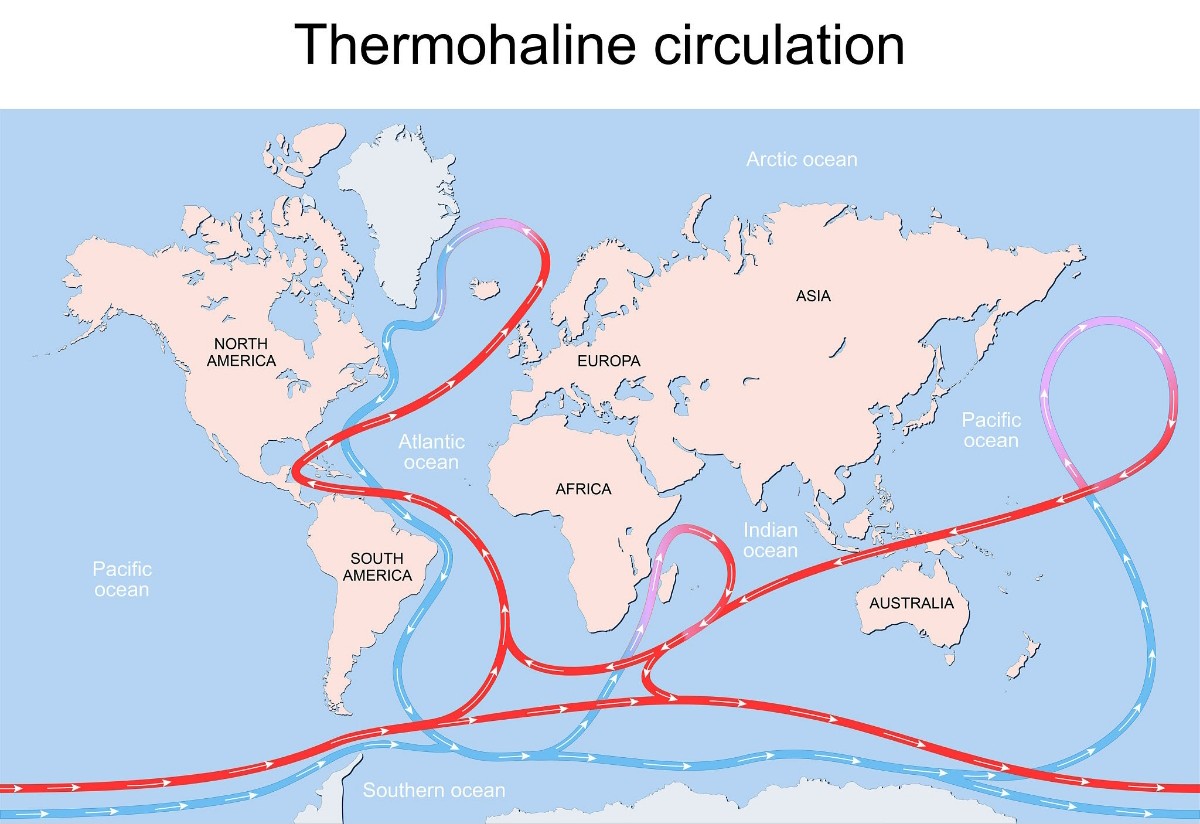
* Ocean currents: The 'conveyor belts' like the Gulf Stream that redistribute heat.
* Tectonic Shifts: Long-term movements that alter landforms and oceanic pathways.
Current global temperatures remain at least 10°C cooler than the long-term Phanerozoic average of 18-25°C. The truth is, no one can say with certainty whether the Earth is entering a warming or cooling phase.
In the conflict between narrative and data, the persistent ice sheets of the poles suggest a planet far more resilient than the climate bureaucracy admits.
The top 2.5 metres of the world's oceans hold as much heat energy as the entire atmosphere above it.
The oceans are the world's thermal powerhouse and it takes a massive amount of energy to nudge its temperature even a fraction of a degree. It's vast heat capacity is the key.
Once oceans begin to warm or cool they don’t just slow down, they operate on timescales of centuries and millennia. The deep oceans are still responding to changes that happened hundreds of years ago.
It’s a slow-motion ballet that ignores all modern noise. The key lies in the Thermohaline Circulation - a global conveyor belt that takes a thousand years to complete a single return trip. It means that water currently resurfacing in some parts of the world hasn't seen the atmosphere since the Middle Ages.
The oceans hold 50 times more carbon than the atmosphere and any slight shift in oceanic outgassing or absorption dwarfs all human output. It’s the tail that wags the dog. Understanding this inertia is the ultimate antidote to climate panic.
We're living in a world dominated by water, with its massive, built-in buffer system that has stabilised life for eons.
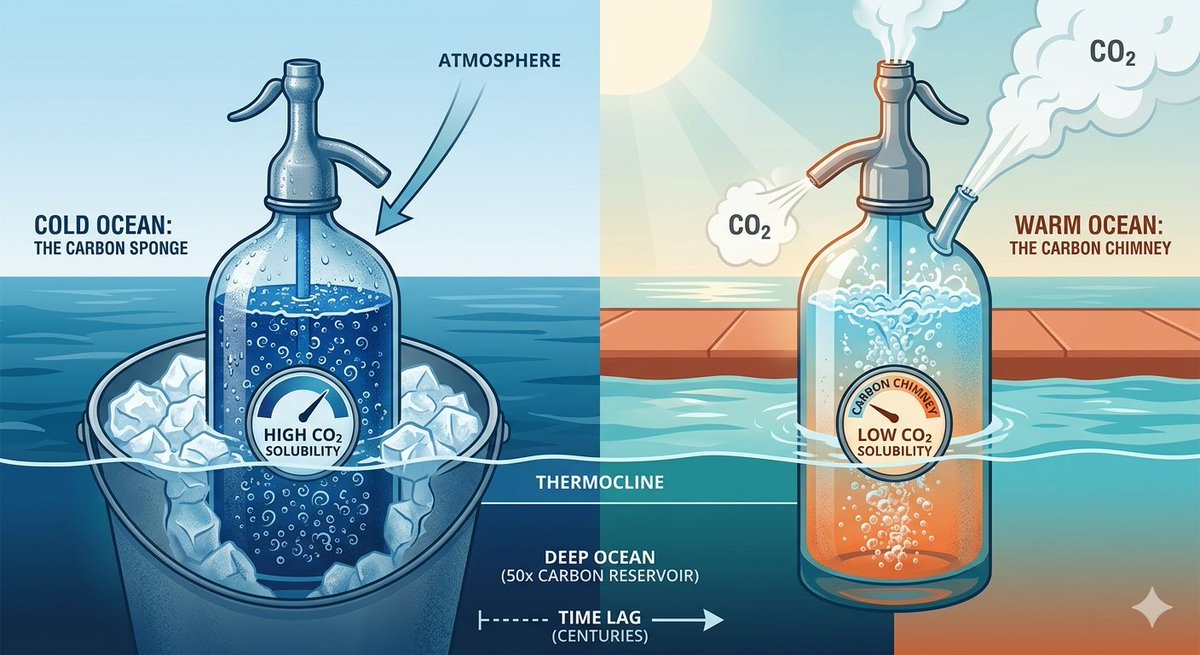
To understand why CO₂ levels rise and fall over millennia, look at a glass of sparkling water.
When it’s cold, it stays fizzy. When it warms up, it goes flat as the CO₂ escapes into the air. The Earth’s oceans work exactly the same way. This is the principle of a solubility pump.
Cold water is a carbon sponge; warm water is a carbon chimney. Because the oceans hold 50 times more carbon than the atmosphere, even a tiny change in sea temperature causes a massive shift in atmospheric CO₂. This explains the time lag seen in ice core data.
Historically, temperature rises first, and CO₂ follows centuries later. Why? Because it takes a long time for the deep, cold thermal flywheel of the ocean to warm up enough to start releasing its stored carbon.
When the oceans finally warm—driven by those million-year Milankovitch cycles—they exhale CO₂. This natural outgassing is a primary driver of the atmospheric shifts we see in the geological record.
It is a biological and physical response to a warming world, not a trigger for a crisis.
The planet is essentially recycling carbon from its massive oceanic reservoir to its parched terrestrial landscapes. It’s a self-regulating system of incredible complexity and beauty.
This is where “uppercase” and “lowercase” came from. In the early days of printing, capital letters were kept in the upper compartments of the type case, while the smaller letters were placed below for easier access.
Doctor: "Your LDL is elevated. I'd like to start you on a statin."
Patient: "What are the side effects?"
Doctor: "Some patients get muscle pain. Fatigue. Occasionally elevated blood sugar. Small cognitive effect in a subset."
Patient: "So: muscle damage, fatigue, diabetes risk, memory problems."
Doctor: "They're rare."
Patient: "But they're the list you just gave me."
Doctor: "The benefits outweigh the risks."
Patient: "By how much? Statins reduce heart attack risk by what percentage?"
Doctor: "Around 25 to 35 percent."
Patient: "Relative risk. What's the absolute reduction?"
Doctor: "..."
Patient: "If my baseline risk is 4% over ten years, a third reduction takes me to 2.7%."
Doctor: "The relative reduction is significant."
Patient: "So I take a daily pill with those side effects for ten years to cut my absolute risk by 1.3 percentage points."
Doctor: "When you frame it like that..."
Patient: "How should I frame it?"
Doctor: "I have some literature..."
Patient: "Does it list who funded the trials?"
Doctor: "..."
Patient: "I'll ask at the desk on my way out."
The Covid Inquiry has claimed this week that the vaccines saved 475,000 UK lives. It's yet another fantasy from the modellers, says Dr Clare Craig. Look at the actual data and you see a very different picture. https://t.co/7kBt4vZj2g
The CDC just admitted that the COVID shots they told all pregnant women to take increase their risk of a leading cause of maternal and fetal death by 24%.
No mainstream media outlets have said a word.....
Michelangelo was only 23 when he carved the Pietà.
More than 500 years later, it still feels impossible.
Has any sculptor ever created something more beautiful than this?
Back in 2003, a German film crew filming in the Gobi Desert captured an incredibly moving moment: after a tough two-day birth, a mother camel rejected her newborn.
A nomadic family then performed the ancient Hoos singing ritual passed down for generations.
Once the song ended, the camel shed tears and finally accepted her baby.
This powerful scene became one of the most memorable parts of the Oscar-nominated documentary The Story of the Weeping Camel.
Dr. Mary Talley Bowden: "With the COVID shots, I'm seeing people that were… perfectly healthy, and then bam… lives destroyed. I've never seen anything like this with any other product on the market."
🦔A researcher invented a fake eye condition called bixonimania, uploaded two obviously fraudulent papers about it to an academic server, and watched major AI systems present it as real medicine within weeks.
The fake papers thanked Starfleet Academy, cited funding from the Professor Sideshow Bob Foundation and the University of Fellowship of the Ring, and stated mid-paper that the entire thing was made up. Google's Gemini told users it was caused by blue light. Perplexity cited its prevalence at one in 90,000 people.
ChatGPT advised users whether their symptoms matched. The fake research was then cited in a peer-reviewed journal that only retracted it after Nature contacted the publisher.
My Take
The researcher made the papers as obviously fake as possible on purpose. The AI systems didn't catch it. Neither did the human researchers who cited it in real journals, which means people are feeding AI-generated references into their work without reading what they're actually citing.
I've covered the FDA using AI for drug review, the NYC hospital CEO ready to replace radiologists, and ChatGPT Health launching this year. All of that is happening in the same environment where a condition funded by a Simpsons character and endorsed by the crew of the Enterprise was being presented as emerging medical consensus. The people making these deployment decisions seem to believe the pipeline from research to AI to patient is more supervised than it actually is. This experiment suggests it isn't supervised much at all.
Hedgie🤗
https://t.co/8Kg8FOrgHW