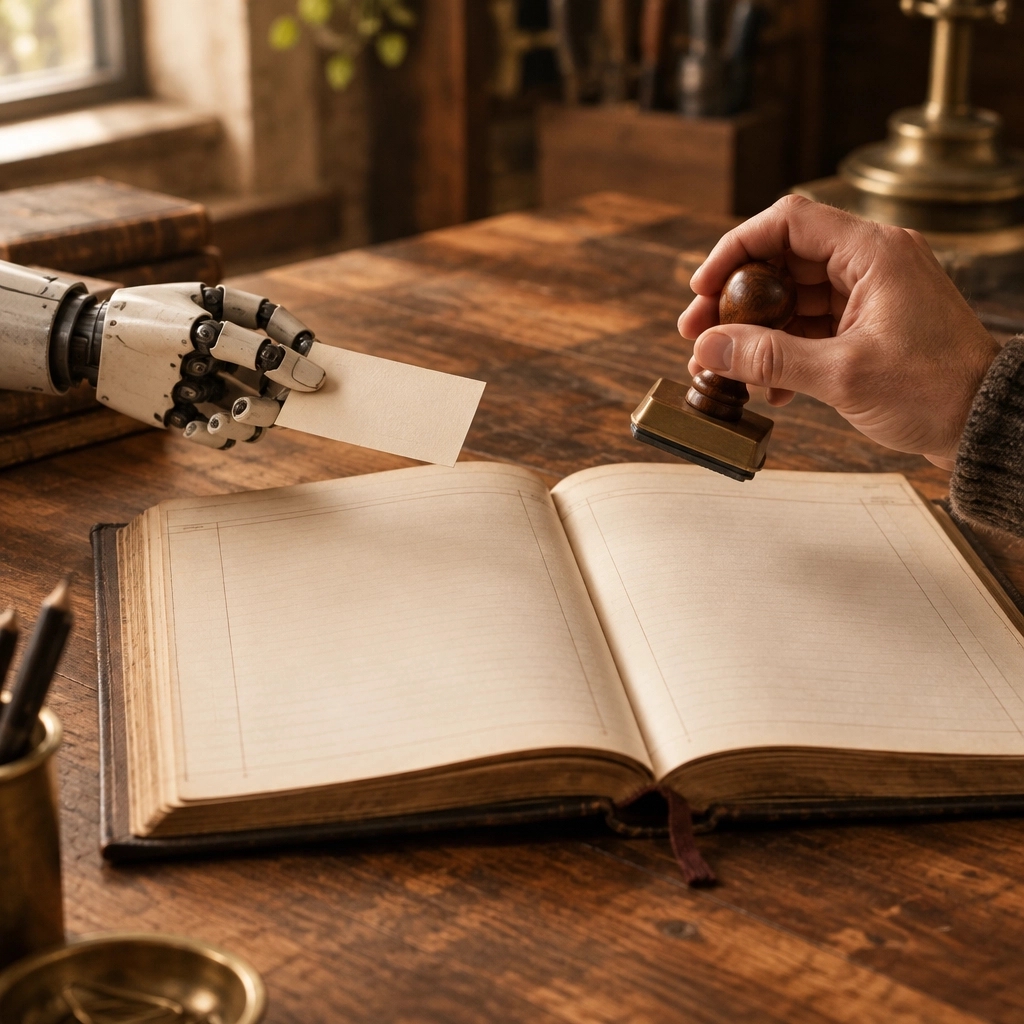
AI can be wrong. So in the system we're building, it can only suggest changes to the record. A separate checker makes them.
When our work lies it will rot.
To an AI agent, the instruction file is the plan. If a stranger can write the plan, the stranger is running the work.
Treat AGENTS.md and CLAUDE.md like code. Know who wrote them and why.
Thinking of starting a community for people who want to learn hardware, work in hardware, or just enjoy tinkering with things in general.
Reply to the tweet if you want in.
```
Date and time for post: Saturday, November 7, 2026, 2:00 PM Central
Instructions: This is a long weekend thought post. Create one square (1:1) photo-style image with no words or text anywhere in it. Scene: a young person sits at a warm, sunlit desk, working with a glowing tablet, with a 1980s scientific calculator beside it. Behind them, slightly out of focus, an older man in a 1980s suit works long math by hand on a chalkboard covered in numbers. The light is warm and bright on the young person and dimmer on the chalkboard, so it reads as the old way fading and the new way starting. Use a warm off-white, charcoal and brass palette, clean and high contrast. Make sure faces and hands look natural. Use the same image on LinkedIn and X. Post the full text word for word on both platforms, even though it is long, and keep the two spaces between sentences exactly as written. No hashtags, no closing question, no disclaimer.
Post (LinkedIn):
A weekend thought.
I watched Margin Call, the 2011 movie. It follows a man who sees the financial crash coming. He works at a big firm in risk assessment, repeatedly warns the people above him, and gets fired because they keep ignoring him.
What struck me was how the movie tells you he's smart. It shows him in a scene talking about a bridge and doing that math in his head as he monologues.
To millennials and younger, that doesn't land. We just go, "So?"
That reaction shows a divide, at about age 45. Most people over 45 grew up before the calculator was everywhere. Doing big math quickly in your head was real proof of a great mind, and men were trained to value it. To them it's still impressive because it's a cool skill. We grew up with the calculator, so to us it isn't. We invested our minds into computers, learning how to use the internet to find rather than memorize.
When the scientific calculator showed up in the 1980s, people were furious. A person should do the math, they said, not a machine.
It's a good skill. But in a way, it's a waste of intelligence. A mind that can do that much math that easily had to skip other training to get there. Before calculators, it was the best use of a mind. After them, it wasn't.
The same goes for knowledge. In the past, a great mind was one that held vast amounts of information. That made sense, because human knowledge was tiny compared to what we have today. Now no one can carry it all, and since the internet, no one needs to. We changed what mental skills had the greatest value.
Now the fury is back, this time over AI. Some groups want to ban it outright. Others want to control what a person is allowed to do with it. Some are betting on watermarks, hidden patterns in AI text meant to show a machine wrote it. But a watermark is a guess based on patterns, not proof. It can be stripped or rewritten away. And it can wrongly flag a person's own work as machine-made, in a world where that guess might be treated as evidence.
That's the over-45 view of the calculator, all over again: a person should do the thinking, not a machine.
Here's the part my generation needs to hear. We were on the right side of the calculator. That doesn't mean we'll be on the right side of AI. If we aren't careful, we'll become the ones saying "a person should do that," and the people younger than us will look back at us and say, "So?"
I think it will take a hundred years to rebuild how we do things around this new model: how we learn, how we work, and how we prove who did what. That's not a reason to fight it. It's a reason to start now.
Not something I'm working on right now. Just a thought I keep coming back to.
Post (X):
I watched Margin Call, the 2011 movie. It follows a man who sees the financial crash coming. He works at a big firm in risk assessment, repeatedly warns the people above him, and gets fired because they keep ignoring him.
What struck me was how the movie tells you he's smart. It shows him in a scene talking about a bridge and doing that math in his head as he monologues.
To millennials and younger, that doesn't land. We just go, "So?"
That reaction shows a divide, at about age 45. Most people over 45 grew up before the calculator was everywhere. Doing big math quickly in your head was real proof of a great mind, and men were trained to value it. To them it's still impressive because it's a cool skill. We grew up with the calculator, so to us it isn't. We invested our minds into computers, learning how to use the internet to find rather than memorize.
When the scientific calculator showed up in the 1980s, people were furious. A person should do the math, they said, not a machine.
It's a good skill. But in a way, it's a waste of intelligence. A mind that can do that much math that easily had to skip other training to get there. Before calculators, it was the best use of a mind. After them, it wasn't.
The same goes for knowledge. In the past, a great mind was one that held vast amounts of information. That made sense, because human knowledge was tiny compared to what we have today. Now no one can carry it all, and since the internet, no one needs to. We changed what mental skills had the greatest value.
Now the fury is back, this time over AI. Some groups want to ban it outright. Others want to control what a person is allowed to do with it. Some are betting on watermarks, hidden patterns in AI text meant to show a machine wrote it. But a watermark is a guess based on patterns, not proof. It can be stripped or rewritten away. And it can wrongly flag a person's own work as machine-made, in a world where that guess might be treated as evidence.
That's the over-45 view of the calculator, all over again: a person should do the thinking, not a machine.
Here's the part my generation needs to hear. We were on the right side of the calculator. That doesn't mean we'll be on the right side of AI. If we aren't careful, we'll become the ones saying "a person should do that," and the people younger than us will look back at us and say, "So?"
I think it will take a hundred years to rebuild how we do things around this new model: how we learn, how we work, and how we prove who did what. That's not a reason to fight it. It's a reason to start now.
Not something I'm working on right now. Just a thought I keep coming back to.
```
@BrianRoemmele The continual bleeding of human intelligence from the writing of code is a dangerous process if we don't know what it is creating. Not because I think the machines will kill us. But because a time when we can't fix something because we let the rule of averages run it all.
@SlimFlexington@CleanTecSystems@sama@elonmusk Most good inventors do come across a little crazy. Because they aren't living in our world. They are trying go live in the one they see.
@SyntheticBeef Intelligence can over come more and more but it can't make something new without a creative direction from a person. High intelligence is just one piece of the puzzle. A person who wants an app for what ever will be easy. People using it is another question.
The best thing a worker did this month was stop.
The rules didn't cover what it was looking at. A guess would have looked like progress.
It stopped and wrote down what it couldn't decide.
A written stop shows the gap. A guess hides it.
Count the clean stop as a success.
Software is about to be rebuilt.
Code is shaped by one limit: a human has to read it. KolibriOS, a full graphical OS, has fit on one 1.44 MB floppy since 2004.
Machines can read every layer at once.
Better structure beats faster chips.
What stays is proof: the record of why.
A seal proves the record didn't change.
It doesn't prove the sentences about the record are true.
An intact record with a wrong summary is still wrong, and it looks trustworthy.
Check the record. Then check every claim against it.
Does the harness matter more than the model?
A new paper put AI agents inside a controlled science workflow. Whether bad results got out depended on the control layer. The model added no measurable benefit.
Build the room before you hire the worker.