Just found out you can buy the same from the phone app and it skips GST completely.
Paid for Claude on web for 4 months, gst added every single time.
I wish I'd known this before.
I added a custom sub-agent to write test for my backend in background.
I'm not able to enable 'accept edits on' or auto-mode for this sub-agent.
It kept interrupting me asking write permission for every change while I'm working on my main agent window.
Any solution?
To really understand how text becomes tokens, I built gpt-tokenizer few months back from scratch, following Andrej Karpathy's GPT series.
Learnt BPE by implementing manually first, then rebuilt the tool on top of tiktoken library.
I've published it on PyPI, so you can try it in two commands:
`pip install gpt-tokenizer`
`gpt-tokenizer`
there are lot of benchmarks that suggest 5.6 sol is the best model in the world right now, but the most reliable way to tell is claude keeps extending fable and starts resetting their limits
@GarvitXalt Actually it's not self hosted.
Microsoft hosts the model, and you are billed by the number of input and output tokens. It's like we subscribed for the service.
I can not use my own deployed TTS and STT models because, livekit plugins are only for python.
Now, I have to rewrite the whole agent worker code in python again.
I'm cooked. less goo.
@GarvitXalt Livekit provides deepgram/nova-3(STT), cartesia/sonic-3(TTS) and google/gemma-4-31b-it(llm) inference for testing.
But I have to use gpt-4o-transcribe(STT), gpt-4o-mini-tts(TTS) and gpt-5-mini(llm). All are deployed on azure.
Initial architecture was simple and based on first principles.
Client would stream the audio, server will process it using VAD, turn detection, cleanup etc.
Then it will sent to STT llm to generate text out of it.
The response stream forwarded to TTT llm, for generating response.
The response would be further forwarded to TTS llm to convert the text into speech.
This speech will be directly streamed to client as response.
But now, Livekit handles all the voice pipeline, VAD, turn detection and optimized WebRTC connection.
So this code is of no use.
Livekit handles everything, from setting up WebRTC, room, to providing full agent voice pipeline(including turn detection, VAD etc.) running in a worker.
Initially, I thought it only helps to connect client and server over webrtc. But this has changed the whole architecture of my application.
I shifted to this, due to it's very low latency, mostly accurate turn detection, and very fast STT -> TTT -> TTS voice pipeline.
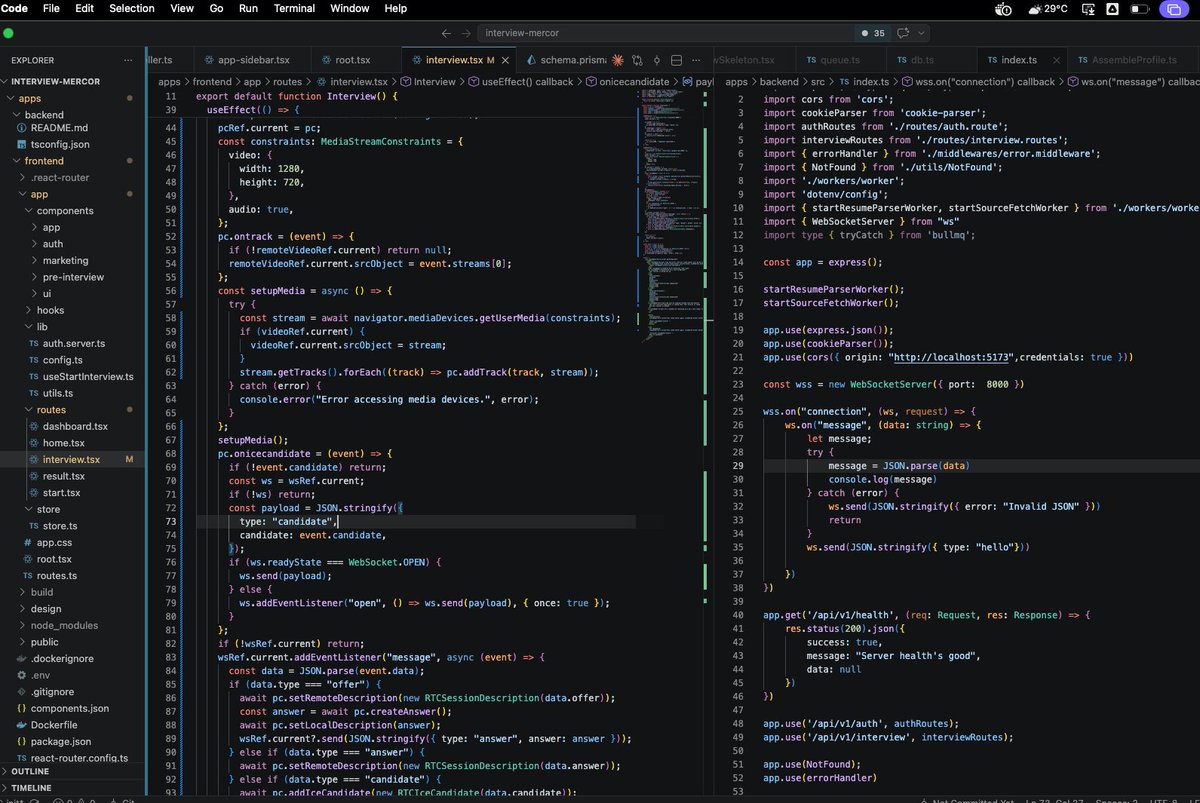
Woke up, started writing code manually to setup websocket and webrtc connection using docs.
Typescript helps a lot in writing cleaner code.
Now I'll implement LiveKit server-side to connect client to the server.
good for me, I can still code without ai.