🚨 In 2026, the US bond market is CRUSHING the Nifty.
• US 10-year yield at 5.28%, highest since 2002
• Dollar at ₹96.31
• FPIs sold ₹36,000 crore in one month
But every screener says the Nifty is "cheap" at 19 PE.
Here's what the same PE hid in 2020, 2022 and 2025 🧵
🚨 𝗧𝗥𝗨𝗠𝗣 𝗝𝗨𝗦𝗧 𝗖𝗛𝗔𝗡𝗚𝗘𝗗 𝗧𝗛𝗘 𝗥𝗨𝗦𝗦𝗜𝗔–𝗜𝗡𝗗𝗜𝗔–𝗖𝗛𝗜𝗡𝗔 𝗘𝗤𝗨𝗔𝗧𝗜𝗢𝗡.
Donald Trump has signed the Russia sanctions bill into law.
Headlines scream:
“100% 𝘛𝘈𝘙𝘐𝘍𝘍 𝘖𝘕 𝘐𝘕𝘋𝘐𝘈 & 𝘊𝘏𝘐𝘕𝘈.”
But that is NOT what happened today.
The real mechanism is much bigger.
𝗛𝗲𝗿𝗲’𝘀 𝘄𝗵𝗮𝘁 𝘁𝗵𝗲 𝗹𝗮𝘄 𝗮𝗰𝘁𝘂𝗮𝗹𝗹𝘆 𝗱𝗼𝗲𝘀 🧵👇
The data center revolution in India is no longer just about floor space—it’s about power density and cooling. ⚡️❄️
We are moving from racks of 5-10 kW to a staggering 200-400 kW. This shift makes traditional air cooling obsolete and liquid cooling a multi-billion dollar necessity.
The global liquid cooling market is projected to soar from $2.8B to over $21B by 2032. If you are looking for the next big industrial value chain, this is it.
In our latest Masterclass, we deep-dive into:
🔹 Why liquid cooling is now "unavoidable."
🔹 The 11x projected increase in cooling-water consumption.
🔹 The shift toward high-efficiency, oil-free centrifugal chillers.
🔹 Which companies are positioned to capture this massive infrastructure spend.
Don't just invest in the "hype"—understand the engineering moats driving the growth.
Watch the Masterclass now:📺 https://t.co/0P91mYmhFU
#DataCenters #ValueInvesting #LiquidCooling #Infrastructure #SadhanStocks
Why does India repeatedly face a dollar problem?
Because India, in many ways, followed the American model of growth
👉without possessing America’s greatest advantage: the US Dollar.
The United States could gradually move away from manufacturing because the Dollar became the world’s reserve and trade currency.
America could run large trade deficits, import goods from across the world, consume more than it produced, and still sustain prosperity because global demand for Dollars financed that model.
Over time, the US increasingly shifted:
👉from factories to finance
👉from production to consumption
👉from industrial capital to financial capital(this is important ton understand)
Its brightest minds moved towards finance, technology, consulting, and asset management rather than mass manufacturing.
Financial wealth became more rewarding than industrial production.
India, after liberalisation, slowly moved in a similar direction.
Privatisation, efficiency, profitability, ROE, EPS growth, shareholder value, and financial market expansion became the dominant economic language.
But India did not have what America had:
A reserve currency.
India cannot endlessly run trade deficits without consequences.
India cannot print globally demanded currency to finance imports.
India must continuously earn or attract Dollars.
And this is where the structural challenge begins.
India became a service and consumption economy before becoming a manufacturing powerhouse.
As manufacturing failed to dominate at scale, growth increasingly depended on:
-services
-domestic consumption
-capital inflows
-financialisation
-and rising asset prices
Meanwhile, China followed a very different path.
China became a manufacturing civilisation before becoming a consumption economy.
China focused relentlessly on:
-factories
-exports
-industrial ecosystems
-logistics
-supply chains
-infrastructure
-and production scale—> most important
For years, Chinese firms often operated with lower margins and lower returns on capital but with enormous focus on volume, exports, employment, and industrial depth.
China chased capacity.
India chased profitability.
China built factories.
India built financial markets.
China strengthened its ability to earn Dollars through exports.
India became dependent on attracting Dollars through capital flows.
And that is why every global shock oil spikes, wars, capital outflows, rising US yields, or risk aversion creates pressure on the Rupee and India’s external position.
Because India’s economic structure still depends heavily on foreign capital and imported energy, while its manufacturing base remains relatively shallow compared to China.
This is also why replacing China in manufacturing is extraordinarily difficult.
Manufacturing dominance cannot be built merely by optimising quarterly profits and market valuations.
It requires:
👉patient capital
👉large-scale production
👉lower short-term profitability
👉deep infrastructure
👉supply chain ecosystems
👉export competitiveness
👉and long-term industrial ambition
Perhaps India now faces a defining economic choice:
Can India become a true economic superpower primarily through consumption, services, finance, and rising stock markets?
Or must it reduce its obsession with margins, ROE, EPS growth, and financial engineering to build real industrial depth and manufacturing strength?
India’s only problem is-
It can’t earn dollars - it has to attract dollars and till than it will remain India’s weak link.
#india #economy #growth
Coal Gasification: India’s “Black Gold 2.0” Moment 🔥
For decades, India has mainly used coal by simply burning it to generate electricity.
But Coal Gasification changes the game completely.
Instead of directly burning coal, the coal is converted into a cleaner fuel called Syngas (Synthetic Gas) using oxygen, steam, heat & pressure inside a Gasifier.
This Syngas becomes a powerful industrial raw material that can be used to produce:
• Synthetic fuels
• Fertilizers like Urea
• Cleaner & more efficient electricity
• Chemicals like Methanol & Acetic Acid
In simple words: India is trying to move from: Burning Coal to Using Coal as a Chemical Resource.
India imports massive amounts of:
• Crude Oil
• Fertilizers
• Natural Gas
• Industrial chemicals
Coal Gasification can reduce these imports significantly by using India’s own coal reserves to manufacture many of these products domestically. This strengthens:
• Energy Security
• Aatmanirbhar Bharat
• Fertilizer Independence
• Chemical Manufacturing
The biggest opportunities may emerge in:
Fertilizer, Chemicals, Energy Infrastructure, Gas Handling & Engineering & EPC
Key PSU names to track:
• Coal India Limited
• GAIL (India) Limited
• Bharat Heavy Electricals Limited
Note: (Always do your own research before investing; this is for educational purposes.)
Coal Gasification. India's largest import substitution plays since solar.
The Cabinet just approved a ₹37,500 crore scheme to back it. The headline number is not the real number.
The real number is ₹2.77 lakh crore. That's what India paid last year importing LNG, urea, ammonia, methanol and ammonium nitrate. Every product on that list can be made from coal.
Almost nobody is asking who is already building this.
So, I went and pulled the order book.
First, what coal gasification actually is.
It converts coal into syngas, a mix of carbon monoxide and hydrogen. Syngas then becomes methanol, ammonia, urea, ammonium nitrate, Synthetic Natural Gas, hydrogen and industrial fuels. So instead of paying foreign suppliers in dollars, India pays domestic miners in rupees.
The scheme:
🔹 Outlay: ₹37,500 crore
🔹 Target: gasify 75 MT of coal (national goal 100 MT by 2030)
🔹 Investment expected: ₹2.5 lakh crore to ₹3 lakh crore
🔹 Subsidy: up to 20% of plant and machinery cost
🔹 Cap per project: ₹5,000 crore
🔹 Cap per product (except SNG and urea): ₹9,000 crore
🔹 Cap per entity group: ₹12,000 crore
🔹 Coal linkage extended to 30 years
The 30-year linkage is the line most analysts will miss. Coal gasification plants are ₹10,000 crore plus capex. No board commits that without feedstock certainty for the full asset life. This is what de-risks the entire scheme.
The order book is not theoretical. The new ₹37,500 crore outlay builds on the ₹8,500 crore scheme from January 2024 under which 8 projects worth ₹6,233 crore are already in execution. The pipeline has been quietly building for 18 months.
The value chain has four layers. Here is who is already in.
👉Layer 1, coal owners:
🔹 Coal India: parent of BCGCL (JV with BHEL for coal-to-ammonium nitrate, ₹11,782 crore at Jharsuguda) and CGIL (JV with GAIL for coal-to-SNG at Sonepur Bazari, ₹13,052 crore). Plus, a standalone ₹12,214 crore coal-to-SNG project in Maharashtra. ₹1,350 crore incentive already received per project.
🔹 NLC India, NTPC: lignite and coal-linked optionality.
👉Layer 2, technology and EPC:
🔹 BHEL: 49% equity in BCGCL. Won LSTK-1 (gasification + air separation + steam) and LSTK-2 (raw gas purification) of the BCGCL project. Uses its own indigenous Pressurised Fluidised Bed Gasifier technology. The only Indian company with a commercial coal gasification tech stack.
🔹 Larsen & Toubro: won LSTK-3 (ammonia synthesis) and LSTK-4 (nitric acid + ammonium nitrate + prilling) of the same BCGCL project. Both booked as "large" orders by L&T Energy Hydrocarbon Onshore.
🔹 Thermax, ISGEC Heavy Engineering, Triveni Turbine: second-order exposure on boilers, steam systems, turbines and auxiliaries.
👉Layer 3, downstream chemicals and fertilisers:
🔹 GAIL: equity in Talcher Talcher Fertilizers Ltd and CGIL plus offtake economics on coal-to-SNG.
🔹 RCF, NFL, GNFC, GSFC, Chambal, Coromandel, Tata Chemicals: long-cycle demand and feedstock optionality.
👉Layer 4, ammonium nitrate, methanol and explosives users:
🔹 Deepak Fertilisers and Petrochemicals: 40% market share in Technical Ammonium Nitrate. 587 KTPA current capacity. Building 376 KTPA expansion at Gopalpur for Q1 FY27 that takes total past 1 MMTPA. Backward integrated via 500 KTPA ammonia plant at Taloja that cut India's ammonia imports by roughly 20%. Also, one of India's five major methanol producers.
🔹 Solar Industries: India's largest industrial explosives player. Heavy AN user. Margin sensitive to domestic AN economics.
🔹 GNFC: methanol, formic acid, acetic acid. Signed 50-50 JV with INEOS in November 2024 for a 600 KTPA acetic acid plant at Bharuch.
🔹 Petronet LNG, Gujarat Gas, IGL, MGL: substitution-risk angle over a decade as coal-to-SNG scales.
So, who makes money first?
Order book visibility is highest today for BHEL and L&T. Both have already converted BCGCL into hard orders. The ₹37,500 crore outlay expands the addressable pipeline by roughly 9x to 10x over the previous scheme. EPC and gasification equipment is the cleanest near-term play.
Coal India benefits two ways. Direct equity in three gasification projects with ₹1,350 crore per project already received. Indirect: 1.3 MT annual captive coal offtake into BCGCL alone is the kind of long-tail thermal coal demand that protects against the secular decline narrative.
Deepak Fertilisers benefits through market structure. BCGCL's 0.66 MMTPA eventually competes, but India today still imports ammonium nitrate from Russia. The near-term effect is domestic AN scaling without import dependence, lining up with Deepak's own 1 MMTPA expansion.
Most policy announcements fade in one news cycle.
This one looks like a 5–10 year industrial buildout.
India is trying to convert its largest domestic resource into a substitute for its biggest import vulnerabilities.
First-order winners: coal owners and EPC giants.
Second-order winners: chemicals, fertilisers and industrial explosives.
Long-term pressure point: gas-import-linked margins.
📌Disclaimer: For educational purposes only. Not a buy or sell recommendation.
Bill Ackman went on a fishing trip in the Tierra del Fuego, Argentina.
His guide was so impressive that Ackman offered him a job at Pershing Square — one of the world's most powerful hedge funds.
The only condition: read 12 books before your first day.
Here are those 12 books. And why Ackman swears by them. 🧵
Complex Ideas. Simple Words. From Sand to Solar Panel: How Solar Power Is Built --
Silicon : A natural element found in sand and rocks - the foundation of solar manufacturing. Think of it like wheat.
Polysilicon : This is highly purified silicon, the starting material for solar manufacturing. Think of it like flour before making bread.
Ingot: Polysilicon is melted and shaped into a solid block called an ingot. Think of it like a loaf of bread.
Wafer : The ingot is sliced into very thin pieces called wafers. Think of them as bread slices.
Solar Cell : The wafer is treated and turned into a unit that can generate electricity from sunlight. Think of it like a sandwich made from bread slices.
Solar Panel : Many solar cells are connected together to make a solar panel. Think of it like a lunchbox carrying many sandwiches.
Simple story: wheat - Flour - Loaf - Slice - Sandwich - Lunchbox.
Solar power : Silicon -Polysilicon - Ingot - Wafer -Cell - Panel.
⚠️ Your SIF fund showed 11% TER on April 6. Before Apr 1, this was hidden. Now SEBI forces funds to show brokerage + trading costs in daily TER.
One heavy trading day spiked costs from 0.62% → 11.17% (same fund, 3 days apart).
This is a single-day figure — not your annual cost. So don't read it that way. But it tells you something important:
High-churn funds are expensive. You just couldn't see it before. Story by @VedantVichare99 https://t.co/X0Fx4LUf6z
Mainboard Leaders & Their SME Counterparts - Hidden Opportunities You Can’t Ignore 🔥👇
💠Waaree Energy →Alpex Solar
💠Syrma SGS → Aimtron Electronics
💠Garden Reach Shipbuilders → Krishna Defence (recently migrated)
💠Transrail Lighting → Rajesh Power / Viviana Power
💠Yatharth Hospital → UniHealth Hospitals
💠Cupid → Anondita Medicare
💠Polycab → JD Cables / Prime Cables
💠Shilchar Technologies → Danish Power
💠Amara Raja Energy → Maxvolt Energy
💠Interarch Building → Sathlokhar Synergys
💠Acme Solar → Oriana Power
💠Gravita India → Baheti Recycling
💠Aditya Infotech → Prizor Viztech
Let’s continue building this list further - you can also add more mainboard players and their SME counterparts to make this list even more comprehensive and insightful.
Disclaimer:
This is for educational purposes only and not investment advice. Please do your own research before investing.
INDIA IS RAPIDLY EXPANDING ITS NUCLEAR ENERGY CAPACITY TO SECURE A CLEANER, RELIABLE, AND SELF-DEPENDENT FUTURE📊🔥
🔹Larsen & Toubro
👉 Nuclear reactors के heavy components और EPC contracts
🔹KSB Limited
👉 Nuclear-grade pumps & valves
🔹Walchandnagar Industries
👉 Reactor components manufacturing
🔹MTAR Technologies
👉 Nuclear & space components
🔹Bharat Heavy Electricals Limited
👉 Turbines, generators for nuclear plants
🔹Hindustan Construction Company
👉 Nuclear plant construction
🔹Kirloskar Brothers Limited
👉 Specialized pumps for nuclear plants
🔹NTPC Limited
👉 Future nuclear projects
🔹Power Corporation of India Limited
👉 Transmission support for nuclear power
🔹Thermax Limited
👉 Heat exchangers, boilers (indirect use)
🔹Data Patterns India
👉 Control systems (indirect high-tech supply chain)
🔹Power Mech Projects
👉 Turbine island & mechanical works
Dis - Not Buy/ Sell Reco
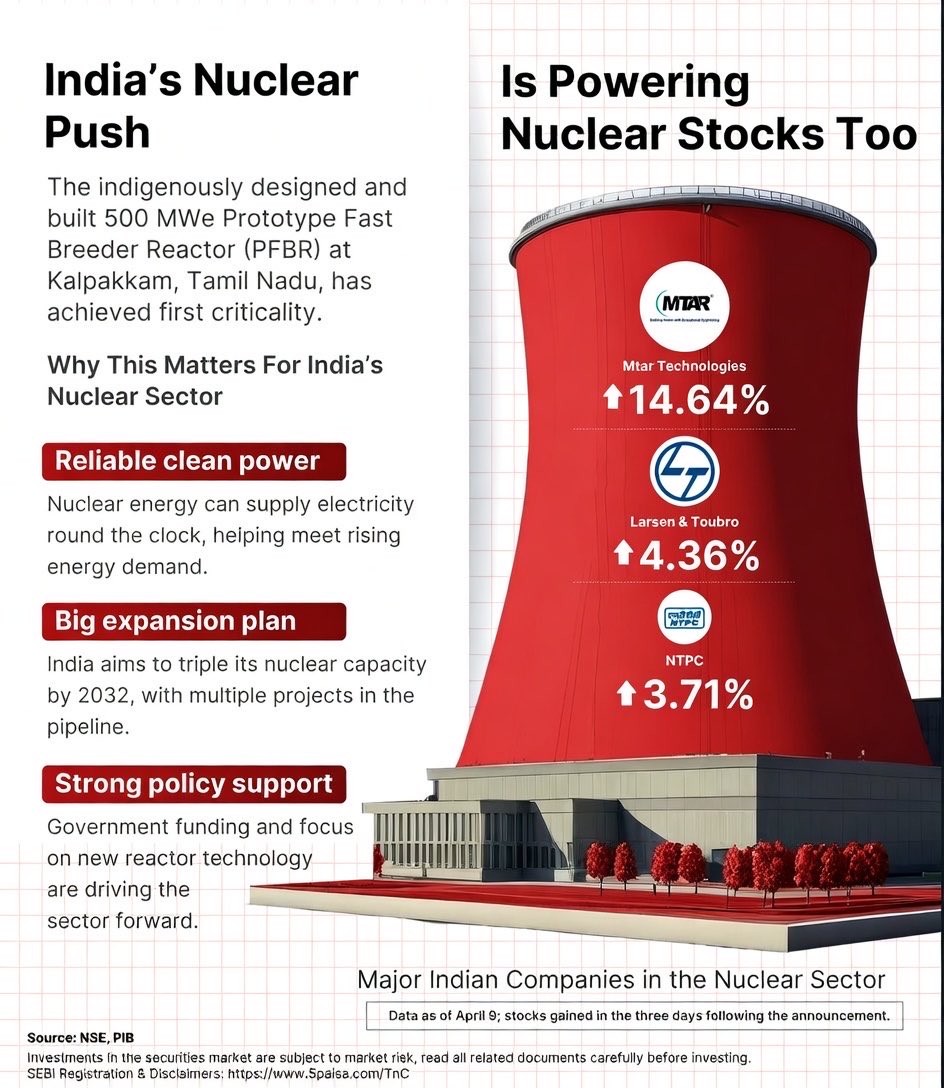
☢️ India’s 🇮🇳 Big Push For Nuclear Energy⚡️
▪️ India achieves first criticality in 500 MW Prototype Fast Breeder at Kalpakkam 🇮🇳
▪️ Cabinet Clears Landmark NUCLEAR ENERGY BILL - “SHANTI” | Key Beneficiary Stocks 🔥
SHANTI - Sustainable Harnessing & Advancement of Nuclear Energy for Transforming India.
For the first time in 60+ years, Private Participation Allowed in Civil Nuclear Sector
📊 Nuclear Capacity Targets:
▪️ 22,000 MW by 2032 | 100 GW by 2047 - From current capacity 8,880 MW
▪️ 25 reactors operating, 17 under construction.
▪️ Essential for baseload as coal & gas plants retire.
▪️ Key pillar for Net-Zero 2070 + Viksit Bharat vision.
▪️ The Bill will be tabled in Parliament early next week.
💼 Key Beneficiary Company Stocks
MTAR Technologies
Larsen & Toubro (L&T)
NTPC
Bharat Heavy Electricals Ltd (BHEL)
Hindustan Construction Company (HCC)
Walchandnagar Industries
Kirloskar Brothers
KSB Ltd
Bharat Forge
NHPC
ABB India
Siemens India
Tata Power
Adani Power
Adani Energy
HCC
💡 A defining moment for India’s energy future. India already has end-to-end nuclear capabilities, now it’s unlocking the ecosystem around it.
🚫 No Recommendation