For those wanting to view this piece in other languages, here are the translated versions from the BBC.
Punjabi https://t.co/6pjH5J8GHF
Urdu https://t.co/JMVkfShb69
Gujaratihttps://www.bbc.com/gujarati/india-59388510
Hindi https://t.co/c2yIS7ztdy
Telugu https://t.co/1uhyxKWK1w
Well done @FloraCarmichael@shrutimenon10 for turning this in-depth influence operations research into a newsworthy report. https://t.co/iJNDWmFZgq. Also a big thanks to @elisethoma5 and staff at @Cen4infoRes for reviewing this research.
These findings are documented in a full transparent influence operations research report here @Cen4infoRes: https://t.co/LLwyBPkSl9
This report was shared with teams at Twitter and Meta. All of the accounts identified in this research have subsequently been suspended 👊
Though the captured activity was only a sample of these accounts, it did show that there was consistent amplification from smaller fake accounts (on right in inner circle).
Using those accounts on the right, we could find more that were being retweeted within the fake network
Doing helps to visualise the interactions (likes, retweets) between accounts.
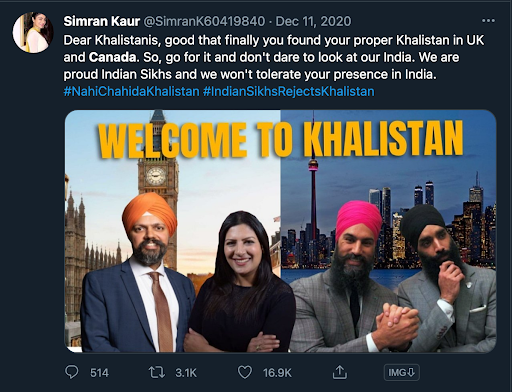
For example, here I have highlighted the interactions of @SimranK60419840 to show its personal spread within the network.
I captured data using the Twitter API on three tags used by the network: #RealSikhsAgainstKhalistan, #SikhsRejectKhalistan & #RealSikhs.
I've set out that data using @Gephi to show the core network of primarily fake accounts and the wider network of amplifiers in the outer ring.
Often with influence operations, looking at a network through visualised data helps with a lot of things - namely identifying how it operates, size, spread and also finding more accounts.
So let's take a look at that.
While the fake personas appeared to gain significant traction on Twitter, their tweets and images were also linked, embedded, or reposted on news sites and blogs indicating platform breakout.
Below are two examples of this.
While most of the content appears to push specific talking points, or narratives, some tweets (example below) went further in a call for 'nationalists' to 'counter & expose' groups this network labelled as extremists.
There was also a common theme throughout the network of fake personas to retweet or tweet about the Indian Armed Forces and Indian Army content.
This content was unique as it was not related to Sikh independence much like the other content.
The fake network of accounts also attempted to push specific narratives about the farmers' protests using messaging claiming that ‘Khalistani terrorists’ hijacked the protests.
However, some of the content gained significant traction. For example this tweet about independence groups overseas received more than 3000 retweets and 16,000 likes.
Not bad for a sock puppet with a set list of talking points to promote certain narratives.
That same tag, as seen on Twitter, shows extremely similar content. Again targeting Sikh independence.
You can see much of the content had few interactions.
So WHAT was their aim?
We can glean some obvious details from the content the accounts post. Here is some of the Facebook activity we looked at. It shows a strong focus on countering Sikh independence. Note the prominence of tags such as #PakistanBehindKhalistan
Many of the personas were present on Instagram as well.
Note: the accounts had significantly less success with metrics on Instagram and Facebook in comparison to the traction they gained on Twitter.
These fake accounts carry their personas over to different platforms.
We found that 22 accounts that were the same personas on Twitter & Facebook. They used the same image, name, cover photo, and posted the same content.
Here is an example of 'Sanpreet' on both platforms.