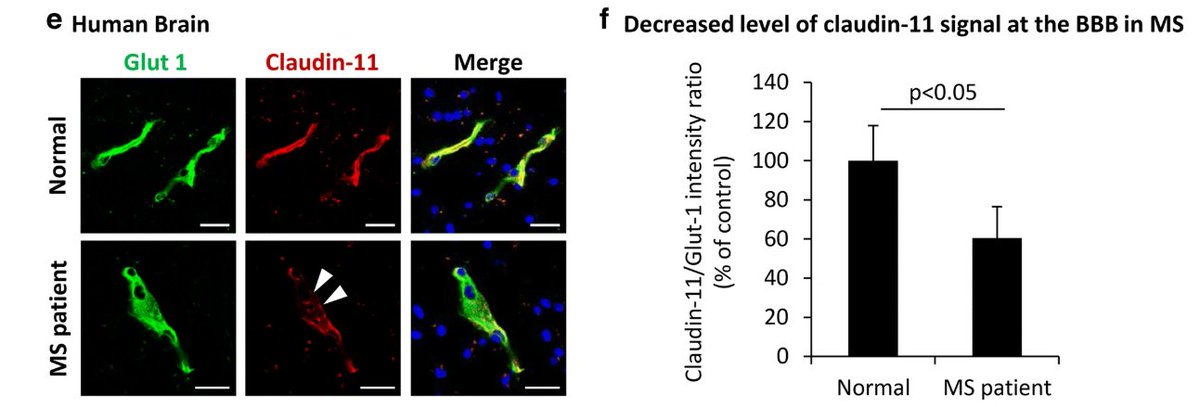
Overall, this paper highlighted that claudin-11 is significantly downregulated at the BBB and BSCB of an MS patient, and that an increase in CNS barrier permeability is observed in monolayers of endothelial cells (and epithelial cells - data not shown). (7/7)
What role does claudin-11 have on blood-brain barrier disruption in Multiple Sclerosis?
This was one of the questions posed by a group of Japanese scientists. https://t.co/oFkPNNh5Xx
Here's what they found: 🧵/7
Downregulation of claudin-11 in a MS patient's BBB and blood-spinal cord barrier (BSCB):
A 64-year old MS patient's brain and spinal cord was used to explore claudin-11 expression. In three BBB and BSCB capillaries of the MS patient, there was a significant reduction of claudin-11 expression. (6/7)
What’s your opinion on authors of research articles stating they’ve noticed a difference between two conditions, but the difference was not statistically significant?
I’ve been told to not include such statements. I understand that sometimes statistical differences do not always mean clinical significance. And that the opposite could possibly be true as well.
It just triggers me for some reason when I see it…😭
(3/4) Fexofenadine's higher selectivity blocks H1 receptors, preventing airway restriction and vasodilation caused by allergies. Its higher affinity for P-glycoprotein ensures more drug binds to H1 receptors throughout the body. This means Fexofenadine is more effective.
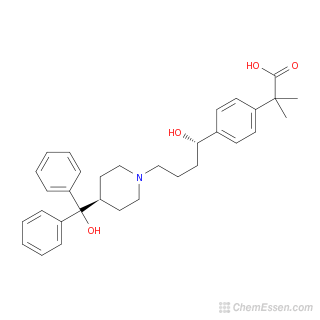
(2/4) Fexofenadine does not cross the blood-brain barrier due to the hydrophilic groups in its structure. Therefore, it cannot enter the brain and exert the sedative effects that 1st generation antihistamines do - keeping the user alert, in control, and safe.
You are less likely to fall asleep at the wheel when taking the antihistamine, Fexofenadine, compared to Brompheniramine. Why?
The answer lies in the blood-brain barrier and the structural properties of 2nd generation antihistamines. 🧵/4
🧠 Bacteria in the Brain?
For years, scientists believed bacteria couldn’t survive in the brain. But new research suggests otherwise, challenging our understanding of brain health and its microbiome.
⚠️ A word of caution: Stay skeptical! Similar findings in the past were debunked due to sample contamination.
💡 Could this discovery reshape how we view brain health, or is it another case of contamination?
🔗 Read the full article here: https://t.co/fD6q67wfIk
#Neuroscience #Microbiome #Research #BrainHealth #Science #Health #ScientificDiscovery