A shuffled deck of cards needs exactly 7 shuffles to become truly random. Not 5. Not 6. Not "a few times." Seven. Persi Diaconis proved it in 1992 and Wall Street has been ignoring the implication ever since.
Below 7 shuffles, the previous order shows through. If you know the starting arrangement, you can predict where cards end up with accuracy that grows the fewer shuffles occur. The deck has memory. The math is exact. Diaconis and Dave Bayer wrote the paper. Seven riffles. Not close to seven. Exactly seven.
The market has memory too. Every position, every liquidation, every earnings expectation, every forced flow leaves a trace on the chart. Your eye sees pure noise. Diaconis's math sees a deck that has not been shuffled enough. The past is right there. You just do not have the tools to count it.
Your gut looks at a chart and calls it random. The math looks at the same chart and counts the shuffles. Only one of them can tell you what the next card is likely to be.
Diaconis has spent 40 years explaining this. Before he was a mathematician he was a professional magician, so he knew what a rigged deck looked like from both sides. The 1992 paper is free. The Stanford lecture on YouTube is free. The number seven has been in every stats textbook for 30 years.
The lesson: what looks random is usually a deck someone did not shuffle enough. The market is that deck.
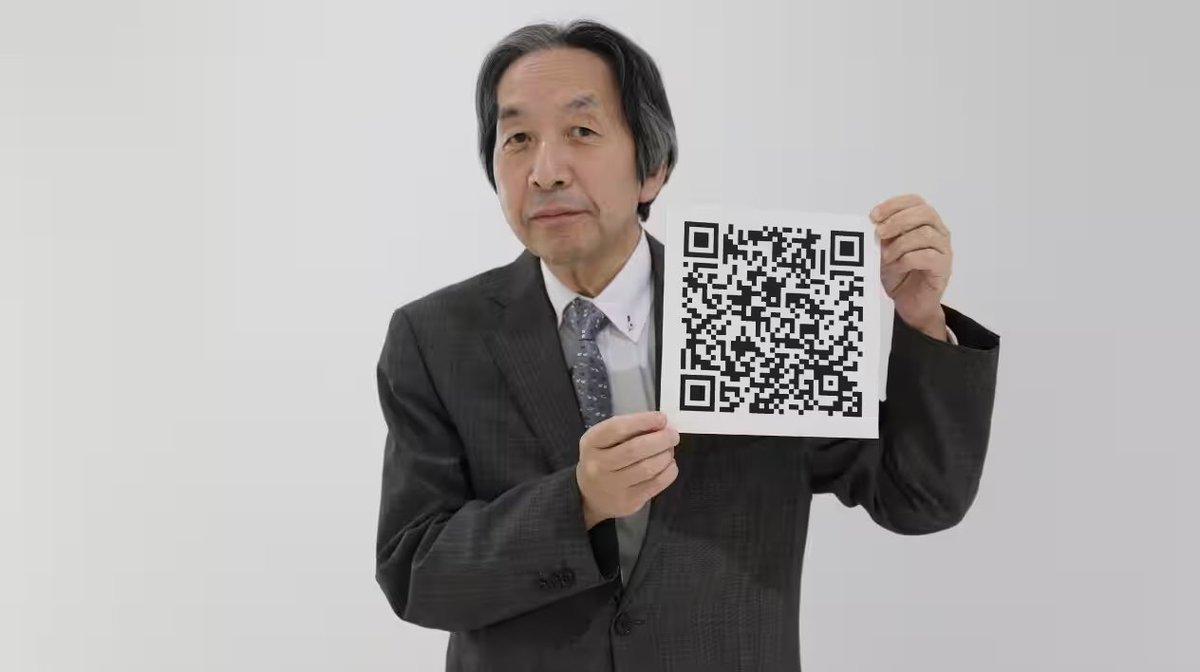
A Japanese engineer invented the QR code for one job, tracking car parts on a Toyota line, then his company chose to give the patent away for free, which is the only reason it ended up on every restaurant table on Earth.
His name is Masahiro Hara. The company was Denso Wave, a parts supplier owned by Toyota.
In 1992 the problem landed on his desk, and it was not glamorous. Workers on the factory floor were drowning.
Every car part had a barcode, but a barcode can only hold about twenty characters, so to track one component they had to stick five or ten barcodes on it.
A worker would stand there scanning a single part ten times in a row. Some of them were scanning close to a thousand barcodes a day. The job had stopped being about building cars and turned into pointing a scanner at stickers all day long.
And there was a second problem nobody upstairs cared about. This was a factory. Oil got on everything. A smudge of grease across a barcode and the whole thing became unreadable, and the line stopped.
Hara was asked to make the scanner faster. He looked at it for a while and realized the scanner was not the problem. The barcode itself was the ceiling. A line of black bars can only hold information going one direction, left to right.
He decided to build something that held information in two directions, up and down as well as across, so it could store hundreds of times more in the same little square.
Then came the part that sounds made up but is not.
Hara played Go on his lunch breaks, the old board game with black and white stones sitting on a grid. He was staring at the board one day and it clicked.
The grid of black and white stones was already a way to store information in two directions. That was the shape of his code.
But building the code was the easy half. The hard problem was speed, because the whole point was to be fast, and a scanner wastes most of its time just trying to figure out where the code is and which way it is turned.
The fix came to him on a train. He was looking out the window at buildings, and one building stood out from all the others because of its shape against the sky. That was the idea.
He put three little square targets in three corners of the code. The moment a scanner sees those three squares, it knows instantly where the code is and how it is rotated, even upside down, even at an angle.
Now here is the detail that shows how far he was willing to go. Those three corner squares only work if nothing else on the page looks like them.
If a magazine ad or a cardboard box happened to have the same black and white pattern nearby, the scanner would get confused and grab the wrong thing.
So Hara and his tiny two-person team went and surveyed printed material. Magazines. Flyers. Cardboard boxes. Piles of it, for days, reducing every picture down to its ratio of black to white area, hunting for the one ratio that almost never shows up in print anywhere. They found it. One to one to three to one to one.
That exact rhythm of black and white is baked into every corner square of every QR code on Earth, and it is there because it is the pattern the printed world almost never produces by accident.
Then he solved the oil.
He built the code so it carries a backup of its own information, spread mathematically across the whole square. You can tear off, smudge, or scratch out up to thirty percent of a QR code and it still scans perfectly, because the code rebuilds the missing piece from the copy it kept of itself.
A worker could get grease on a third of the label and the line would keep moving. This is the same math that lets a scratched CD still play and lets a spacecraft send data back across the solar system without asking to repeat itself.
He finished in 1994. He named it Quick Response, after what it does for the person using it, not after what it is.
And then Denso made the decision that actually mattered.
They held the patent. They could have charged a fee on every single scan, and given how many billions happen now, that would have made someone unimaginably rich.
Instead they announced they would not enforce their rights to collect royalties, and they published the specification openly so anyone could use it. Hara later said it was not even a big argument inside the company.
That one choice is the whole story. A code that costs nothing to use is a code everyone builds on. Airlines put it on tickets. Phone makers built readers into cameras.
Then a pandemic hit and the world needed a way to hand someone information without touching anything, and the free little square that a Toyota engineer built for greasy factory workers was suddenly on every menu, every payment, every door.
Hara still works there. He has said, more than once, that he never imagined it would spread this far, and that the part he is proudest of is that it got used to keep people safe.
The man built it to survive oil on a factory floor. It ended up surviving everything else too.
You have scanned his work a hundred times this year. Now you know whose it was.
The more solar energy India stores, the more money India dumps into the Chinese economy.
India is #3 in the world right now for solar electricity generation (recently overtaking Japan).
However, India still hasn't figured out solar energy storage.
Much of the current storage happens in lithium-ion batteries. China is the world's largest supplier of lithium (raw) and li-ion cells.
And if China decides to increase the export price of this lithium, it would meaningfully stunt the growth of India's solar energy industry.
That's why what Meine Electric is such an important company.
Their fast charging iron-air batteries (first in the world) use iron, water, and air. No lithium.
Their supply chain is 90% indigenous, and they have four granted patents for this tech.
99% of options traders are gambling because they never learned the fundamentals.
This 1-hour Yale lecture changes everything.
In just 60 minutes, you’ll learn more about options trading than most overpriced trading courses ever teach.
No hype. No fake gurus. Just real knowledge.
Save this and watch it without distractions. 📌
Harry Markowitz, the Nobel laureate who invented modern portfolio theory:
"Every fund from Bridgewater to Citadel runs on one equation I wrote as a 25-year-old grad student. Wall Street pays quants $500K to use it. It's free."
the thread above teaches you to build a portfolio the real way, with the mathematics of capital allocation. every line of it traces back to one paper markowitz wrote in 1952.
before him, "don't put all your eggs in one basket" was folklore. he turned it into algebra. he proved a portfolio's risk isn't the average of its parts, it's driven by how the parts move together, the covariance. combine assets that don't move in lockstep and you cut risk without giving up return. that is the closest thing to a free lunch in all of finance, and he wrote the exact equation for how much of it you get.
that single insight, mean-variance optimization, is the engine under every serious fund on earth. renaissance, bridgewater, citadel, your pension, all of them size risk with markowitz's math. he published it in 1952, won the nobel in 1990, and it sits in every textbook and this free lecture. same story i keep telling: the math that runs the trillion-dollar machine has been public and free for seventy years.
here is the part markowitz himself warned about. the equation is only as good as the numbers you feed it, your estimates of return and covariance. feed it garbage and the "optimal" portfolio it hands back is confidently, precisely wrong, and it detonates in the exact crisis it was built to survive. the optimizer is free. estimating the future honestly, and knowing when to distrust your own inputs, is the entire job.
GOOGLE CEO SUNDAR PICHAI: "IF YOU DON'T LEARN HOW TO ORCHESTRATE AGENTS NOW, YOU'LL SPEND 2027 CATCHING UP TO PEOPLE WHO STARTED TODAY."
30 minutes on why the best engineers stopped writing code line by line and started orchestrating agents instead.
Most people think building an agent requires an engineering degree.
It doesn't.
It requires one guide and one afternoon.
Watch the interview.
One guide. One afternoon. That's all it takes.
Nassim Taleb, options trader and author of "The Black Swan":
"Every green day makes you more confident, exactly like a turkey being fed before Thanksgiving. Your best day and your last day tend to arrive together."
the article above is about telling a real edge from luck. taleb built his career on the danger nobody prices in: the longer your winning streak runs, the more confident and the more fragile you quietly become.
picture a turkey fed generously every single day. each feeding makes it more certain the farmer loves it. its data looks better, its "model" says life is safe and getting safer, and its confidence is highest on the very last morning before thanksgiving. maximum certainty arrives at the exact moment of maximum risk.
that turkey is the trader on a hot streak. every green day is another feeding. your equity curve climbs, your conviction swells, you size up, and the market, like the farmer, gives no warning at all. the blowup never comes when you feel worried. it comes when you feel invincible.
that is why a long track record can be the most dangerous thing you own. it is not proof you are safe. it is the turkey's data, one feeding from the truth. the rarer the disaster, the longer the streak that hides it, and the more certain you will be right before it lands. taleb has warned about this for twenty years, in his books and in this free talk. same point as my article: a winning streak is not proof of skill, it is often just the fattening before the fall.
here is the edge. treat your best streak as your most dangerous moment. size so that no single day can ever be your thanksgiving. stay humble exactly when you feel like a genius. the math is free. surviving the day the feeding stops is the only skill that ever mattered.
@CMShehbaz Mr. PM, you should focus on reviving Pakistan's economy and distancing from Terrorist Infrastructure. That's what going to help Pakistani citizen become prosperous.
Do something which makes your people to follow scientific temper and education rather than likes of Hafiz Saeed
A Navy SEAL ran 100 miles with no training, broken feet, kidneys shutting down, peeing blood.
His conclusion changed how millions train: when your mind says you are done, you are only at 40% of what your body can do.
If I wanted to be unbreakable, I would do these 7 things he learned in hell
1. Treat exhaustion as a lie your brain tells you.
Did you know?
Many of India's biggest mutual fund companies have foreign owners.
1] Nippon India AMC
- 71.9% owned by Nippon Life (Japan)
2] Mirae Asset AMC
- 100% owned by Mirae Asset (South Korea)
3] Franklin Templeton AMC
- 100% owned by Franklin Templeton (USA)
4] HSBC AMC
- 100% owned by HSBC (UK)
5] PGIM India AMC
- 100% owned by Prudential Financial (USA)
6] Invesco AMC
- 100% owned by Invesco (USA)
7] Baroda BNP Paribas AMC
- 50% owned by BNP Paribas (France)
8] Mahindra Manulife AMC
- 49% owned by Manulife (Canada)
9] SBI AMC
- 36.3% owned by Amundi (France)
10] ICICI Prudential AMC
- 35% owned by Prudential (UK)
Which one surprised you the most?
Jonathan Gruber, MIT economics professor:
Every quantitative strategy starts with the same problem: what if the person on the other side knows something you don't?
This free MIT lecture explains adverse selection, one of the core ideas behind modern market making and quantitative trading. When information is unevenly distributed, the side with less information pays for it.
The mathematics behind market making has been public for years. The formulas are easy to find.
The hard part is identifying when the flow you're trading against is smarter than you are.
Bookmark this before it gets buried in your feed.
Everyone calls it "Soros breaking the Bank of England." it was Stanley Druckenmiller's trade. and Soros's only contribution was telling him to bet more.
1992. Druckenmiller sees it: Britain needs low rates, Germany needs high ones, and the two currencies are chained together at a fixed rate. something has to break. he sizes the short at $5 billion - already enormous.
he walks into Soros. Soros isn't impressed:
"why are you only doing $5 billion?"
"this is a one-way bet," Soros tells him. do $15 billion. the error wasn't being too aggressive. it was being too timid on a trade you're certain of.
they pressed. the pound broke. the fund made 62% that year.
his whole philosophy in one line:
"diversification is really overrated"
find one thesis you've truly done the work on, put your eggs in it, and watch the basket closely. and when it finally works, don't grab the profit just to feel good:
"you can't just make yourself feel good by taking a profit"
~1hr, free. the trader behind the pound on why the real risk is betting too small ↓
Sir David Spiegelhalter, Cambridge professor:
"Give me 10,000 traders and I'll show you a genius with a flawless five-year record, built by luck alone. I can even tell you how many to expect."
the article above is about telling a real edge from luck. spiegelhalter spent his career at cambridge turning that exact question, is this real or just chance, into hard numbers.
start ten thousand traders flipping coins and some will "win" five years straight. not because they're gifted, but because with enough people a spotless streak is guaranteed to land on someone. that someone writes a book, sells a course, and calls it skill. it was arithmetic.
his whole message is that you cannot judge chance by how surprising it feels, you have to compute it. how likely was this record if the person had zero skill? until you can answer that, a winning streak is not evidence of anything. he built a career and these free public lectures on making that rigorous. same point as my article: a run that feels like genius is a question, not an answer.
here is the edge. do the calculation your gut refuses to, ask how many lucky fools your sample was always going to produce before you assume you're not one of them. the math is free. the humility to run it on your own success is the rarest thing there is.
Nassim Taleb, options trader and author of "The Black Swan":
"Wall Street pays $500K for a five-year track record. I traded options for two decades and watched records like that vanish in a single afternoon."
the article above is about telling a real edge from luck. taleb built his whole career and his books on one warning: a track record is the weakest evidence there is.
a trader can win every single day for years and still be sitting on a hidden risk. the five good years don't prove skill, they just haven't met the one bad day yet. that is the entire "fooled by randomness" trap, dressed up as a resume.
and you only ever see the survivors. for every rich trader with a spotless record, thousands ran the same reckless bet and quietly blew up. the graveyard is silent, so the lucky fool looks like a genius. none of this is new, taleb has said it for 25 years and the talk is free. same point as my article: a winning streak is not evidence.
here is the edge, and it isn't a hot record. it's surviving. sizing so your one bad day can't erase you, and staying skeptical of your own success while everyone else worships theirs.
Stanford computer science professor just revealed how to master Markov Decision Processes.
83-minutes. free. By Stanford.
here's what they cover:
• search problems vs. stochastic environments
• policy evaluation & q-value recurrence math
• value iteration loop engineering
• convergence limits under a cyclic graphs
Bookmark & watch today. Then read the article below.
India's real transformation isn't happening in corporate boardrooms but in the daily choices of ordinary Indians who refuse to give up. This film is inspired by one such true story. Narrated by Aamir Khan, who was moved enough to lend his voice. The first of many. Watch it. @Bajaj_Finserv