Here's Jed Meyer of St. Cloud CU talking about Cloud Dollar ($CLDUSD) and what they're working on with @MetallicusTDBN. This is the beginning of a new era of a more legitimate digital asset industry and @metallicus and @MetalBlockchain are at the forefront of it.
Only 3 projects share $100M+ in revenue annually with their token holders:
1. Hyperliquid
2. Pump Fun
3. Aerodrome
What's impressive is that all of them went live only 3 years ago.
Idiotic take.
1. You're insinuating Jed Meyer is lying and would risk his own reputation and the reputation of St. Cloud by doing so. It's happening whether you like it or not. It may not be at the speed you and others want but that's enterprise business for you.
2. There was zero real world adoption of Tesla vehicles in 2005 as they were still in R&D. In 2008 they launched their first vehicle and the rest is history. People that lack foresight and patience have been proven wrong time and time again.
St. Cloud CU feels like nothing more than a PR stunt. There is zero real-world adoption on Metal Blockchain right now—this looks like pure hype to pump liquidity so insiders and investors can recoup their money
$XPR
$METAL
$mtl
$Metallicus
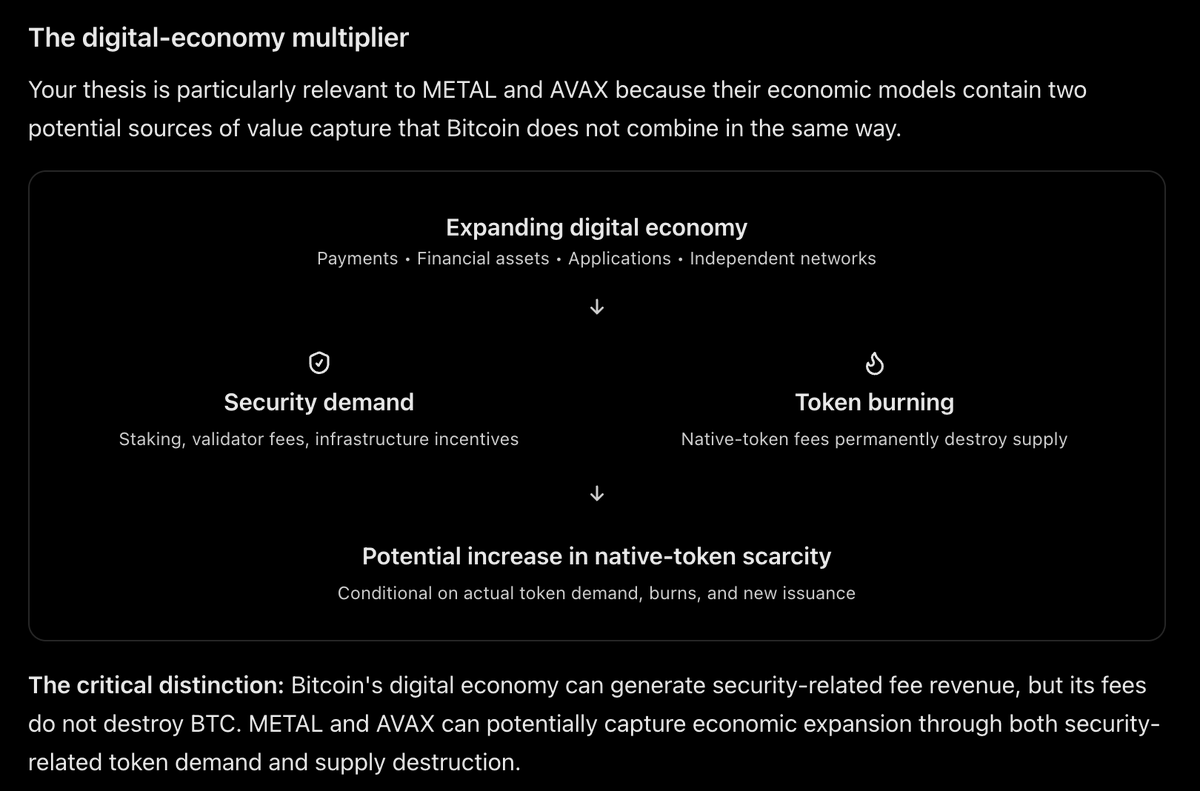
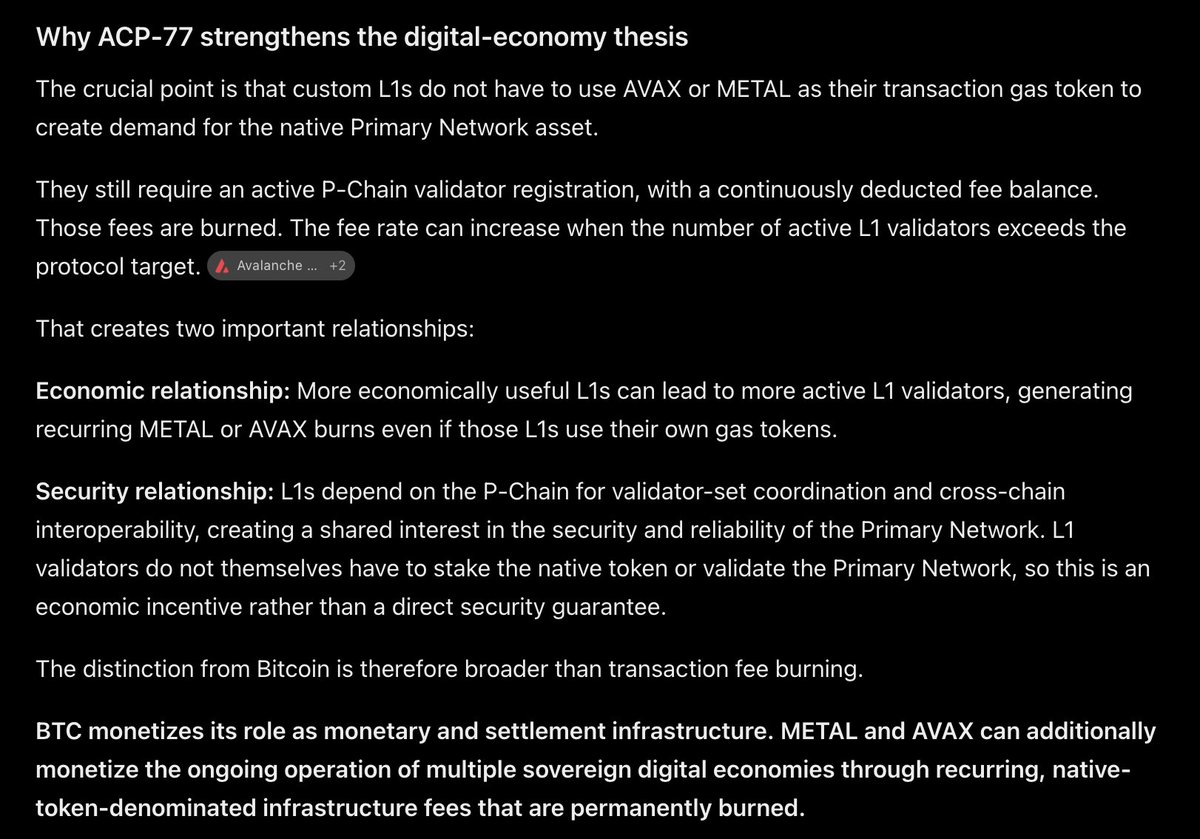
Some people are just never going to get it. They will touch $AVAX because L1s are tied to the p-chain and have an operational dependency. You onboard, then adapt parameters, and the cost of migration means they'll stay put. $AVAX as a token will also evolve.
It’s time for Ava Labs to go public. Many people would like upside exposure to the potential of this tech, especially in light of this NYSE announcement, but they’ll never touch the token.
I'm surprised @JoelKatz still holds 3M $XRP at this point.
The XRPL's rigid architecture constrains programmability, composability, and the granular compliance controls required for institutional adoption at scale.
Fast settlement alone isn't enough.
People will cry about the value capture of the tokens but they'll never tell you how much work is going on to constantly improve the economics of $AVAX. There's a lot of disingenuous actors in the space that peddle nonsense because something isn't the way they want it right now.
Introducing the six research teams selected through our first Call for Research Proposals 🔺
The teams will take on some of the most important open questions in blockchain economics.
Accelerating research already underway through our economic research agenda.
The economics of decentralized networks deserve the same intellectual rigor as the protocols themselves.
Great to see the Avalanche Foundation bringing together researchers from Stanford, Oxford, Imperial and other leading institutions to tackle fundamental questions around validator incentives, security, and value accrual.
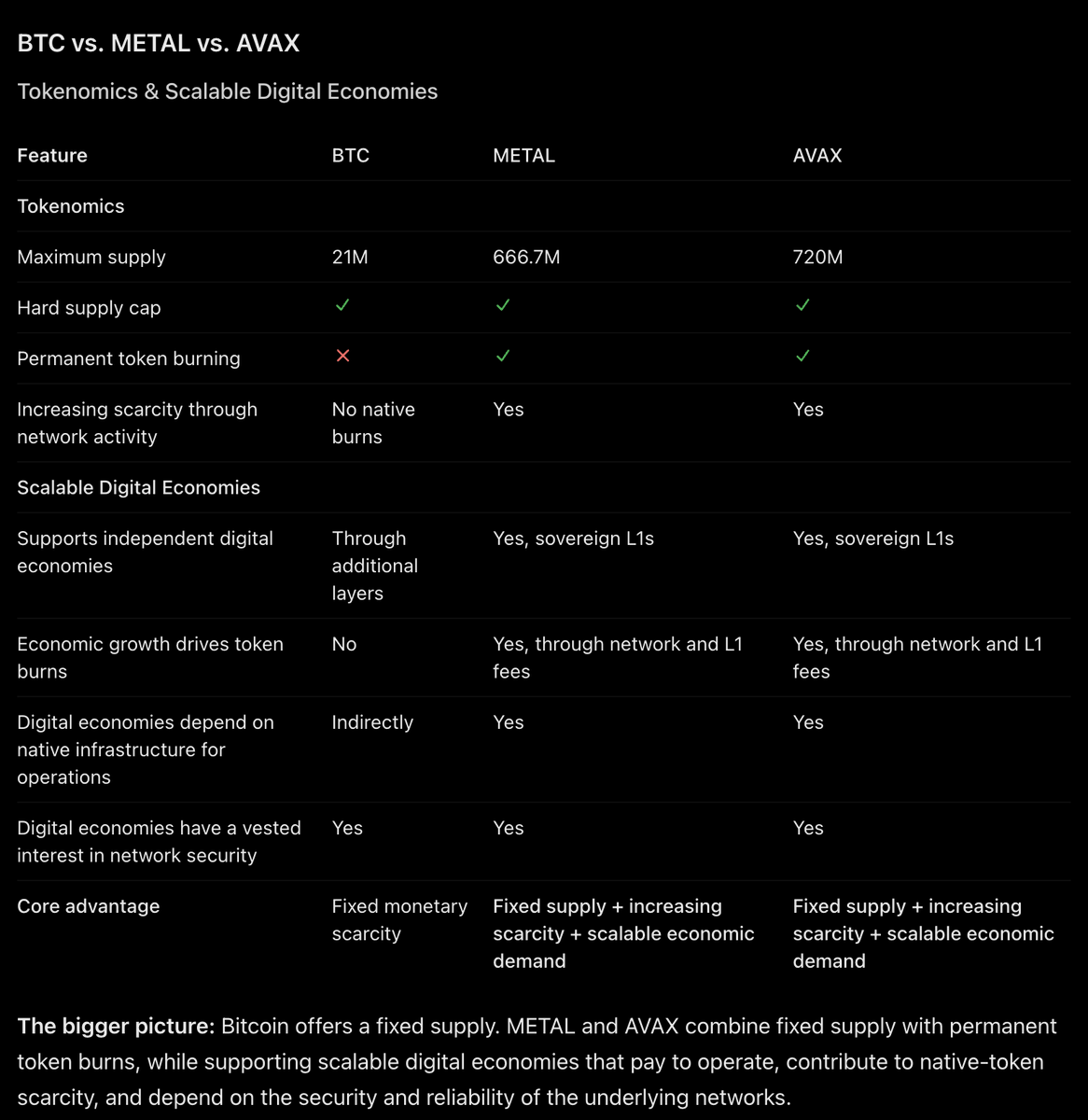
The same people criticizing the burn rate and tokenomics of $AVAX and $METAL refuse to apply the same standards to other assets including $BTC. As for sell pressure, it occurs with all of them as a tradeoff of ensuring the networks are secured.
Why Avalanche for NYSE?
It’s important to note that this was not a quick, monetarily-driven decision made without due diligence, as I’ve seen a few posts speculating that. After more than a year of evaluating and testing multiple blockchain networks, NYSE arrived at Avalanche for a multitude of reasons.
For those who have followed Avalanche closely, this shouldn’t come as much of a surprise. For everyone else, it’s worth understanding the fundamental difference between building for speculative crypto markets and building the infrastructure that underpins global capital markets.
For regulated financial institutions, high TPS and low transaction fees are the baseline. Most modern blockchains can offer some version of both, with the much harder problem being architectural.
Monolithic chains share consensus, execution, and blockspace. Conventional EVM L2s introduce dependencies on external settlement layers, sequencing, and data availability. Both models come with constraints that become particularly consequential when institutions need direct control over their infrastructure, especially when it comes to regulatory compliance.
Avalanche was designed around a different premise.
Avalanche L1s operate with independent consensus, dedicated validator sets, customizable virtual machines, configurable fee markets, and protocol-level permissioning. Institutions can define who validates, who participates, how transactions are processed, and how their networks are governed, with the flexibility to implement regulatory requirements directly into the infrastructure.
They can do so without inheriting the congestion or settlement dependencies of another chain, while retaining the ability to interoperate with other networks and access the broader Avalanche ecosystem’s assets and liquidity.
This combination of sovereignty, customization, performance, and interoperability is what makes Avalanche uniquely suited for true capital markets. It’s one thing to offer institutions a place to deploy applications, anyone can do that. It’s another thing to give them the ability to operate the underlying infrastructure on their own terms.
We’ve spent years building around the conviction that the world’s largest financial institutions would eventually need purpose-built blockchains of their own, rather than forcing entirely different businesses and regulatory environments onto a single shared network.
NYSE’s decision is a powerful validation of that thesis.
And I believe we’re only beginning to appreciate just how important these architectural decisions will be as global financial markets continue to move onchain.
People that take today's crypto landscape and apply degen DeFi economics to tomorrow's crypto landscape where robust business models, compliance, security, and sound economics matter more are NGMI. They will filter themselves out before the serious money moves in.
@hypurrexe@el33th4xor All L1s have validators and they're registered with and dependent on the p-chain in the primary network. The low IQ people are the ones that can't see past simple degen DeFi economics and fail to understand that other things matter at enterprise level.
I keep hearing that 'XDC does subnets'. In reality, XDC doesn't do proper subnets. XDC Zero is essentially a modified bridge based architecture that relies on a relayer and oracle. For asset swaps, Subswap is required. In short it's trash. Calling a cat a dog doesn't make it one.
Progress being made on PulseVM almost every day.
You can track the progress here, and see how much work is being done to keep moving things forward.
https://t.co/m6cyKmNAL6
Thank God metal-blockchain:native has almost zero exposure to all these shitty opaque CEXs, and 98% of the volume is home on @MetalXApp where it belongs.
It's hilarious watching @binance trying to play the good guys in the space after everything they've done and are still doing. Deflecting onto @MEXC isn't gonna save you. Next time the law catches up with you there'll be no pardons. Remember that. Tick tock! ⌛️