in order to become a better person, you must first realize how horrible you really are. not in the dramatic sense, but in the quiet ways you sabotage yourself, repeat unhealthy patterns, hurt people who care about you, or tolerate what wounds you. you cannot grow if you keep pretending you’re innocent in the story you’ve created.
i regret to inform you that personal growth rarely comes from acquiring new knowledge and almost always from:
•getting humiliated
•showing up terrified and doing it anyway
•admitting you might be the problem
it is an unwritten rule of life that after every prolonged period of hardship and uncertainty, there is going to be a period when you are going to achieve quantum leaps across multiple areas of your life. the only requirement is that you do not give up on yourself.
It took a little longer than expected, but we have created a website for people to view the footage collected from Gaza in one place. You no longer have to download the entire archives to see them.
It includes:
64,537 videos
17,905 photos
Ability to download individual videos
Searchable index
Exhaustive sources list (300+ journalists)
Geolocation data
Livemap with minute to minute updates
Victim list
It can be accessed here: https://t.co/s0Se94PXWF
Please share & quote tweet to help this post break out of the twitter algorithm prison.
We will keep adding the rest of the archives to the site, be patient- it is difficult work. Continue to seed the torrents provided, as that is the best way to ensure the footage remains stored in decentalized way.
God bless all those who sacrificed their lives to get this footage out, and everyone invovled in collecting/archiving it.
Join our telegram:
https://t.co/bvcis3b9GT
Follow our backup accounts:
@ZionismExposedx & @IsraelExposedAr
The untold story of Malaysia's role in SpaceX's survival.
Malaysia was instrumental in keeping SpaceX alive in its early years. One could argue it helped save Elon during his lowest financial period.
Falcon 1's first three launches, 2006 to 2008, all failed. The company was nearly bankrupt — grown men were weeping after the third failure. The fourth flight in September 2008 finally reached orbit with a dummy payload, RatSat. But still, no paying customer.
SpaceX needed a real commercial customer to prove the business was viable.
That customer was Malaysia.
Malaysia was looking to launch its satellite, RazakSAT, and needed a reliable, cost-effective option. Dr Ahmad Sabirin first give Elon a call on Christmas 2003 to explore the possibilities of launching of satellite to the low equatorial orbit and met in El Segundo, And after many discussions, they agreed to launch from Omelek Island in the Kwajalein Atoll.
On July 14, 2009, RazakSAT flew — the fifth and final Falcon 1, and SpaceX's first-ever commercial launch. The Malaysian flag Jalur Gemilang was painted on the side of the rocket.
That payment helped SpaceX make payroll through its hardest stretch. And it put Malaysia in orbit. Win win.
For old times' sake, Elon should drop by Malaysia. Ask someone to hold his teh tarik for one more handshake.
Dr Ahmad Sabirin & Elon, 2004.
I don't think people realize just how extraordinary what we're witnessing with Iran is.
I was arguing with a dear journalist friend of mine yesterday who was telling me that Iran was winning, yes, but only on the strategic level, not tactically.
The type of thing a skinny kid getting stuffed in lockers in highschool tells himself to make himself feel better: "These people will BEG to work for me in ten years. Everyone knows jocks peak in highschool. They'll literally beg." 😏
I think that's precisely wrong, and that's what makes the Iran war different. As of now, Iran is in fact holding its own tactically too.
Think about other U.S. wars of aggression these past few decades. Take Vietnam, Afghanistan, Libya, Iraq, Serbia, etc. (the list is unfortunately very long). The pattern was roughly always the same with an immense power differential between aggressor and victim. These wars were, by and large, imperial: the empire attempting to crush a much weaker people whose only realistic recourse was guerrilla resistance. And that is when they actually had the will to resist: some - like Libya - barely even bothered, just resigning themselves to their fate (despite being, at the time, the richest country in Africa).
As spectators of these wars, if you had any moral sense, the dominant emotion was a kind of helpless disgust: you were watching a giant stomp through someone else's house.
Sure, the U.S. actually lost many - if not most - of these wars, famously replacing the Taliban with the Taliban or being expelled with their tail between their legs from Vietnam, but the power differential was no less real for it.
It's just that power doesn't always guarantee victory: sometimes the giant can't kill everyone, and eventually tires of trying. But the “victories” won this way were always pyrrhic at best: the people endured, yes, but what they were left with was a country in ashes that takes decades to rebuild. Meanwhile, in the grand scheme of things, the giant walked away with little more than a bruised ego.
Iran is - remarkably - proving to be an entirely different beast: when others were merely surviving a giant, Iran appears to be able to compete with one.
What just happened over the past 48 hours is the best illustration of this. You had the President of the United States issue a formal ultimatum: reopen the Strait of Hormuz within 48 hours or we "obliterate" your power grid.
Iran's response was essentially: we dare you, if you do this we'll make all your Gulf allies uninhabitable within a week.
And, as we saw, Trump backed down: pretexting non-existent "VERY GOOD AND PRODUCTIVE CONVERSATIONS" with Iran, he said his ultimatum no-longer applied (or, rather, became 5 days). Adding he now envisaged the Strait of Hormuz being “jointly controlled by me and the Ayatollah.” To the amusement of Iran’s diplomacy (https://t.co/o4JnJJoAGS).
That, folks, is a textbook tactical victory. It is, remarkably, Iran demonstrating in this instance that it had escalation dominance over the United States of America. That is, the ability to credibly threaten consequences so severe that the US - for perhaps the first time since the Cold War - found it preferable to stand down.
That's no skinny kid being locked in a locker dreaming of revenge fantasies. That's the kid grabbing the bully's wrist mid-shove and watching his face change.
And it's not the only tactical victory in this war so far. Take the episode over the Israeli attack on Iran's South Pars gas facility. Iran had warned that if that happened U.S. allies in the region - including Israel - would face a symmetrical response.
And they delivered: famously devastating Qatar's Ras Laffan facility - which produced roughly 20% of global LNG supply - and leading, according to Qatar themselves, to a $20 billion loss of annual revenue for the next 5 years (https://t.co/Myd3QZDbYf).
Not only that but they also managed to hit Israel's Haifa refinery (https://t.co/XvFqewBZPZ), one of the country's most strategic and protected sites.
The result was Trump distancing himself from the South Pars attack, saying that Israel had "violently lashed out" unilaterally and that "NO MORE ATTACKS WILL BE MADE BY ISRAEL pertaining to this extremely important and valuable South Pars Field." Israel then said it wouldn't strike Iran energy sites anymore (https://t.co/tk0rA5NaWS).
From where I stand, that's another tactical victory. It is, at least, Iran demonstrating that is can fight back **symmetrically** against the U.S. and its allies. Not through asymmetric resistance with IEDs hidden in the roadside or traps hidden in the jungle, but eye for eye, and against some of the most heavily protected sites on the U.S.'s side.
That's qualitatively different from any other adversaries the U.S. has directly fought in recent wars.
There's plenty more, such as the pretty relevant fact that Iran has gained control of the single most strategic energy chokepoint on earth and the U.S. is finding it impossible to break that control.
To the point where Trump has been reduced to publicly begging China - of all countries - for help, which given Trump's ego mustn't have been easy to do. Only to be told no. By China. And by everyone else he asked.
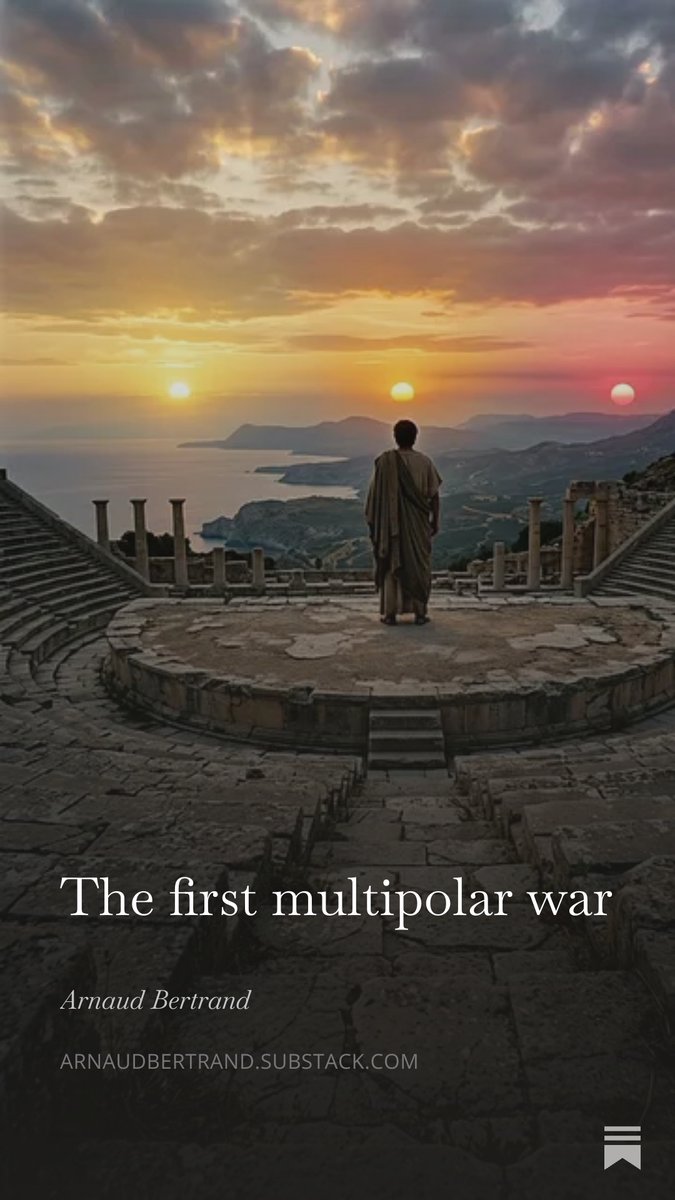
This is the topic of my latest article: how this is, in fact, the first genuine "multipolar war."
First, in the narrow sense: because Iran is revealing itself to be a genuine pole of power - not a superpower, but an actor that cannot be submitted, which is all multipolarity is.
And second, because the war itself is accelerating multipolarity everywhere else: the U.S. has never been more isolated, never looked weaker and its security guarantees have never been more hollow.
In my article I lay out the full scoreboard - military, economic, political - and explain why this war has already changed the world, regardless of how it ends.
Enjoy the read here: https://t.co/FoB8dIKwTb
Most people will read this and think optimists live longer because they eat better and exercise more. The study says something wilder.
Lee et al. controlled for smoking, diet, exercise, alcohol, depression, BMI, and socioeconomic status. The longevity effect still held. The most optimistic quartile lived 11 to 15% longer and had 1.5 to 1.7x odds of reaching 85 even after removing every behavioral difference.
Which means something is happening at the level of biology, not just habits.
Rozanski’s meta-analysis across 229,391 participants found optimists carry 35% lower cardiovascular event risk. Blackburn’s Nobel Prize-winning lab at UCSF found pessimistic attitudes are associated with accelerated telomere shortening. Cortisol suppresses telomerase, the enzyme that rebuilds the protective caps on your chromosomes. So chronic negative expectation literally erodes the structures that keep your cells from aging.
The loop runs: pessimistic cognitive style → sustained HPA axis activation → elevated cortisol → telomere degradation → accelerated cellular senescence. Optimists interrupt that loop at the top. They show less emotional reactivity to stressors, faster recovery from acute stress, and they default to reframing threats as challenges rather than catastrophizing.
The part nobody talks about from this paper: the authors explicitly state optimism is modifiable. This isn’t a personality trait you’re born with. Cognitive reappraisal training, morning sunlight for cortisol rhythm regulation, deliberate breathing protocols for vagal tone, structured gratitude practices. All of these shift the prefrontal cortex patterns that determine where you sit on the optimism spectrum.
A 35% reduction in cardiac events from a trainable psychological variable is a bigger effect size than most supplements on the market. That’s the real story buried in this abstract.