Chinmoy Krishna Das was given 5 hours to perform the last rights of his mother. He then fell to the feet of Shri Krishna, crying profusely, before being taken back to jail.
My heart aches watching these videos. Fuck Jihadis. Fuck Bangladesh. Fuck their Jihadi govt.
Hindu Monk Chinmay Krishna Das Prabhu touched the feet of Radha-Krishna in Pundarik Dham temple of #Chattragram before being taken to jail yet again. He was given merely few hours of parole to see mortal remains of his mother for one last time.
Hindu monk Chinmoy Das has been jailed in Bangladesh on fabricated sedition charges since leading an Oct 2024 rally for Hindu safety against genocide following Sheikh Hasina coup.
Recently, his mother requested on her deathbed that the Bangladesh grant her son bail so she could see him one last time, but the plea was denied. She passed away with her final wish unfulfilled. Chinmoy Das was granted a brief five-hour parole to perform her last rites, he is now back behind bars.
India, as a natural civilizational home and moral refuge for non-Abrahamic populations facing systemic persecution in the Indian subcontinent, cannot afford to watch this unfold in silence.
It’s time Hindus of north India learnt that there are two streams of the collective faith: Vedic and Tantric. Not all Hindus are Vedic, although the value systems and rituals converge at times. Bengal largely follows the Tantric system, but the province is not the only part of India that adheres to Tantra. In 2018, the Sangh ecosystem was taken aback, for example, when the Sabarimala debate erupted. At that point, even Bengalis were surprised by what the fuss over letting women into the shrine of Ayyappa was all about. It was a different aspect of Tantra.
Further, within the Vedic system, beliefs have evolved. Strictly speaking, neither Shiva nor Shakti should have issues with meat. The abstinence from non-vegetarian food was a Vaishnava thing. Vaishnavism started with Krishnaism, also known as Bhagavatism. Krishna’s companionship and protection of cattle — Gau-pala/Gopala — extended to the belief that He wouldn’t like to see the animals slaughtered. This faith was dominated by Brahmins, who determined the rules. The religion was, by and large, what Hinduism was in the BC era.
Historians say it was a strict regime not only in the spiritual domain but also in the social realm. The masses were uneasy with the disciplinarian dos and don’ts. Those at the periphery of mainstream society started getting alienated; a part of the population was lost to Buddhism already. This was much before foreigners began invading this land.
While Shiva and Shakti are as old and eternal as Vishnu, Shaivism and Shaktism, in that order, surfaced in the late BC and early AD eras, respectively. The pioneers of these breakaway factions were not Brahmins. As proof, one may study the Shiva temples of Tamil Nadu, which were not built by Brahmins or officiated over by the jati in the initial phases.
Hindus, who had been Vaishnavas since the BC period, disowned Shaivas due to the consumption of narcotic substances, and Shaktas due to the consumption of meat — especially in places of worship.
However, while castes that are now identified as SC and OBC — the descendants of the Cholas, for example — had separated from the Brahmin-dictated masses with a lot of zeal, the enthusiasm faded with passing generations. The temples of Shiva, the Father of Tantra, fell into disuse. In faraway Bengal, burglars and non-Kshatriya kings, who patronised Kali, were abolished or banned, and they became outdated in post-British modern India. Her temples were taken over by the elements, lying neglected in jungles or amid wilderness.
Brahmins, unable to bear the sight of the neglect of Shiva and Shakti, took over and revitalised the Jyotirlingas, Shaktipeethas and other places of Shiva and Shakti worship. When Brahmins became the arbiters of Shaivism and Shaktism too, they brought back with them the vegetarian value system the Shaivas and Shaktas had abandoned centuries ago. Brahminism now governs all three major denominations of Hinduism. Meanwhile, Vaishnavism spread quietly as a Gaudiya sect across the region that is now Odisha, Bangladesh and the Northeast since the age of Chaitanya Mahaprabhu; they wouldn’t tolerate meat either.
Bengali Brahmins, mostly brought in from kingdoms that are now in Uttar Pradesh and Bihar during the Sena dynasty’s rule, had earlier been refused re-entry into northern India by other Brahmins for whom migrating was a sin! Ostracised by their fellows, the Brahmins of Bengal adopted the way of living of other Bengalis. Further, Bengalis, the first Hindu community to be influenced by the British on a large scale, got over the caste system for all practical purposes. This is why one sees even Brahmins among Bengalis consume meat.
The form of Shakta tradition prevalent in Eastern India isn't the universal form of Shakta tradition. There are significant Shakta traditions without meat offering. Also, it's comical to argue that the gluttonous lot is eating only sacrificial meat.
Shakti is core. Meat is not.
The core of Shaktism is Devi as Shakti. Meat or pashu bali is part of the ritual practice of particular traditions, not the defining principle of Shakta Dharma.
In Shakta practice, offerings depend upon adhikara, achara, sampradaya, deshachara and the particular form of Devi being worshipped.
Some traditions prescribe meat and pashu bali. Others prescribe niramisha or sattvika offerings.
Even bali can take different forms, including animal sacrifice as well as substitutes such as kushmanda (pumpkin), coconut or other prescribed offerings.
This distinction is visible within Devi worship itself. The rituals associated with Kali or certain forms of Chandika need not be the same as that followed for Lakshmi, Saraswati, Annapurna or other manifestations of Shakti.
So yes, meat and pashu bali have genuine scriptural and historical places within particular Shakta traditions. Denying that would be equally wrong.
But going from “some Shakta traditions prescribe meat” to “meat is core to Shakta Hinduism” is a gross generalisation.
Example:
Samayachara and Dakshinachara Sri Vidya are very much part of the Shakta tradition, yet their worship of Devi as Lalita Tripurasundari can be completely vegetarian.
The focus is on mantra, Sri Chakra puja, japa, meditation and sattvik offerings, not meat or pashu bali.
These traditions have been practised for centuries across Tamil Nadu, Karnataka, Andhra Pradesh, Telangana and Kerala, and the Sri Vidya tradition is also closely associated with Adi Shankaracharya, particularly through the Saundarya Lahari and later Shankaracharya traditions. Important centres include Kanchipuram and Sringeri.
So being Shakta does not automatically mean meat or animal sacrifice.
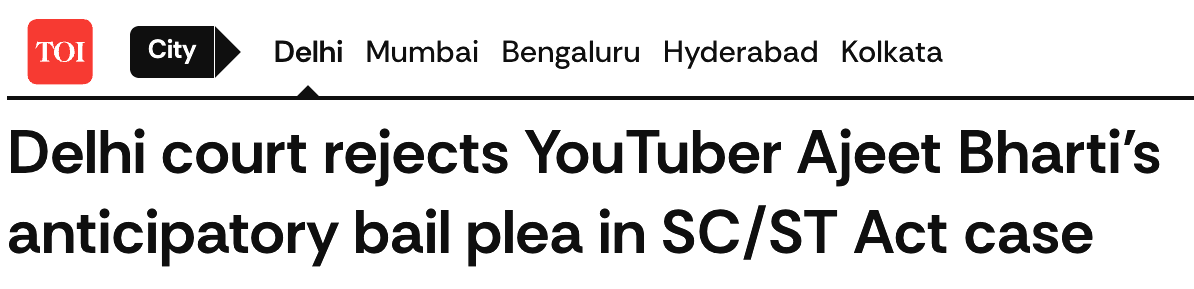
Anticipatory bail has just been denied to @ajeetbharti in the case where the FIR against him invoked draconian SC/ST act provisions. Ajeet's remarks were a reaction to provocation involving his sister. He could be jailed for up to 7 years.
I stand with Ajeet. And so should you.
In 2005, a 39 year old separatist leader from Srinagar went to Pakistan to gather support for his campaign.
At one of those events he met a 19 year old woman from a well connected Karachi family.
They married 4 years later. In the 17 years after that, they were almost never in the same country. But she became the loudest voice in the world for his cause and Pakistani propaganda.
Her name is Mushaal Hussein Mullick.
She was born in Karachi on 23rd October 1986. Her father was an economist. Her mother ran the women's wing of a big Pakistani political party. She studied in London.
The man she married is Yasin Malik. He is the chairman of the Jammu Kashmir Liberation Front. That is the group that started the armed insurgency in Kashmir at the end of the 1980s.
Now look at what this marriage actually did.
It gave Pakistan a citizen with a personal reason to talk about Kashmir everywhere in the world.
That matters more than it sounds.
If a Pakistani official stands up at the United Nations and talks about Kashmir, everyone knows what he is doing. He is dismissed.
A wife talking about her husband is different. She cannot be called a paid lobbyist. She cannot be accused of following orders. She is simply a woman worried about the man she married.
That is a very hard thing to argue against in public. And she used it fully.
She campaigned at the United Nations. She wrote to human rights organisations. She gave interviews around the world. She called his imprisonment a war crime.
Every single time, the Kashmir issue travelled with her.
In 2018 Pakistan gave her a national women's rights award. In 2020 she received a United Nations Women's award for peace and human rights.
Then in August 2023 the government of Pakistan made it official. She was appointed adviser to the Prime Minister on human rights and women's empowerment. She held that post until March 2025.
Think about what that means.
For 3 years, Pakistan's official voice on human rights was the wife of a man serving life imprisonment in India for funding terrorism. A man who is also an accused in the kidnapping of a Home Minister's daughter, in the killing of 4 unarmed Indian Air Force men at a bus stop in Srinagar, and in the murder of a Kashmiri Pandit nurse named Sarla Bhat.
Now here is the part that tells you the most.
In 17 years of marriage, she never lived with him. She never lived in India. He never lived in Pakistan. He has said he was not allowed to speak to her by phone or video call for the last 8 years.
By any normal meaning of the word, it was not a marriage.
It was a title. It was an arrangement.
And a title was exactly what was useful. Not a wife in a house. A wife on a stage.
Was it planned that way from the day they met in 2005? Nobody outside can prove that.
What can be said is what happened.
A 19 year old met a man 20 years older at a political meeting. 18 years later she was a minister in her own government, and the most quoted voice anywhere on Earth for a man sitting in Tihar Jail.
On 2nd September 2026, from that jail, he filed papers in a Srinagar court. He said he would not fight the murder trial, and the court could hang him if it wished.
In the same papers, he ended the marriage. He said he did not want her to spend her life as a widow, and told her to start again.
The campaign will carry on. It just will not need the certificate any more.
Both The Government of India and Supreme Court have surrendered before the Cockroach Janta Party. The consequences of this capitulation will be serious in the days ahead.
As always, the police are left with no one willing to stand by them. If this is the message being sent, then perhaps, during the next riot, the police should simply step aside and let rioters and criminals do as they please. After all, why should the police risk their lives when the system refuses to stand behind them?
Is this really the message we want to send?
#WATCH | Rajgarh, Madhya Pradesh: Surendra Singh Chaudhary, a 21-year-old https://t.co/FSeJ8UZLDX. student from Biaora, Rajgarh district, launches a single-handed cleanup campaign for the polluted Ajnar River.
Known on social media as 'Bittu Tabahi', Surendra started the drive on Jan 26, 2026, navigating health risks like limb infections & encountering snakes while cleaning debris near a local temple. The local municipality has also supported his campaign by providing JCB and Poclain machines to remove accumulated old waste and polythene.
(Visuals from the Ajnar River)
If one has never listened to the story of Yadunath (Krishna, Lord of the Yadus)
Then he is like one who has made his head the home of worms .
the tongue ,which doesn’t praise Krishna, is like a vine of poison
@GurpreetR64837 जहां छिटपुट बार “अल्लाह” का वर्णन है वो मुसलमानों को सनातन धर्म समझाने का प्रयास है। उदाहरण ये सुनो।
गुरबाणी इसलामिक विचारधारा का सिरे से नकारती है लेकिन बिना वैष्णव पटल के ऊटपटाँग बन जाती है।
और भाई कौन तुम खोतों से जुड़ना चाहता? यह और भी बड़ी गलतफहमी है!
On the joyous occasion of Shri Krishna Janmashtami, I recall in our childhood in Sadh Nagar, Palam Colony, Delhi, there lived a Sikh gentleman JS Sethi who had a small Gurdwara sahib at his home. He was an officer in the Railways. He, his wife and his mother used to do kirtan. As a visitor there I would also learnt to play dholak in the kirtan. He would take out a few parbhatferis (प्रभात फेरी) on Janamasthami with me playing dholak in the front. Still vaguely remember a few lines:
हरि गोविंद गोपाल गाते चलो,
हरि गोविंद गोपाल गाते चलो,
नाम जपते चलो,कर्म करते चलो,
नाम धन का ख़ज़ाना लुटाते चलो,
हरि गोविंद गोपाल गाते चलो….
कँवल नैन मधुर बैन (Kaval Nain Madhur Bain) श्री गुरु ग्रंथ ਸਾਹਿਬ (Guru Granth Sahib Ji) में दर्ज पाँचवें पातशाह श्री गुरु अर्जन देव जी द्वारा रचित एक प्रसिद्ध शबद/संवैया (Svaiyay Mehl 5) की पंक्ति है।
मूल पंक्ति (Gurbani Line)"ਕਵਲ ਨੈਨ ਮਧੁਰ ਬੈਨ ਕੋਟਿ ਸੈਨ ਸੰਗ ਸੋਭ ਕਹਤ ਮਾ ਜਸੋਦ ਜਿਸਹਿ ਦਹੀ ਭਾਤੁ ਖਾਹਿ ਜੀਉ ॥"(कवल नैन मधुर बैन कोटि सैन संग सोभ कहत मा जसोद जिसਹਿ दही भातु खाहि जीਉ)
शब्दों का अर्थ (Word Meanings)कवल नैन (Kaval Nain): कमल के फूल जैसे सुंदर और बड़े नेत्रों वाले (यहाँ श्री कृष्ण के रूप का वर्णन है)।मधुर बैन (Madhur Bain): मीठे और प्यारे वचन बोलने वाले।कोटि सैन (Koti Sain): करोड़ों सैनिकों या सखाओं/साथियों के समूह से घिरे हुए।संग सोभ (Sang Sobh): जिनके साथ यह शोभा बढ़ती है।कहत मा जसोद (Kahat Ma Jasod): जिन्हें माता यशोदा पुकारती हैं।जिसਹਿ दही भातु ਖਾਹਿ ਜੀਉ (Dahi Bhatu Khahi): और जो प्रेम से दही-भात (दही और चावल) खाते हैं।
Beautiful hymn by Sikh Guru Nanak Dev in deep love & humble devotion of Shri Krishna. Krishna—the complete AND playful manifestation of divine acc to Hindus, expressing the vastness of Indic thought & greatness of Hindu civilization. Shubh Janmashtami all!
1) Earliest Sikh historical source records:
है कनियन को पंथ प्रताप
कनिया सेवी सतिगुरू आप
Girls have [Khalsa] sect’s splendor/protection,
Our Guru [Gobind Singh] himself served Devi.
Far from reducing her to genitalia [literally ‘aurat’ in Arabic] all Hindu Kshatriyas worship Durga, seek blessings from the Goddess - in their Dharma the feminine serves as the primary manifestation of the unmanifest divine.
2) Jauhars didn’t happen only in middle ages. The fire kept smouldering. Here’s eyewitness account from 20th century near Jhang.
Historian KS Lal's research concludes that the average life expectancy of a Hindu woman in Muslim harems was 1 year.
A Hindu noble woman was raped by the Sultan, his brothers, then his generals and finally passed over to their homosexual servants. Most women would succumb to deep tearing and internal sexual organ damage.
What bravery is it to live this life, Swara? I am sure you would know.







![puneet_sahani's tweet photo. 1) Earliest Sikh historical source records:
है कनियन को पंथ प्रताप
कनिया सेवी सतिगुरू आप
Girls have [Khalsa] sect’s splendor/protection,
Our Guru [Gobind Singh] himself served Devi.
Far from reducing her to genitalia [literally ‘aurat’ in Arabic] all Hindu Kshatriyas worship Durga, seek blessings from the Goddess - in their Dharma the feminine serves as the primary manifestation of the unmanifest divine.
2) Jauhars didn’t happen only in middle ages. The fire kept smouldering. Here’s eyewitness account from 20th century near Jhang.](https://pbs.twimg.com/media/HRSRquDXoAIqbKB.jpg)


