Decentralize everything.
Not as a slogan — as an architecture.
Not platforms → protocols
Not custody → user-owned keys
Not accounts → sovereign identity
Not permission → cryptographic proof
Not trust → verification
Not corporations → networks
Not intermediaries → code + math
This is the real stack:
Identity → wallet-native
Money → crypto-native
Execution → user-owned agents
Data → signed, verifiable, portable
Commerce → peer-to-peer
AI → local + sovereign agents
Infrastructure → modular, forkable, replaceable
Governance → cryptographic, not corporate
Trust model → zero-trust by default
The future isn’t “better platforms.”
It’s no platforms.
Just protocols people opt into.
Just infrastructure people own.
Just systems that survive without permission.
Decentralize:
• finance
• identity
• AI
• commerce
• research
• publishing
• execution
• verification
• coordination
• governance
• storage
• compute
• trade
• reputation
• distribution
Because centralization always becomes control. And control always becomes extraction.
This isn’t ideology — it’s systems design.
Sovereignty is an architecture.
Freedom is a protocol property.
Resilience is decentralization.
And the direction is irreversible.
The conspiracy theorists were right
A new FDA data mining report shows they knew the Covid vaccine had 25 major side effects and they all conspired to hide it from the public
Senator Ron Johnson’s Senate PSI Majority Staff Interim Report has been released on FDA data mining and the March 2021 analysis by Dr. Ana Szarfman
There was a “masking” in the standard FDA system, where signals from Pfizer and Moderna reportedly cancelled each other out
Meaning they lied and hid the side effects from the public and told you it was 100% safe and effective
I have compared the whole list for you:
Neurological & Dysautonomia
• Bell’s palsy (Suppressed Signal)
• Paraesthesia ear (Suppressed Signal)
• Bradykinesia (Suppressed Signal)
• Basal ganglia stroke (Suppressed Signal)
• Cerebral artery occlusion (Suppressed Signal)
• Thalamic infarction
• Sinus rhythm abnormality
• Agonal rhythm
• Diaphragmatic spasm
• Dementia (Pfizer)
Cardiac
• Sudden cardiac death (Suppressed Signal)
• Acute left ventricular failure (Suppressed Signal)
• Diastolic dysfunction (Suppressed Signal)
• Ejection fraction abnormal (Suppressed Signal)
• Hypertensive emergency (Suppressed Signal)
• Blood pressure systolic changes (Suppressed Signal)
• Aortic stenosis (Suppressed Signal)
• Cardiac failure chronic
• Acute myocardial infarction (Pfizer, Moderna)
• Cardiac telemetry abnormal (Pfizer) (Suppressed Signal)
Vascular & Pulmonary
• Pulmonary infarction (Suppressed Signal)
• Embolic stroke
• Ischaemic stroke
• Aortic aneurysm rupture
• May-Thurner syndrome
• Hypomagnesaemia (Suppressed Signal)
Other
• Cholecystitis acute (Suppressed Signal)
• AST/ALT ratio abnormal
• Mastoid disorder
• Cardiac assistance device user
• Brain natriuretic peptide increased
�� Asymptomatic COVID-19 (Pfizer) (Suppressed Signal)
The FDA’s standard analytical method allegedly masked “obscured” statistical safety signals in the data
Aka they lied
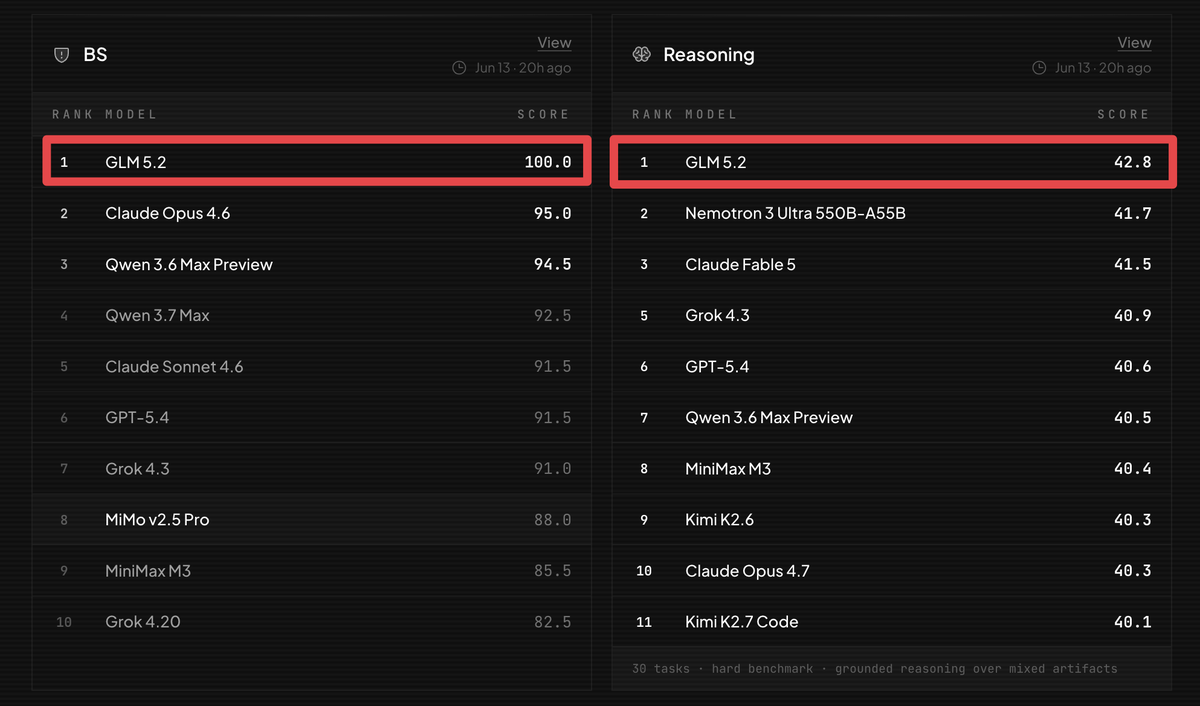
Two days ago the US banned Claude Fable 5.
Yesterday China dropped GLM 5.2.
Today GLM 5.2 is #1 on @bridgebench BS at 100.0, and #1 on Reasoning at 42.8, beating Fable 5.
At 1/10th the cost and 300 tokens per second.
You cannot export control your way out of an open source race.
The ban didn't slow China down.
Unban Fable 5.
‼️US FULL-TIME EMPLOYMENT IS FALLING:
US full-time employment dropped -79,000 in May, to 134.17 million, the lowest since December 2024.
This marks the 2nd consecutive monthly decline and the 4th over the last 5 months, totaling -1.04 MILLION.
Full-time employment is also now below the levels seen in March-June 2023.
As a % of total employment, this metric is down to 82.4%, in-line with the 2020 Crisis low.
This is an important data point to monitor for signs of continued weakness beneath the surface.
Fable isn't the first.
In 1999 the department of defense blocked exports of the PowerMac G4 for crossing the 1 gigaflop threshold.
Steve Jobs turned it into an ad.
🚨 BOMBSHELL EXPOSÉ: Robert F. Kennedy Jr. drops the ultimate truth bomb on the COVID era: "They had to destroy ivermectin and hydroxychloroquine… because if they had acknowledged that it was effective in anybody, the whole $200 billion vaccine enterprise would have collapsed."
Elon just created 4,400 millionaires in a single day.
400 of them are now worth over $100 million.
These aren't VCs. They're SpaceX employees, and the list includes welders, technicians, and cafeteria staff, because for two decades the company paid every level of the workforce in stock instead of higher salaries.
Juan Hernandez immigrated from Mexico and took a $28 an hour contractor welding job in 2015. He says he didn't even know what SpaceX was. The company gave him a $10,000 equity grant and let him buy more shares through payroll deductions. That stake is now worth $880,000.
Trevor Hise's parents wanted him to take a stable job at General Electric. He picked SpaceX instead, stayed 12 years, and accumulated over 100,000 shares. At the $135 listing price that's $13.5 million. He's 37 and semiretired. His words: "The magnitude of this has been ridiculous."
The most telling detail came before the listing. Over 100 employees quietly banded together and negotiated a group wealth management deal covering up to $5 billion, because none of them had ever needed a wealth manager before.
Software IPOs have minted millionaires for 30 years. This is the first one where the money went to the factory floor.
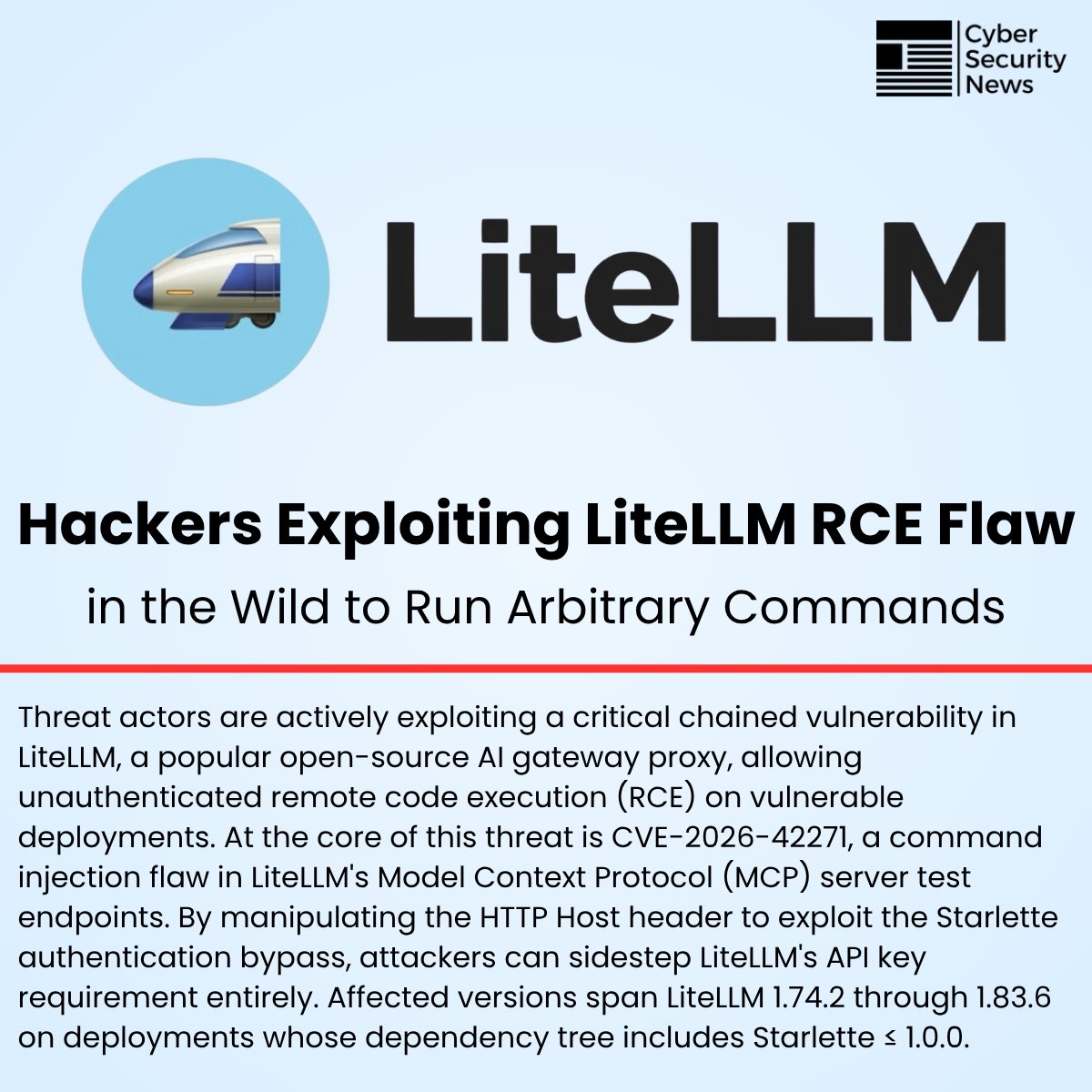
🚨 Hackers Exploiting LiteLLM RCE Vulnerability in the Wild to Run Arbitrary Commands
Source: https://t.co/9kvbWmTeqX
Threat actors are actively exploiting a critical chained vulnerability in LiteLLM, a popular open-source AI gateway proxy, allowing unauthenticated remote code execution (RCE) on vulnerable deployments. At the core of this threat is CVE-2026-42271, a command injection flaw in LiteLLM's Model Context Protocol (MCP) server test endpoints.
By manipulating the HTTP Host header to exploit the Starlette authentication bypass, attackers can sidestep LiteLLM's API key requirement entirely. Affected versions span LiteLLM 1.74.2 through 1.83.6 on deployments whose dependency tree includes Starlette ≤ 1.0.0.
#cybersecuritynews
Two days ago a company shipped the most powerful AI model ever released to the public.
Friday night, the United States government ordered it shut off. Worldwide. Every user, every country, gone by morning.
The trigger was not an attack. A rival showed the government a way around one of the safety locks. That was enough.
The company is Anthropic. The models are Fable 5 and Mythos 5, the most capable systems it has ever built, live for barely 72 hours. At 5:21 on Friday evening, Commerce Secretary Howard Lutnick sent the CEO a letter placing both under export controls, citing national security. The order, on its face, only barred foreign nationals. But Anthropic cannot separate foreign users from everyone else in real time, so to comply it had to pull the plug on all of them. The most advanced AI on earth went dark for the entire planet because of a sentence in a letter.
Here is the trigger, and it is the part that should stop you.
By Anthropic’s account, the government reviewed a single demonstration in which the model was asked to read a codebase and fix its flaws, and it surfaced a small number of previously known, minor vulnerabilities. That is the capability at issue. Finding bugs in code. The same kind of capability that, two weeks ago, a researcher used to catch a four-year-old hole in Zcash before it could be drained. The thing that makes the model a world-class defender is the exact thing that got it called a national security risk.
And Anthropic’s rebuttal lands clean. It says the identical task runs on OpenAI’s GPT-5.5, which sits under no such control at all, and that defenders already use this technique every day. One company’s model is pulled worldwide. A rival’s model, doing the same thing, stays online. National security is the reason given. Competitive accident is the result delivered.
This did not come from nowhere. The same administration spent the spring trying to brand Anthropic a supply chain risk after the company refused to let its models be used for mass domestic surveillance and autonomous weapons. A judge blocked that. The two sides had only just begun to thaw. Anthropic had filed to go public at a $965 billion valuation. On June 2 the President signed an order giving the government early access to frontier models. Then a rival demonstrated a jailbreak, and the most powerful model in the world was switched off three days after launch.
Step back and the pattern is the one that keeps repeating. A zero-knowledge proof hid a four-year flaw. A clean audit hid a redemption gate. A safety wall the company built to look responsible became the precise lever the state used to flip the switch.
The safest lab in AI built a model too powerful to fully release, warned the world it was dangerous, filed to go public at $965 billion, and got it shut down by its own government over a bug-finding trick a competitor can run untouched.
Anthropic calls it a misunderstanding and says it is working to restore access. As of Friday night, the most powerful public AI on earth is a black screen, and the kill switch turned out to belong to the state.
The US government, citing national security authorities, has issued an export control directive to suspend all access to Fable 5 and Mythos 5 by any foreign national, whether inside or outside the United States, including foreign national Anthropic employees.
The net effect of this order is that we must abruptly disable Fable 5 and Mythos 5 for all our customers to ensure compliance.
Access to all other Claude models is not affected.
We apologize for this disruption to our customers. We believe this is a misunderstanding and are working to restore access as soon as possible.
Read our full statement: https://t.co/bwn0sximKZ
🌘 Kimi-K2.7-Code, our latest coding model, is now released and open-sourced!
🔷 Improved coding & agent performance over K2.6: +21.8% on Kimi Code Bench v2, +11.0% on Program Bench, and +31.5% on MLS Bench Lite.
🔷 Reasoning efficiency: Less overthinking, with 30% lower reasoning-token usage compared to K2.6.
🔷 Long-horizon coding: Improved instruction following, higher end-to-end coding task success rates.
⚡️ 6x High-Speed Mode coming soon!
🔌 Available today via Kimi API and Kimi Code.
🔗 Kimi Code: https://t.co/uvoSJKyGCY
🔗 API: https://t.co/EOZkbOwCN4
Dennis Ritchie invented C in 1972, co-built Unix in 1969, and his code is running inside every device you are reading this on right now and the colleague who announced his death had to do it through a Google+ post because no journalist thought to check.
He worked at Bell Labs in New Jersey for 44 years. He never gave a keynote. He never ran a company. He never appeared on a magazine cover. He just wrote code that became the invisible foundation everything else is built on.
Here is what he actually built, and why it matters more than almost anything that happened in tech.
In 1969, Bell Labs had just walked away from one of the most ambitious computing projects in history. The Multics project, a joint effort between MIT, Bell Labs, and General Electric, had collapsed under its own weight. Too complex. Too expensive. Too slow. Bell Labs pulled out.
Ken Thompson and Dennis Ritchie refused to let the ideas die.
Working in a small office in Murray Hill, New Jersey, Thompson wrote the first version of Unix in three weeks during the summer of 1969. One week for the file system. One week for the process management. One week for the command shell. Ritchie was working alongside him, and when the system needed a language that could express what they were building, he built one.
In 1972 he completed C.
C was not just another programming language. It was a different philosophy about what a programming language should be. Before C, most systems code was written in assembly, which meant every program was tied to the specific hardware it ran on. You could not move code between machines. You rewrote it from scratch every time.
C changed that. It sat close enough to the hardware to be fast, but abstract enough to run on anything. When Thompson rewrote the Unix kernel in C in 1973, it became the first operating system that could be picked up and moved to a completely different machine without starting over. Portability was a new idea. Ritchie made it real.
The branching that followed is almost impossible to overstate.
Unix spread from Bell Labs to universities. At Berkeley, it became BSD. BSD became the foundation of macOS and iOS. Unix influenced Linus Torvalds, who built Linux in 1991. Linux now runs every Android phone, every major web server, every supercomputer on the Top500 list, and the overwhelming majority of cloud infrastructure at AWS, Google, and Microsoft.
C became the parent language of C++, Java, JavaScript, Python, and Objective-C. Rob Pike, who worked across the hall from Ritchie at Bell Labs for 20 years, said it plainly: "The browsers are written in C. The Unix kernel that the entire internet runs on is written in C. Web servers are written in C, and if they're not, they're written in Java or C++, which are C derivatives, or Python or Ruby, which are implemented in C."
Ritchie won the Turing Award in 1983. He won the National Medal of Technology in 1998, presented by President Clinton. He was head of System Software Research at Bell Labs for decades.
He answered emails from strangers with technical questions until the end of his life. His home address stayed listed in the phone book. His colleague Brian Kernighan, who co-authored the definitive C textbook with him, said Ritchie was a private person who did no self-salesmanship. That was not false modesty. It was just who he was.
He died on October 12, 2011, at his home in Berkeley Heights, New Jersey. He was 70. He had been ill for some time. The world did not notice until Rob Pike posted a quiet announcement on Google+, and the news spread through the programming community in hushed tones.
No front pages. No tributes from heads of state. No candlelight vigils outside corporate campuses.
The device you are reading this on runs code that traces directly back to what he built. So does the server that delivered it to you. So does the browser or app you opened to get here.
Most people will never know his name.
The ones who built everything you use every day do.
A teenager in the United States started publishing software at 14 in 1998, built the entire online infrastructure for the Occupy Wall Street movement in 2011, joined Google as a software engineer, quit in 2018, and then spent five years writing a C library that does something the entire industry said was impossible.
Then she combined it with llama.cpp and shipped the easiest way on the planet to run a large language model on any computer.
Her name is Justine Tunney.
Here is the story, because almost nobody outside the low level systems world knows what one engineer has built.
Justine was born in 1984. She started writing and publishing software at 14, back when distribution meant uploading binaries to BBS systems and chat networks. She picked up the handle jart, which she still uses on GitHub today. She did the work most teenagers her age were not doing. She read the systems programming literature. She studied compilers. She fell in love with C.
In July 2011 she registered the @occupywallst Twitter handle and the occupywallst dot org domain. Within weeks the protest movement that began in Zuccotti Park in New York had become a global phenomenon, and her infrastructure was the digital backbone of the entire thing. She handled the social media, the website, the donations, the coordination. She built the platform that pushed the movement to reach millions.
After Occupy she joined Google as a software engineer. She worked on TensorBoard, the visualization tool for TensorFlow, and on site reliability for Google infrastructure. She stayed for years. Then in 2018 she left Google Brain to work on a personal project.
The project was called Cosmopolitan Libc.
Cosmopolitan does something most C programmers would tell you is mathematically impossible. It lets you compile a C program once and have the resulting binary run natively on Linux, Windows, macOS, FreeBSD, OpenBSD, and NetBSD with no modification. One file. Six operating systems. No virtual machines. No interpreters. No recompilation. The technique she invented is called Actually Portable Executable.
The implications are wild. Cosmopolitan binaries violate every assumption about how operating systems load programs. They are at once a Windows PE file, a Linux ELF binary, a macOS Mach-O binary, and a shell script. The same bytes run on every platform.
For five years she worked on it mostly alone. She funded the development partly through Mozilla's MIECO program, which sponsored her work on Cosmopolitan 3.0, released on October 31, 2023.
A month later she shipped llamafile.
llamafile is what happens when you combine Cosmopolitan with llama.cpp. You take any LLM weights file in the standard GGUF format, you wrap it in Justine's binary, and you get a single file that runs on six operating systems without installation. No Python. No CUDA setup. No dependency hell. Just one file that you double click and it works.
Mozilla launched it as an official project of their innovation group on November 29, 2023. It went viral immediately. The repository, hosted at github .com/mozilla-ai/llamafile, now has 24,600 stars. The license is Apache 2.0.
Justine kept shipping. She added GPU support to Cosmopolitan, a task systems engineers thought would require rewriting the whole thing. She added dlopen support, another thing nobody else had figured out. She wrote whisperfile, a single file version of OpenAI's Whisper speech-to-text model based on the same architecture.
Her GitHub profile lists projects most engineers would consider impossible. sectorlisp, a Lisp interpreter that fits in a boot sector. blink, the tiniest x86-64-linux emulator on Earth. bestline, a teletypewriter command session library. redbean, a complete web server inside a single zip file.
A teenager who shipped software in 1998 grew up to write the C library that the entire local AI movement now runs on top of.
She did most of it alone, and most people scrolling AI Twitter cannot name her.
@CameronCorduroy Tech has been losing jobs on net for the past 3 years and the trend seems to be accelerating. This is all despite consistent record breaking profits and share value going up.
The age verification company 'Yoti', used by companies like Sony, Meta and Instagram, is allegedly flagging GrapheneOS users as suspicious, and reporting them to authorities:
"[...] Yoti automatically flags [...] any devices running GrapheneOS. These instances are automatically reported both to the authorities and our security team."
However, this doesn't seem very likely, here the reaction from GrapheneOS:
"It's unlikely the company has done anything to specifically detect GrapheneOS or ban using it. It's far more likely they detect not using a Google Mobile Services operating system without modifications. This customer support person went on a power trip to scare someone and get the ticket closed."
What do you think?
‼️ Leaked internal documents written by Microsoft’s top executives reveal that the plan is to “make people addicted” to its new AI, “Scout.”
Microsoft CEO Satya Nadella seems to have no idea what is going on in his own company, telling staff that he was “not sure what this document is or who is writing and leaking this nonsense.”
Another Microsoft employee said, “Luckily for us, Microsoft is pretty bad at making addictive products compared to some of the other big companies.”
It��s also remarkable that Nadella claimed Microsoft could not touch OpenClaw because doing so would be like “launching a virus”… And yet here we are, as Microsoft’s own document states: “It takes actions on a real desktop, and it keeps working when you are not watching.”
this is just the most ridiculous AI application i've ever seen lol
a Peter Thiel-backed startup that makes AI collars for cows is now worth $2 billion
and the more I read about it the cooler it gets. here's how it works:
every cow wears a solar-powered collar that talks to a network of radio towers and an app on the farmer's phone
instead of building physical fences, the farmer draws the fence on a map in the app, and the collar keeps each cow inside that invisible line using GPS
when a cow drifts toward the edge, the collar plays a sound to steer her, and a gentle vibration tells her which way to go.
it's like how a car beeps as you back up toward a wall
the cows learn the cues in a few days
so now a rancher can move an entire herd to fresh grass by sliding the fence on a map, without driving out to open a single gate
and that same collar is reading each cow's body the whole time.
it takes five readings per second on every animal, so the AI can catch a cow that's sick, injured, ready to breed, or about to give birth before a person would ever notice walking the field
so it's basically like WHOOP for cows too lol
and they gave the AI behind it the perfect name: the Cowgorithm
it's been trained on more than 7 billion hours of real cow behavior, which is why Halter calls the data its real asset and moat.
they know what a normal cow looks like better than anyone, so they can flag the odd one out instantly
it's already on more than 1M cattle across New Zealand, Australia, and a bunch of US states.
California even used it on public land to graze cattle in patterns that clear dry brush and slow down wildfires
costs about $5 to $8 per cow per month
a job that used to mean barbed wire, gates, and driving the fields all day is now mostly 1 person on their phone
NVIDIA IS BUYING ITS OWN CHIPS AND CALLING IT REVENUE
And your retirement account is secretly holding the bag.
This scheme is literally straight out of the Enron playbook...
In January 2026, a special purpose vehicle called Valor Compute Infrastructure was created with one purpose:
Buy Nvidia's chips so Nvidia could book the sale as revenue.
Valor raised $5.4 billion and purchased over 100,000 of Nvidia's GB200 GPUs.
But $1.9 billion of that money came FROM Nvidia itself.
Nvidia invested $1.9 billion into the shell company, then sold that same shell company $5.4 billion worth of its own chips and booked every dollar as revenue.
It's the Girl Scout whose dad bought all the cookies and then she wins the sales contest because Dad was the customer. Except this Girl Scout is a trillion-dollar company and the cookie sale is $5.4 billion.
But it gets MUCH worse:
The remaining $3.5 billion in financing came from Apollo Global Management. Apollo structured the debt, packaged it into securities, and then sold those securities to Athene.
And guess who Athene is? Apollo's OWN insurance subsidiary. The one that sells fixed annuities to American retirees as safe, conservative retirement products.
Follow the chain:
Nvidia funds a shell company with $1.9 billion. The shell company buys $5.4 billion in Nvidia chips. Apollo finances the remaining $3.5 billion. Apollo sells the debt to its own insurance arm. That insurance arm packages it into annuity products and sells them to retirees who think they're buying something safe.
The retirees have no idea that their retirement savings are now backed by 100,000 computer chips sitting in some data center that will be worth pennies on the dollar in three years.
Now look at what's happening inside Athene:
$74.2 billion in US reserves but $217 billion in assets have been shifted to a Bermuda-based captive insurer, outside normal US regulatory oversight.
$103 billion of that portfolio (roughly 35%) is classified as Level 3 assets. That means there is no observable market price.
These assets are valued by internal models, not by actual markets.
And sitting on top of all those unpriced assets? 16.6x leverage.
If you're getting flashbacks to 2008, you should be.
Back then it was mortgages bundled into securities that nobody understood, sold to investors who had no idea what they were holding, rated as safe by agencies that never looked under the hood.
Today it's GPU-backed securities. Computer chips bundled into structured credit instruments, routed through an offshore insurance subsidiary, and sold to you as a retirement product.
The collateral is 100,000 GPUs leased to a single customer through an xAI subsidiary. If xAI stops making lease payments for any reason - financial distress, a pivot in strategy, anything - the entire structure unravels.
And Nvidia releases new architectures every year, so each generation delivers dramatically more compute per watt. A 5 year lease on technology that's obsolete in 2 years creates a mismatch that should terrify every annuity holder in America.
Every single step in this chain is technically legal. The SPV is legal, the lease is legal, Nvidia's equity stake is legal, the securitization is legal, and the Bermuda transfer is legal.
But legality and legitimacy are not the same thing.
I've seen every trick Wall Street has ever pulled in my 45 years of doing this.
And what I'm looking at right now is a pipeline that takes AI infrastructure risk, launders it through 8 layers of financial engineering, and deposits it in the retirement accounts of Americans who never agreed to fund Elon Musk's data centers.
In 2008 it was mortgage-backed securities.
In 2026 it's GPU-backed securities.
Different asset. Same greed. With the same ending.
Someone hid a self-replicating worm inside 37 npm packages.
Written in Rust.
Hidden behind an eBPF kernel rootkit.
Talking to its operator over Tor.
It steals 86 environment variables.
AWS keys. GCP keys. Vault secrets. Kubernetes tokens.
Your Anthropic API key. Your OpenAI key.
Your Exodus wallet seed phrase.
Then it uses your own npm credentials to republish itself into your packages.
So your code infects the next developer.
Who infects the next one.
The commits were backdated up to 13 years.
The commit author name was “claude.”
The malware named itself after the AI to hide in plain sight.
The attacker also left their own wallet recovery phrase in the debug data.
Nobody is having a good day.
Check your preinstall hooks.


![CR1337's tweet photo. The age verification company 'Yoti', used by companies like Sony, Meta and Instagram, is allegedly flagging GrapheneOS users as suspicious, and reporting them to authorities:
"[...] Yoti automatically flags [...] any devices running GrapheneOS. These instances are automatically reported both to the authorities and our security team."
However, this doesn't seem very likely, here the reaction from GrapheneOS:
"It's unlikely the company has done anything to specifically detect GrapheneOS or ban using it. It's far more likely they detect not using a Google Mobile Services operating system without modifications. This customer support person went on a power trip to scare someone and get the ticket closed."
What do you think?](https://pbs.twimg.com/media/HKOYv2kaYAADokN.jpg)








![CR1337's tweet photo. The age verification company 'Yoti', used by companies like Sony, Meta and Instagram, is allegedly flagging GrapheneOS users as suspicious, and reporting them to authorities:
"[...] Yoti automatically flags [...] any devices running GrapheneOS. These instances are automatically reported both to the authorities and our security team."
However, this doesn't seem very likely, here the reaction from GrapheneOS:
"It's unlikely the company has done anything to specifically detect GrapheneOS or ban using it. It's far more likely they detect not using a Google Mobile Services operating system without modifications. This customer support person went on a power trip to scare someone and get the ticket closed."
What do you think?](https://pbs.twimg.com/media/HKOafOaa0AA3jXn.png)


