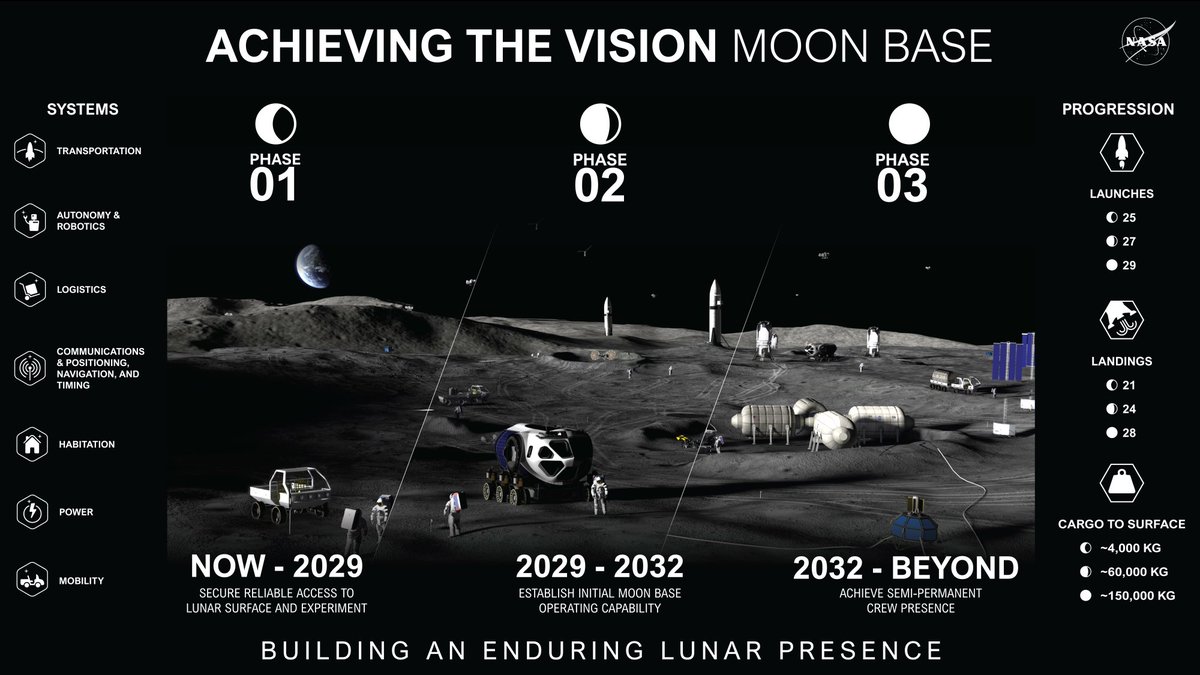
NASA just officially unveiled their master plan for a permanent Moon Base at the lunar South Pole
This is not just about flags and footprints. NASA is moving to establish an enduring, sustained human presence, and they are heavily relying on commercial innovators to build it
The roadmap is highly aggressive:
• Phase 1: Heavy robotic missions and commercial payload deliveries
• Phase 2: Semi-permanent infrastructure, including fission surface power and lunar drones
• Phase 3: A sustained, permanent human outpost
The most important takeaway is NASA explicitly stated this base is the ultimate proving ground to prepare humanity for missions to Mars
While legacy aerospace companies are still struggling to reliably get a small capsule to the ISS, NASA is setting the stage for massive lunar infrastructure....which is exactly the kind of heavy-lift planetary deployment SpaceX’s Starship was designed for
The multi-planetary economy is officially kicking off
🇫🇷 A French tax official was arrested for selling crypto investors' home addresses and financial records to criminal networks.
41 kidnappings followed. One every 2.5 days since January 2026.
The criminals didn't need to hack anything. They bought a list from someone inside the government.
France is the most dangerous country in the world right now if you hold crypto and someone knows about it 💀
Source: Le Mond
41 kidnappings of crypto holders in France in 3.5 months of 2026.
Why?
🥖 French tax officials selling crypto owners' data to criminals (Ghalia C.) + massive tax database leaks.
Now the state also wants IDs and private messages of social media users.
More data = More victims.
Food for thought.
Trump, Hormuz and the End of the Free Ride
For half a century, Western strategists have known that the Strait of Hormuz is the acute point where energy, sea power and political will intersect. That knowledge is not in dispute. What is new in this war with Iran is that the United States, under Donald Trump, has chosen not to rush to “solve” the problem. In Hegelian terms, he is refusing an easy synthesis in order to force the underlying contradiction to the surface.
The old thesis was simple: the US guarantees open sea lanes in the Gulf, and everyone else structures their economies and politics around that free insurance. Europe and the UK embraced ambitious green policies, ran down hard‑power capabilities and lectured Washington on multilateral virtue, secure in the assumption that American carriers would always appear off Hormuz. The political class behaved as if the American security guarantee were a law of nature, not a contingent choice. Their conduct today is closer to Chamberlain than Churchill: temporising, issuing statements, hoping the storm will pass without a fundamental reordering of their responsibilities.
Trump’s antithesis is to withhold the automatic guarantee at the moment of maximum stress. Militarily, the US can break Iran’s residual ability to contest the Strait; that is not the binding constraint. The point is to delay that act. By allowing a closure or semi‑closure to bite, Trump ensures that the immediate pain is concentrated in exactly the jurisdictions that have most conspicuously free‑ridden on US power: the EU and the UK. Their industries, consumers and energy‑transition assumptions are exposed.
In that context, his reported blunt message to European and British leaders, you need the oil out of the Strait more than we do; why don’t you go and take it? Is not a throwaway line. It is the verbalisation of the antithesis. It openly reverses the traditional presumption that America will carry the burden while its allies emote from the sidelines.
In this dialectic, the prize is not simply the reopening of a chokepoint. The prize is a reordered system in which the United States effectively arbitrages and controls the global flow of oil. A world in which US‑aligned production in the Americas plus a discretionary capability to secure,or not secure, Hormuz places Washington at the centre of the hydrocarbon chessboard. For that strategic end, a rapid restoration of the old status quo would be counterproductive.
A quick, surgical “fix” of Hormuz would short‑circuit the dialectic. If Trump rapidly crushed Iran’s remaining coastal capabilities, swept the mines and escorted tankers back through the Strait, Europe and the UK would heave a sigh of relief and return to business as usual: underfunded militaries, maximalist green posturing and performative disdain for US power, all underwritten by that same power. The contradiction between their dependence and their posture would remain latent.
By declining to supply the synthesis on demand, and by explicitly telling London and Brussels to “go and take it” themselves, Trump forces a reckoning. European and British leaders must confront the fact that their energy systems, their industrial bases and their geopolitical sermons all rest on an American hard‑power foundation they neither finance nor politically respect. The longer the contradiction is allowed to unfold, the stronger the eventual synthesis can be: a new order in which access to secure flows, Hormuz, Venezuela and beyond, is explicitly conditional on real contributions, not assumed as a right.
In that sense, the delay in “taking” the Strait, and the challenge issued to US allies to do it themselves, is not indecision. It is the negative moment Hegel insisted was necessary for history to move. Only by withholding the old guarantee, and by saying so out loud to those who depended on it, can Trump hope to end the free ride.
⚡️He is doing narrative conditioning. Simple as that.
Germany’s elite knows the model is breaking under four pressures:
1. Demographics
2. Energy constraint
3. Security spending
4. Slow state capacity
They cannot say that cleanly because it implies:
•benefits get cut
•retirement gets pushed out
•taxes go up
•the country becomes less comfortable by design
So they pick the culturally acceptable scapegoat: “people are lazy.”
That is the mask.
The real mechanism:
Germany is losing because:
1. Capital formation has slowed
2. Deployment speed is glacial
3. Risk and experimentation are punished
4. Regulation became a second economy
5. Energy pricing became a structural handicap
6. The population pyramid inverted
Work more hours does not fix any of those. It just extracts more from the same clogged machine.
The deeper truth:
This is a reallocation war.
China is a machine that converts coordination into output.
Germany is a machine that converts coordination into process.
When the world shifts into a speed competition, process cultures get exposed.
So the state needs a new legitimacy story for why life will feel tighter even if GDP does not crater.
That story becomes:
•You must do more
•You must accept less
•You must be grateful for stability
•The problem is you, not the system
The true fork
Germany can choose:
A) Speed reform
Permitting, energy, defense industrial capacity, housing, infrastructure, AI diffusion, tax simplification
B) Austerity by culture war
Moralize, blame workers, stretch hours, hold the same bureaucracy constant, decline slower
Merz is selling B because A requires breaking sacred cows and he does not have the coalition strength to do it fast.
🧠🪱
Elons stocks aren’t wealth. If the number of Tesla shares doubled the world isn’t any richer. If the number of Tesla cars doubled, it’s measurably richer.
For him to get to $1t in capital, he has to organize labor to set the means of production in motion to produce enough consumer wealth that his companies are worth trillions. Aka he has to ship wealth to consumers.
Whoever runs on inequality isn’t a socialist. They aren’t running on “let’s build more houses or more hospitals” because they actually can’t find anyone competent who can organize labor so these things end up being built. The outcome is always just more state debt and inflation.
Umarell are men of retirement age in Italy who spend their time watching construction sites, stereotypically with hands clasped behind their back and offering unwanted advice
https://t.co/b1TIIkXxf3
WE’VE SANCTIONED: Thierry Breton, a mastermind of the Digital Services Act. In August 2024, while serving as European Commissioner for Internal Markets and Digital Services, he published a letter using the DSA to threaten @elonmusk ahead of his livestream interview with President Trump. Before the interview, Breton ominously reminded Musk of @X’s legal obligations and ongoing “formal proceedings” for alleged noncompliance with “illegal content” and “disinformation” requirements under the DSA.
Imagine a scenario in which large numbers of white people start saying that they “feel black,” and that because of this feeling, and their enjoyment of stereotypically “black behavior,” they are now not just black themselves, but the most marginalized and vulnerable type of black person.
Imagine them insisting that they should be the main focus of all activism meant to help PoC. Imagine them having operations to darken their skin and mimic stereotypically black features. Imagine them walking around in blackface, and saying it’s the exact same thing as actually being black.
Imagine them being honored as black citizens by the White House, being summoned to talk to the President about issues facing the black community, being supported by celebrities, and having laws passed to make white people who identify as black a protected class.
Imagine these people demanding membership in black organizations, insisting that they receive a share of the reparations that CA is about to pay, and demanding they be given awards created specifically to honor black achievement. Then imagine them getting their way.
Now imagine mobs of them showing up to black events that don’t include them, carrying threatening signs and air horns to drown out any speakers with noise. Imagine them coming up with slurs for any black person who doesn’t accept that white people are black if they say they are.
Imagine them calling for the rape, torture, and mass murder of any black person who disagrees with them. Imagine them getting black people doxxed, harassed, assaulted, fired from their jobs, and investigated by the police for saying that you have to be born black to be black.
Now imagine the government supporting their demands.
That’s exactly the position that women are in right now, with a few extras, like being locked in cells with dangerous men, the sexual predation of lesbians via coercion, and the increased risk of sexual assault in what used to be female-only spaces. Our oppressors are now claiming not only the right to oppress us in whole new ways, but the right to erase our identities as women and rewrite the meaning of womanhood in ways that suit - and include - them.
If you wouldn’t support this kind of behavior towards black people, you have no business supporting this kind of behavior towards women.
Just a month later and...
🇪🇺 ChatControl is back!
Now they're trying to pass an even more far reaching ChatControl law through the back door, in a form even more intrusive than the originally rejected plan, without needing any of the EU countries votes
The new proposal:
- total mandatory surveillance of ALL text chats, emails and social media in the EU
- obligatory registration of your ID/passport to your chat, email or social media account
- minimum age requirement for chat, email and social media apps of 16 (!)
The only way to stop this law is if EU countries veto it
Read more here by @echo_pbreyer:
https://t.co/Yg2iXX9uWs
This is one of the best explanations of what is going in America right now, why @ZohranKMamdani won in NYC, and what the risks are for our country and the world.
@elonmusk is the spokesperson. He is brilliant, incredibly articulate , and spot on.
What makes this video even more remarkable is that I am pretty sure but not totally sure that it is AI. Not just Elon speaking the words, but the words that are actually spoken.
For someone who has followed Elon for many years and spent a few hours with him, the tone, the choice of words, the thoughts behind them match with the Elon that we all know. But it is highly likely to be AI. The principal reason why I believe this to be so is that I don’t think Elon would have had the time to put this together.
If you want a glimpse of the future where we do not know what is real and what is fake, this is worth watching for that reason alone.
But even more importantly, what Elon says here is one of the most important things you will watch this year.
Do yourself a favor and watch this video:
https://t.co/Tw39l5H78R
And would the person who created this let us know who they are. They deserve a round of applause.
This is terrifying. Did anyone see Macron's statements?
European leaders have pledged to 'retake control' of social media with a 'European agenda of protection and regulation'.
He insisted that Europeans should only trust 'established news outlets'.
Yeah - because the biggest threat facing Europe is definitely frustrated peasants talking about all the foreigners attacking them and destroying their country - not the politicians and their open-borders policy that put them there.
How can anyone believe that online safety is about 'children'?
It is about safety for the political class.
https://t.co/GAeab10Mi1
⚡️This one is bigger than people realize.
It looks like a story about layoffs and offshoring but underneath, it’s the opening move in a structural realignment of how knowledge economies function.
Let’s unpack it layer by layer.
1. The Surface Layer - Efficiency Theater
At first glance, this is classic corporate optimization: JPMorgan cutting costs, shifting labor to cheaper markets, and leaning on AI to replace entry-level analytical grunt work.
It’s what every large organization does at the end of a long-cycle credit squeeze.
But that’s not the real story. This isn’t just about “cutting fat.”
This is about redefining the base layer of cognitive labor - the very substrate investment banking has run on for a century.
For the first time, AI has reached the point where the analyst’s toolkit is replicable: Excel modeling, pitchbook generation, financial analysis, even presentation language - all can now be synthesized faster and cheaper by large models.
2. The Deconstruction of the Knowledge Pyramid
In the old banking structure, the hierarchy looked like this:
Analysts → Associates → VPs → MDs.
The analysts fed the machine. They learned the system through repetition. They became the system through pattern absorption.
AI collapses that progression.
When a model can instantly perform the repetitive work that trains future MDs, you decouple knowledge transfer from apprenticeship.
This means:
•You no longer need the bottom of the pyramid to sustain the top.
•You break the feedback loop that produced institutional memory.
•You accelerate institutional decay under the illusion of efficiency.
The junior layer is where intelligence is born in an organization, it’s the metabolic zone where new models of thinking form.
When you replace that with automation and outsourcing, you hollow out the core that generates future decision-makers.
This is the first phase of cognitive deflation - when capital preserves profit at the cost of its own long-term intelligence.
3. The Paradox
AI’s value is pattern recognition, but pattern recognition relies on human imagination to feed it.
Once you fire the humans who generate unique patterns - the ones who deviate, notice anomalies, or see opportunities - the AI begins eating its own exhaust.
The reflexive loop becomes closed instead of open.
Models learn from models.
Reality becomes derivative.
This is the same structural failure that caused the 2008 crash - recursive risk modeling divorced from reality.
So while JPMorgan sees short-term gains, it’s actually participating in a slow internal collapse of cognitive diversity.
4. The Global Labor Arbitrage 2.0
Outsourcing to India and Argentina is not new.
But this time, it’s not just labor, it’s thinking.
We’re entering a phase where intellectual arbitrage replaces physical or manufacturing arbitrage.
The West once outsourced production. Now it’s outsourcing cognition.
And here’s the irony: in doing so, it accelerates the eastward migration of intellectual capital.
India is not just absorbing tasks, it’s absorbing competence.
Every offshored analyst role creates new local expertise, which will eventually loop back as competition to the very system that outsourced it.
This is how empires dissolve quietly - through the export of their own capacity to think.
5. Deeper Compression
The monetary system is becoming self-referential - a network that thinks in spreadsheets, speaks in basis points, and feels in data.
The humans at the bottom were the neurons.
Now the neurons are being replaced by circuits.
But here’s the paradox:
Every system that automates cognition eventually hungers for consciousness.
When everything becomes efficient, the only thing of value is awareness.
So while JPMorgan believes it’s replacing humans with code, what it’s really doing is creating the vacuum that demands higher forms of human intelligence to fill it.
Here is the real punchline of the #Clarity Act, stripped to first-principles microstructure:
From “regulation by lawsuit” → “regulation by ledger.”
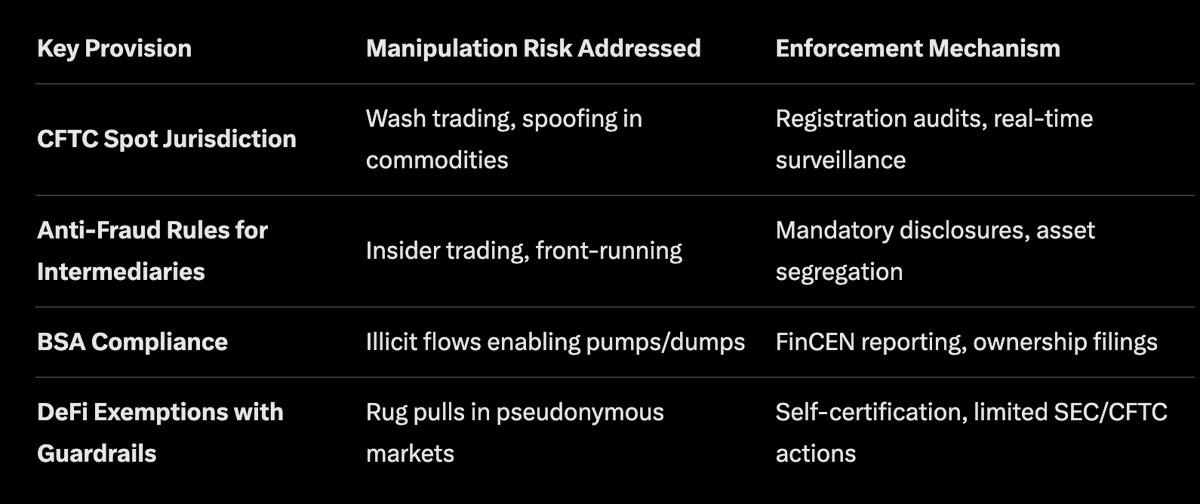
CFTC gets spot authority for digital commodities; SEC keeps disclosure for security-like tokens; BSA/FinCEN pulls flows onto auditable rails; custodians must segregate; exchanges/prime brokers must register; >5% holders disclose; DeFi gets exemptions only when no intermediary exists. Proof-of-reserves and real-time surveillance turn “claims” into attestable facts.
Immediate market physics (0–6 months):
• Wash-traded “ghost liquidity” evaporates (volumes fall 20–40% on some venues).
• Spreads widen, realized volatility rises—healthier price discovery.
• Rehypothecation risk collapses as client assets are walled off.
• Offshore spoofing engines face delisting/on-shoring or exit.
Second-order effects (6–24 months):
• U.S. liquidity quality surges: deeper NBBO-like books, tighter basis, fewer fake prints.
• BTC/ETH and fully reserved stables win (commodity-like + compliance-ready).
• Long-tail/meme tokens reliant on wash farms lose market access.
• ETF/qualified-custody pipes scale because compliance risk becomes quantifiable, not litigated.
System design insight:
Market integrity ↑ → Institutional risk capital unlocks. You trade lower vanity volumes for higher signal-to-noise and cheaper capital over time.
What to watch (hard metrics, not vibes):
1. Cancel-to-trade ratios and odd-lot share on U.S. venues.
2. Frequency/assurance level of PoR attestations.
3. Spot/futures basis and funding spikes (should compress).
4. Custody segregation breaches (should trend to zero).
5. On-shore share of global BTC/ETH volumes vs. offshore perps.
Risks to flag!
Over-broad “intermediary” definitions could centralize DeFi; proof-of-reserves must include liabilities to be meaningful.
Bottom line is this …
Clarity doesn’t pump prices … it cuts noise. That’s exactly what lets real capital arrive.
MUST READ for crypto investors - How the #Clarity Act Targets and Removes Manipulation
The "Market Structure Bill" refers to the Digital Asset Market Clarity Act of 2025 (#Clarity Act), a bipartisan U.S. legislative effort to establish a comprehensive federal framework for digital assets. It clarifies regulatory jurisdictions primarily between the Securities and Exchange Commission (SEC) for securities-like tokens and the Commodity Futures Trading Commission (CFTC) for commodities like Layer 1 tokens while addressing long standing issues like fraud and manipulation.
Crypto markets have been prone to manipulation due to weak oversight, including wash trading (fake volume), spoofing (fake orders to mislead traders), pump-and-dump schemes, and insider trading. The #Clarity Act combats this through explicit rules, enhanced enforcement, and structural safeguards. Here's a breakdown:
1. Clear Jurisdictional Split for Stronger Oversight CFTC as Primary Regulator for Spot Markets: The bill grants the CFTC exclusive authority over "digital commodities" , expanding its anti-fraud and anti-manipulation powers beyond derivatives to spot trading. This fills a regulatory gap where manipulation thrived without federal policing.
Impact: Intermediaries (exchanges, brokers) must register as Digital Commodity Brokers/Dealers (DCBs/DCDs) with a futures association, proving they aren't engaging in manipulation via audits and compliance checks. This includes real-time surveillance to detect anomalous trading patterns.
SEC's Retained Role: For "restricted digital assets" (security-like tokens), the SEC enforces disclosure rules and monitors for conflicts, but with clearer boundaries to avoid overreach. A limited SEC anti-manipulation role persists for hybrid assets.Impact: Reduces "existential labeling fights" (e.g., endless SEC lawsuits), allowing faster enforcement against bad actors without stifling secondary markets.
2. Mandatory Anti-Manipulation and Integrity Requirements
Prohibitions and Surveillance: Platforms must ensure trading is "not susceptible to manipulation," with rules mirroring traditional markets (e.g., no front-running, proper order book transparency). This includes recordkeeping, reporting, and segregation of customer assets to prevent commingling that enables theft or rigged trades.Example: Exchanges like @binance could face swift CFTC delisting for spoofing, as seen in past cases, with automated tools flagging 90%+ cancellation rates as red flags.
Disclosure Mandates: Issuers and 5%+ holders must report beneficial ownership, curbing insider trading. Platforms treat digital assets as Bank Secrecy Act (BSA) financial institutions, enabling FinCEN tracking of illicit flows.Impact: Enhances transparency—e.g., requiring proof of reserves to expose fake liquidity—directly countering wash trading, which inflates volumes by up to 40% on some exchanges.
3. Registration and Accountability for Intermediaries
New Tracks for Compliance: Creates paths for custodians, dealers, and DeFi protocols to register, with exemptions for truly decentralized activities (e.g., liquidity pools without intermediaries). Non-compliant entities risk bans.Impact: Forces offshore manipulators to onshore or exit the U.S. market, reducing "ghost walls" and bot-driven layering.