Episode 536: The Systems Librarian. Features an interview with the brand new systems librarian at Georgia Tech, Martin Patrick. Plus we talk about birds! https://t.co/NimzaGXw7N
Episode 533: Didn't You Get the Memo? @kspace of @MITLibScholarly talks about the new OSTP memo on public access to federal research, and how it might (or might not) impact academic libraries. https://t.co/WIt3X5cK7B
Episode 532: The University Archivist. Alex McGee talks about her new position at the Georgia Tech Library, and she discusses identifying and filling gaps in archival collections. https://t.co/xAx1KDmySL
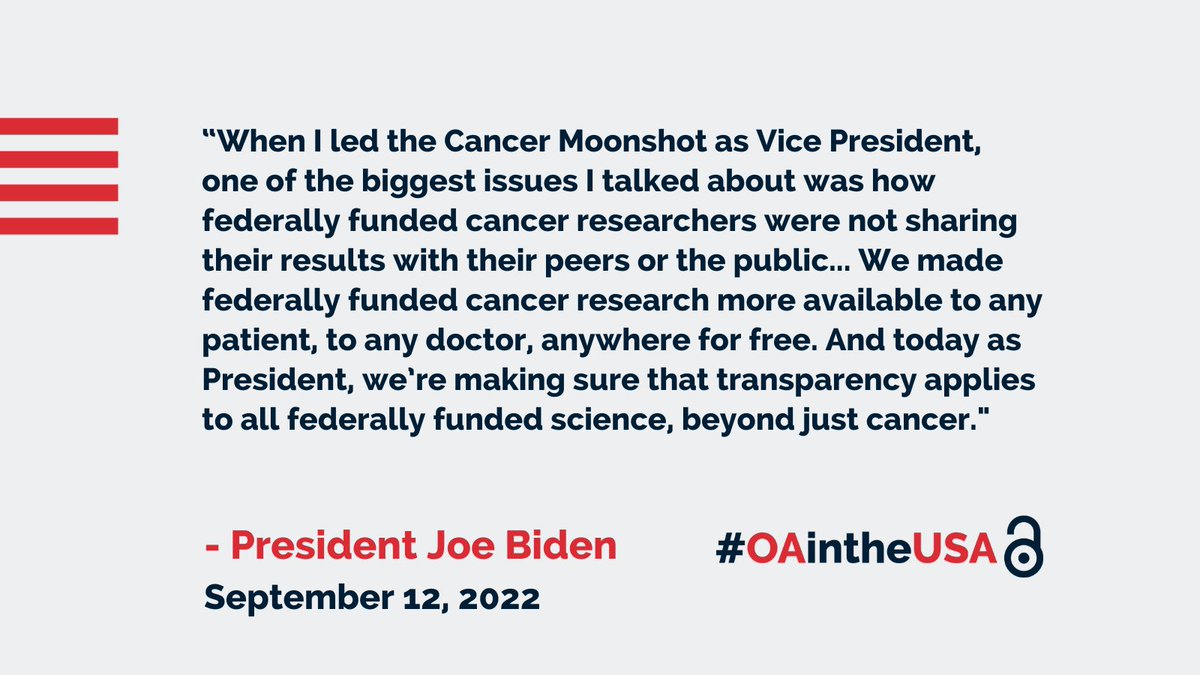
In his remarks just now on the Cancer Moonshot, @POTUS raised research sharing as "one of the biggest issues" necessary to speed discovery and highlighted his administration's work to ensure "transparency applies to all federally funded science." #OAintheUSA
Today the @WhiteHouse announced that all federally funded research will be made openly available. Importantly, it eliminates the 12-month embargo. This is the result of decades of work by @SPARC_NA, @petersuber, @mbeisen, and so many more. #OpenAccess https://t.co/baSNzXPh4Y
Today's new episode: Spin vs Peer Review. Epidemiologist @EvanMayoWilson discusses his research into whether peer review helps to mitigate author bias in academic publications. https://t.co/nAf3MvICNY
We're excited to welcome @PikaGoldin to campus this week to discuss her book, which traces women’s journey to close the gender wage gap and sheds new light on the continued struggle to achieve equity between couples at home. Registration: https://t.co/dLrutIFbcM @PrincetonGCEPS
Lost in the Stacks episode 526, "Unseen Labor". Guest Ann Kardos of UMass-Amherst discusses her creative (and collaborative) metadata stitching project. Metadata is a public service! https://t.co/EKSOiGqhCP
Lost in the Stacks, episode 522: The Library of Parliament (HAPPY CANADA DAY!). To celebrate Canada day, we speak with Jamila Hastick about what it's like to work as a librarian in the Canadian Library of Parliament/Bibliothèque du Parlement. https://t.co/u2mnQRV0Zf
Lost in the Stacks, episode 521: What is an industrial hygienist, and what do they have to do with libraries? We find out with Kathy Makos (Smithsonian, retired) and Jenny Houlroyd (Georgia Tech). https://t.co/yT8GB9JRQ4
@OSIUnited@RickyPo@AsensioResearch @matteozullo_mz @LSEImpactBlog No surprise here but I would argue that gratis OA is still a form of OA. Furthermore, NASEM's permissions reqs are not profit-driven (unlike Elsevier, etc), as their application of copyright is only intended to secure the integrity of the findings.
@RickyPo@OSIUnited@AsensioResearch @matteozullo_mz @LSEImpactBlog claim #1 implies that the definition of OA should be limited to non-paywalled scholarly journals. This is contrary to UNESCO's own definition: "Open Access means free access to scientific information" https://t.co/RGEsQOt9QJ
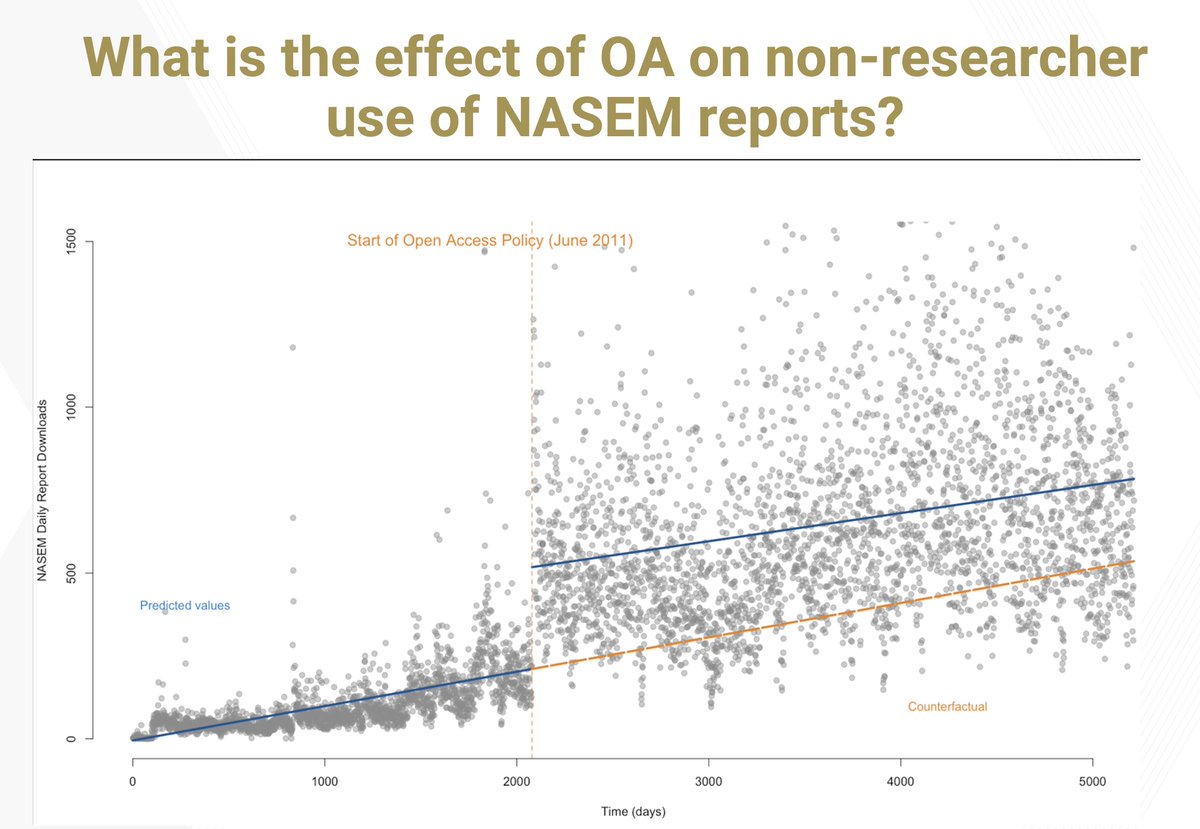
@RickyPo@OSIUnited@AsensioResearch @matteozullo_mz @LSEImpactBlog There appear to be two claims: 1) "these reports are white papers more...than academic journal articles," 2) "there's always been a broad audience for science white papers." If claim #2 were true then we would not see level change post-OA policy for non-researcher downloaders:
@RickyPo@OSIUnited@AsensioResearch @matteozullo_mz @LSEImpactBlog Also relevant is that .edu and .gov downloaders resulted in *temporary* level change, with immediate increase post-OA policy change, and then neg slope change over time. Regression to the mean. Yet, larger post-OA dwnlds of reports by non-researchers has remained consistent.
@RickyPo Forthcoming: I analyzed 8.2M NASEM dwnlds from 2006-2020. NASEM OA went into effect June 2011. I observe level change by personal downloaders post-OA. If non-researchers were already wtp for paywalled NASEM reports, we would expect no discontinuity or regression to counterfactual