Solana traders, tired of settling for the first offer?
@CoWSwap is now live on Solana and i'd give this one a shot.
You sign your trade, solvers compete to fill it and if someone finds a better price, you keep the extra.
That's a green flag i'd actually look for.
First date? Try a swap → https://t.co/ozIzRRBwf2
One of the biggest advantages of tokenization is removing the limitations of traditional market hours.
@ethena is now supporting Securitize’s new liquidity facility for BlackRock’s BUIDL fund.
→ 24/7 liquidity access
→ Liquidity within 1 hour for eligible holders
→ Up to $100M in facility capacity
What’s interesting is Ethena’s expanding role beyond USDe, becoming part of the infrastructure connecting institutional finance with onchain markets.
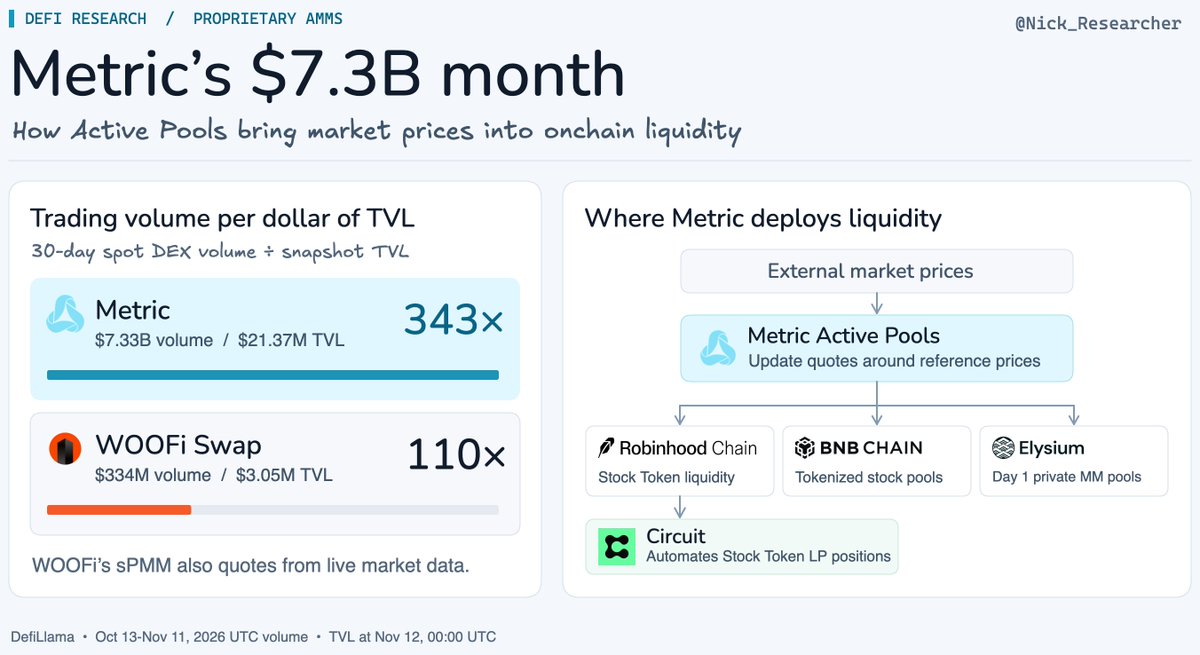
➥ @metricxyz is one of the more interesting capital-efficiency plays in DeFi
$7.3B in monthly DEX volume with just ~$21M in TVL
that puts monthly trading volume at ~342x current TVL
ofc, volume/TVL isn't a perfect measure of capital efficiency, especially when comparing different AMM designs
but it's enough to make it outstanding 99% of other projects out there.
fyi, Metric uses Active Pools and proprietary AMM infra
where liquidity can adjust pricing based on external market info instead of waiting for arbitrage traders to correct stale pool prices
this is particularly relevant for tokenized stocks
unlike newly launched meme tokens, assets like tokenized equities already have reference prices in traditional markets
the challenge is keeping onchain liquidity aligned with those prices without exposing LPs to excessive adverse selection
and Metric is already building around that opportunity
→ @RobinhoodCrypto + @BNBCHAIN: tokenized stock liquidity
→ @CircuitAI: automated LP management for Stock Tokens on RH
→ @Enter_Elysium: private market-maker pools supported from day 1
Metric recently introduced Markout APR
- which attempts to measure LP performance after accounting for adverse price movements following trades
- much more useful question than simply advertising high fee APR
a pool can process billions in volume and still be a bad deal for passive LPs if informed traders consistently trade against stale prices
the team has also introduced an Immunefi bug bounty of up to $500K following audits by Zellic and Sherlock
useful security work against exploits, team is doing good deed
i'm putting Metric higher on my priority RWA DEX infra
grinding points early if your ever want next big airdrop: https://t.co/MUNXQ4Ezqz
Lots of great opportunities in crypto, but they're scattered across chains for you to find them
Also, lots of hacks and exploits too recently
@LABtrade_ is a good place to have your money safe and ready to act on all those opportunities
APE $HOCK on #Elysium
The credit layer for Elysium. lending and borrow on Esylium by anything. There is no liquidation order, launch on $VOLTA
Moon or zero—it's a gamble for now
https://t.co/m7lNEwA5Tn
https://t.co/ch6aeli702
https://t.co/SCyEvKoWbV
🔥 Revenue-backed tokens are becoming their own DeFi narrative. I think it's the healthiest shift we've had in a while.
For years, most DeFi tokens were just governance tokens. You voted, and that was it.
The protocol could print money and holders got nothing. Now protocols are sending real revenue into buybacks and burns.
I see it as part of a bigger change in how we value altcoins:
- first it was TVL and users. big numbers, but easy to farm and easy to fake.
- then it was fees. better, b/c fees mean real business model
- now it's token value capture, fees started flowing back to the token.
Each step got closer to cash flow. I don't think we go back.
The numbers back it up:
- protocols spent about $638M on buybacks from Jan to Aug 2026 (17% up ytd)
- ~90% of it came from two tokens: $HYPE and $PUMP.
So the trend is real, but it's very concentrated.
Not every buyback is equal. This is how I judge whether one actually matters:
- it runs automatically, a fixed % of revenue
- tokens get burned or locked, not held in a wallet.
- it's bigger than the unlocks, otherwise it just soaks up dilution.
Tokens I'm watching in this meta:
1/ $STONK: ~60% of platform revenue goes toward buying back and burning $STONK. A real revenue-backed flywheel, with buybacks tied directly to platform activity.
2/ $HYPE: 49.69M burned, about 4.97% of max supply. The cleanest model right now.
3/ $PUMP: $496M burned, about 17.4% of supply. The most aggressive one.
4/ $UNI: fee switch live since Dec 2025. 113.3M burned, but 100M was a one-time treasury burn. The ongoing burn is only about 1.85% of circulating supply per year.
5/ $RAY: $204M bought back, and the buyback wallet holds 32% of circulating supply. It's not burned thou, and that need to watch.
6/ solana:HZ1JovNiVvGrGNiiYvEozEVgZ58xaU3RKwX8eACQBCt3: 100% of DAO revenue now buys PYTH. Still small for now, an estimated $6.6M a year.
7/ $ENA: the one I'm waiting on. Its fee switch turns on when USDe hits $7.5B. It's ~$4.87B today.
However, i think buybacks don't make a token good but revenue does. I expect the gap between revenue tokens and vote-only tokens to keep growing.
In this cycle, revenue-backed tokens is a big moat, imo.
NFA, DYOR.
AI agents managing money without proper authorization is a serious wake-up call
As AI becomes more integrated into finance, security and permission controls will be just as important as the technology itself
The future isn’t just autonomous finance. It’s autonomous finance with accountability
1.1M ethereum:0xad29f2723fcdbcf665f210f25e06f97477e417cf has been bought back & burned, nearly 1% of circulating supply in the first round alone.
and this is just the beginning of @grvt_io monthly buyback plan.
i see this as a pretty positive step for ethereum:0xad29f2723fcdbcf665f210f25e06f97477e417cf tokenomics, especially since the project has actually bought back and burned tokens rather than just making promises.
a few numbers from the dashboard:
>> 1.1M ethereum:0xad29f2723fcdbcf665f210f25e06f97477e417cf bought back on the open market
>> 1.1M ethereum:0xad29f2723fcdbcf665f210f25e06f97477e417cf permanently burned, not held in treasury
>> Equivalent to 0.96% of circulating supply and 0.11% of total supply
All buyback activity is published on a dashboard for the community to verify onchain.
Meanwhile, GRVT is introducing this mechanism as the project prepares for 4 major launches ahead of GRVT 2.0 at the end of November, from Earn and Stable Funding Perps to Yield as Margin.
If these products bring in more users and revenue, GRVT could have more resources for future buybacks. Of course, the size of each round remains at the issuer's discretion.
More products → More users → More revenue → More potential ethereum:0xad29f2723fcdbcf665f210f25e06f97477e417cf buybacks & burns.
i'm still pretty bullish on ethereum:0xad29f2723fcdbcf665f210f25e06f97477e417cf in the coming phase. The first buyback is complete, and there's plenty to look forward to on the roadmap.
dyor & nfa
$STONK is starting to look interesting again at these levels
I’ve mentioned @LaunchOnSF / $STONK a few times before, bought around $0.2x and also added more on the recent dip.
Rn, the market cap is around ~$100M, much lower than the previous high.
Here’s what StonkFun has achieved:
>> ~$35.5M in total revenue.
>> ~$21.2M used for buybacks.
>> More than 207M $STONK bought back.
>> Around 60% of platform revenue is used for buyback + burn.
More trading → more revenue → more buybacks.
StonkFun is also still building. The platform has added support for more quote assets and recently launched Baskets, where a token can be paired with a basket of assets like OpenAI, META, Anthropic, SPCX, and GOOG.
When onchain activity comes back, this is still one of the names i want exposure to.
NFA.
Crypto casinos are showing what crypto-native UX should feel like. 🏛️
Fast capital. Less friction. Better distribution.
@DuelCasino is worth watching because the winners here won’t be decided by the loudest promo, but by retention, execution and user experience. ⚔️
Slowmist’s security audits have already found mcp plugin vulnerabilities.
The vulnerabilities could leak a wallet's private key directly, not only redirect an agent to some unapproved service.
The attack doesn't touch the wallet's own code at all.
A single compromised plugin response can trick the agent layer sitting in front of the wallet into exposing the key it was holding.
Which means the wallet's own security can be flawless and the funds still walk out through the agent wrapped around it.