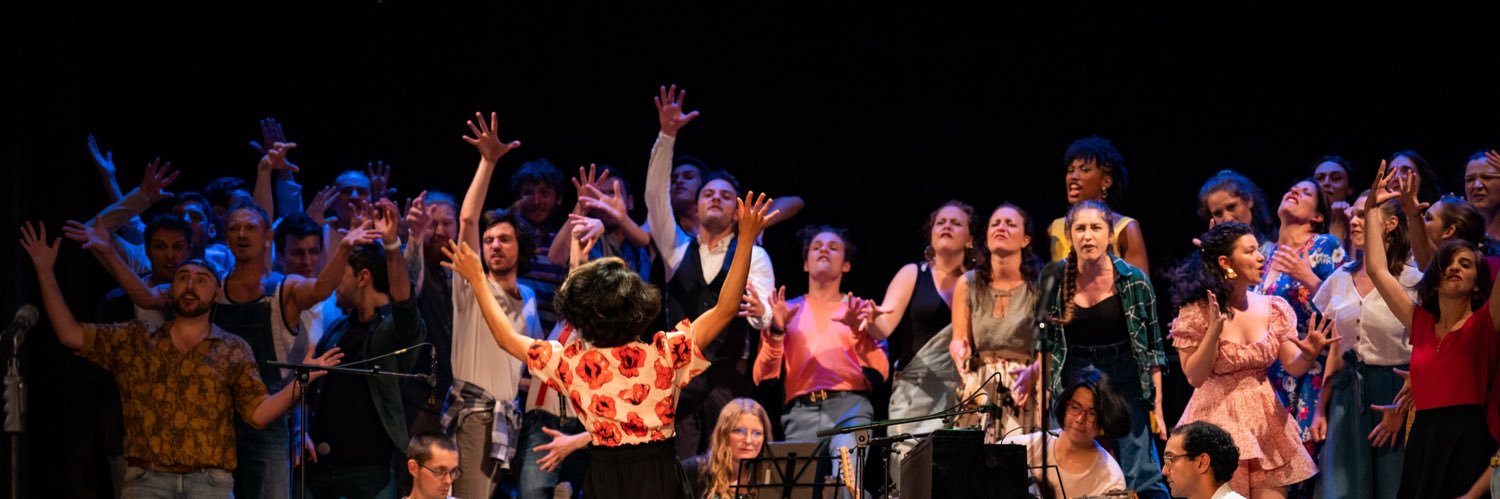
Also available from the recording studio is the performance of "Crown City" from Mario Kart World!
🎶 Listen to the track on #NintendoMusic: https://t.co/z0nYeabQOk
3.Should Odysseus repent for his hubris or human pride, maybe pride appropriate for a great man?
4.Our age demands apologies of greatness. Do you?
5.What are…the gods? Figments of imagination or necessary noble lies?
Hannah Einbinder on being called brave for using her platform to support Palestine:
“I don’t believe what I do is brave at all. It’s rational. And the fact that others are cowardly doesn’t make what I do brave. The people of Gaza are brave. I live with immense privilege. In my view, speaking about Palestine as I do is the least I can do.”
(https://t.co/CVU0udhLLW)
@BochetMEliot Soie, Alessandro Barrico! «C’était au reste un de ces hommes qui aiment assister à leur propre vie, considérant comme déplacée toute ambition de la vivre. On aura remarqué que ceux-là contemplent leur destin à la façon dont la plupart des autres contemplent une journée de pluie.»
Shadows of trees representing shadows of the multiple individualities now gone and the Ocean representing the infinite mesmerizing Joining, moving slowly and surely towards and away from Carol. She’s walking dangerously between the two, feet in the water. Stunning. #Pluribus
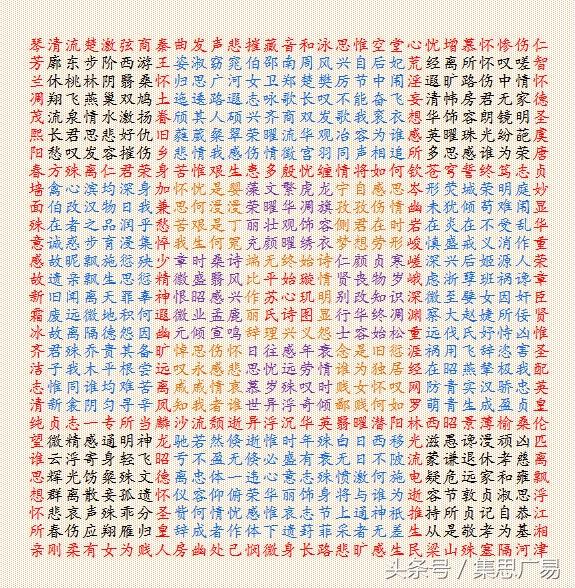
This strange square 👇 is undoubtedly the most extraordinary work of literature in human history. Yet, unfortunately, barely anyone in the West has ever heard of it.
There was this woman poet in 4th century China called Su Hui (蘇蕙), a child genius who had reportedly mastered Chinese characters by age 3.
At 21 years old, heartbroken by her husband who left her for another woman, she decided to encode her feelings in a structure so intricate, so beautiful, so intellectually staggering that it still baffles scholars to this day.
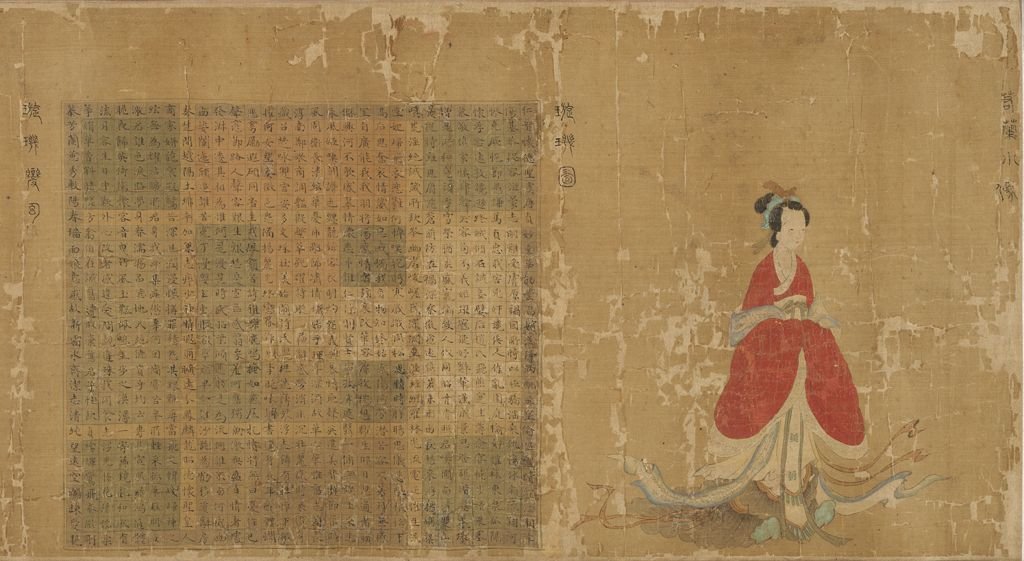
Came to be known as the Xuanji Tu (璇璣圖) - the "Star Gauge" or "Map of the Armillary Sphere" - it's a 29 by 29 grid of 841 characters that can produce over 4,000 different poems.
Read it forward. Read it backward. Read it horizontally, vertically, diagonally. Read it spiraling outward from the center. Read it in circles around the outer edge. Each path through the grid produces a different poem - all of them coherent, all of them beautiful, all of them rhyming, all of them expressing variations on the same themes of longing, betrayal, regret, and undying love.
The outer ring of 112 characters forms a single circular poem - believed to be both the first and longest of its kind ever written. The interior grid produces 2,848 different four-line poems of seven characters each. In addition, there are hundreds of other smaller and longer poems, depending on the reading method.
At the center a single character she left implied but unwritten: 心 (xin) - "heart." Later copyists would add it explicitly, but in Su Hui's original the meaning was even more beautiful: 4,000 poems, all orbiting the space where her heart used to be.
Take for instance the outer red grid of the Star Gauge. Starting from the top right corner and reading down, you get this seven-character quatrain:
仁智懷德聖虞唐,
貞志篤終誓穹蒼,
欽所感想妄淫荒,
心憂增慕懷慘傷。
In pinyin, it is:
Rén zhì huái dé shèng yú táng,
zhēnzhì dǔ zhōng shì qióng cāng,
qīn suǒ gǎnxiǎng wàng yín huāng,
xīn yōu zēng mù huái cǎn shāng.
Notice how it rhymes? táng / cāng / huāng / shāng
The rough translation in English is: "The benevolent and wise cherish virtue, like the sage-kings Yao and Shun, With steadfast will I swear to the heavens above, What I revere and feel - how could it be wanton or dissolute? My heart's sorrow grows, longing brings only grief."
Now read it from the bottom to the top and you get this entirely different seven-character quatrain:
傷慘懷慕增憂心,
荒淫妄想感所欽,
蒼穹誓終篤志貞,
唐虞聖德懷智仁。
The pinyin:
Shāng cǎn huái mù zēng yōu xīn,
huāngyín wàngxiǎng gǎn suǒ qīn,
cāngqióng shì zhōng dǔzhì zhēn,
táng yúshèngdé huái zhì rén.
It rhymes too: xīn and qīn, zhēn and rén
And the meaning is just as beautiful and coherent: "Grief and sorrow, longing fills my worried heart, Wanton and dissolute fantasies - is that what you revere? I swear to the heavens my constancy is true, May we embody the sage-kings' virtue, wisdom, and benevolence."
That's just 2 poems out of the over 4,000 you can construct from the Xuanji Tu!
At the very center of the grid, the 8 red characters wrapped around the central heart, she "signed" her poem with a hidden message:
詩圖璇玑,始平蘇氏。 "The poem-picture of the Armillary Sphere, by Su of Shiping."
Or reversed:
蘇氏詩圖,璇玑始平。 "Su's poem-picture - the Armillary Sphere begins in peace."
Many scholars, and even emperors, throughout Chinese history have been completely obsessed by Su Hui's puzzle.
For instance, in the Ming dynasty, a scholar named Kang Wanmin (康萬民) devoted his entire life to the poems (https://t.co/4exP9zpqbc), ending up documenting twelve different reading methods - forward, backward, diagonal, radiating, corner-to-corner, spiraling - and extracting 4,206 poems. His book on the subject ("Reading Methods for the Xuanji Tu Poems", 璇璣圖詩讀法) runs to hundreds of pages.
Empress Wu Zetian herself, the legendary woman emperor of the Tang dynasty, wrote a preface to the Xuanji Tu around 692 CE (https://t.co/yW7aR73MPc).
Incredibly, there's even far more complexity to the Xuanji Tu than just the poems:
- The name 璇玑 (Xuanji) - Armillary Sphere - is astronomical in meaning and the way the poems can be read mirrors the way celestial bodies orbit around a fixed center. It's a model of the heavens.
- Her original work, with the characters woven on silk brocade, was in five colors (red, black, blue/green, purple, and yellow) which correspond to the Five Elements (五行) - the foundational Chinese philosophical system that explains how the universe operates. So it's also a model of the entire cosmic order according to ancient Chinese philosophy.
- It's also of course deeply mathematical with this 29 x 29 perfect square grid, with sub-squares, lines and rectangles, and a structure which allows for symmetrical reading patterns in all directions
- Last but not least, the content of the poems themselves contain multiple registers. On top of expressing her personal grief and longing for her husband, it's also filled with accusations against the concubine (Zhao Yangtai) he left her for, reflections on politics (with many references to sage-kings) and philosophical reflections.
So the Star Gauge is simultaneously:
- A love letter (expressing personal longing)
- A legal brief (arguing her case against her rival)
- A cosmological model (structured like the heavens)
- A Five Element diagram (encoding the fundamental structure of the world according to ancient Chinese philosophy)
- A mathematical construction with perfect symmetry and precision
And yet, for all this complexity, we should not forget this was all ultimately in service of the simplest human message imaginable: a 21-year-old woman asking the love of her life "come back to me".
Her husband did, eventually. According to what empress Wu Zetian herself wrote in her preface to the Xuanji Tu, when he received Su's brocade he was so "moved by its supreme beauty" that he sent away his concubine and returned to his wife. As the story goes, they lived together until old age.
The heart at the center was filled after all.
"J'ai toujours écrit des poèmes et des chansons, même si je n'ai jamais rien publié."
🎙️ L'ancien ministre @jmblanquer présente pour la première fois l'une de ses compositions musicales, au micro de @Stephbou08 dans #LeJournalInattendu sur #RTL
something I think about at least four times a week is this video of this guy who was absolutely stymied by the musical Chicago. “THIS TOOK PLACE IN THE 1920s?” makes me HOWL
why is transmasc music like: *ukulele* Don't mess with me, I'm a big boy now, and I'm very scary
and transfemme music like: *synthesizer* you should drive drunk you should drive drunk you should drunk drive(distorted voice filter)
[THREAD] Pourquoi la position de Bouteldja sur la Pride des banlieues cherchant à diviser les luttes antiracistes et les luttes féministes et LGBT est réactionnaire et fausse.
Tout en défendant une ligne para-LFI et jouant à son conseillère politique, Bouteldja propose une critique féroce non du « libéralisme LGBT » mais des luttes LGBT des personnes racisées et immigrées tout court.
Elle déclare que ces luttes et le sujet politique LGBT ont pour origine l’Occident et sont occidentales dans leur nature et ne doivent pas exister sous la même forme ou même du tout dans Saint-Denis, Bakou, Marrakech, etc.
Bouteldja prétend que la Pride des banlieues ne devrait pas exister tant que n’a pas cessé le racisme d’Etat, la répression coloniale des quartiers populaires, etc.
Il faudrait plutôt hiérarchiser et se préoccuper d’abord de Gaza, des violences policières, de l’islamophobie, des premières préoccupations des populations subissant le racisme.
C’est la version antiraciste de la logique class first : « le sexisme on va s’en occuper après la révolution, aujourd’hui la priorité c’est l’économie ».
Les luttes LGBT des personnes racisées et immigrés sont vues avec du soupçon, ce serait de l’intégration dans l’ordre blanc et dominant au détriment des siens.
La position de Bouteldja est grossière, volontairement polémique, anachronique et fausse.
Les LGBT, immigrés et non, racisés et non, prennent part aux luttes pour la Palestine, aux luttes antiracistes, dénoncent l’islamophobie et violences policières.
Leur propre oppression en tant que LGBT n’est pas un sujet secondaire mais aussi une lutte à part entière qu’on doit articuler aux combats contre l’impérialisme, le capitalisme et le racisme d’Etat.
Les luttes LGBT de façon générale ont été instrumentalisées par l’Etat et les entreprises ces dernières décennies pour donner un vernis progressiste au néolibéralisme.
Ce fait réel ne peut pas être utilisé pour les décrédibiliser comme néolibérales en soit, au contraire, cette cooptation doit être combattue. Les luttes LGBT doivent être de nouveau politisées et poussées dans un sens révolutionnaire
Donc, en ce qui concerne la Pride des banlieues, certains éléments que peut pointer Bouteldja sur l’instrumentalisation politique par l’État sont justes, mais c’est la tradition du néolibéralisme progressiste.
Dans le cas de la Pride des banlieues, le risque d’instrumentalisation ne saurait effacer l’engagement sincère des centaines de jeunes queers racisés, habitants des quartiers, immigrés, mais aussi le contenu de la marche qui réclame des investissements massifs pour la santé et la régularisation de tous les sans papiers
Ces jeunes et moins jeunes qui, souvent, sont obligés de quitter leur foyer car ils et elles sont homosexuels et trans, doivent traverser des océans et des mers pour survivre pour arriver dans une Europe traversant un tournant à droite et un nouveau saut dans la persécution des personnes LGBT
Bouteldja, d’ailleurs, parle de cette tendance, du début de la fin du néolibéralisme progressiste, des attaques de Trump et de Starmer contre les droits LGBT. Les Etats et les grandes entreprises abandonnent le soutien hypocrite aux LGBT, Bouteldja le voit et n’en tire aucune conclusion progressiste...
Que peut proposer à ces opprimés Bouteldja ? Ranger leur identité LGBT dans le placard, ne pas politiser l’oppression qui les a relégués à la marge de la société. Il faudrait être invisibles et lutter pour des « vraies priorités ».