At long last, Lisa Harness is here! 🤖🎁
Lisa is a groundbreaking AI agent-harness:
- Hard budgets and enforced limits
- Dynamic model routing
- Lossless context (no compaction)
- Verifiable actions
Anthropic, OpenAI, et. al. are trying to create models you can trust. That's cool, but I'd rather run models without having to trust them. 🚫💀
There are a lot of other cool features, but TBH, the biggest W is its ability to keep many complex, multi-topic conversations straight and learn with you. 🧠
I've been working on it and using it for ~6 months. It's still beta quality; this is the first public release, but it's very usable and useful.
Blog post: https://t.co/HoHeUfAP8g
The project link is in my bio.
LMK what you think!
@BHolmesDev I'm with @mitsuhiko, calling it a workshop. I also share his advocacy for building better instead of building more, and "factory" is synonymous with "mass production," which seems at odds with that.
I don't care what you call it, but I'll consider mine both.
@johncrickett Not disagreeing, but how will they acquire those skills? That's the trick now. Imagine you're like me and already have them from pre-AI dev experience. We have to help the next gen with more than "sorry, NGMI" posts.
@sebgoddijn Lisa-Harness is already here if you want to see some close. And its MIT-licensed FOSS so feel free to build on it instead of starting from scratch. Its a harness builders' runtime.
@DannyFlows@sebgoddijn Lisa-Harness isn't exactly that but closer than most things you could compare it to and definitely whats in the pipe for it. Stay tuned. 👀
I'm not one of those people, but I've been writing software for 30 years, and I've written several critical systems, including the authentication system for a popular U.S. bank/brokerage.
I no longer review code. 😶
I had to wean myself off it, and I'm tempted, but knowing it's a dead end, I'm determined to stop entirely.
The only times I've read code since July have been to spot-check for code smells or out of pure curiosity. In the few cases, I was at best skimming. I was looking for a bad pattern, not a bad instruction (anymore).
The one exception is bash/PowerShell. I will still *write* it because the models create hot garbage for both.
Last year (before I built my own harness), I created a VSCode extension (never published) that did what you said—it tallied what my agents read, which I then used to tailor the content to each agent.
For example, I created an AGENT-INDEX.md that listed everything in order for reference; I had the extension maintain the index and even annotate it with stats so I could get real-time feedback.
It worked, but TBH I couldn't measure effectiveness, and around that time, I created Lisa-Harness. So it died.
I'd be interested in hearing your results, especially how you measure the benefit, since I couldn't figure out how. 😆
@tequilafunks I guess that depends on what you mean by "safe." Either way, I'm not a "solo indie dev." My company has been around for 12 years, and I've been here for 30. And as I said earlier, I have a real long-term stake in it, so I won't be "moving on" anytime soon. But, hey, your call.✌️
Yep. I am really happy with the innovative approach I took in Lisa-Harness to tackle it:
1) Context is shrunk through referencing and dereferencing—no lossy context summarization.
2) The coolest part: the trigger is based on real-time cache performance—so it decides when to compact (and bust the cache) and when not to, based on the math. It's always optimal, and you never have to worry about it!
The results are pretty compelling. I trust it more than any other harness for long-running tasks.
Lisa-Harness wasn't supposed to be a great coding agent, but it's turning out to be!
What makes a coding agent hard is balancing context, tool use, and caching. "Simple!" you might say, but not when you consider how those things interrelate in the coding process. It's very different from a GTM bot!
Lisa's "coding" pack is built primarily to build itself, but you can (and I do) use it for other projects in, e.g., Ansible, Go, and TypeScript. There's also an "hdae" pack, a port of @gmkurtzer's software factory for a fully gated workflow.
But they're just examples. Lisa-Harness and those packs are MIT-licensed FOSS on GitHub, and I'm betting you can BYO a coding agent for whatever workflow in a day, maybe two.
😅It's an independent runtime that runs as a process. It's not a collection of services, brokers, clients, and so on. It has a very light footprint.
So the answer is: whatever tools and processes you can run on 1 GB of RAM, 1 vCPU, and 50GB of SSD. 😁For me, that's basically everything I want to do.
PS. My plan is to combine it with my other project, https://t.co/3ESN1OQAp6, so it can spawn an independent, running clone of itself. 😲 Can't wait to get that working. 🏆
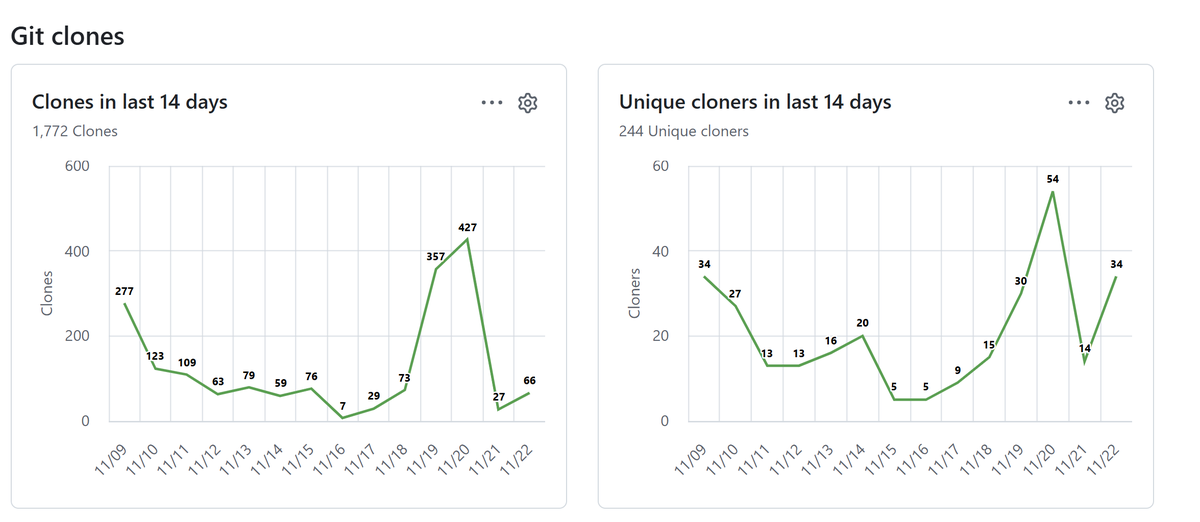
What the public view doesn't show is the clones since the release almost a month ago. The previous 14 days are about the same. So I don't think ⭐ is necessarily correlated with interest. TBH, I don't know why >500 people would clone a project without saying so. Sometimes I wonder if it's LangChain/Pi/... staff. I guess we'll find out in the coming weeks—I hear LangChain's got some announcements.😆
But the real reason you should use Lisa is that it's not VC-funded. It is a full-time job for me (not a side project), but I am building it with/for a community of like-minded developers who guide the project, not investors. 🤗
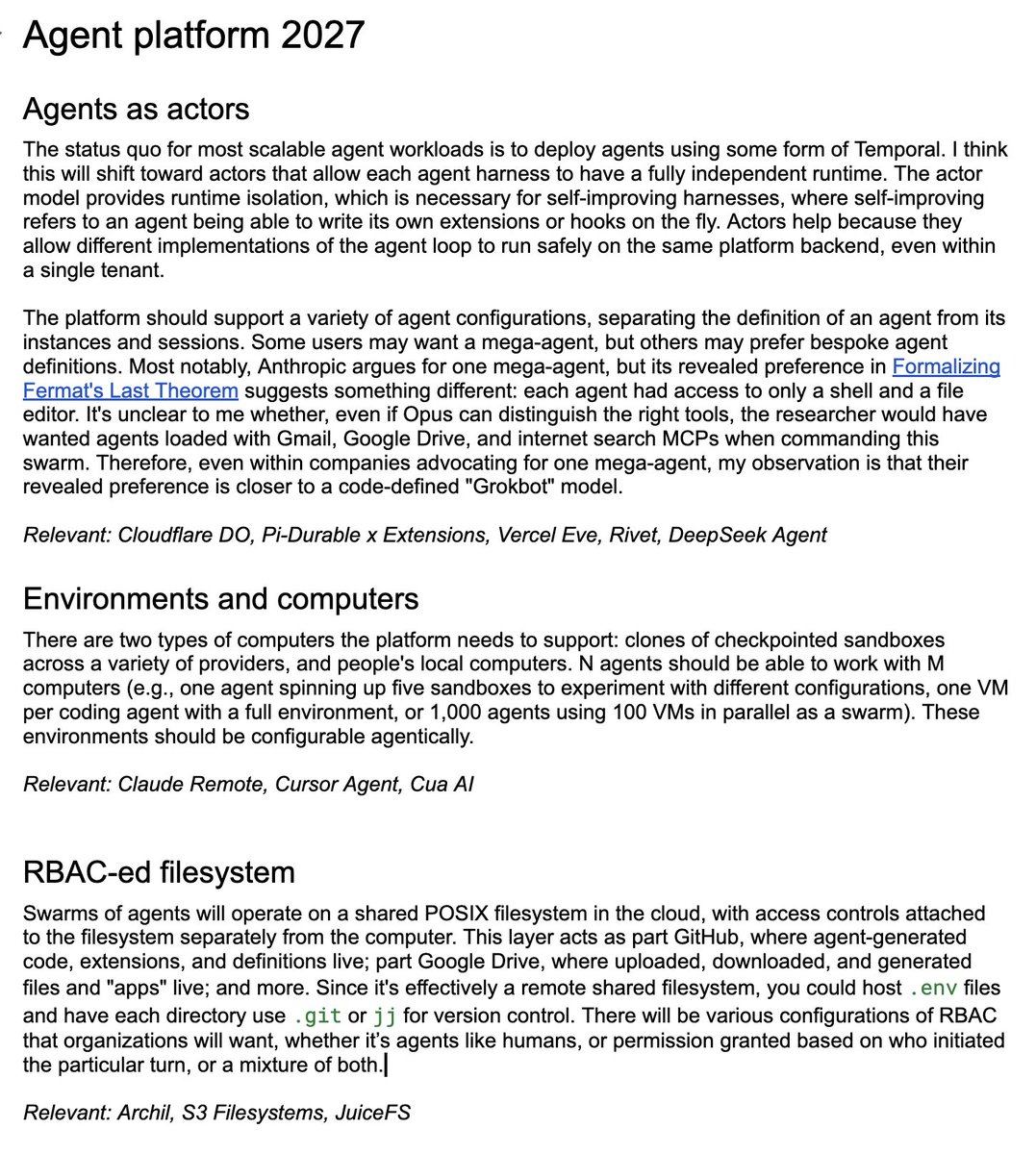
Some of the conclusions I see drawn from this are bananas! It seems like everyone just launches from the (last) "Apps" section and contorts it to their view(?). And why are we pretending this is a coherent document?
I like the independent runtime idea and agree we need RBAC/ABAC and sandboxing, which (I think) it says.
F*ck, AI-pilled X is a weird place. 😵💫
Agent platform of 2027.
This is the end game. This is the blueprint for the one and only application layer software that will exist. Every other software will effectively become databases for this layer, the everything agentic operating system for the million agent swarm to work on top of.
This is obviously the end game vision for the application layer of ChatGPT and Claude. I have reasons to believe that an independent company will own this product layer. But most ADE, "enterprise agent platform", or vertical saas companies, are focused on the wrong things far too narrowly, not technically competent, and do not have the product / technical vision to see this inevitable future.
The correct agent platform that wins will function like the base of a garden, from which customers will plant their unique "seeds" to grow their own plants and trees, managed and evolved by agents, humans, and signals from the sensors of the business. This presents a clearer picture than "factory of a factory" imo.