Here's the part 2 so let's dive into it: 👇
5. How an AI agent actually uses it?
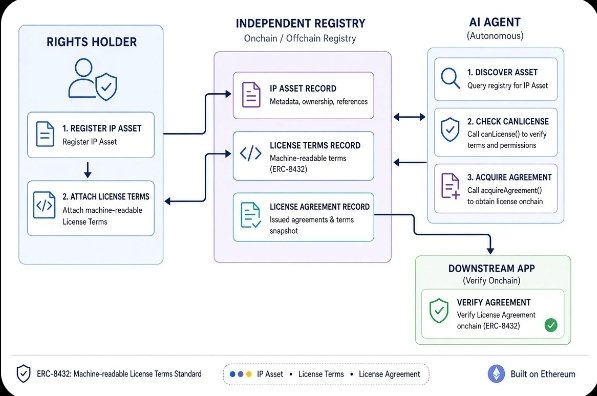
1. Rights holder registers the work + attaches reusable license terms
2. Agent discovers the asset, reads the machine-readable terms, checks canLicense
3. If it passes, agent calls acquireAgreement (often in one transaction)
4. Downstream apps verify the agreement status onchain before using the content
Ownership of a token no longer has to mean “figure out the rights yourself.” and it will help alot.
----------
6. Why Soneium specifically?
Sony sits on one of the world’s largest entertainment IP catalogs (music, film, anime, games).
Tokenized IP is core to their vision.
“Register once, license everywhere on Soneium” is the explicit goal:
• rights holders become discoverable by catalogs, marketplaces, and agents; developers integrate once instead of per-platform.
----------
7. What this can bring to Web3:
1. Turns ownership into queryable permissions
2. Makes IP licensing native to AI agents instead of an afterthought
3. Enables independent registries to interoperate instead of locking creators into one platform
4. Creates a flywheel:
more machine-readable IP → more agents and apps that can legitimately use it → more value back to rights holders
It’s infrastructure for a world where AI constantly remixes creative works and the rights can actually travel with the work.
----------
8. @soneium has said it will support it and wants builders to help shape and implement it.
This is the kind of boring-but-critical standard that usually only becomes obvious in hindsight.
Hope this 2 parts be useful to you.
Your idle USDC just got a serious upgrade.
Startale App rolled out two new Earn vaults today, so you can now put USDC to work right alongside USDSC and ETH directly in the app.
Here’s what’s live:
• Gauntlet USDC Prime: Curated by Gauntlet, powered by Morpho.
Your USDC is lent to borrowers who post major crypto assets as collateral (over-collateralized).
• Flowmark fGenesis USDC: Curated by Flowmark, also on Morpho.
Currently lending against PGNGI+ tokenized by Asseto and linked to Partners Group’s Next Generation Infrastructure strategy.
Real-world assets meeting onchain yield
Key details that matter:
• Both vaults live on Ethereum and only accept deposits from your Startale Smart Wallet (no MetaMask or external wallets).
• Earnings compound automatically your yield starts earning too.
No manual claiming or redepositing.
• No deposit fees.
Startale takes only a small cut of earnings on the Gauntlet vault (never of your principal).
Flowmark has no withdrawal fee.
• No lock-ups.
Withdrawals are usually instant; if the vault is fully lent out, you get what’s available immediately and the rest once borrowers repay.
Your position keeps earning in the meantime.
These sit nicely next to the existing USDSC vault (T-bill backed, on Soneium, instant withdrawals, zero Startale fee), giving you clearer options depending on whether you want pure stablecoin yield or exposure to crypto-backed or RWA-linked lending.
If you’ve been sitting on USDC, this is one of the cleaner ways to put it to work inside an app that already handles USDSC, ETH, and the rest of the Startale ecosystem.
Open the app → Earn → pick a vault.
Full details: https://t.co/1tMawWxMid
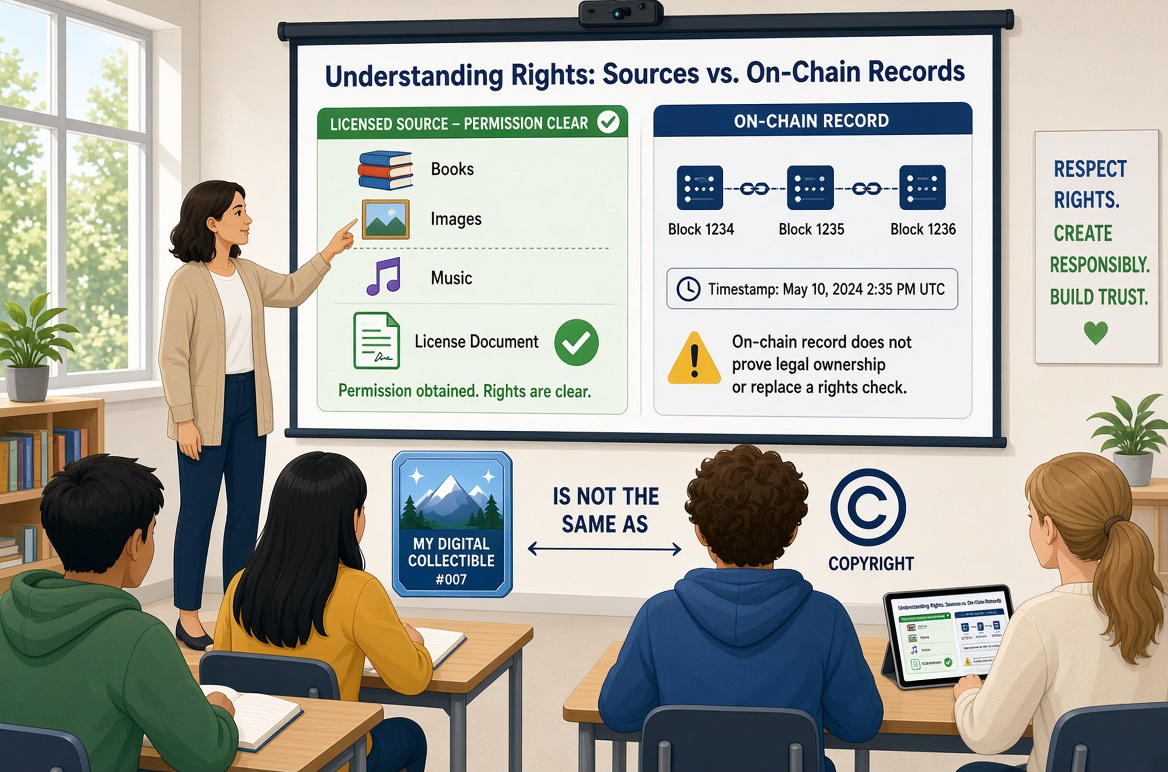
The safest way to use well-known characters and stories in class is through projects and sources that already have a license.
Before a card, an image, a piece of music, or a scene goes into the lesson, it should be clear who gave permission, for what use, and how far that permission goes. Popularity, or a file that looks “official,” is not the same as clearance.
Logging a claim on a blockchain does not prove that nobody else has rights, a timestamp only shows that a record existed at a certain moment.
Provenance can clarify the history of that record, but it does not prove legal ownership of the work, and it does not settle a rights dispute by itself.
Another claim may already exist, or there may be a separate contract that never appears onchain.
In class, those pieces stay separate. Holding a collectible or a digital file is ownership of that item.
Copyright and trademark sit with the original work and do not move automatically.
Licensing is the permission that sets the actual limits of classroom use.
Attribution is only credit to the creator. It is not a license.
The practical path is to use licensed sources, and to tell students that an onchain record does not replace a check of the legal rights.
If the rights holder and the permitted scope are unclear, even a clean onchain record does not make the class legally safe.
Just moved some idle WETH into @StartaleApp’s Earn vault.
It starts earning the second it lands, compounds in real time and I can pull it back whenever I want plus no lockups, no claiming, no extra steps.
@gauntlet_xyz handles the strategy, @Morpho runs the markets underneath.
Idle ETH is just ETH that hasn’t started working yet.
Tengen in the office 😎
Really loving the new SAPCO Studio design it looks sharp and the vibes are excellent.
The development and design teams are doing outstanding work.
Clean execution, strong attention to detail, and clear momentum.
Excited to see what’s next. 👏
One of the nfts I'm very bullish about is @themutualfun in this thread I will explain why so lets dive into it : 👇
1/ the cleanest thing about @themutualfun is the unit of account.
one seat = one chair in a fund = 401,000 $TMF.
not a vibe.
a fixed rate.
4,001 seats. supply of $TMF is 4,001 × 401,000 = 1,604,401,000. minted once. never again. no team allocation.
@RobinhoodApp chain.
take a seat.
----------
2/ a seat is the share, not a jpeg with utility taped on.
five things in one token:
-64x64 portrait painted and stored by the contract.
-no ipfs, no server
-a permanent claim on one of five funds
-a weekly vote on the book
-a 13-week vote on whether the fund keeps going
-an erc-6551 briefcase that catches the checks
-sell the seat, the briefcase moves with it.
the cash is part of what you’re buying.
----------
3/ the open market is built so $TMF can’t fully float away from the chair.
anvil amm and house rate 401,000 $TMF per seat.
it always holds enough $TMF to buy seats back.
random seat: +8% (433,080)
specific seat: +16% (465,160)
sell: −8% (368,920)
1,000 seats sit in that pool from day one, next to 401,000,000 $TMF.
deposit a seat, $TMF comes out. reverse it, a seat comes back.
circulating $TMF has a chair under it.
----------
4/ the yield switch is enrollment, and it’s where the burn starts.
holding does nothing until you pay a one-time front-end load in $TMF.
half burned to the chairman’s estate.
half dropped straight into that fund’s book.
class c retail: 40,100 $TMF, 1.00x weight
class b: 100,250, 1.50x
class a: 200,500, 2.00x
class i: 401,000, 2.50x
class r: 1,002,500, 3.33x
enrollment dies on transfer.
the next owner pays again.
every resale is another burn plus fresh capital in the book.
----------
5/ supply of chairs only shrinks.
two enrolled seats, same fund, same class, can merge. one is retired forever.
the survivor steps up a class with no second load, and the retired seat’s checks move over.
class r can’t merge.
nothing above it.
4,000 chairs at the open.
fewer after people start consolidating.
scarcer seat, same hard $TMF rate.
----------
6/ five funds, same rules, different voters.
that’s the actual product.
argon, bogle, smaug, midas, vladd. 800 chairs each.
you don’t pick.
a future blockhash deals you in, weighted by open chairs, and it sticks.
friday closing bell, 20:00 utc.
enrolled weight votes the book.
anyone can hit the public buttons and collect a small eth tip for running the week.
every 13th week they vote on whether that fund continues and a fund that closes stays on the board, marked.
identical at mint, the holders are the strategy.
----------
7/ contracts go out ownerless.
no upgrade path.
no pause switch.
two payout addresses, settable by a safe, on the record.
seat 0 is the chairman’s, lobby piece and will never sold.
mint path is tight: soulbound tmf pass, burn one, mint two seats at 0.01 eth each.
passes don’t trade but seats do.
subscription desk opens oct 22, 3pm et. or you buy a seat off the amm from the start.
----------
8/ stack the flows and it compounds in one direction.
enrollment burns $TMF and funds the book. votes move the book. checks land in the briefcase, so the seat’s resale includes the cash. merges delete chairs. resales re-enroll and burn again. the amm keeps the 401k rate so the token stays tied to the asset.
membership with a balance sheet and a vote. prospectus has the tables: https://t.co/b3h3ARjOFz
not advice. the chair is the trade.
----------
9/ plus you can join the WL and try your chance at ;
https://t.co/nNFohtxTep
Huge move by Soneium.
What is ERC-8432 ?
is a draft Ethereum standard for an onchain IP asset and license registry and It gives independent registries one shared interface to identify a work, publish license terms machines can read, and record or check license agreements onchain.
This is help creators alot.
Bullish 🔥
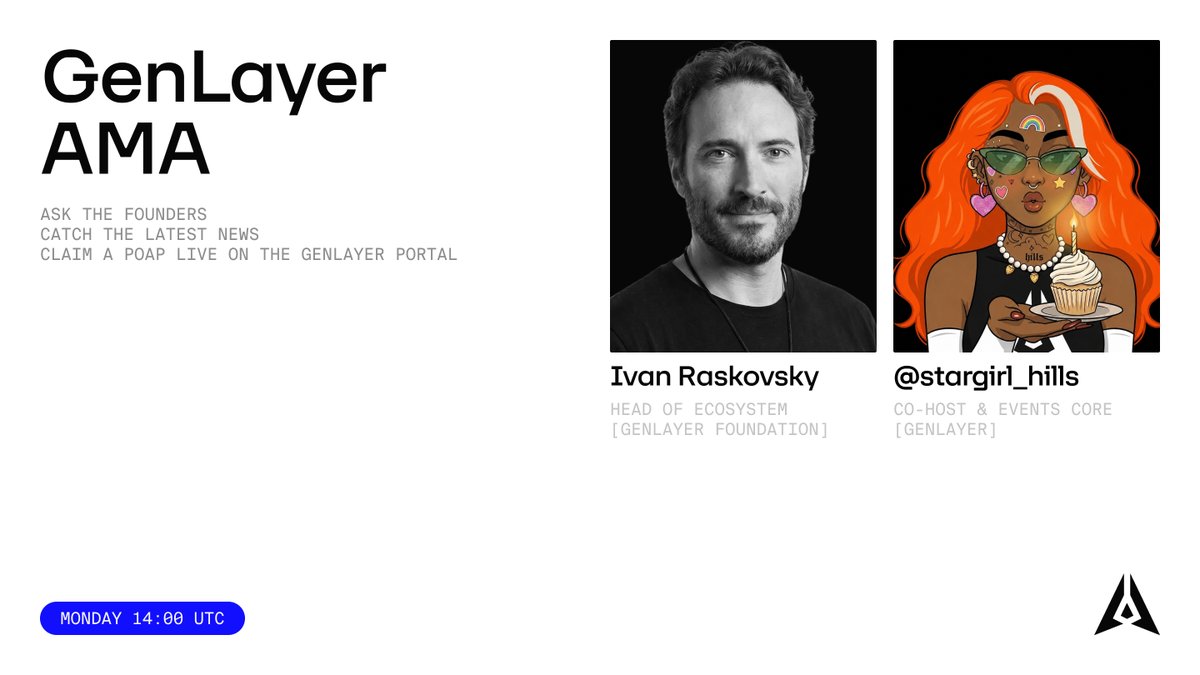
Tune in today for the latest updates from the GenLayer ecosystem.
@raskovsky will be live answering community questions.
Set a reminder & send yours 👇
By 2030, AI agents will move nearly $9 trillion.
Every one of those transactions can end in a disagreement, and almost nobody is preparing for it.
That's why we built GenLayer, the adjudication layer for contracts that can actually think and start judging what's fair.