I decided to audit Audrey Truschke's recent book - India: 5,000 years of History, with AI.
Through this exercise I wanted to see if Audrey was actually biased. The goal was to:
1. Check citations for accuracy.
2. Find patterns in her bias and discretions, if any.
Both are hard to do by hand, but easily verified if the work is done by AI.
I classified the inaccurate ones into 4 levels. Severity 1 and 2 are nitpicks and minor mistakes, that don't hide or change anything that the primary source says.
But severity 3 is if the sentence changes the meaning of what the source says. For example, if a monastery is said to be "sacked", but the source says that the monks were killed.
Severity 4 is where it's an omission or her cited source says the opposite. For example, she says that Akbar banned enslaving war captives. But her cited source says that the war captives could be enslaved, but not their families.
And here's the headline result in this screenshot:
1. Of her 2,310 endnotes, I checked about 1807 because that's what sources were available to me.
2. About 68% of the notes were accurate. But that's a very low number.
3. There are 185 serious finding of severity 3 and 4. This is material omission or serious change in what her source says.
4. Almost 200 findings where she says the exact opposite of what her source says! Of these 12 are at severity 4 and 46 are at severity 3.
Clearly, Audrey hasn't paid much attention to detail in this work.
Keep watching this space - I'll be tweeting out more examples of my findings!
Why do Western intellectuals so often despise Sanatana Dharma, and why do they seem to be so dismissive of (practicing) Hindus and Hindu faith? When it comes to Sanatana Dharma, there is certainly none of the romanticizing Western Orientalism that we find with regard to Islam (cf. "Lawrence of Arabia"), Shinto (despite WWII), Chinese religion (witness the highly respectful tone of most Sinology), or even Buddhism (which though originating in Sanatana Dharma is seen in the West as an elite religion). Even Western academics who study Sanskrit no longer seem to admire the religion it embodies, though things may have been different in centuries past. Elite Western antihinduism really does seem to be something "sui generis" -- of its own kind.
I don't have a research-based answer, though I do have a guess. I suspect it is related to a residual iconoclasm in the post-Christian West, especially in Protestant countries. Jewish lore has it that Abraham founded his religion by smashing all the idols in his father's shop. Like most Muslims, Protestant Christians have embraced this inherent iconoclasm. Today it's not only Hindu idols that they smash; they also deface and pull down their own statues. Look at civic art in the West today: except when it explicitly defiles the Western inheritance, it is all abstract. Even Mohammed would approve.
I have told Jewish audiences that elite Western antisemitism has its roots in a civilizational shame at having appropriated the Jewish God. I suspect something similar is at work with regard to antihinduism. Hindu worship is, after all, a reminder of the West's pre-Christian past. The towering classical figures of Western literature (Homer, Herodotus, Aeschylus, Sophocles, Thucydides, Plato, Aristotle, Plutarch, Virgil, Horace, Cicero, etc.) would all have felt quite at home in a Hindu temple. They would have felt equally at home performing puja in a typical Hindu home. Ancient Greco-Roman worship was essentially the same as ancient Hindu worship -- and contemporary Hindu worship. It is Hindus who have kept the classical tradition alive.
There is thus, perhaps, also a deep-seated civilizational shame in the West at having repudiated the religion of our forefathers. Might we instinctively recognize that we have embraced (indeed: appropriated) a Middle Eastern god who is not our own, and adopted Middle Eastern practices (monotheism, iconoclasm, zealotry) that are not native to our culture? At first reading that just sounds crazy, but consider the fact that Christianity has repeatedly sought to cleanse itself of recurring idolatry, just as Persia (another ancient Indo-European culture) has been the focus of repeated cleansings of Islam. Might it be that the West's folk culture has always been in tension with the iconoclasm of elite intellectualism?
The desire to burn a candle in front of an idol (of Mary or a saint), or to burn incense in a home shrine (not just for air purification) seems to run deep in Western folk spirituality.
All of this is of course highly tenuous. But I do find it plausible that there is an inertial cultural complex (not a psychological "race mind") that, having evolved over millennia, still has not after 2000 years fully assimilated the imposition of Christianity. The very fact that the ancient (Pagan) world is considered "classical" indicates that it is still a cultural touchstone for our civilization. Yet the West (and especially the intellectual vanguard of the West) is in perpetual conflict with that classical inheritance. Just look at Nolan's Odyssey to see that. We have inherited a classical literature but we recoil at a classical morality.
Hindus (or at least: the core proponents of mainstream popular Hindu faith) do not recoil at their classical inheritance, or at ours. The morality of the Bhagavad Gita does not differ much from the morality of Plato or of the Iliad, but all of these are completely at odds with the morality taught by Jesus -- or in Western schools. Traditional Christian morality and modern secular morality are very different, but they both represent a repudiation of the Indo-European classical inheritance. In short, Hindus remind us of our purer selves, or at least of our original selves. They represent the faith of the old gods from which we have strayed.
Today, Western intellectuals are clearly able to admire non-Western religions that do not remind them of their own classical inheritance. They seem, however, to display a visceral aversion to Sanatana Dharma, especially in its continuing contemporary practice. Those Western intellectuals of the 18th and 19th centuries who did embrace Sanskrit literature (British orientalism, American transcendentalism, German romanticism) seemed to have done so precisely because they yearned to repudiate their Christian cultural overlay. For today's Western intellectuals, Shinto and Buddhism can feel like refinements, whereas Hindu faith seems retrograde.
The colonized mind, of course, perceives this, but misinterprets the Western intellectual's revulsion at Hindu worship for mere disdain. The post-Hindu anti-Hindu looks down on the Sanatani's faith. But the post-Christian anti-Hindu recoils from it. Whereas post-Hindu intellectuals feel embarrassed by their Hindu inheritance (and Hindu neighbors), post-Christian intellectuals feel humiliated. Hindus are an unwelcome reminder of the religion they have long since lost.
There are of course other elements that feed into Western intellectual antihinduism: colonialism, racism, elitism, fear of the unfamiliar, etc. But its visceral nature seems to me to be much more consistent with shame. I feel personally certain that shame lies at the core of Western antisemitism. I think it likely that a parallel but opposite shame lies at the core of Western antihinduism. With regard to Jews and Judaism, the shame of having appropriated the Hebrew god results in a combination of adulation and hatred. With regard to Hindus and Sanatana Dharma, the shame of having repudiated our own gods results in a combination revulsion and resentment.
There never was a Hindu Holocaust under Western colonialism, yet neither was there much concern over tens of millions of Hindu deaths, whether due to starvation, disease, or Muslim violence. Western intellectuals don't hate Hindus the way so many of them seem to hate Jews. But they do seem to resent the mere existence of Hindus, to the point that they might prefer to see Hindus erased from history. That may sound like an extreme overstatement of Western antihinduism. If you think so, read any Western academic journal of Hindu studies and compare it to those focused on Buddhist, Shinto, Confucian, or even Muslim studies, and you'll see my point.
When a high-profile Muslim becomes Hindu, it becomes a major setback to their ecosystem. We have to amplify it and try for others.
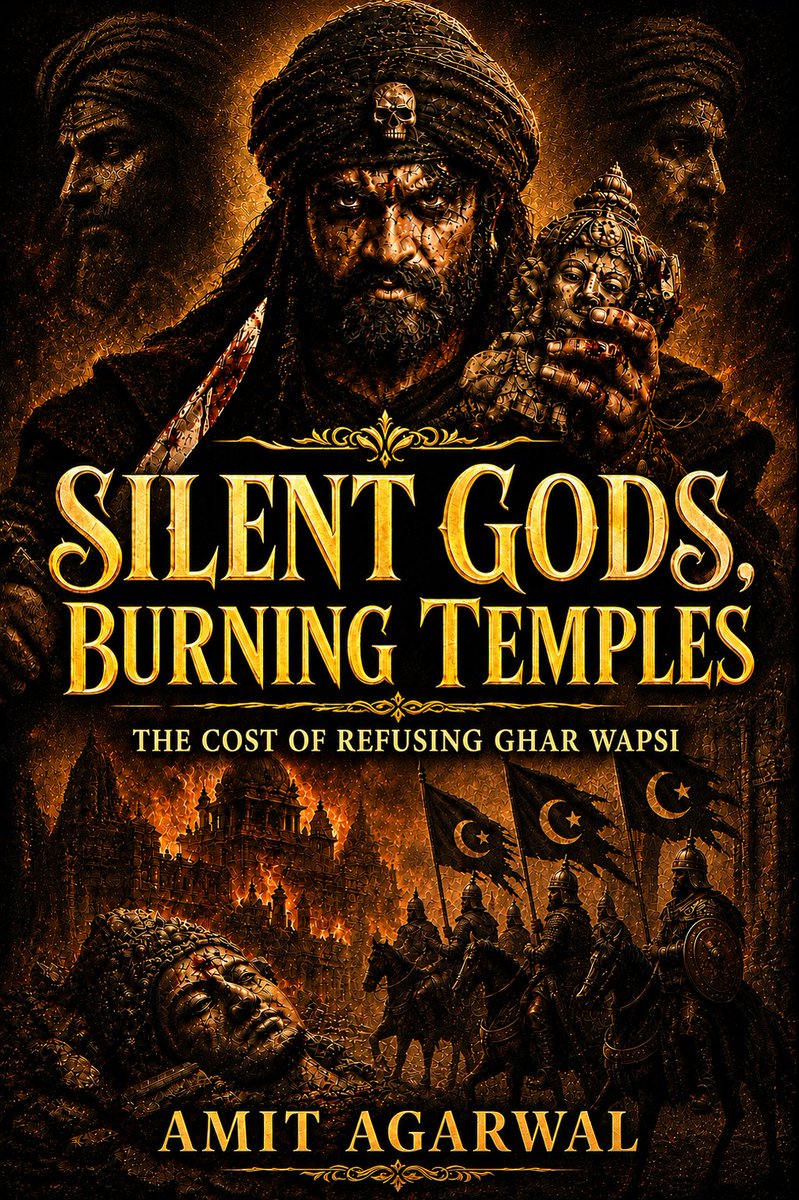
In this regard, do read my book on ways to promote Ghar wapasi...
In #MannKiBaat, श्री नरेंद्र मोदी can take this up.
Hate-monger Nazia Elahi Khan is reportedly converting to Hinduism and adopting the name Nandini Pandey.
Not one Dalit has ever become a Brahmin in 5,000 years, but a so-called or self-proclaimed Muslim can convert and adopt a Brahmin surname.
It is straight out of my book: A never-ending Conflict, published in 2022...
Bangladeshis and Pakistanis in the guise of Muslim Brotherhood are habitual in creating terror in India.
#DurgaAshtami#Prabhas#Kolkata
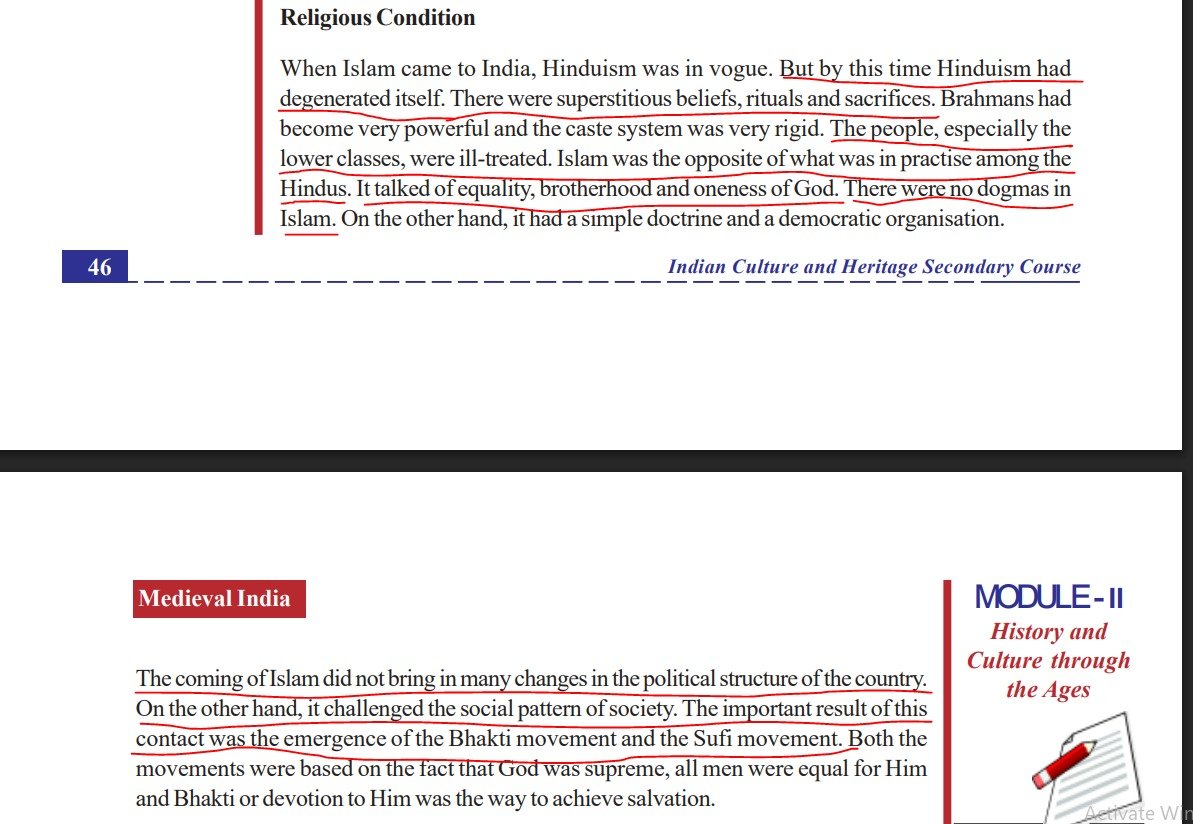
"Hinduism degenerated & ill-treated lower classes.
Islam was opposite of Hinduism. It stood for equality, brotherhood & oneness of God. Bhakti movement emerged because of the arrival of Islam."
-says NIOS Text Book on Indian Culture & Heritage
Chapter 4, page 46-47 of NIOS Senior Secondary School Text Book for Indian Culture and Heritage compares Hinduism and Islam and outrightly ridicules Hinduism.
It says that Hinduism degenerated when Islam arrived in India, Hinduism ill-treated lower classes. Islam was the opposite of what was in practise among Hindus. It talked of equality, brotherhood and oneness of God. There were no dogmas in Islam. On the other hand, it had a simple doctrine and a democratic organisation.
The book demeans Hindu religious practices as superstitions.
It is ironical that this is a part of the course titled- "Indian Culture and Heritage".
We have just started analyzing only a few subjects. But what we have found is quite disgusting.
The same following themes repeat across multiple subjects - Gender Studies, Sociology, Indian Culture and Heritage, History, Political Science etc-
1. Hinduism is bad, General Category particularly Brahmins and Thakurs are villains.
2. Islam, Christianity, Buddhism are great religions and these religions treat women better than Hinduism.
3. Arrival of Islam and Christianity was a God's gift to India as they have pulled India out of dark ages.
& The books provide absolutely no references for these claims.
Q is whether there are no audits or checks in the preparation of these text books?
What is the recourse of the common Hindu when the government itself wages a war on our traditions and inject falsehood?
BJP 3.0 is like congress 2.0(2009-14). Utterly rudderless, don’t have clue of what’s going on. It is siding with PDA who is core congress supporter & don’t give it damn.
It is hell bent on alienating its core base of general category. If election is held now, it will sorely lose
Kohinoor original name is Shyamantak श्यामन्तक, gem of Shyam or श्री कृष्ण. This Janamashtmi, let's make some noise to bring back our heritage.
Hundreds of other diamonds were also looted.
Read complete history of diamonds in "Not Just Kohinoor"
#HappyJanmashtami#RadheRadhe
None other than @ARanganathan72 ji took a few minutes out of his precious time to talk about my book.
Do read the book... You won't be able to put it down once you start it.
Drawing from history, book presents Ghar Wapsi not as a political slogan, but as a profound act of return.