@Dev_Fadnavis
Dear Deva Bhau Sir, I would like to invite you for tea or ताक ... at our house at The Ark which is just 5 minutes from Raheja Chowk ... I / We have no personal work request :)
We just love your leadership ❤️
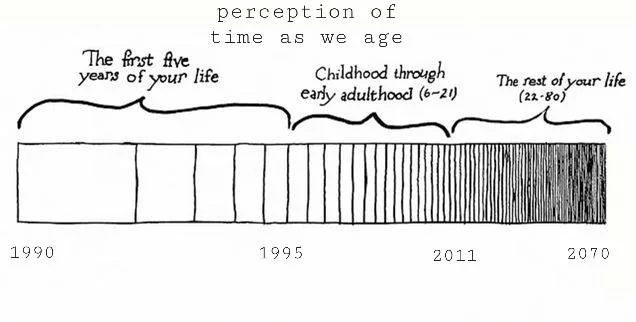
When you’re 5 years old, a year is 20% of your life. And when you’re 50 years old, a year is 2% of your life. This is an explanation given why time speeds up as you age. It's called Janet's law. It states you’ve experienced roughly half of your perceived by life by 20 years old. Or to put it another way: A summer holiday for a 5 year old feels as long as the 10 years from 40 to 50 years old.
But Janet's law can be broken with high agency.
You have agency over the speed time. You're not a passive victim. A better explanation of why time speeds up as you age is because you have fewer new experiences as an adult, so your brain deletes the memories. If you take agency over your life, do new things and create memory dividends, time slows down.
If you live your life on autopilot, you may die at 80, but feel like you died at 20 years old.
If you take agency over your life, you may diet at 80, but feel like you died at 200 years old.
The richest people in the world are quietly switching to flip phones. Not because they’re old. Not because they hate technology.
But because smartphones are destroying something far more valuable than money. Most people won’t realize it until it’s too late.
At a private dinner, a banker friend of mine noticed something strange.
Every billionaire at the table pulled out a button phone.
No apps. No notifications. No glowing screens.
It felt less like coincidence and more like a silent agreement.
He finally asked:
“Why don’t any of you use smartphones?”
The room went quiet.
Then someone said:
“Because every notification is someone else controlling my mind.”
To them, smartphones aren’t tools anymore.
They’re attention leaks.
Every buzz pulls focus.
Every scroll fragments thinking.
Every algorithm trains reaction instead of intention.
And attention is the rarest currency on Earth.
One billionaire said something chilling:
“Money is easy to make again. Focus is not.”
He explained that once attention breaks, decision quality collapses.
And bad decisions destroy fortunes faster than bad markets.
So they simplified.
Old phones. One function. Call. Message. Off.
No feeds competing for dopamine.
No endless mental noise.
No invisible manipulation.
Just silence, on command.
Ironically, the wealthier they became, the less technology they personally touched.
Their assistants manage screens.
They manage thinking.
Because power isn’t access to information—it’s control over your inner world.
One investor admitted:
“Quitting my smartphone lowered my anxiety more than therapy.”
Not because life became easier, but because his mind finally stopped being pulled in 100 directions.
He could hear his own thoughts again.
Meanwhile…
Most people wake up and touch their phone before touching their own awareness.
News. Fear. Comparison. Noise.
The mind gets hijacked before the day even begins.
The elite understand something most never learn:
If you don’t decide how your attention is used, someone else will decide for you.
And they will profit from it.
This is why flip phones became a status symbol.
Not because they’re cheaper, but because they signal independence.
“I choose when I connect.”
“I choose when I consume.”
“I choose when I disappear.”
Real luxury isn’t faster internet.
It isn’t the newest device.
It isn’t constant access.
Real luxury is mental silence.
Undisturbed thinking.
And time with yourself.
That’s the upgrade money can’t buy—unless you protect it.
That’s why 2 Rules of Michael Saylor’s (@saylor) 10 Rules for Life hit so hard:
Focus your energy
Guard your time
[see the full 10 + 2 pinned to my profile]
Assuming you’re not ready to ditch the smartphone yet, here’s how to reclaim focus and turn X into your superpower:
• No more doom scrolling or rage bait—mute, block, curate Lists for signal only.
• Use search intentionally: Dive into inflation, taxes, Bitcoin strategies instead of reactive feeds.
• Set strict notification rules and time blocks.
Reading the right things catapults you toward financial independence.
Grab “The Millionaire Next Door” and “The Bitcoin Standard” (free audiobook on YouTube).
Want to dig deeper on why digital minimalism is the real power move? Ever heard of Cal Newport’s 2019 book Digital Minimalism: Choosing a Focused Life in a Noisy World?
This builds on his earlier ideas from Deep Work (focused, high-value effort) and tackles how constant digital noise—smartphones, apps, notifications, social media—fragments attention, spikes anxiety, and erodes meaningful living.
Core Definition of Digital Minimalism
Newport defines it as:
A philosophy of technology use in which you focus your online time on a small number of carefully selected and optimized activities that strongly support things you value, and then happily miss out on everything else.
Thread 🧵
A Japanese Manager Once Told Me: “We Fire Employees Who Arrive on Time.”
I laughed.
Then he explained why—and it completely changed how I see success.
I first heard this in Tokyo during a business dinner.
I asked why being late is such a serious offense in Japan.
He replied calmly:
“We don’t fire the late ones. We fire the ones who arrive exactly at the start.”
The table went silent.
In my culture, arriving right on time means:
• responsible
• disciplined
• professional
In his culture? It means passive.
He explained:
“If you arrive at 9:00 sharp, you’ve waited until the last possible second.”
That tells us something important.
It tells us you didn’t plan for:
• traffic
• delays
• uncertainty
• responsibility beyond yourself
And if you don’t plan for uncertainty… you can’t be trusted with systems.
He said something I’ll never forget:
“Only the weak arrive in the last minute.”
Not because they’re lazy—but because they think in limits, not margins.
Japanese companies don’t value accuracy.
They value anticipation.
A professional arrives early to:
• settle the mind
• read the room
• prepare mentally
• show readiness
Not to rush in out of breath.
That idea stayed with me.
And once I noticed it… I couldn’t unsee it.
The most successful people everywhere, no matter within which country:
• arrive early
• stay calm
• observe first
• speak last
They’re already present before others even enter.
They build trust before the meeting begins.
They notice details others miss.
They create opportunity before others react.
That edge compounds.
Showing up early isn’t about time.
It’s about mindset.
Exactly on time says: “I did the minimum.”
Early says: “I came prepared for reality.”
Business, and life, require margin.
When someone says, “But I came on time,”
I no longer hear discipline.
I hear the limit of their thinking.
Japan understood this long ago:
Success begins before the clock starts.
Will Americans and Germans and many others relearn these self-explanatory principles?
The question going forward is:
Will YOU continue with the behavior of the Have-Nots, or choose the behavior and success of the Have-Yachts?
Bitcoin. 🟠
"Someone kept calling the radio station requesting the same song. For 114 days straight.
I'm a DJ at K-Rock 98.3. Overnight shift. Midnight to 6 a.m. Mostly lonely truckers and insomniacs listening.
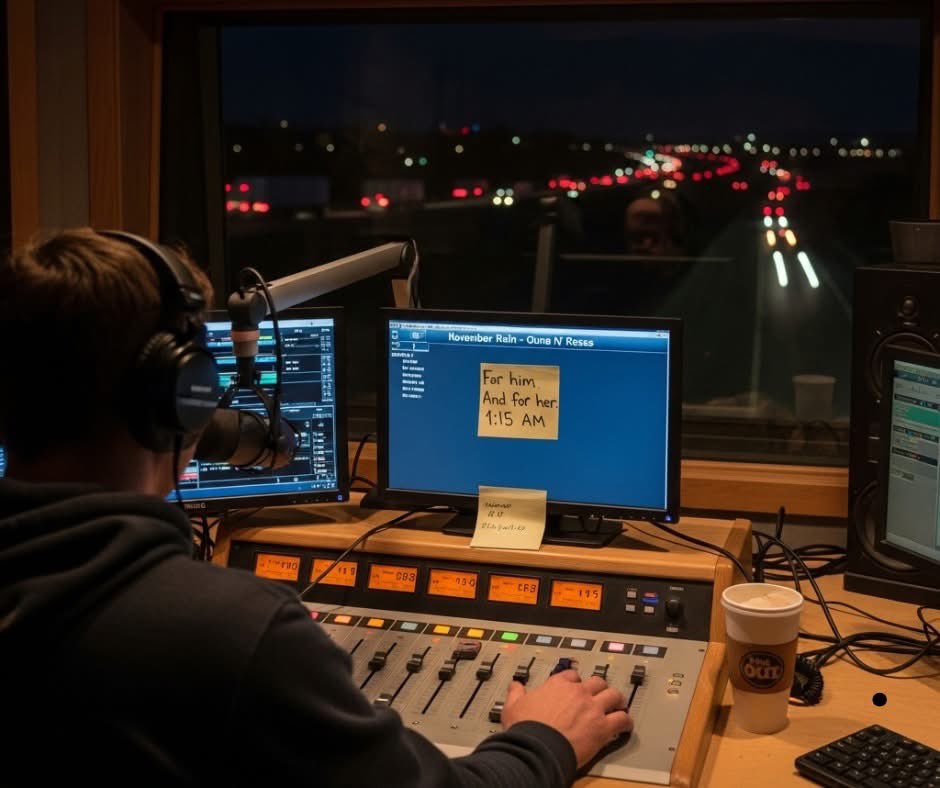
Around 1:15 a.m. every single night, same number calls. Same request, "November Rain" by Guns N' Roses. Eight-minute guitar solo version.
First week, I played it. Thought maybe someone really loved that song.
Second week, I started screening the calls. "We just played that yesterday, how about something else?"
"November Rain, please."
"We have a no-repeat policy"
Click. They'd hang up.
But they'd call back the next night. 1:15 a.m. exactly. "November Rain."
This went on for months. My coworkers thought it was hilarious. Started a betting pool on when the caller would give up.
They never did.
Day 47, "Look, buddy, what's the deal with this song?"
Long silence. Then, "Just play it. Please."
The voice sounded older. Male. Tired.
I played it.
Day 82, My manager told me to block the number. "It's harassment."
I didn't block it.
Day 91, I answered. Before they could speak, I said, "It's queued up. Playing at 1:30."
"Thank you," they whispered.
Day 114, The call came. But different voice. Younger. Female.
"This is about the November Rain requests," she said. "My grandfather passed away this morning. He won't be calling anymore."
My stomach dropped.
"He had dementia," she continued. "Couldn't remember much. But he remembered that song. Said it was playing when he proposed to my grandmother in 1992. At some restaurant. She died five years ago. The song was the only piece of her he could still hold onto."
She was crying. "He'd get confused at night. Agitated. The only thing that calmed him was that song. So I'd call you. Every night. He'd sit next to me, listening on the radio, and for eight minutes he'd remember her. He'd smile. Then forget again. But for those eight minutes....."
I couldn't speak.
"Thank you for playing it," she said. "Even when you were annoyed. Even when your manager wanted you to stop. Those eight minutes were everything to him."
She hung up.
I sat in that booth. Played "November Rain" at 1:15 a.m. Nobody requested it. I just played it.
Did it again the next night.
And every night since.
Some listeners complained. "Why do you keep playing the same song?"
I never explained. Just said, "Station policy."
But truckers started calling in. Said they pulled over during that 1:15 a.m. slot. Listened to the whole eight minutes. Some knew why. Most didn't.
One guy said, "I don't even like that song. But something about hearing it at 1:15 every night..... feels like church. Like we're all stopping together. For something."
They were right.
It's been six months. I still play it. Every single night. 1:15 a.m.
Some things aren't about what you like. They're about what someone needed. Once. When nothing else worked.
That song's not mine anymore. It belongs to an old man who forgot everything except how to love his wife.
And now it belongs to everyone driving lonely highways at 1:15 a.m., looking for a reason to keep going.
Eight minutes. Every night.
That's my church now."
Let this story reach more hearts....
.
Ai image is for demonstration purpose only.
.
By Mary Nelson
An interesting exercise.
Also helped brush up my speed reading skills
But the reason I’m sharing it is because embedded in it is a principle that applies well beyond speed reading: You see the ‘big picture’ only when you have a single focal point & eliminate distractions…
(Video Courtesy @UltraLinx )
In Budapest, there is a fountain that looks like an open book. At regular intervals, a sheet of water curves to one side to give the illusion of a page being turned
Success is no accident. It is hard work, perseverance, learning, studying, sacrifice and most of all, love of what you are doing or learning to do. —@Pele
In Arth shashtra Aacharya Vishnu Gupta - Chanakya advised that The King should collect taxes like Bees connect Honey from the flowers.
Taxation of Equity Arbitrage Fund is the perfect example of Aacharya’s advice.
In FY 25 Kotak Equity Arbitrage Fund ( KEAF ) Regular Plan Growth option delivered a return of 7.50 % post expenses.
The Short term Capital Gains along with cess and surcharge for FY 25 is ~ 23.92 %
The Government, Regulator and Exchanges generates revenue from the arbitrage trades under following heads
-Stamp Duty on Broker Contract Note
- SEBI Charges
- Transaction Tax
- GST on SEBI and Transaction Tax
- GST on Brokerage
- STT
- Stamp Duty collection on Subscriptions to KEAF
Total Expenses incurred by KEAF in FY 25 on above heads was Rs 1,050 Crore on an Average AUM of Rs 52,440 crore or 2 % Fund Average AUM or 27 % of Post Expenses ( net ) return of FY 25
Total Revenue ( Tax + Transaction charges ) to the Government as a % of net Return is ~ 51 %
The transaction costs incurred by the counter party on the KEAF trades will be similar ~ 27 % Post expenses return of FY 25
Total Revenue ( Tax + Transaction charges ) to the Government after adding counter party transactions costs as a % of net Return is ~ 78 %
One swallow doesn’t make a summer.
Let us look at three year calculations.
The three year numbers aren’t far apart ( even though STCG was lower at 17.94 % in FY 23 and 24 )
Total Revenue ( Tax + Transaction charges ) to the Government as a % of net KEAF Return between FY 22 to FY 25 is ~ 48 %
Total Revenue ( Tax + Transaction charges ) to the Government after including counter party transactions costs as a % of net KEAF Return between FY 22 and FY 25 is ~ 75 %
Investors are happy with post tax return of arbitrage fund due to STCG rates.
The Govt. laughs all the way to the bank as it collects Gross revenue of 78 % and net revenue of 51 % from arbitrage fund returns.
Aacharya Vishnu Gupta will be very happy to see that his advise is followed in taxation of Arbitrage Fund.
Mutual fund investments are subject to market risks, read all scheme related documents carefully.
As 2025 comes to a close, I'm continuing a tradition that I started during my time in the White House: sharing my annual lists of favorite books, movies, and music. I hope you find something new to enjoy—and please send any recommendations for me to check out!