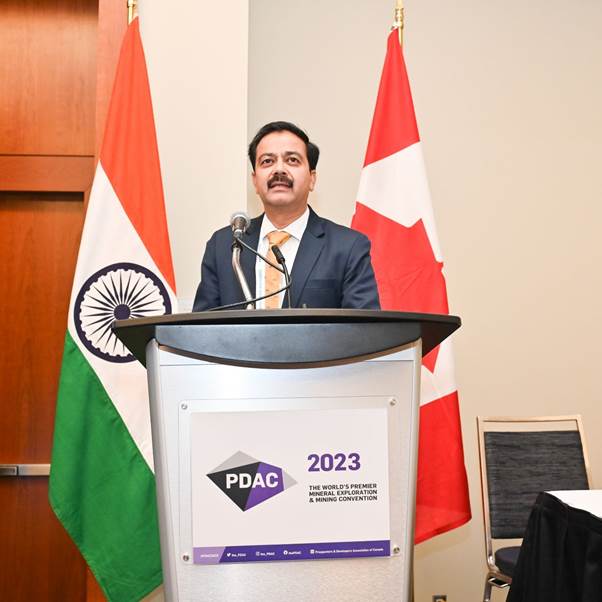
India Day was celebrated at the #PDAC2023 convention in Toronto, Canada.
Shri Vivek Bhardwaj, IAS, Secretary, @MinesMinIndia along with senior officials of the Ministry, @CoalMinistry & C.I.I. attended the event.
Details: https://t.co/lF0sUZJppe
@HCI_Ottawa@IndiainToronto
Mohan Khokar's collection will help future research scholars,academicians
and PHD students. There have been very few original, pioneering, scholars who are pan-Indian and know each form intimately.
No one has done for Indian dance as much as Mohan Khokar and his family.
invites, dolls, paintings, statues, magazines just about anything and everything related to Indian dance heritage and history. It was an expensive passion that took a heavy toll financially on the family and they had to accommodate and adjust accordingly.
The collection of Mohan Khokar spanning a life time includes rare photographs (taken by Mohan Khokar himself), statues (including a Chola bronze to a sholapith), postage stamps, paintings, press clippings, brochures, posters, costumes, masks, gramophone records, visiting cards,
Their belief was that India’s dance heritage and wealth should stay within the country. Thanks to the family's generosity, Mohan Khokar's life mission is now India’s national treasure.
The MKDC was sought by the Lincoln Centre, New York Public Library, New York City & Sweden Dance Museum in Stockholm,but to the credit of Asish Khokar & his late mother, M.K. Saroja, a legendary Bharatanatyam dancer & Padma awardee, decided to keep the collection in India itself.
With over 45 books on dance to his credit, Asish Khokar after his father's demise has carefully looked after the collection, studied it & contributed to it. He also edits and publishes a dance annual, 'Attendance' the only dance magazine of its kind in India since 1999.
Mohan Khokar's extensive unique collection now forms the Mohan Khokar Dance Collection at the INGCA, New Delhi. Which was reintroduced to the world thanks to his son, Asish Khokar, himself a famous dance scholar, critic, commentator, author & columnist.
The house itself has a fascinating story behind it related to the blessings of a Sufi saint. Also it is said that during the 1947 partition riots the people who took refuge in this house apparently all survived.
Mohan Khokar only 10yrs old lost all his relatives & friends in that quake.The newspapers & offical records showed that Khokar house alone withstood the earthquake.Later on apparently the best of British engineers came to examine their house as to how it alone withstood the quake
Mohan Khokar served the Sangeet Natak Akademi for 18 years which was the Akademi's golden period thanks to him.
An interesting anecdote: In the Quetta, Pakistan earthquake of 1935, in which 40,000 people are estimated to have died.
Mohan Khokar was the first in the country to go to distant villages capturing forms like Bhagavata Mela, the Chhau, Yakshagana, Ottan Thullal and Kutiyattam. With his untiring efforts he preserved and popularized many dance forms which were near extinction.
He was also the earliest authority on Indian dance,writing nationally on dance for magazines,journals & newspapers.He took it upon himself to learn & share his knowledge as most of the stuff being written about was from foreigners who had scant knowledge of Indian dances&culture.
Arundale was so surprised to see this boy all the way from Punjab with such a zeal for dance that she agreed to take him in, the rest is history.
Mohan Khokar had in-depth knowledge of all the Indian classical and folk forms.
Such was his determination that he undertook an 8 day train journey from Lahore to reach Chennai and requested the Great Rukmani Devi Arundale to teach him Bharatanatyam.Chennai for him was a place world apart in language, culture and tradition.
Incidentally a person who was also part of the troupe would go on to became his future soul mate and one of the Bharatnatyam greats herself. But the only way back then for Mohan Khokar to learn Bharatnatyam was to move to the south.
Mohan Khokar got a chance to view Bharatanatyam performances of dancer and choreographer Ram Gopal and his troupe while on their tour to Lahore. He was so mesmerized by their movements that he decided to learn it for himself.