Two indicators. Built on the same framework Eric teaches in Trade The Edge.
The TTE Value Indicator monitors up to six correlated markets simultaneously and detects when your primary market moves out of alignment with them. It classifies signals based on correlation breakdown strength and tracks performance using ATR-based targets and stops. The statistical dashboard shows which setups have the highest historical follow-through, so signal quality is visible before any decision is made.
The TTE Liquidity Withdrawal Indicator tracks rejection pattern performance candle by candle in real time. The signal filtering is live, meaning it updates based on actual results on the instrument and timeframe you are trading, not on historical assumptions that may no longer apply.
Both are available on TradingView. Starting from GBP 9.99 per month. Seven-day money-back guarantee. Link in bio.
🛡️ Education only. Trading involves risk of loss.
#globalexquant #tradetheedge #TradingView #institutionaltrading #tradereducation
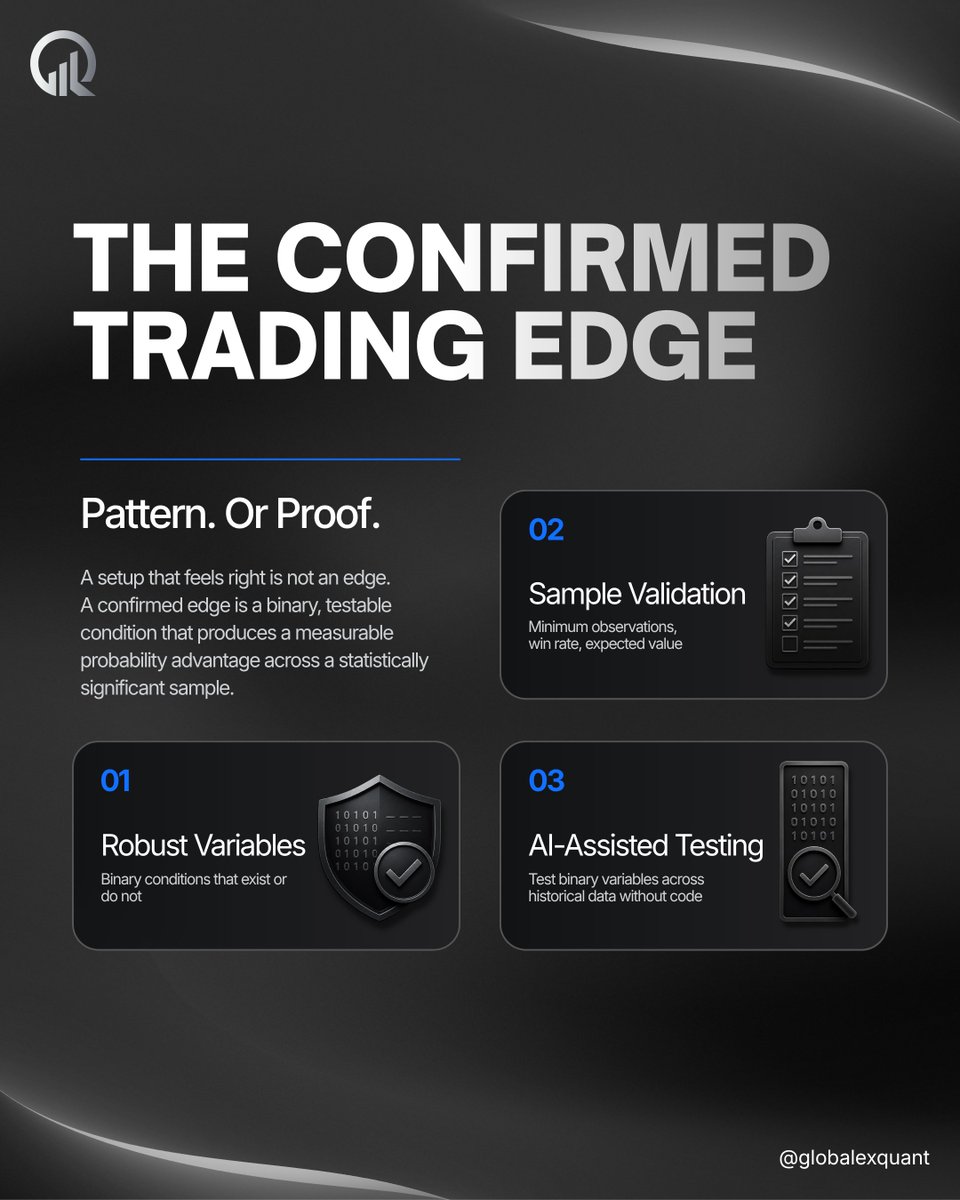
A setup feeling right and a setup being confirmed are two different standards. Most traders never test which one they are actually operating on.
Here is the full framework for confirming whether a setup has a real statistical edge.
ROBUST VARIABLES
A robust variable is a binary condition. Either it exists at the time of entry or it does not. Is price at yesterday's session low? Yes or no. Is the volume profile showing a High Volume Node at this level? Yes or no. Binary variables retain statistical validity in live markets because they cannot be adjusted after the fact. The more conditions required to confirm a setup, the fewer qualifying samples exist and the weaker the statistical foundation becomes.
CURVE FITTING
Curve fitting occurs when a strategy is built around too many confirming conditions. Each added condition narrows the qualifying sample until the data set is no longer statistically meaningful. A model that works perfectly on historical data but fails in live markets has been fitted to the past, not tested against the future. The cost of overfitting is invisible until the strategy is already live and capital is already at risk.
THE TESTING PROCESS
Define the entry condition as a binary question. Is price at the Asia session low? Yes or no. Count every instance where that condition was met across a minimum of 200 historical observations. Record each outcome as a win or a loss. Calculate the win rate across the full sample. Multiply the win rate by the average winner and subtract the loss rate by the average loser. A positive result confirms a measurable edge.
HOW THE FRAMEWORK APPLIES
Once a binary variable is confirmed to have a positive expected value across a sufficient sample, position sizing can be calibrated to the statistical confidence level. A higher win rate on a well-sampled variable justifies a larger weighted position. AI tools can be used to run this counting process across historical data without writing code. The output is the same: a win rate, an average outcome, and a calculated expected value that either confirms or invalidates the variable.
Have you tested your setup? Drop it in the comments.
🛡️ Educational content only. Not financial advice.
#globalexquant #quantitativetrading #tradereducation #institutionaltrading #riskmanagement
Gold and the NASDAQ share a currency. They do not share a cause.
Both are priced in dollars. Both respond to dollar strength. Treating them as the same kind of trade because of that shared pricing currency is a precision error that compounds across every multi-asset analysis built on it.
TANGIBLE ASSETS
Gold belongs to the tangible asset class along with the broader metals and commodities complex. Its value is anchored in physical scarcity and real-world demand that exists independently of any single market's sentiment. The primary driver is inflation expectations and real yield calculations. When inflation rises and real yields compress, holding a non-yielding physical asset becomes comparatively more attractive, which is the actual mechanism behind Gold's price movement. The asset is dollar-priced, but its fundamental driver is the relationship between inflation and yield, not the dollar in isolation.
INTANGIBLE ASSETS
The NASDAQ belongs to the intangible asset class along with broader equity indices. It has no physical form. Its value is a claim on future corporate earnings, discounted by current risk appetite and prevailing interest rates. When earnings expectations strengthen or the discount rate applied to those future earnings eases, the index moves. This driver is structurally distinct from inflation. A rate hike can hurt equities by raising the discount rate on future earnings at the exact same moment that inflation data is doing something completely different.
WHY DOLLAR STRENGTH AFFECTS EACH CLASS DIFFERENTLY
When the dollar strengthens, the transmission mechanism into each asset class runs through a different channel. For Gold, dollar strength often coincides with tightening monetary policy, which raises real yields and makes the opportunity cost of holding a non-yielding asset higher. For the NASDAQ, the same tightening cycle raises the discount rate applied to future corporate earnings, compressing valuations through an entirely separate mechanism. Both assets can fall during the same dollar-strength period, but the price action gives no indication that the underlying cause was identical.
THE ANALYTICAL ERROR
Building a correlation model that uses dollar strength as the single explanatory variable for both Gold and the NASDAQ assumes a shared causal pathway that does not exist. The practical consequence is misreading divergence: when Gold and the NASDAQ move independently of each other despite both being dollar-priced, that is not a breakdown in correlation. It is confirmation that the two assets were never driven by the same mechanism to begin with.
🛡️ Educational content only. Not financial advice.
#globalexquant #intermarketanalysis #gold #NASDAQ #institutionaltrading
Identifying which market is mispriced is only the first half of the problem.
The second half is knowing when the spread has reached maximum divergence before convergence begins. Most traders only solve the first half.
Here is the full sequence.
SPREAD WIDENS. EDGE APPEARS.
When correlated markets diverge, the spread between them widens as the gap grows. Commercial banks track this divergence in real time using the skew line. When the skew line signals maximum extension, the spread is at saturation. That is the exact zone where convergence becomes the higher-probability outcome.
THE SKEW LINE SIGNAL
The skew line measures volatility-adjusted relative positioning between two correlated instruments. When the spread reaches its widest point, the skew line peaks and begins to turn. That turn is the saturation signal. The key detail is that price on the primary instrument may still be rising at this point. The skew line diverging downward while price moves up is what produces the Diamond Formation.
THE DIAMOND FORMATION
The Diamond Formation occurs when both the spread line and the skew line begin falling simultaneously while the primary instrument price is still moving higher. This divergence between price and positioning reflects commercial banks quietly reducing exposure before the retail momentum move exhausts itself. It does not predict direction. It identifies the point where the spread has reached saturation and convergence is the structurally expected next move.
WIDER BUBBLE. LARGER MOVE. LONGER HOLD.
Bubble size refers to the magnitude of spread divergence at saturation. A wider bubble at the point of the Diamond Formation signals a larger macro repositioning event. Wider divergence does not produce a scalp opportunity. It signals a higher timeframe swing trade with a correspondingly longer hold period.
What does your spread tell you right now? Drop it in the comments.
🛡️ Educational content only. Not financial advice.
#globalexquant #spreadtrading #intermarketanalysis #institutionaltrading #tradereducation
When there is no defined target, position sizing has no anchor.
The size of a trade becomes a function of how confident the trader feels at that moment, which is one of the least reliable inputs available. Good analysis does not fix this. A trader can be analytically correct and still overtrade, oversize, or hold past a rational exit because there is no pre-defined point at which the session is done.
The monthly target model changes the relationship between performance and decision-making. When the target is reached, the psychological pressure to continue trading dissolves because the criteria for a successful month are already met. That removal of pressure is not just a comfort. It eliminates one of the structural conditions that produces the worst trading decisions, which is the compulsion to keep going when stopping is the correct action.
The compounding dimension matters for a different reason. A defined percentage target applied consistently produces a curve that is measurable and comparable month to month. Chasing undefined upside produces no comparable baseline at all, which makes it impossible to evaluate whether performance is actually improving or just variable.
🛡️ Educational content only. Not financial advice.
#globalexquant #tradingpsychology #riskmanagement #institutionaltrading #tradereducation
Paridafx X Pipstone Capital giveaway
10 x 5k instant accounts
HOW TO ENTER:
1. Join both discord
https://t.co/vXVbHj3J7v https://t.co/vUGnxmNtw9
2. Register
https://t.co/F7OB6rveRS
3 .Follow us on X
@cryptoparida@Pipstonecapital
Like repost The tweet
Paridafx x Blueberry Funded giveaway.
10 x 10k prime challenge
Step 1: register using the link is must https://t.co/D4BLYS5HeS...
Step 2: join discord https://t.co/UONvyYmRKQ
Step 3 : Follow
@cryptoparida
and
@BlueberryFunded
Like, ReTweet and share registration screen shot in comments
All the best