Protocol for the ongoing consensus work on this topic in IBD with my co-PIs @amjohnsonMD@AndresYarur and a super team including @jalpa_devi@SamiSamaanMD@phillyIBDdoc Matt Vincent Shannon Coombs @MouhandMD and RAND/UCLA methodologist @EdBarnesMD
Stay tuned for the actual 3 part survey output:
Modulate Obesity and relateD metabolic complIcations For Yielding improvements in IBD outcomes (MODIFY-IBD): consensus on obesity and cardiometabolic comorbidities in inflammatory bowel disease using systematic reviews and the RAND/UCLA appropriateness m… @BMJ_Open https://t.co/DaS6UV0NYV
📢 New pub from #REBOOTIBD consortium and #NorthAmericanpCD group, longer tweet coming from @jalpa_devi
Real-World Effectiveness of Upadacitinib for Perianal Crohn’s Disease: A Multi-Center Retrospective Study - @AGA_CGH in N =125 patients
- 45.5% achieved clinical response,
- 39.4% clinical remission.
- On pelvic MRI (n=78), 55.1% improved and 11.5% completely healed.
- Clinical response higher in anti-TNF–naïve vs. exposed (66.7% vs. 33.3%; p=0.001)
- Clinical response higher in those with shorter disease (54.7% vs. 33.3%; p=0.04) pCD patients
https://t.co/fBVGv53lKL
Come swing by the poster hall to see our Olmsted County IBD posters by Dr Mouhand Mohamed Tu1554,Tu1635, and Tu1650! One on Crohn’s surgery rates, another on steroids and hospitalizations in CD, and one on IBD natural history in those diagnosed >60 years!
Hanging out at the Olmsted County Crohns surgery poster (Tu1635) with @MouhandMD We have seen a significant reduction in Crohn’s surgical rates among those diagnosed after 2000 #DDW2026@DDWMeeting
🗨️ “The 10-year risk for #colectomy in patients with #UlcerativeColitis still appears to be approximately 15%,” Dr. Isabel Lopera said.
Lopera, study PI @EdwardLoftus2 and mentor @amjohnsonMD reported results from 50+ years of data at #DDW2026. https://t.co/AukuicfeTI
@EdwardLoftus2 presenting results from the ANTHEM-UC study, on the efficacy of Icotrokinra, the first oral peptide targeting IL-23, in patients with UC who were advanced therapy naive vs exposed @DDWMeeting
This morning, while preparing a talk, I thought about how to represent the complexity of diagnosis and disease evolution
Like white light passing through a prism, each wavelength travels at a different speed and bends differently, revealing a spectrum. Similarly, one disease can unfold in multiple ways, each specialist controls one color, but the patient is the whole light
I thought it was a nice representation
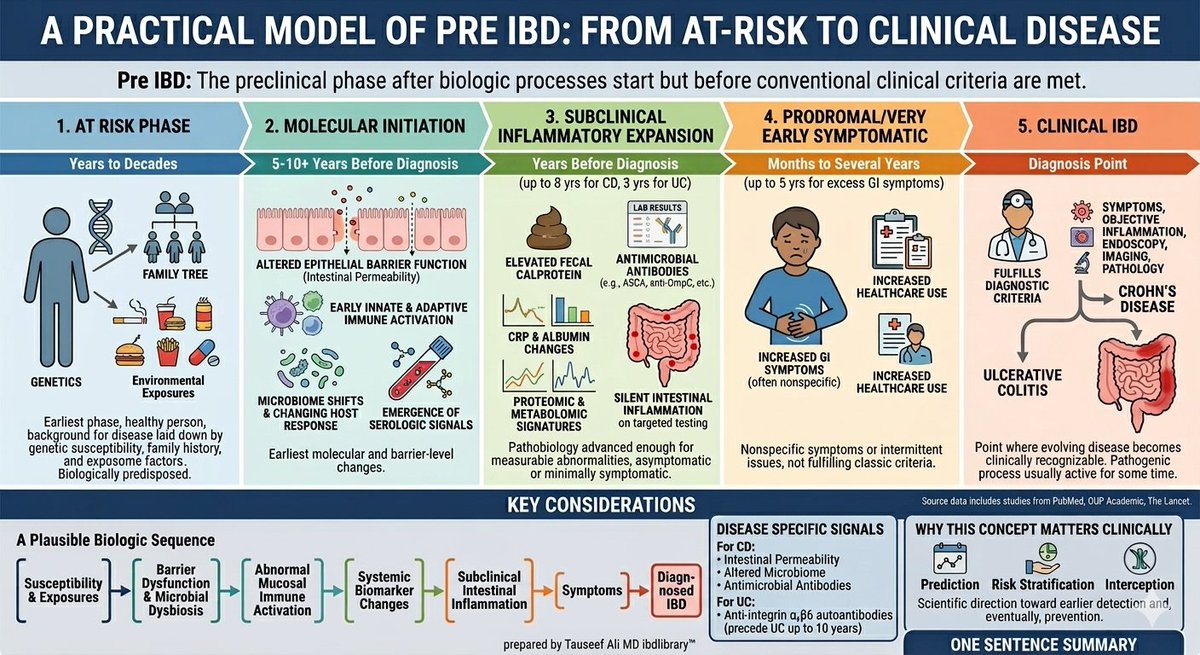
Understanding the journey to an IBD diagnosis is key to unlocking early intervention. This detailed infographic breaks down "Pre IBD," the crucial preclinical phase where biological changes begin long before symptoms appear.
From genetic predisposition to molecular initiation and subclinical inflammation, the path to Crohn’s disease or ulcerative colitis often spans years. Recognizing these early stages opens the window for prediction, risk stratification, and potentially interception.
Dive into the science behind the "At Risk" phase, microbiome shifts, and disease-specific signals.
https://t.co/GA7J7ruGkC
Join expert bariatric endoscopists @DanMaselliMD & @EricJVargasMD for a FREE webinar February 18th on innovative, minimally invasive weight-loss procedures. Learn how endoscopic sleeve gastroplasty (ESG) and gastric fundal mucosal ablation (GFMA) work, who they’re for, and what results patients can expect—plus a live Q&A. Submit questions anytime to: [email protected] and don’t forget to register here! —> https://t.co/yf6l1ctsvf
AGA Clinical Practice Update on Inpatient Management of Adults With #IBD : Expert Review https://t.co/aO3wBxBjQF @AmerGastroAssn@AGA_Gastro Over the next couple of days I am going to summarize the recommendations of this AGA CPU by @ShirleyCoMekMD@JHashashMD@IBDMD and me 🧵
Evaluating the Impact of Visceral Adiposity and Sarcopenia on Outcomes in Hospitalized Patients with Acute Severe Ulcerative Colitis | Digestive Diseases and Sciences @amjohnsonMD https://t.co/B0F3cw5XSk
📢 New in Gastroenterology from PROMISE group:
Prediction and Prevention of Inflammatory Bowel Disease: A Call to Action
Summarizing the key points from the May 2025 PROMISE Workshop
@LopesScopes@khalili_MD@JeanFredericCo1@KenCroitoru#IngaPeter
https://t.co/OZh3es0lhY
As gastroenterologists, we need to move past the outdated idea that IBD is only a disease of undernutrition.
📊 The evidence is clear:
Obesity increases the risk of Crohn’s disease
It is associated with more active disease and poorer outcomes
It may reduce response to therapy
And it increases surgical risk
Visceral fat—especially mesenteric fat—is biologically active and can fuel intestinal inflammation. This has real implications for how we counsel patients, dose therapies, and design multidisciplinary care models.
💡 Obesity in IBD is not a failure—it’s a modifiable risk factor and an opportunity to improve outcomes.
Proud to share this educational work through IBD Library™.
@saia_gi@CrohnsColitisFn@CrohnsColitisUK@aboutIBD@getgutsycanada@gastrogirl@AmCollegeGastro@AmerGastroAssn
https://t.co/LSuyjX3spu
GLP1-Receptor agonists & Clinical Outcomes of IBD: A Syst. Review/Meta-analysis.
https://t.co/OA5hEmqb2P
👉11 studies with 16,242 IBD pt Rx with GLP1-RAs
👉wt loss ~various GLP1RAs included
👉GLP1- RAs assoc 🔽risk of surgery
👉Sens. analysis: 🔽risk hosp./surgery in BMI≥30
Another clinically useful RWE data output from #REBOOTIBD consortium led @amjohnsonMD@MayoClinicGIHep Longer tweet to follow on data!
Multicenter Study of the Real-World Effectiveness and Safety of Risankizumab in Crohn’s Disease @JCC_IBD@Y_ECCO_IBD https://t.co/RWHSSlPcWe