Keep your problems smaller than your life. A flat tire is a flat tire. A bad meeting is a bad meeting. A canceled flight is just an extra two hours. These things become catastrophes when you let them. But they stay manageable when you remember the depth of your real life- the people you love, the work you care about, the beautiful years still ahead. Zoom out. Fit your reaction to the size of the problem.
The greatest economic crisis in some homes is not inflation. It is internal competition.
I've watched couples hide investments, buy property in secret, pursue degrees without discussing them, and celebrate promotions that quietly threaten the marriage.
Not because they hate each other.Because somewhere along the journey, partnership became rivalry.
A family cannot build generational wealth when husband and wife are running separate races.
The strongest marriages are not built by the smartest individuals.
They are built by couples who understand one simple truth: Your spouse is your greatest investment, not your greatest competitor.
Tugende tulonde ba Chairman
On Visitation Sunday:
As you go on a visitation Sunday for u child who’s in boarding school, avoid focusing on the wrong things.
Many parents drive to school, offload a bucket of KFC 🍗, sit in the compound, eat with the child, hug, and drive off.
The food is finished by evening. The visit is forgotten by Monday morning. Imagine u came all that way to fill a stomach.
Make the visit count. Focus on three things:
1. Talk to the teacher, not just the child 👨🏽🏫
Ask how they behave when you’re not watching. Ask abt the subjects they’re failing. The teacher sees the child u don’t. Get the truth while you’re standing there.
2. Check the books and the body 📘
Open the exercise books. Are they marked? Is homework done? Does your child do corrections? Then look at the child. Is he thinner? Sad? Withdrawn? A child in trouble rarely says it. U must read it.
3. Feed the heart, nt just the mouth ❤️
Sit and ask real questions.
-“Are you okay here?
-“Who are your friends?”
-“What are you afraid of?”
Let them talk. Sometimes a child is enduring something in silence and this is their only chance to be heard.
Bring the food, yes. But leave behind courage, correction, and connection.
That is what a child remembers long after the chicken and duddies u bought from Fraine Supermarket is gone.
#Parenting
This kid Samuel (Lori’s son from @ lorisamuelsmom Instagram/TikTok) is going viral for his insanely accurate bird calls.
He can do over 100 different ones! The Oklahoma 12-year-old crushed it at his school talent show
@GODFREY_Kutesa My son does- every term I purpose to go to the book store with him and he chooses three novels, by the end of the school term he’s sharing with me which were the most interesting- I have loved watching his interest grow more and more.
Sydney Gongodyos’ senseless murder is a stain on our society. Everyday, I cry for this stranger that has united us in grief.
My hope is that something good can come from this; May we learn lifes’ harshest lessons and may we as a society,be better for it.
RIP Sydney.
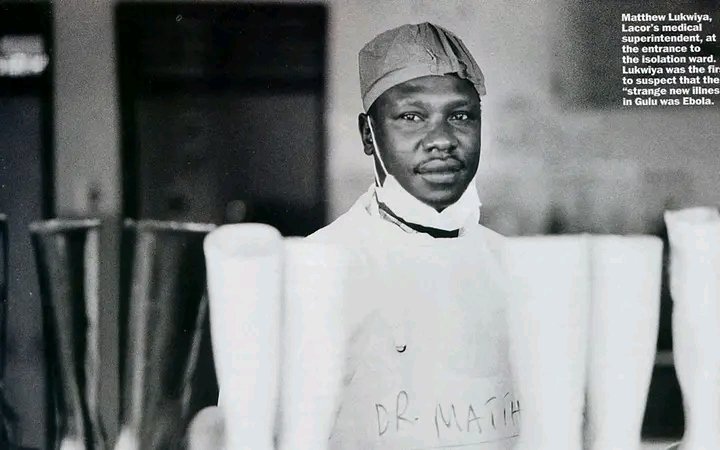
In Memory of Dr. Mathew Lukwiya
In his final hours, he spoke to Sister Apio Anyai Angioletta, the paediatric nurse who had known him for years. She would later remember his exact words.
"Sister, things are worsening. I have tried to fight. The battle is almost over. Now I am seeing that I am also going. The time has come for me to go. That I know. I am going. But if I go, I will be at the doorway. Nobody is going to die now. I will tell my God that enough is enough."
Then he began to sing a hymn about war. Everyone in the room broke down. Sister Apio replied, "No, doctor, it will not be like that." But it was. On December 4th his breathing briefly stabilised. Later that evening his lungs began to haemorrhage. He died at 1:20am on December 5th, 2000.
He was buried at 4pm the same day. The coffin was sprayed with Jik bleach as it was lowered. Margaret asked if she could see him one last time and was refused. The body was considered too infectious.
He was placed in a grave he had chosen himself while he was dying, at the Grotto inside the hospital grounds, beside Dr. Lucille Teasdale and later Piero Corti. Teasdale had died in 1996 of AIDS, contracted while operating on an HIV-positive patient.
The student was buried beside his mentors.
And then something extraordinary happened. After Lukwiya's death, every remaining Ebola patient at Lacor survived. Not another single person died at the hospital. Sister Apio remembered the promise he had made on his deathbed: "I will tell my God that enough is enough." It is the kind of detail you would not believe if you read it in a novel.
By the time the WHO declared Uganda Ebola-free on February 6th, 2001, 425 confirmed and probable cases had been recorded, and 224 Ugandans had died, including thirteen health workers from Lacor alone.
The survival rate during the outbreak was nearly 50%, compared to as low as 10% in previous African outbreaks, largely because of the systems Lukwiya had built before anyone else even knew what was happening.
This is what the mainstream story leaves out. The intern who refused a teaching job in England. The doctor who walked into the bush instead of the nuns. The administrator who turned the hospital into a shelter for nine thousand people, most of them children, every night.
The Acholi son of a smuggler who topped his country in school, won the John Hay Prize at Liverpool, and still chose Gulu over everything else. By the time he made that final speech to his nurses, the heroism was already the entire shape of his life. The Ebola work only made it public.
Happy Heroes Day, Dr Matthew and all healthcare workers who sacrifice more than they should have to! #HeroesDay
# *Copied*
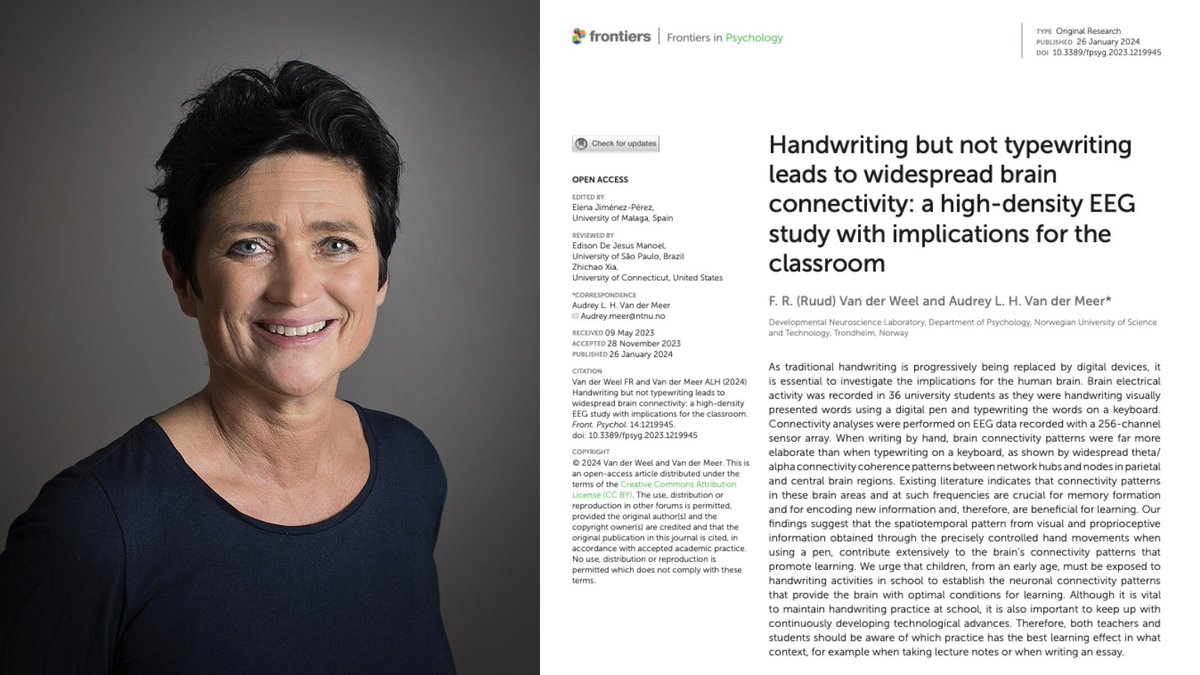
A Norwegian neuroscientist spent 20 years proving that the act of writing by hand changes the human brain in ways typing physically cannot, and almost nobody outside her field has read the paper.
Her name is Audrey van der Meer.
She runs a brain research lab in Trondheim, and the paper that closed the argument was published in 2024 in a journal called Frontiers in Psychology. The finding is brutal enough that it should have changed every classroom on Earth.
The experiment was simple. She recruited 36 university students and put each one in a cap with 256 sensors pressed against their scalp to record brain activity. Words flashed on a screen one at a time.
Sometimes the students wrote the word by hand on a touchscreen using a digital pen, and sometimes they typed the same word on a keyboard. Every neural response was recorded for the full five seconds the word stayed on screen.
Then her team looked at the part of the data most researchers had ignored for years, which is how different parts of the brain were communicating with each other during the task.
When the students wrote by hand, the brain lit up everywhere at once.
The regions responsible for memory, sensory integration, and the encoding of new information were all firing together in a coordinated pattern that spread across the entire cortex. The whole network was awake and connected.
When the same students typed the same word, that pattern collapsed almost completely.
Most of the brain went quiet, and the connections between regions that had been alive seconds earlier were nowhere to be found on the EEG.
Same word, same brain, same person, and two completely different neurological events.
The reason turned out to be something nobody had really paid attention to before her work. Writing by hand is not one motion but a sequence of thousands of tiny micro-movements coordinated with your eyes in real time, where each letter is a different shape that requires the brain to solve a slightly different spatial problem.
Your fingers, wrist, vision, and the parts of your brain that track position in space are all working together to produce one letter, then the next, then the next.
Typing throws all of that away. Every key on a keyboard requires the exact same finger motion regardless of which letter you are pressing, which means the brain has almost nothing to integrate and almost no problem to solve.
Van der Meer said it plainly in her interviews.
Pressing the same key with the same finger over and over does not stimulate the brain in any meaningful way, and she pointed out something that should scare every parent who handed their kid an iPad.
Children who learn to read and write on tablets often cannot tell letters like b and d apart, because they have never physically felt with their bodies what it takes to actually produce those letters on a page.
A decade before her, two researchers at Princeton ran the same fight using a completely different method and ended up at the same answer. Pam Mueller and Daniel Oppenheimer tested 327 students across three experiments, where half took notes on laptops with the internet disabled and half took notes by hand, before testing everyone on what they actually understood from the lectures they had watched.
The handwriting group won by a wide margin on every question that required real understanding rather than surface recall.
The reason was hiding in the transcripts of what the two groups had actually written down.
The laptop students typed almost word for word, capturing more total content but processing almost none of it as they went, while the handwriting students physically could not write fast enough to transcribe a lecture in real time, which forced them to listen carefully, decide what actually mattered, and put it in their own words on the page.
That single act of choosing what to keep was the learning itself, and the keyboard had quietly skipped the choosing and skipped the learning along with it.
Two studies. Two countries. Same answer.
Handwriting makes the brain work. Typing lets it coast.
Every note you have ever typed instead of written went into your brain through a thinner pipe. Every meeting, every book highlight, every idea you captured on your phone instead of on paper was processed at half depth.
You did not forget those things because your memory is bad. You forgot them because typing never woke the part of the brain that would have made them stick.
The fix is the thing your grandmother already knew.
Pick up a pen. Write the thing down. The slower road is the faster one.