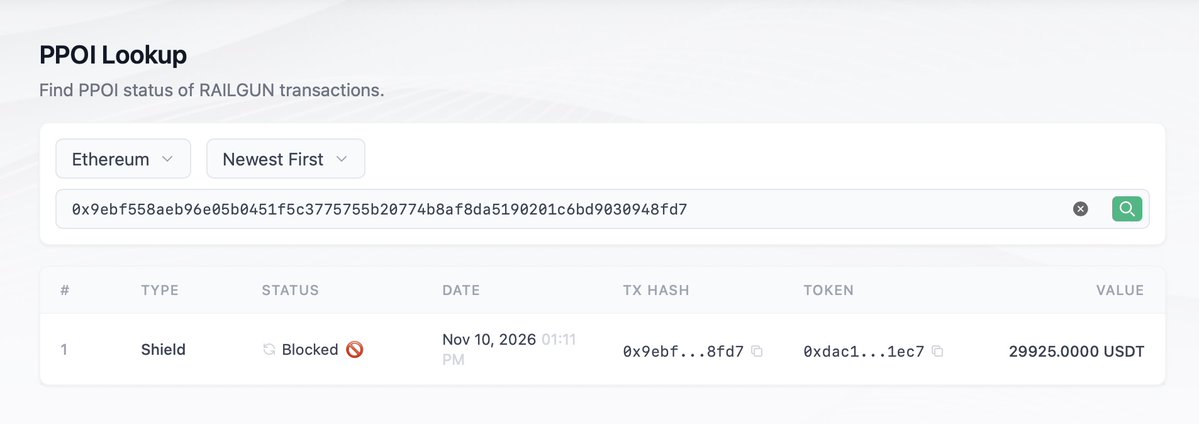
No, these two are not addresses, they are transaction hashes. Both are the attacker's deposits to Railgun on 10 Nov. Railgun's PPOI system flagged them, so the funds could not be moved inside Railgun, and the attacker had to withdraw them back to the sending addresses.
The addresses controlled by the attacker, from which these transactions were sent:
0x7b5e1197f70a18f20ad636e169f53afe8d6fa3bd - sent 0x9ebf558aeb96e05b0451f5c3775755b20774b8af8da5190201c6bd9030948fd7 (30,000 USDT, 10:11 UTC). The funds came back in 0xe3f7887db3ee641e8decac3e7c54ad20bb4f9751fb6780dd428e869a1437b521 (29,850.19 USDT, 11:15 UTC).
0x4567294ab21a2a53b13dd13dc604b1f226229bbb - sent 0x05f282193ebafb51375c1206b85c5efd7a4be355cf87775a9f64f1fd56f656be (9,799.45 USDC, 14:58 UTC). The funds came back in 0x45b1601e4d7a677094595f3ea8f90d172d2575b35a434a63f1cd41867678d70a (9,750.51 USDC, 17:21 UTC).
🚨86,477 USDT stolen: 2 attempts to launder it via Railgun stopped
On Nov 9, a crypto service lost 86,477 USDT (TRC-20) due to unauthorised access to its infrastructure.
The attacker used a no-KYC exchanger to swap the funds from Tron to Ethereum, then tried to launder them via Railgun (twice). The second time, a part of the funds was swapped to USDC using NEAR Intents infrastructure, and transferred to a new address. Both attempts failed and the deposits were blocked, which meant the attacker had to return the funds to the original addresses.
This is where @RAILGUN_Project’s Private Proofs of Innocence (PPOI) system comes in. PPOI reacts quickly to the attacker's transactions, not letting stolen funds get any further inside Railgun - the only option left is to withdraw them back.
@aml_crypto is working on this case with @officer_secret. We continue to monitor the funds. The investigation is ongoing. We are working on the digital traces left by the attacker on the server and on the infrastructure behind the IP addresses used during the attack.
Wagyu says it has agreed on repayment plans with large holders. So far, we haven't seen any of those payments on Hyperliquid.
Most of the affected wallets received something. Most of the money, however, has yet to be recovered.
Data: Hyperliquid trades, Nov 20-24.
https://t.co/dHabmxwKpm
https://t.co/D1WK2bKrip is back live!
I'm really sorry for everything that happened.
Most people have been refunded who were affected by the XMR1 depeg.
A few large holders I made payment plans with, they will be repaid overtime.
Wagyu’s XMR1 crash: who lost money and who got it back?
We looked at Hyperliquid trade data to see what happened on Nov 20, who bought the dip and how much Wagyu has paid back so far.
@aml_crypto x @officer_secret
Looking at the individual payouts:
They ranged from $0.16 to $2,774, with a typical payout of around $43.
78 wallets with larger losses, $3.99M between them, received nothing.
Purchases made in the first 11 minutes of the crash don't appear to have been counted at all.
Thanks, @etherscan. Great partners to work with. The Wagyu exploiter’s addresses got their labels within hours of the incident. Whoever runs into these funds next will see the warning first.
The dark side of advertising in the shadow economy
Wagyu just grew right before our eyes. Seven months after launch, the service claimed $700 million in volume, and its founder publicly showed off multi-million dollar swaps. The same visibility made the service popular in the shadow economy. ZachXBT named it as one of the channels used to move funds into Monero after the theft of $106 million from a European entity. After the Lighter attack the service took in about $3.5 million for conversion to XMR in just over an hour.
Popularity like that comes at a cost. A service handling large and sensitive flows is itself a target. First there were the extortionists. The WhiteArmor group demanded $5 million and, when refused, published three months of internal data – 38,628 orders and 10,139 IP addresses. Then came the hack On November 20, 5.2 million XMR1 were withdrawn from the deployer address, and some $13.5 million was stolen. In both cases, the users were the ones who took the hit. Some came looking for privacy, but got their data out in the open. Others were left with a token that dropped from $488 to $1 in half an hour.
Publicity brings customers, but it also brings those who know how to count other people's money and look for weak spots. The more popular a service is in the shadow economy, the less space it has for security mistakes.
AML Crypto is working with @officer_secret on a big investigation into Wagyu: how the service works, where its liquidity comes from, and how it has been used in money laundering schemes. It’s coming out soon.
People are starting to write to the Wagyu exploiter. Directly on the blockchain, in messages attached to transactions sent to his addresses.
There are ads interspersed with all the other messages. A swap service writes “Hey genius use this platform its very secure” link attached. Friendly tip on where to wash 7,348 stolen ETH, delivered straight to the wallet. One transaction fee per ad budget. Targeting: spot on. Leads:1.
The money still hasn't moved. We still watch.
Wagyu has replied. Almost five hours after 5.2M XMR1 left his own wallet, the founder is “not completely sure what happened yet”.
Here is what’s known so far. The tokens went out in three transfers over half an hour, each one signed with the deployer key. The statement doesn’t mention the key. It doesn’t say whether XMR1 still swaps back to real Monero either. Swaps being fine is not much comfort if you are holding a one-dollar token.
He says he is open to talks. The other side is quiet: 7,348 ETH have been sitting on 0xF32D…Dc59 and 0x1464…20Bf since morning and haven’t moved.
We are watching these funds. If they move, we’ll post.
Graph: https://t.co/gJIbVTstRc
Hi.
Not completely sure what happened yet, will investigate.
Seems like MMs of XMR1 got hit primarily as they kept buying the endless amount of XMR1 being dumped on the market.
Swappers were OK, suffered no loss there.
Whoever did this, I'm open to negotiations of course.
Wrapped Monero came unwrapped. On November 20, Wagyu’s XMR1 on Hyperliquid went from $479 to $1. Real XMR didn’t notice and stayed around $475. Lookonchain politely asked if this was a hack.
On-chain it all looked pretty routine. Address 0x1464dacaceb0d511f9964cdac5eba50ea42220bf got 5.2M XMR1 straight from the deployer wallet 0x2077…e06a (Wagyu owner). Three transfers: 100K, another 100K and, why not, 5M. Then the Hyperliquid order book, 13.22M USDC, and 7,467 ETH on the way out. The book ran out before the tokens did: 4.8M XMR1 are still sitting there unsold.
Graph: https://t.co/gJIbVTstRc
Nobody had to print anything. All 20M XMR1 were issued back in December 2025, in one go. That is more than the amount of Monero that exists, by the way. About 1.3M made it into circulation. The rest waited on one address with one key.
Wagyu’s founder did warn everyone: “I am the counterparty risk”. As for multisig, he said it only turns 1/1 custody into 2/3 custody. Today the market priced that difference at $478 per token.
Two versions. Someone stole the deployer key and sold the tokens. Or they were sold by whoever had the key from day one. On-chain you can’t tell them apart: same signature.
The same key issued ZEC1 and TRX1. They are still there, for now.
XMR2 (XMR - Beluga), which showed up on Hyperliquid on November 10, has nothing to do with this: different deployer, different service, no link to the incident that we could find.
The dark side of advertising in the shadow economy
Wagyu just grew right before our eyes. Seven months after launch, the service claimed $700 million in volume, and its founder publicly showed off multi-million dollar swaps. The same visibility made the service popular in the shadow economy. ZachXBT named it as one of the channels used to move funds into Monero after the theft of $106 million from a European entity. After the Lighter attack the service took in about $3.5 million for conversion to XMR in just over an hour.
Popularity like that comes at a cost. A service handling large and sensitive flows is itself a target. First there were the extortionists. The WhiteArmor group demanded $5 million and, when refused, published three months of internal data – 38,628 orders and 10,139 IP addresses. Then came the hack On November 20, 5.2 million XMR1 were withdrawn from the deployer address, and some $13.5 million was stolen. In both cases, the users were the ones who took the hit. Some came looking for privacy, but got their data out in the open. Others were left with a token that dropped from $488 to $1 in half an hour.
Publicity brings customers, but it also brings those who know how to count other people's money and look for weak spots. The more popular a service is in the shadow economy, the less space it has for security mistakes.
AML Crypto is working with @officer_secret on a big investigation into Wagyu: how the service works, where its liquidity comes from, and how it has been used in money laundering schemes. It’s coming out soon.
Fair point. From the side of fraud investigations, being able to freeze funds would be great. But if that's not part of Railgun's policy, a mechanism that stops stolen funds from being laundered through it is already a big win. In this case it worked exactly that way: the funds went back to the attacker's own address.
Exactly. This case shows that privacy and protection from illicit funds can coexist. PPOI keeps stolen funds out, regular users keep their privacy. The only downside is that it’s a quick-response requirement. That’s why we’re working hard to automate key steps so attackers have less and less opportunity.
Thank you! It’s critical that we show that attackers can be fought and stolen funds can be returned to their rightful owners. This will require partnerships across the blockchain industry and with the IT infrastructure providers on which attackers rely, as well as dialogue with law enforcement to speed up the response. Equally important is sharing experience on what works. We are open to cooperation and partnerships including with competitors to recover through joint effort.
Update: @etherscan have tagged the attacker's addresses. Thank you for the fast reply! We'll keep an eye on the cluster of attacker addresses and let you know if we see any new ones. Thanks for working with us to fight illicit activity!
🚨86,477 USDT stolen: 2 attempts to launder it via Railgun stopped
On Nov 9, a crypto service lost 86,477 USDT (TRC-20) due to unauthorised access to its infrastructure.
The attacker used a no-KYC exchanger to swap the funds from Tron to Ethereum, then tried to launder them via Railgun (twice). The second time, a part of the funds was swapped to USDC using NEAR Intents infrastructure, and transferred to a new address. Both attempts failed and the deposits were blocked, which meant the attacker had to return the funds to the original addresses.
This is where @RAILGUN_Project’s Private Proofs of Innocence (PPOI) system comes in. PPOI reacts quickly to the attacker's transactions, not letting stolen funds get any further inside Railgun - the only option left is to withdraw them back.
@aml_crypto is working on this case with @officer_secret. We continue to monitor the funds. The investigation is ongoing. We are working on the digital traces left by the attacker on the server and on the infrastructure behind the IP addresses used during the attack.