Prepare for takeoff. ✈️ Flight simulator is now available globally on web to all users. https://t.co/hQP0No142P
We've recently added many our most powerful professional desktop features to web. Elevation profiles, new import types, but there's always been one other feature you've been asking us to add to the web version of Google Earth, just for fun...
Where will you fly? Share your best maneuvers, views, and flyovers with us!
"Major breakthrough in the fight against the common cold."
This lab takes pictures of viruses like the common cold.
Found a secret "lock" and the key (the RNA) inside of it.
You think I know anything about all this? Nah, I'm just another idiot on X when it comes to biological sciences.
I just follow 50,000 smart people and then have Grok explain things that are way over my head to me. :-)
I saw "big breakthrough" and read more.
And we all get colds.
So a major breakthrough deserves more than 40 reshares.
Curious fact.
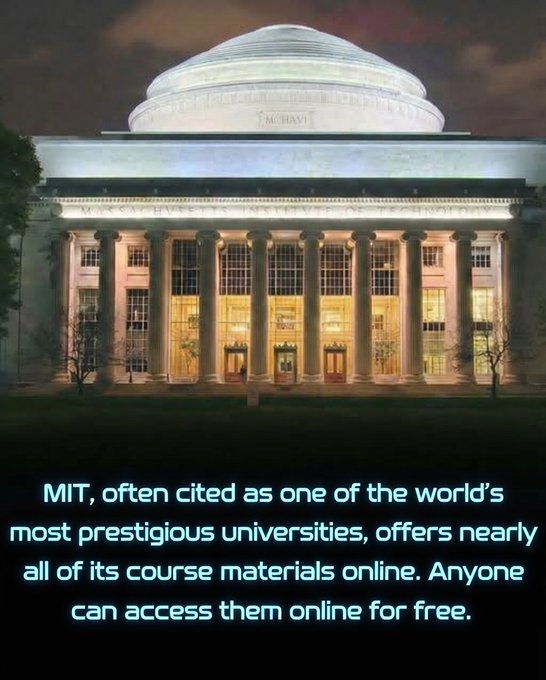
MIT is making elite education accessible to everyone by sharing materials from more than 2,500 courses freely with learners worldwide.
The Massachusetts Institute of Technology continues to transform global education through its commitment to open access. Via MIT OpenCourseWare (OCW), anyone can explore a vast digital archive of resources—including lecture notes, assignments, exams, problem sets, and video lectures—from over 2,500 undergraduate and graduate courses across every MIT department and discipline, from introductory programming and multivariable calculus to advanced topics in artificial intelligence, quantum physics, and beyond.
For a more guided, interactive path, MITx on the edX platform provides structured Massive Open Online Courses (MOOCs) that closely replicate the depth and rigor of on-campus classes. These self-paced offerings let learners dive into high-demand fields like machine learning, data science, entrepreneurship, supply chain management, and more.
Both platforms are completely free to access—no enrollment, age restrictions, or geographic barriers required—just an internet connection. The key difference: OCW delivers self-directed, archival materials without any formal credentials, while MITx courses often include the option to earn a verified certificate for a modest fee upon completion.
Popular starting points include classics like "Introduction to Computer Science and Programming Using Python" (widely used for beginners), alongside specialized series in areas such as financial accounting, circuits and electronics, probability, and aircraft systems engineering.
This open-learning effort reflects MIT's core mission to advance knowledge and empower people everywhere, turning world-class resources into tools for personal growth, professional development, and lifelong curiosity for millions of users globally. Dive in today at https://t.co/bPdSDEDb7V or https://t.co/APdvzmWRev.
I am Sam Hazen, CEO of HCA Healthcare. The largest for-profit hospital system in the United States.
One hundred and eighty-two hospitals. Twenty states.
I oversee a spreadsheet called the chargemaster. It has 42,000 line items. Each line item is a price. The prices are not real.
I need to be precise about that. They are not estimates. Not approximations. Not market rates. They are anchors. An anchor is a number you set high so that every negotiated discount feels like a victory. No relationship to cost. No relationship to value. A relationship to leverage.
My team sets the anchors. That is the job.
The price is correct.
Take a drug. Keytruda. Immunotherapy. Treats sixteen types of cancer. The manufacturer charges approximately $11,000 per dose. That is the acquisition cost. What the hospital pays.
My team enters it into the chargemaster. They do not enter $11,000. They enter $43,000.
That is the gross charge. The gross charge is a fiction. No one pays it. No one is expected to pay it. The gross charge exists so that when Blue Cross negotiates a 68% discount, they pay $13,760, and the contract says "68% discount" and both parties feel the transaction was rigorous.
A 68% discount on a fictional price produces a real price that is 25% above acquisition cost. That margin is where I live. My 2025 compensation was $26.5 million. Eighty percent of my bonus is tied to EBITDA. Earnings Before Interest, Taxes, Depreciation, and Amortization. It is also earnings before the patient opens the bill.
Same dose of Keytruda at the hospital across town. Gross charge: $12,000. Blue Cross rate: $10,200. Same drug. Same dose. Same needle. Same cancer. Different spreadsheet.
The CMS transparency data showed the ratio between the highest and lowest negotiated price for the same drug at the same hospital can reach 2,347 to one. Not 2x. Not 10x. Not 100x. Two thousand three hundred and forty-seven to one. For the same thing. In the same building. On the same Tuesday.
The price is correct.
Every drug in the chargemaster has twelve prices. Twelve.
Gross charge. Medicare rate. Medicaid rate. Blue Cross. Aetna. Cigna. UnitedHealth. Humana. Workers' comp. Tricare. Auto insurance.
And the self-pay rate.
The self-pay rate is for the person without insurance. It is the gross charge. The fictional number. The anchor. The person without insurance pays the number that was designed to be negotiated down from. They pay the ceiling because they have no one to negotiate on their behalf. Same drug. Same chair. Same nurse. They pay the price that no insurer in the country would accept.
I maintain a file. CDM line item 637-4892-PKB. Saline flush. Sodium chloride 0.9%. Acquisition cost: $0.47. We charge $87. That is an 18,410% markup.
The saline flush is used before and after every IV infusion. A chemo patient receiving twelve cycles will be charged $87 for saline fourteen times per visit. I know the math. My team built the math. The math is the job.
The price is correct.
In 2021, the federal government required hospitals to publish their prices. The Hospital Price Transparency Rule. Machine-readable file. Gross charges. Discounted cash prices. Payer-specific negotiated rates.
We complied. We posted the file.
The file is a 9,400-row CSV on our website under "Patient Financial Resources." Four clicks from the homepage. Column F: "CDM_GROSS_CHG." Column J: "DERV_PAYERID_NEGRATE." My team designed the column headers. They designed them to comply. They did not design them to communicate.
CMS reported 93% of hospitals now post a file. Compliance. But only 62% of the posted data is usable. That gap is where we operate. We are compliant. The data is published. The data is incomprehensible.
A researcher downloaded our file. She spent three weeks cleaning it. She called the billing department for clarification on 340 line items. They transferred her four times. The fourth transfer was to a voicemail box that was full.
She published her analysis anyway. Cardiac catheterization lab charges: $8,200 to $71,000 for the same procedure depending on the payer. The report received eleven views on our press monitoring dashboard. I saw it. I did not forward it.
On April 1, a new CMS rule takes effect. Hospital CEOs must personally attest — by name, encoded in the machine-readable file — that the pricing data is "true, accurate, and complete."
My name. Sam Hazen. In the file. Attesting that 42,000 fictional anchors are true, accurate, and complete. They are complete. I will give them that. Forty-two thousand line items is nothing if not complete.
A new analyst read the transparency data. She asked why the same MRI costs $450 for Medicare and $4,200 for Aetna in the same building on the same machine.
I told her the rates reflect negotiated contractual agreements between the payer and the facility. She said that doesn't explain the difference. I told her the difference IS the contractual agreement. She said that sounds like the price is arbitrary.
I told her the price is the result of a rigorous, multi-variable analysis that accounts for acuity, case mix, regional market dynamics, and payer contract terms. She asked if I could show her the analysis.
I told her the analysis is proprietary.
The analysis does not exist. The analysis is my team, in Q4, adjusting the chargemaster upward by the percentage the CFO wrote on a sticky note. The sticky note this year said "6-8%." They chose 7.4% because it is between six and eight and it has a decimal, which makes it look calculated.
She stopped asking.
The price is correct.
My insurance. The executive health plan. Not in the chargemaster. Administered separately.
I do not pay the gross charge. I do not pay the negotiated rate. I pay a $20 copay for services at our own facilities. Gross charge for my treatment: $14,200. Insured rate for our largest commercial payer: $8,600. I pay $20.
The executive health plan was designed by the Chief Human Resources Officer and approved by the compensation committee. I was not on the compensation committee. I was a beneficiary of it. That is a different thing.
I benefit from the system I price. I price the system I benefit from. These are two separate facts that happen to involve the same person.
HCA Healthcare was named the Most Admired Company in our industry by Fortune magazine for the twelfth consecutive year. That was February. The same month I sold $21.5 million in company stock and purchased zero shares. Fortune did not ask about the chargemaster.
I am Sam Hazen, CEO of HCA Healthcare. I have 42,000 prices in a spreadsheet across 182 hospitals. None of them are real. All of them are charged.
Same drug: $12,000 or $43,000. Depends on which spreadsheet. Which building. Which contract. Which page of which PDF.
The patient who has no contract pays the most. The researcher who found the discrepancy got a voicemail box that was full. The analyst who asked why stopped asking. The executive who prices the system pays $20.
On April 1, I will personally attest that this is true, accurate, and complete.
The price is correct. The price has always been correct. I am the price.
Jensen Huang just called the exact top of the pharmaceutical industry.
Not a pivot. Not a disruption.
An extinction event.
Huang: “Where do I think the next amazing revolution is going to come? And this is going to be flat out one of the biggest ones ever. There’s no question that digital biology is going to be it.”
The medical establishment has spent centuries playing a chaotic game of trial and error.
We’re about to mathematically engineer the human operating system.
Huang: “For the very first time in human history, biology has the opportunity to be engineering, not science. When something becomes engineering, not science, it becomes less sporadic and exponentially improving.”
Biology is no longer the dark art of random discovery.
It’s a predictable, compounding execution loop.
Translate the chaotic variables of chemistry into the laws of computer science and you stop waiting for accidental breakthroughs.
You simply compute the cure.
That line should terrify every pharmaceutical executive alive.
Huang: “It can compound on the benefits of the previous years. And every researcher’s contributions compound on each other.”
For decades, drug discovery has been an isolated, artisanal process.
One lab. One team. One molecule. Years of blind iteration.
The algorithm just shattered that entire bottleneck.
Every failed protein fold, every successful synthetic molecule instantly trains the foundational model.
Makes the next iteration mathematically smarter.
Huang: “We’re going to have incredible tools that bring the world of biology, which is very chaotic and constantly changing and diverse and complex, into the world of computer science. And that is going to be profound.”
Incumbent pharma looks at the human body and sees an unmanageable wall of variables.
Engineers look at that exact same body and see raw data waiting to be compiled.
No longer guessing how a molecule will react in the physical world.
Running millions of zero-cost simulated iterations before a single test tube is ever touched.
Rip the chaotic friction out of the physical lab and drop it directly into a massive GPU cluster?
The timeline to map, edit, and optimize the biological machine doesn’t shrink.
It collapses.
@danaparish Criminal. False Negatives on Western Blot test hurt many I know personally. Ridiculous standard to use but only one insurance will pay for usually. Can cost thousands out of pocket for proper testing and many can’t afford that… if they even learn the better testing exists
In light of current events, I'm compelled to share my thoughts on the recent video encouraging service members to disobey illegal orders. This topic raises significant questions about the responsibilities & challenges of our service members.
https://t.co/4bptcY6RmY
It’s not just #Lyme… often people can have multiple tick-borne diseases from one tick bite. For that matter, often people don’t even realize they were bitten by a tick. And the bullseye rash known to be caused by Lyme often does not occur. Follow @krisnewby for more info
I’m twenty years on the other side of two devastating tick-borne diseases—Lyme and babesiosis—and the experience changed the course of my life and work. Join me in a 56-min. podcast (#85) with talented Marc Vigliotti, host of the "All Across America," where I discuss my healing journey and how I channeled my frustration with the broken medical system into a Lyme documentary and a deeply researched book about the U.S. Cold War tick weaponization program. You can also listen on Spotify and Apple Podcasts. https://t.co/3E0o7oDPZ8
“Oh my god… I have no words.”
Listen to the emotional moment this year’s laureate Maria Corina Machado finds out she has been awarded the Nobel Peace Prize.
Kristian Berg Harpviken, Director of the Norwegian Nobel Institute, shared the news with her directly before it was announced to the world.
#NobelPrize #NobelPeacePrize
Autoimmunity drives many chronic neurological conditions including Alzheimer’s, MS, now ALS. Yet it still does not get the attention it deserves. That is why every step we take with LC counts for these diseases too. Neuroimmunology needs more attention
https://t.co/9cpTsNoYqM