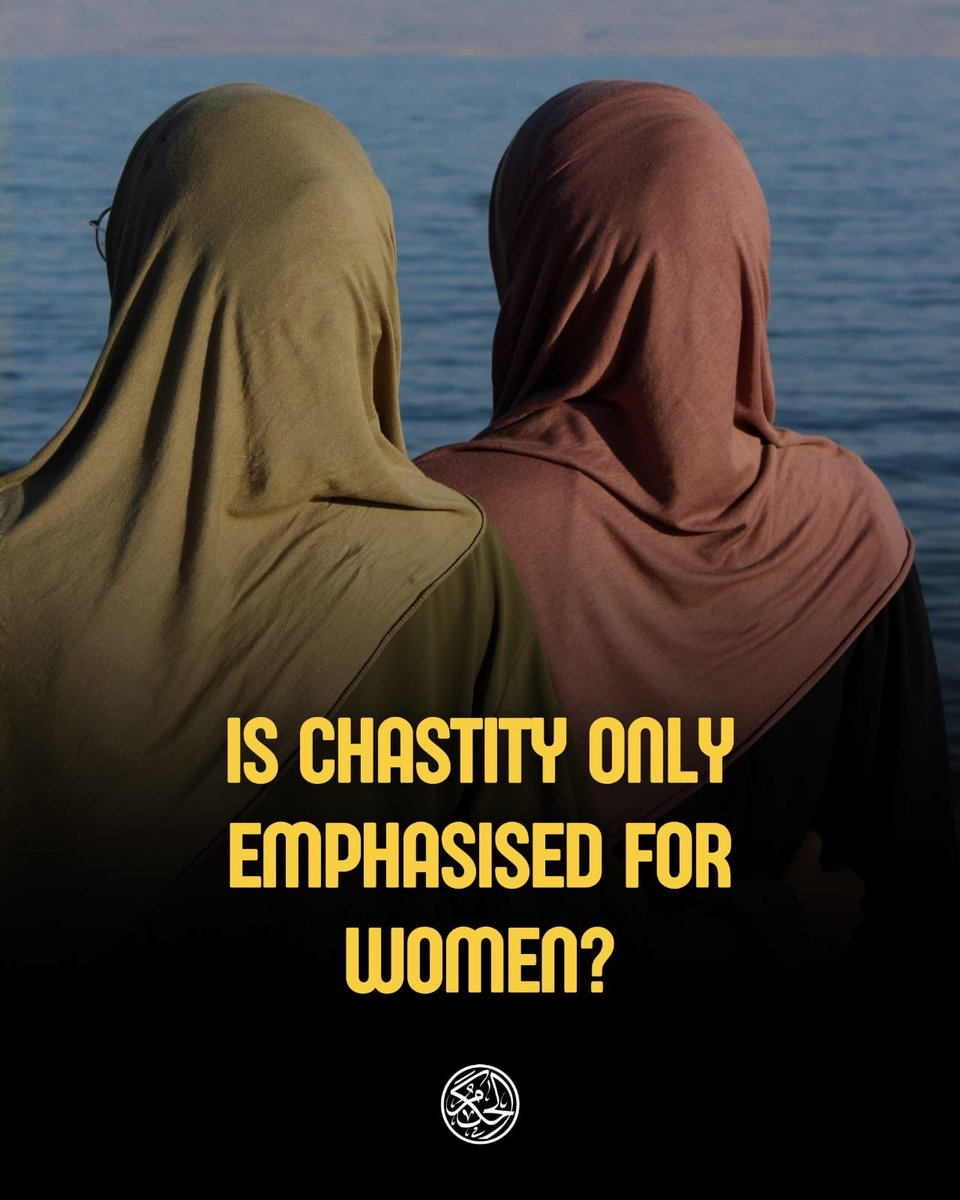
A non-Ahmadi woman from Germany wrote to Hazrat Amirul Momineen, Khalifatul Masih V (aa):
“Why is emphasis placed on a woman remaining a virgin, yet no similar emphasis is placed on men?”
In his letter dated 18 December 2023, Huzoor-e-Anwar (aa) gave the following answer to this question:
“Your second question – that Islam does not emphasise the moral reform of men and only insists that women remain virgins before marriage – is incorrect. The Sharia teaches both men and women alike that they must refrain from every form of evil. In the Holy Quran, where women are commanded to lower their gaze and guard their chastity, men are given the same command: to lower their gaze and guard their chastity. Indeed, in terms of sequence, this command is first addressed to men and only thereafter are women mentioned. (Surah an-Nur, Ch.24 : V.31-32)
“Furthermore, with regard to unlawful sexual relations, in the Holy Quran, where the punishment of the woman guilty of zina is mentioned, the punishment of the man guilty of zina is mentioned alongside it in exactly the same manner; no distinction whatsoever has been made between them. (Surah an-Nur, Ch.24 : V.3) Moreover, when we look at the time of the Holy Prophet (sa), we find several instances in which men were punished for zina, whereas only one or two such cases are found regarding a woman and even in that case it is expressly mentioned that the woman repeatedly presented herself before the Holy Prophet (sa), insisting that she be punished. (Muwatta Imam Malik, Kitab al-hudud, Bab al-rajm)
“Thus, Islam has consistently taught equality between men and women in the reward for virtue and the punishment for vice. However, in the Western society in which you live, equality in matters relating to men and women is merely claimed, but by no means practised. As a result, the balance of life has been disturbed and the human race is moving towards ruin both materially and spiritually.”
Which prayer should we make for Hazrat Khalifatul Masih (aba)?
"Pray that Allah the Almighty grants blessings in the works of the Khilafat, that his plans are fulfilled, and that Allah the Almighty produces virtuous results from them."
📜 Revisiting the century-old debate
Prophets of God do not live forever. Like all human beings, they are born, they live, and they die. Yet the mission entrusted to them, to convey God’s message and fill the earth with divine grace and blessings, extends far beyond the span of their earthly lives.
The most Benevolent God elongates the lives and missions of His messengers through the institution of Khilafat, so that the world may never be deprived of the blessings of messengership in any age.
The Holy Prophet (sa) said:
“There has never been a prophethood which was not succeeded by Khilafat.”
The Promised Messiah (as) was a prophet of God. This was his claim and this was the title bestowed upon him by the Almighty God in various revelations. Therefore, following the continuous practice of God, what should naturally come after his prophethood is the institution of Khilafat.
The Ahmadiyya Anjuman Ishaat-e-Islam Lahore broke off from the Ahmadiyya Muslim Community on the basis of Khilafat. According to them, the Anjuman founded by the Promised Messiah (as) is his rightful successor. More than a century has passed since then, and the respective conditions of both the Qadian and the Lahori Jamaat are evident for all to observe. The Ahmadiyya Khilafat stands strong with the support of Allah the Almighty to this day.
The Promised Messiah (as) made it clear in The Will that, just like the Holy Prophet (sa) was succeeded by Hazrat Abu Bakr (ra) and other Khulafa, he too would be succeeded by Khilafat, the “second manifestation” of divine power.
Throughout the hundred-year history of the Jamaat, Allah the Almighty has continued to extend His mighty hands in support of the Jamaat, fulfilling the prophecy of the Promised Messiah (as), while the Ahmadiyya Muslim Community, under the leadership of Khilafat, continues to present and spread the pristine message of Islam to all the corners of the earth.
❓️ Why did Prophet Muhammad (sa) forbid tampering with or clipping coins?
Someone from the UK wrote to Hazrat Amirul Momineen, Khalifatul Masih V (aa), asking whether the prohibition mentioned in the hadith against tampering with coins might have been intended to prevent inflation.
In his letter dated 22 January 2024, Huzoor-e-Anwar (aa) provided the following guidance regarding this issue:
“The ahadith you mentioned in your letter concerning the prohibition against tampering with coins are recorded in Sunan Abi Dawud (Kitab al-buyu‘) and Sunan Ibn Majah (Kitab at-tijarat), in a narration from Hazrat Abdullah bin Mas‘ud (ra), which states that the Holy Prophet (sa) forbade tampering with coins in circulation among Muslims without a valid necessity.
“In fact, at that time, transactions involving official coins – the dirham, which was generally of silver and the dinar, which was generally of gold – were conducted by count, rather than by weight. Therefore, some people would wrongfully clip the edges of these coins, keep the gold or silver for themselves and then pass those coins in the market by count. Similarly, some people would melt them down into lumps of silver or gold and keep them, which reduced the circulation of currency in the market, caused loss to the state and created a shortage of currency for the people. Thus, with a view to the moral training of Muslims, the Holy Prophet (sa) instructed them to refrain from this wrongdoing, fraud and loss to the state, just as they were instructed to refrain from other evils.
“However, where it became necessary to melt these coins down – for instance, where coins had become worn and unsound with age or where their value had been reduced due to tampering or where, following a change of government, the incoming government wished to put its own coins into circulation in the market – then, in all such cases, this prohibition did not apply to the relevant authority and the authority could remint those old coins into new ones.
“Hence, this injunction of the Holy Prophet (sa) has nothing to do with inflation. In those days, a temporary shortage of foodstuffs and rising prices generally occurred as a result of famine. And when the period of famine passed and the economy recovered, that temporary shortage would also come to an end and prices would return to their previous level.”
The Holy Quran speaks of the Messenger (sa) of Allah as one who was “raised among the unlettered (people)”, and “among others from among them who have not yet joined them.”
Earlier Muslim grammarians and exegetes preserved two readings of wa-akharina minhum. Al-Farra' and az-Zajjaj, a century apart, both recorded them as ordinary grammar.
The genitive reading: God raised the Messenger (sa) among the unlettered and among others from among them. The verb “He raised” (ba'atha) carries over to both.
The accusative reading: The later people are taught and purified by the Messenger (sa) just as the first people were taught and purified.
Earlier exegetes explained each reading within their own theology. But its sharper implication stayed latent – waiting for a claimant to draw it out.
Hazrat Mirza Ghulam Ahmad (as) did not invent either grammatical route. Ahmadi literature accepts both and drew out their implication.
The verse places the Messenger (sa) himself in relation to the later people. His relation cannot be reduced to a message travelling through history.
By buruz is meant a representative-spiritual coming, in which the spiritual presence of the Messenger (sa) is renewed in a later figure without bringing a new Shari'ah.
The doctrine preserves the Seal of Prophethood by leaving the bearer of the buruz without an independent prophetic office.
Sunni, Twelver Shi‘i and Ibadi exegetes alike preserved the same two readings. The grammar stayed open for over a thousand years.
Muhammad al-Tahir Ibn Ashur took a different approach. He said the genitive reading is “not permissible” (la yajuz) and rerouted the syntax.
Ibn Ashur rerouted wa-akharina through “unto them” (‘alayhim), or read it as an object accompanying the action. Two old routes closed; a new one took their place.
For the Ahmadi reading, otherness doesn't mean absence. The Messenger (sa) is among the akharin through buruz, fulfilled in the Promised Messiah (as).
This was recognised grammar, not invented grammar. Ahmadi authors built real doctrinal weight on it.
Ibn ‘Ashur's prohibition is best understood as an answer to the Ahmadi argument, closing, after decades of Ahmadi material in print, exactly the grammar that argument depends on.
This year, our Shura was convened at Hadiqa-e-Ahmad, a sprawling 341-acre estate nestled in the heart of New South Wales, approximately a two-and-a-half-hour drive from Sydney on 5-7 June 2026. The setting, while serene and expansive, greeted us with a markedly colder climate than the gentle, temperate conditions we are accustomed to in our coastal cities around Australia. Nearby, Bathurst revealed itself as a charming and picturesque township, adding to the quiet dignity of the overall experience.
I took the opportunity to explore Bathurst’s gentle charm, completing a 22-kilometre bike ride near the Macquarie river and nearly 25 kilometres more through walking and running during those three days. However, the brisk mornings, dropping to a sharp -2°C – quickly reminded me that a typical Sydney wardrobe is quite unprepared for such invigorating cold.
As I participated in the proceedings in my capacity as a Shura delegate, I found myself reflecting deeply, not only on the deliberations themselves, but also on the significance of the gathering and the unique character of the location. These moments of contemplation were both humbling and enriching, prompting me to pause and appreciate the broader purpose and spirit of the Shura.
I felt compelled to share some of these reflections in the hope that they may resonate with others and capture, in some measure, the essence of this meaningful experience.
"If Allah the Almighty can take a person like me and, through him, bring about the progress of the Jamaat, then this in itself is proof that the Jama'at is true."
Hazrat Mirza Masroor Ahmad (aba) emphasised that the global progress of the Community is a living sign of Allah’s support, witnessed day after day across the world.
When I was 10 years old, my mother would sit next to me and gently recite prayers every night and I would repeat them after her.
After the prayers, she would softly explain to me the meaning of the hijab, why Muslim women observe purdah and also why it is so lovely to choose modesty for the sake of Allah.
They were simply gentle explanations given with love; there was never any coercion or force. I paid close attention and let her words sink into my heart.
When I think of purdah, the first and strongest image that comes to my mind is my mother.
As a young child, I remember watching her put on her burqa every time she stepped outside. She never complained, never treated it as a burden. It was simply a part of who she was.
She grew up in Pakistan observing purdah and when she attended university, she wore a full niqab that covered her face, leaving only her eyes visible.
When I look at her old photographs now, she stands out, not because she tried to, but because of the dignity and quiet confidence she carried. Without saying much, she taught me that purdah is strength.
But still, questions lingered in my young mind:
• What would others think of me if I started wearing a hijab?
• Would my friends still like me?
• Would they see me differently, as though I now carried a visible mark?
🌎 𝗜𝗻𝘁𝗿𝗼𝗱𝘂𝗰𝗶𝗻𝗴 𝘁𝗵𝗲 𝘄𝗼𝗿𝗹𝗱 𝘁𝗼 𝗜𝘀𝗹𝗮𝗺’𝘀 𝘀𝗽𝗶𝗿𝗶𝘁𝘂𝗮𝗹 𝗮𝗻𝗱 𝗲𝗰𝗼𝗻𝗼𝗺𝗶𝗰 𝘀𝘆𝘀𝘁𝗲𝗺 ☪️
On 31 May 2026, Waqf-e-Nau boys from Belgium were blessed with a mulaqat with Hazrat Mirza Masroor Ahmad, Khalifatul Masih V (aa) at Islamabad, Tilford, UK.
A question was asked about the statement of Hazrat Musleh-e-Maud (ra) that a time would come when the world would seek a new system and the Ahmadiyya Muslim Community would present a Nizam-e-Nau. The questioner asked whether, in light of present world conditions and the possibility of global war, such a system could be established after a future war.
In response, Huzoor (aa) explained that he had long been drawing the Jamaat’s attention to this matter. He said, “I have been saying this to the Jamaat for quite some time: when war takes place and devastation comes upon the world, then people will ask and seek [answers].” For this reason, Huzoor (aa) said, Ahmadis should begin introducing people to Jamaat-e-Ahmadiyya and the teachings of Islam before such circumstances arise.
Huzoor (aa) further explained that Ahmadis should tell the world, “It is through the teachings of Islam alone that your world can be saved, and it is through this system alone that the world will benefit. Therefore, you should turn towards Allah the Almighty.”
He said that when people turn towards Allah the Almighty and Jamaat-e-Ahmadiyya presents this system, that is when this matter will come to pass. Referring to what he had stated previously in addresses to non-Muslim audiences, Huzoor (aa) said, “You have seen socialism, you have seen communism and you have seen capitalism, yet everywhere you see only disorder. Now adopt the true system of Islam as well and see; then you will come to know that the true system of Islam guarantees the betterment of the poor, the betterment of orphans, the betterment of widows and the economic condition of the world.”
Huzoor (aa) advised that Ahmadis should begin explaining both the economic and spiritual systems of Islam to people from now. He said that Ahmadis should tell them, “If you follow both of these, therein lies your protection; otherwise, there is none.”
Huzoor (aa) added that after people witness the consequences of worldly systems, Ahmadis should do tabligh to those who remain and tell them, “Now come towards this system. Having seen that system, you brought destruction upon yourselves; now come towards this one.”
☪️ In Islam, is it forbidden to shake hands with the opposite gender❓️
Hazrat Khalifatul Masih V (aa) provided the following guidance:
“Islam does not permit a man and a woman who are outside the prohibited degrees of marriage [non-mahram] to shake hands with one another. Therefore, such a man and woman should not shake hands with each other. It is also mentioned in the ahadith that the Holy Prophet (sa) would not shake hands with non-mahram women. (Sunan an-Nasa’i)
“The Promised Messiah (as) states in this regard:
“‘Look at the righteousness of our Lord and Master, the Greatest of the Prophets, Best of the Virtuous, Muhammad, the Chosen One, peace and blessings of Allah be upon him! He would not shake hands even with chaste and pious women who came to pledge allegiance to him. Instead, he would seat them at a distance and exhort them only verbally regarding repentance.’
“Hazrat Maulvi Sher Ali (ra) relates, ‘Once, the late Dr Muhammad Ismail Khan submitted to the Promised Messiah (as) that an English lady doctor worked with him in the hospital and she was an elderly woman. She would sometimes shake his hand; what was the ruling regarding this? Hazrat Sahib (as) replied, “This is not permissible. You should excuse yourself by saying that this is not permissible in our religion.”’
“Thus, Islam forbids handshaking between a non-mahram man and woman. However, where a mahram relationship exists, there appears to be no objection to a man and woman shaking hands.”
حضرت مسیح موعودؑ فرماتے ہیں:
میں تو یہ جانتا ہوں کہ مومن پاک کیا جاتا ہے اور اس میں فرشتوں کا رنگ ہو جاتا ہے۔ جیسے جیسے اللہ تعالیٰ کا قرب بڑھتا جاتا ہے وہ خدا تعالیٰ کا کلام سنتا اور اس سے تسلی پاتا ہے۔ اب تم میں سے ہر ایک اپنےاپنے دل میں سوچ لے کہ کیا یہ مقام اسے حاصل ہے؟
(لیکچر لدھیانہ۔ روحانی خزائن جلد 20۔ صفحہ 293-294)
https://t.co/iDQlSJVuXa




![AlHakamWeekly's tweet photo. 🌎 𝗜𝗻𝘁𝗿𝗼𝗱𝘂𝗰𝗶𝗻𝗴 𝘁𝗵𝗲 𝘄𝗼𝗿𝗹𝗱 𝘁𝗼 𝗜𝘀𝗹𝗮𝗺’𝘀 𝘀𝗽𝗶𝗿𝗶𝘁𝘂𝗮𝗹 𝗮𝗻𝗱 𝗲𝗰𝗼𝗻𝗼𝗺𝗶𝗰 𝘀𝘆𝘀𝘁𝗲𝗺 ☪️
On 31 May 2026, Waqf-e-Nau boys from Belgium were blessed with a mulaqat with Hazrat Mirza Masroor Ahmad, Khalifatul Masih V (aa) at Islamabad, Tilford, UK.
A question was asked about the statement of Hazrat Musleh-e-Maud (ra) that a time would come when the world would seek a new system and the Ahmadiyya Muslim Community would present a Nizam-e-Nau. The questioner asked whether, in light of present world conditions and the possibility of global war, such a system could be established after a future war.
In response, Huzoor (aa) explained that he had long been drawing the Jamaat’s attention to this matter. He said, “I have been saying this to the Jamaat for quite some time: when war takes place and devastation comes upon the world, then people will ask and seek [answers].” For this reason, Huzoor (aa) said, Ahmadis should begin introducing people to Jamaat-e-Ahmadiyya and the teachings of Islam before such circumstances arise.
Huzoor (aa) further explained that Ahmadis should tell the world, “It is through the teachings of Islam alone that your world can be saved, and it is through this system alone that the world will benefit. Therefore, you should turn towards Allah the Almighty.”
He said that when people turn towards Allah the Almighty and Jamaat-e-Ahmadiyya presents this system, that is when this matter will come to pass. Referring to what he had stated previously in addresses to non-Muslim audiences, Huzoor (aa) said, “You have seen socialism, you have seen communism and you have seen capitalism, yet everywhere you see only disorder. Now adopt the true system of Islam as well and see; then you will come to know that the true system of Islam guarantees the betterment of the poor, the betterment of orphans, the betterment of widows and the economic condition of the world.”
Huzoor (aa) advised that Ahmadis should begin explaining both the economic and spiritual systems of Islam to people from now. He said that Ahmadis should tell them, “If you follow both of these, therein lies your protection; otherwise, there is none.”
Huzoor (aa) added that after people witness the consequences of worldly systems, Ahmadis should do tabligh to those who remain and tell them, “Now come towards this system. Having seen that system, you brought destruction upon yourselves; now come towards this one.”](https://pbs.twimg.com/media/HLXx9a5XsAA3LT6.jpg)

![AlHakamWeekly's tweet photo. ☪️ In Islam, is it forbidden to shake hands with the opposite gender❓️
Hazrat Khalifatul Masih V (aa) provided the following guidance:
“Islam does not permit a man and a woman who are outside the prohibited degrees of marriage [non-mahram] to shake hands with one another. Therefore, such a man and woman should not shake hands with each other. It is also mentioned in the ahadith that the Holy Prophet (sa) would not shake hands with non-mahram women. (Sunan an-Nasa’i)
“The Promised Messiah (as) states in this regard:
“‘Look at the righteousness of our Lord and Master, the Greatest of the Prophets, Best of the Virtuous, Muhammad, the Chosen One, peace and blessings of Allah be upon him! He would not shake hands even with chaste and pious women who came to pledge allegiance to him. Instead, he would seat them at a distance and exhort them only verbally regarding repentance.’
“Hazrat Maulvi Sher Ali (ra) relates, ‘Once, the late Dr Muhammad Ismail Khan submitted to the Promised Messiah (as) that an English lady doctor worked with him in the hospital and she was an elderly woman. She would sometimes shake his hand; what was the ruling regarding this? Hazrat Sahib (as) replied, “This is not permissible. You should excuse yourself by saying that this is not permissible in our religion.”’
“Thus, Islam forbids handshaking between a non-mahram man and woman. However, where a mahram relationship exists, there appears to be no objection to a man and woman shaking hands.”](https://pbs.twimg.com/media/HLRdGu7WIAAHEgG.jpg)





