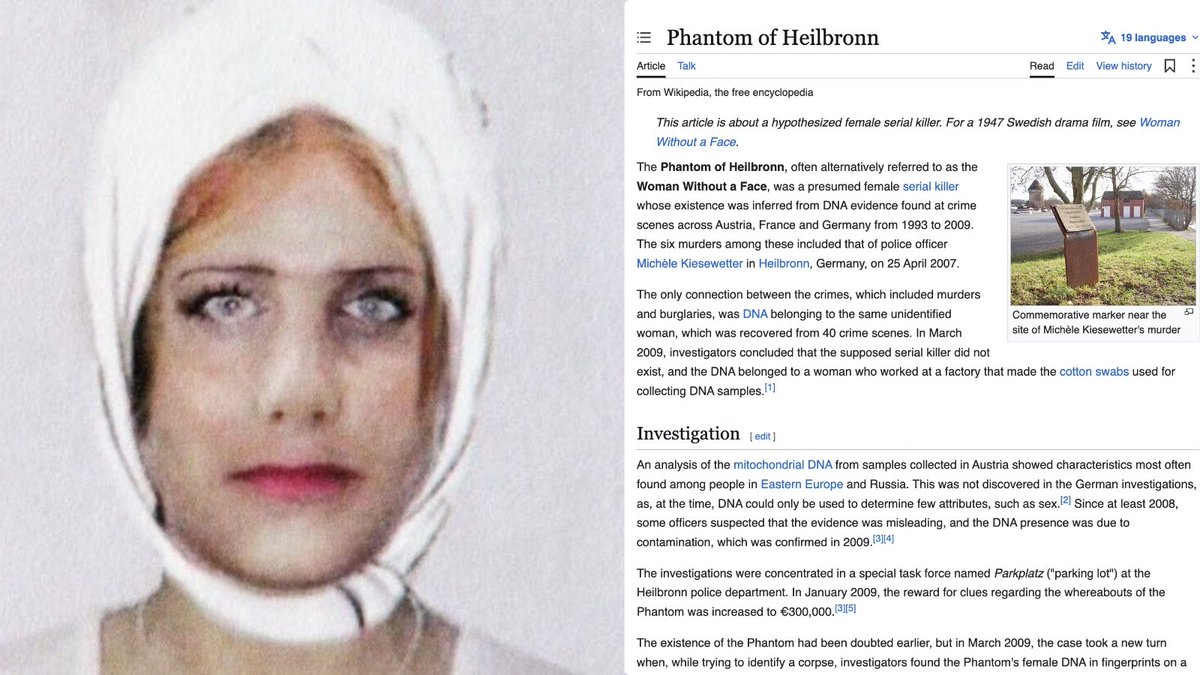
Police in three countries spent 8 years hunting a female serial killer whose DNA turned up at 40 crime scenes.
She never existed.
Her DNA was on a cup at a murder scene in Germany. On a kitchen drawer after another killing. On a syringe. On a toy pistol after a robbery in France. On a half-eaten cookie inside a trailer. On a stone thrown through a window.
Murders, burglaries, stolen cars. Germany, Austria, France. The same woman every time.
The press called her the Woman Without a Face.
Then in April 2007, a 22-year-old police officer named Michèle Kiesewetter was shot dead in her patrol car in Heilbronn, Germany. The woman's DNA turned up there too.
Now she was a cop killer. A special task force was set up. The reward for information grew to €300,000, about $400,000.
Nobody could make the pattern fit. A killer who shot a police officer, but also broke into an empty swimming pool and left DNA on a cookie?
Some officers began to suspect the evidence itself.
In March 2009, they found her DNA somewhere impossible. While trying to identify a body, investigators found her DNA on a man's asylum application form. Female DNA, on a man's paperwork.
That was the end of the Phantom of Heilbronn.
The DNA wasn't coming from the crime scenes. It was coming from the cotton swabs used to collect it.
The swabs were sterile. But sterile only means free of germs. It doesn't mean free of human DNA. They had never been certified for DNA collection.
The contaminated swabs all came from one factory. The DNA belonged to a woman who worked there.
Police in Bavaria bought their swabs from a different supplier. That's why the most wanted woman in Europe never struck in Bavaria, right next door to many of her "crime scenes."
Kiesewetter's real killers were identified in 2011. A neo-Nazi terror cell that had nothing to do with the Phantom.
The case changed the rules. In 2016, a new international standard, ISO 18385, set out how forensic swabs must be made to keep them free of human DNA.
For 8 years, the most trusted evidence in police work kept pointing at the one person who had touched every swab.
Have you ever trusted a result so completely that you never thought to check where it came from?