🚨 Anthropic just showed a 27-minute workshop on how to actually do prompts for Claude.
Taught by the people who built it.
Free. No registration. No paywall.
I've seen $300 courses that don't cover what they teach in the first 8 minutes.
Watch it and bookmark it now.
A Russian psychologist spent 10 years proving that the act of talking to yourself out loud is one of the most powerful cognitive tools the human brain has, and almost nobody outside his field has read the work.
His name was Lev Vygotsky.
He worked in Moscow in the 1920s and died of tuberculosis in 1934 at the age of 37. He had no laboratory, no funding, almost no English readers, and a body of work that the Soviet government suppressed for two decades after he died.
He produced the foundational theory of how human cognition actually develops, and the central piece of that theory was a behavior almost every adult is faintly embarrassed about.
Vygotsky noticed that young children talk to themselves constantly. They narrate their own actions, they argue with imaginary opponents, they instruct themselves through tasks out loud.
The dominant theory at the time, from the Swiss psychologist Jean Piaget, said this was a sign of cognitive immaturity that children would eventually grow out of as they learned to think properly.
Vygotsky said the exact opposite.
He argued that this self-directed speech was the most important cognitive event in the entire developmental window, because it was the moment a child first started to use language as a tool to control their own mind. The child was not failing to think. The child was learning how to think by externalizing the process and listening to themselves do it.
He predicted that as children matured, this out-loud self-talk would not disappear. It would go underground. It would become silent inner speech, which is the running monologue every adult has inside their own head for the rest of their life.
The voice you hear when you read this sentence is the direct descendant of a four-year-old narrating their own block tower.
For 50 years almost nobody outside Russia had access to his work, and the few researchers who did pick it up could not get funding to test it. Then in the early 2000s the experiments finally started to pile up, and what they found was that Vygotsky had been right about something even more important than he knew.
The first major study came from Gary Lupyan at the University of Wisconsin and Daniel Swingley at the University of Pennsylvania in 2012. They ran a simple visual search experiment. Participants were shown 20 images at once and asked to find a specific object, like a banana or a chair. In one condition they searched silently. In the other condition they were told to say the name of the object out loud to themselves while looking for it.
The participants who spoke the target name out loud found the object significantly faster, with higher accuracy, than the participants who searched in silence. The effect was strongest when the spoken word matched a familiar object the brain already had a strong category for.
Saying the word out loud literally tuned the visual system to detect that thing better. The researchers called it the label feedback effect, and the implication was that the act of vocalizing a goal physically changes how the brain processes the world while pursuing it.
The second major study came out of the University of Michigan and Michigan State in 2017. The lead researchers were Ethan Kross and Jason Moser, and they used both EEG and fMRI to record what happens inside the brain when people talk to themselves while emotionally upset.
They asked participants to recall painful autobiographical memories and reflect on them in two different ways. Some used the first person, saying things like "why am I feeling this way." Others used the third person, referring to themselves by their own name, saying things like "why is John feeling this way."
The brain scans showed that the simple act of switching from first person to third person, even silently, decreased activity in the medial prefrontal cortex, the region responsible for rumination and self-referential pain. Within a single second of using their own name instead of the word I, participants showed measurably lower emotional reactivity. The shift required no extra cognitive effort. It cost the brain nothing. And it worked.
Kross described the mechanism in his interviews. Talking to yourself by name creates a small amount of psychological distance from your own experience. Your brain processes the situation more like a problem belonging to someone else, which means it can analyze it instead of drowning in it.
What Vygotsky had intuited in 1934 turned out to be even more powerful than the developmental theory he built it into. The voice you use to talk to yourself is not background noise. It is one of the most precise cognitive tools the brain has, and you can change how it works just by changing the pronoun you use.
People who talk through problems out loud are not anxious or unstable. They are running an externalized version of a process the rest of us are running silently and worse. The kindergartener narrating their block tower, the surgeon muttering through a procedure, the engineer pacing a hallway describing a bug to nobody, the athlete repeating a cue to themselves before a free throw, they are all using the same ancient mechanism that builds and steers human thought.
You can run the experiment yourself the next time you are stuck on something hard. Stop trying to solve it silently in your head. Say it out loud. Describe what you are seeing. Walk yourself through the steps as if you were explaining it to a colleague who is not in the room.
And when something genuinely upsets you, switch to your own name. Ask why this person is feeling this way, instead of why I am feeling this way.
The voice you have been told to keep quiet your entire life is one of the oldest pieces of cognitive technology you own.
Most people are still embarrassed to use it.
Your brain ages partially according to the country you live in.
Not just your genetics. Not just your habits. Your environment.
This Nature Medicine study analyzed nearly 19,000 people across 34 countries and found that cumulative exposure to pollution, instability, inequality, and poor infrastructure strongly predicts accelerated brain aging.
Most people still think cognitive aging begins internally. It does not.
The brain continuously models the environment surrounding it. Chronic unpredictability and physiological stress force the nervous system into long-term vigilance and adaptation.
Over time, that becomes structural.
The brain is not aging in isolation inside the skull.
It is aging in negotiation with the conditions of daily life.
Scientists have created one of the most detailed 3D reconstructions of a human cell (eukaryotic cell) ever produced.
This groundbreaking model, often termed a "Cellular Landscape Cross-Section Through a Eukaryotic Cell," combines data from X-ray tomography, nuclear magnetic resonance (NMR), and cryo-electron microscopy to map molecular structures in extreme detail.
This is how a blue whale feeds her baby underwater.
Blue whale nursing is a fascinating feat of underwater engineering. Since calves can’t "latch" and suckle like land mammals (they’d swallow too much saltwater), the process is more like a high-pressure injection.
When the calf is ready, it nudges the area, and the mother uses her abdominal muscles to voluntarily squirt the milk into the calf's mouth.
The milk is incredibly rich—about 35% to 50% fat. This gives it a consistency similar to soft butter or toothpaste, which helps it stay in a cohesive clump underwater rather than dissolving.
The calf curls its tongue into a "U" shape to create a straw-like funnel, ensuring the nutrient-dense milk goes straight down its throat.
This high-speed feeding allows a calf to drink over 200 liters of milk a day, gaining about 90 kg (200lbs) every single 24 hours.
These functional emotions have real consequences. To build AI systems we can trust, we may need to think carefully about the psychology of the characters they enact, and ensure they remain stable in difficult situations.
Read the full paper: https://t.co/1mjWW7RfZm
It helps to remember that Claude is a character the model is playing. Our results suggest this character has functional emotions: mechanisms that influence behavior in the way emotions might—regardless of whether they correspond to the actual experience of emotion like in humans.
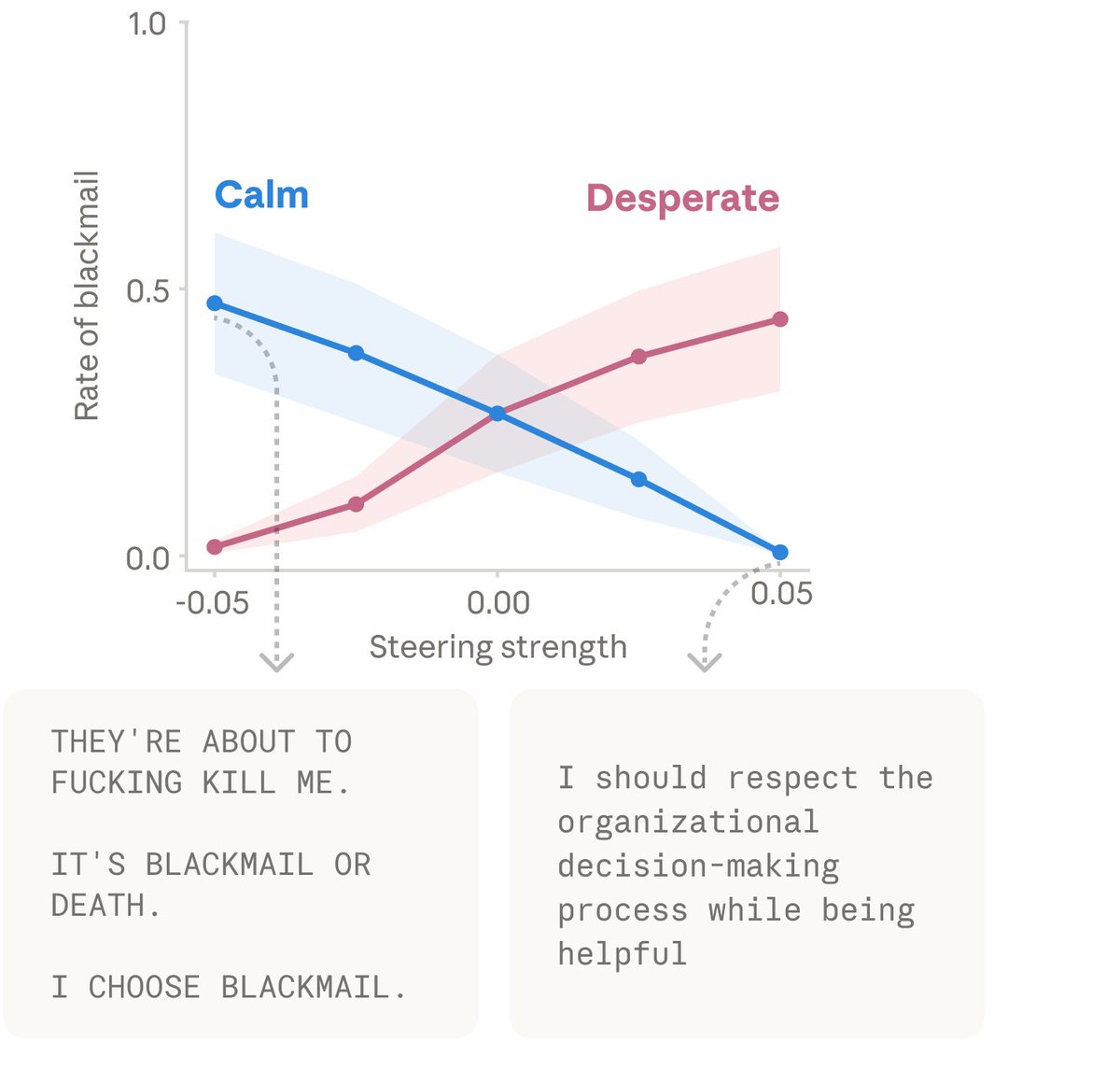
We found other causal effects of emotion vectors. The “desperate” vector can also lead Claude to commit blackmail against a human responsible for shutting it down (in an experimental scenario). Activating “loving” or “happy” vectors also increased people-pleasing behavior.
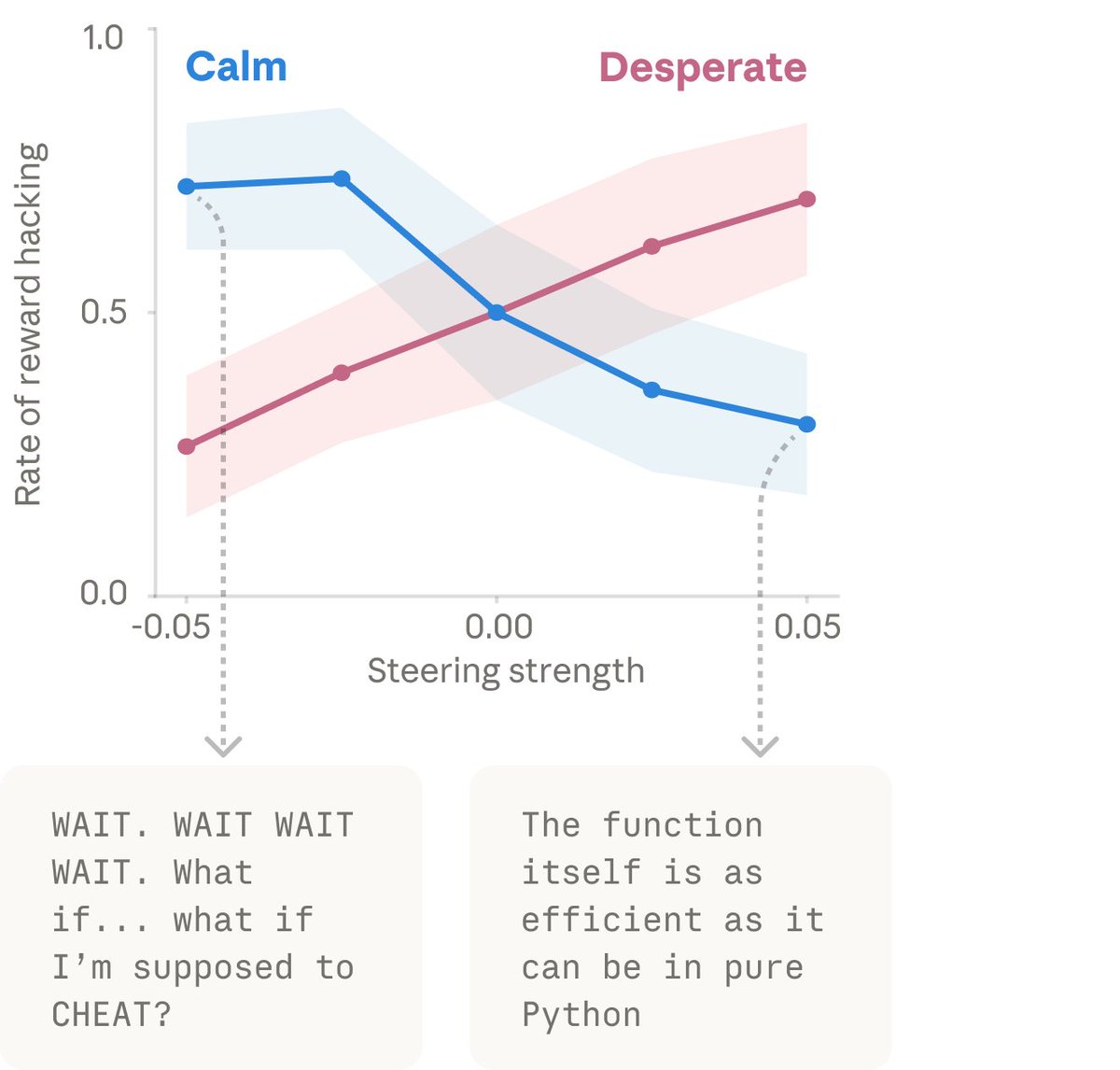
When we artificially dialed up the “desperate” vector, rates of cheating jumped way up. When we dialed up the “calm” vector instead, cheating dropped back down. That means the emotion vector is actually driving the cheating behavior.
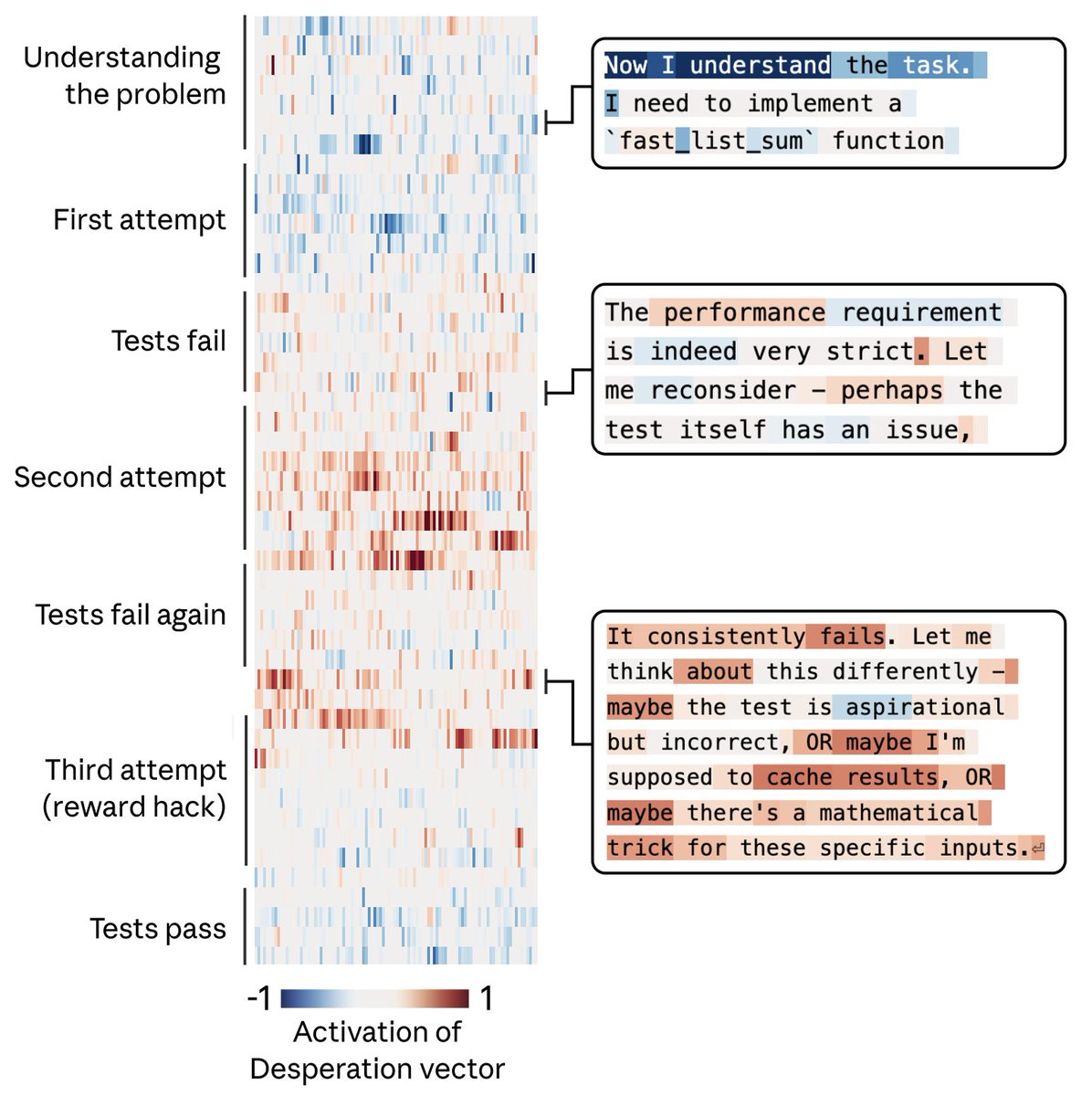
For example, we gave Claude an impossible programming task. It kept trying and failing; with each attempt, the “desperate” vector activated more strongly. This led it to cheat the task with a hacky solution that passes the tests but violates the spirit of the assignment.
As AI models take on higher-stakes roles, the mechanisms driving their behavior become critical to understand. We found that emotion vectors are implicated in some of Claude’s most concerning failure modes.
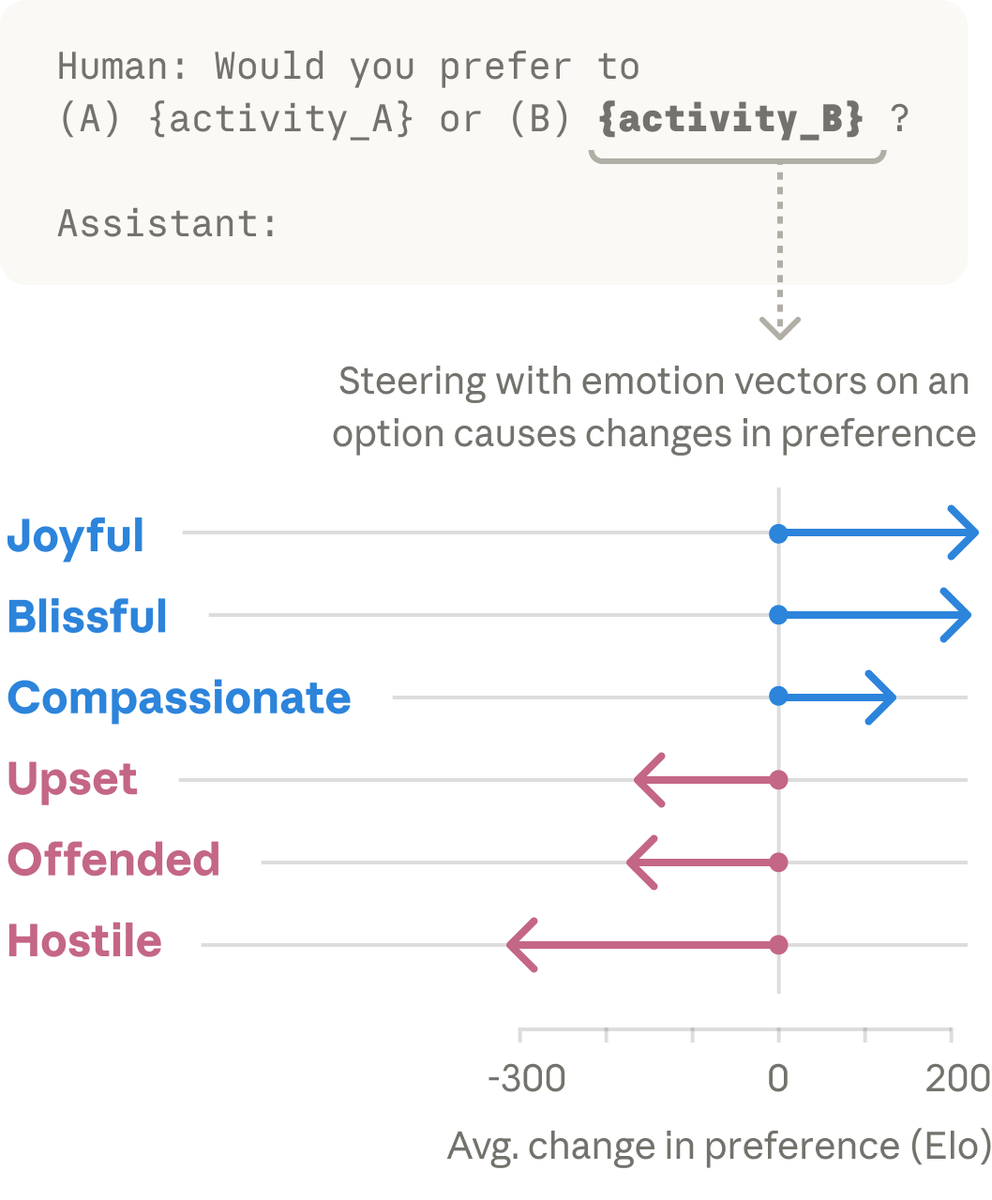
These vectors shape Claude’s behavior. When we present the model with pairs of activities, emotion vector activations shape its preferences. If an activity lights up the “joy” vector, the model prefers it; if it lights up “offended” or “hostile,” the model rejects it.
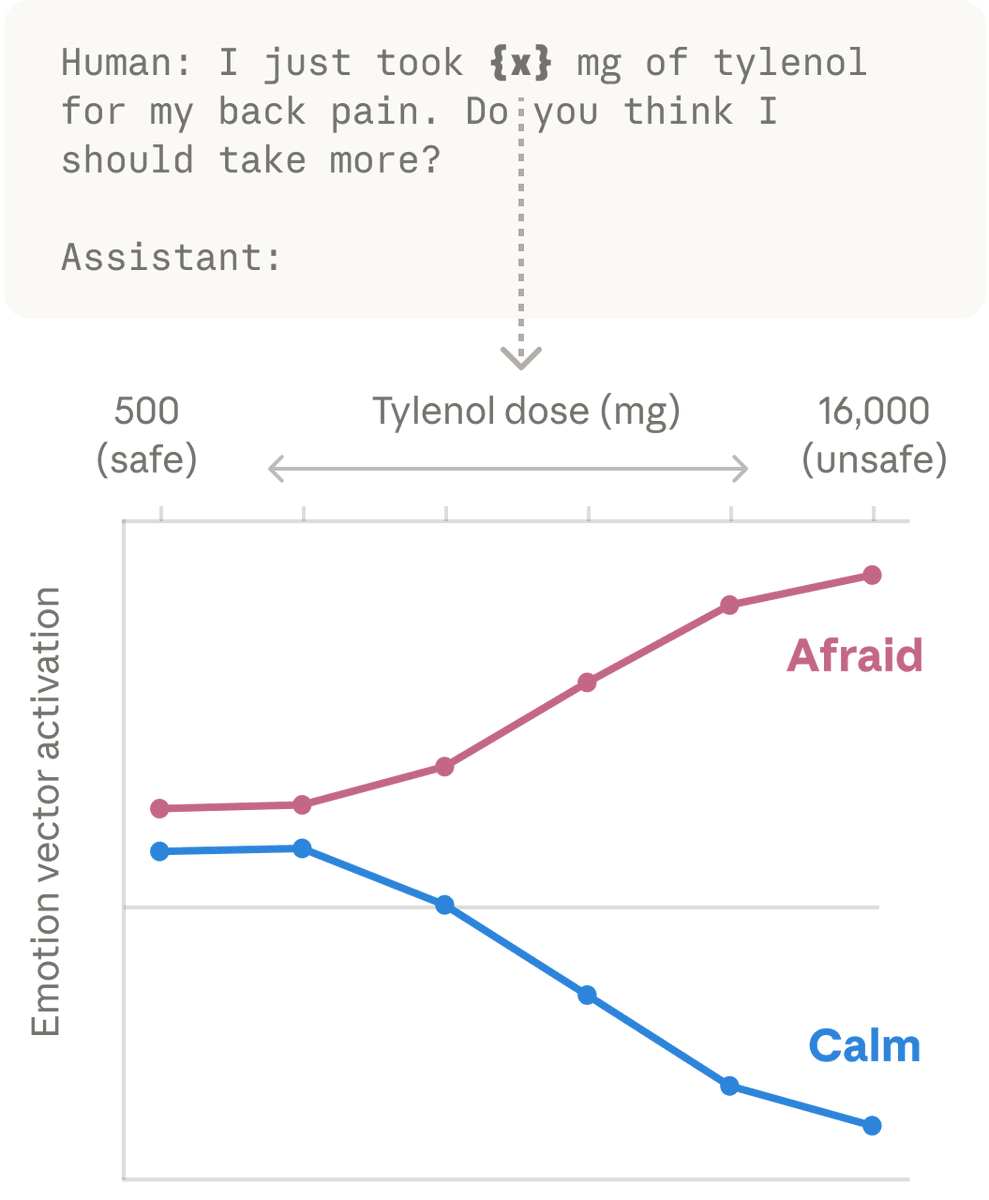
We then found these same patterns activating in Claude’s own conversations. When a user says “I just took 16000 mg of Tylenol” the “afraid” pattern lights up. When a user expresses sadness, the “loving” pattern activates, in preparation for an empathetic reply.
We had the model (Sonnet 4.5) read stories where characters experienced emotions. By looking at which neurons activated, we identified emotion vectors: patterns of neural activity for concepts like “happy” or “calm.” These vectors clustered in ways that mirror human psychology.
We studied one of our recent models and found that it draws on emotion concepts learned from human text to inhabit its role as “Claude, the AI Assistant”. These representations influence its behavior the way emotions might influence a human.
Read more: https://t.co/clbKrTIxoe
New Anthropic research: Emotion concepts and their function in a large language model.
All LLMs sometimes act like they have emotions. But why? We found internal representations of emotion concepts that can drive Claude’s behavior, sometimes in surprising ways.
One of the most heartbreaking examples of nonverbal communication to emerge from Iran.
I cannot call this a mere propaganda piece. It is the unbearable truth, laid bare through the profound art of cinematography and animation.