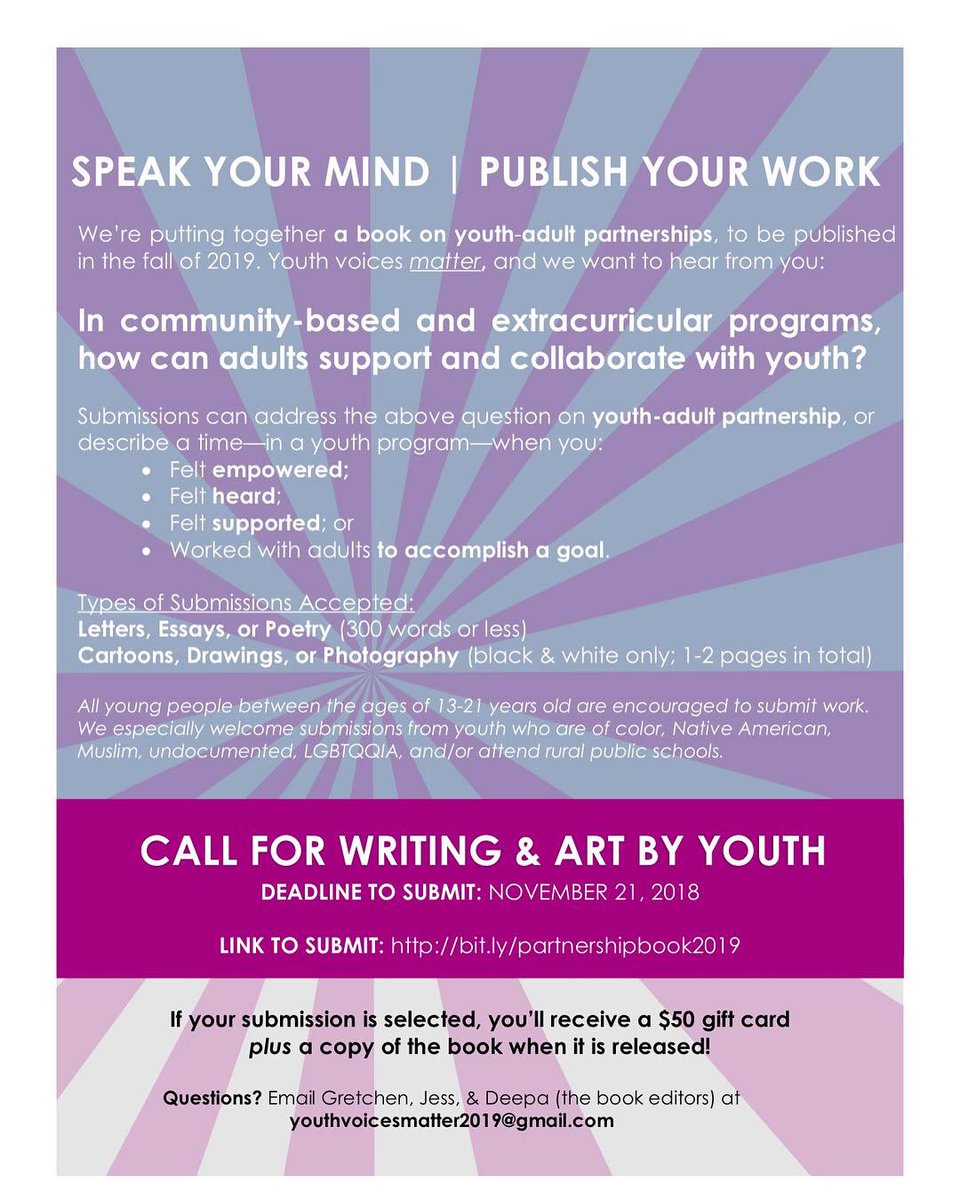
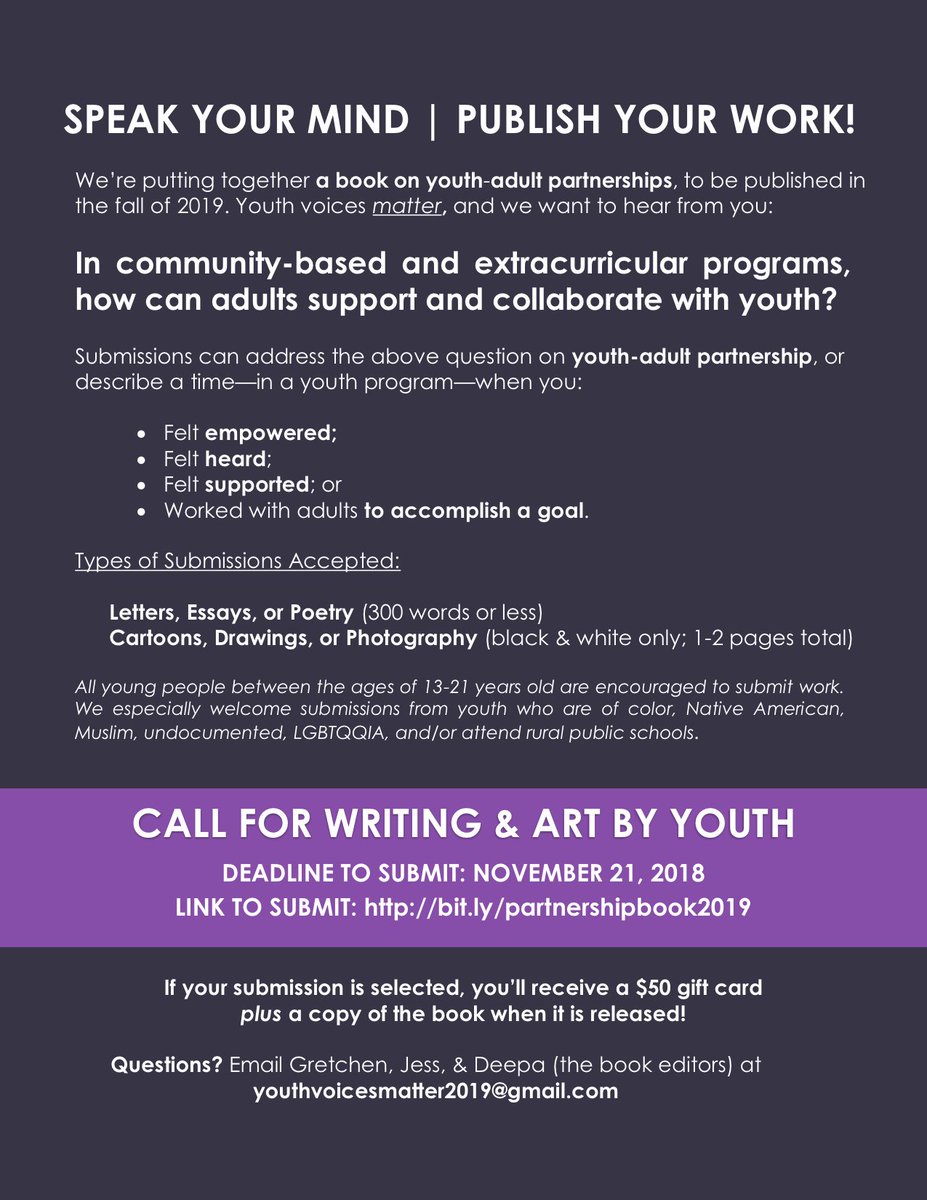
Attn Youth (13-21) - Publication Opportunity!
Tell us about a time in an afterschool club or youth program when you:
• Felt empowered, heard, or supported
• Worked with adults to accomplish a goal
Submission Info: https://t.co/APRfFHXNKo
I’ve said it before but it can’t be said enough, so many of the people seeking refuge in the United States wouldn’t be doing so in the first place if the US hadn’t engaged in decades of imperialism that destabilized these countries’ political systems & fractured their economies.
We must not allow this issue at the border to be separated from the fight against prisons and policing—they are the same issue. https://t.co/VRfsaYmZBv
I’ve seen so many young girls on my feed standing up for what they believe in, even if they’re standing alone. Let me tell you - my heart bursts with joy every single time. Young girls have strong voices and we are not scared to use them. https://t.co/3oXNhQXe0N
A9 Give youth a seat at the table and encourage them to lean in. Make introductions for them -- or let them introduce themselves -- and let them lead conversations #ToolkitTalk https://t.co/35AppmRJvX
A10 Start by asking your child(ren) what they notice, what they worry about, what they want to change. There are so many places to put one’s energy, I think part of our role can be to help our children figure out where they want to put theirs. #ToolkitTalk https://t.co/7fj3zExI64
Q10 How can parents and caring adults help connect students to productive ways to get involved in their community and causes they believe in? What resources are out there? #ToolkitTalk
A9 Think about what it means to be an ally – there are a growing number of resources out there to help you with this (e.g., https://t.co/wrQxdGpWLN). #ToolkitTalk
A9 Demand that other adults invite youth into spaces that you are a part of; refuse to speak on behalf of young people if they are not in the room. #ToolkitTalk
A9 Youth are one of the largest constituent groups in our nation, but they are not a monolithic group. They represent many identities, communities, belief systems & life experiences. Don’t flatten their multiplicity. #ToolkitTalk https://t.co/u17rpBjcC3
Q9 From the classroom, to college campuses, all the way to the capitol, adults have more power than youth in most settings. How can adults use their power to make sure that young people's’ voices are heard (without stepping in and taking over)? #ToolkitTalk
A8 Youth organizers across the country are using social media to galvanize and educate folks. I’m often particularly impressed by their graceful responses to inappropriate and disrespectful adults. #ToolkitTalk
A8 This is one place where youth and adult power dynamics are often flattened, particularly because youth are often more skilled at this mode of communication. #ToolkitTalk https://t.co/BJ8WguILYd
Q8 Social media is often used to express opinions, connect with people and causes, and to mobilize. How does social media impact a young person’s ability to make their voice heard? What should students (and families) be aware of when it comes to online activism? #ToolkitTalk