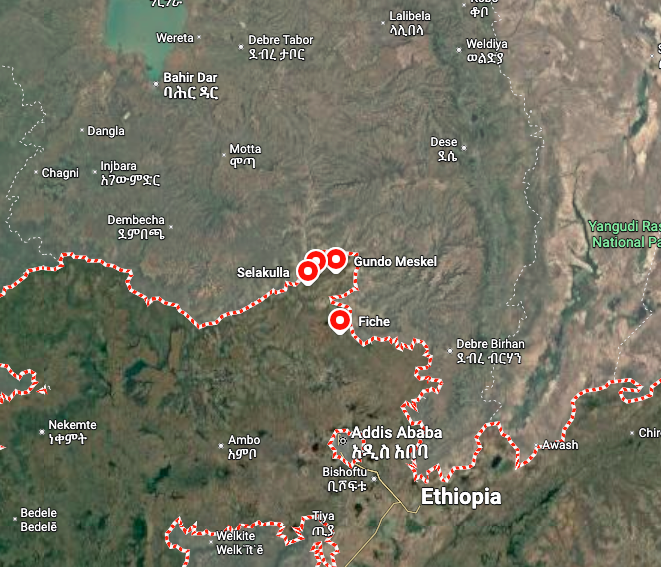
⚡️Regime forces kill civilians and destroy schools, health posts, and homes during large-scale offensive in Hageremariam-Kesem Woreda (📍North Shewa Zone, Amhara Region, Ethiopia).
🔴 On July 12th, regime forces launched coordinated offensives from eight directions against units under the Hailemariam Mamo and Aklilu Habtewold Divisions (AFNM-SPAC Kessem Corps), while carrying out widespread attacks on civilian communities across multiple kebeles.
🔴 The operation targeted residential areas in Qiddis-Geye, Zala-Zenbaba, Wuha-Meda, Sherer-Sost-Amba, Yelat-Tabot-Washa, Qulqual-Ayib-Amba, Amfar-Chemeri, and Bego-Tit-Amba Kebeles, where homes, schools, health posts, agricultural offices, livestock, and other civilian property were looted or destroyed.
🔴 At least two civilians were killed during the operation, including an unidentified farmer in Qulqual-Ayib-Amba Kebele and Hunyalew Getachew in Sherer-Sost-Amba Kebele. In Sherer-Sost-Amba, regime forces also destroyed a local school, looted computers, solar equipment, and educational materials, vandalized offices, destroyed official documents, and looted a grocery shop.
🔴 In Wuha-Meda Kebele, regime forces looted four oxen belonging to two residents and emptied or looted more than ten grain storage silos belonging to another resident, further worsening the humanitarian impact on affected communities.
#Amhara_War_Updates
⚠️NATIONAL DIALOGUE⚠️
Our people have endured unimaginable suffering mass killings of civilians, and atrocities in both Amhara and Tigray regions. Families torn apart, communities devastated, and thousands displaced. Yet true justice remains elusive. No comprehensive, independent investigations. No accountability for those responsible.
And political detainees jailed for their beliefs, ethnicity, or simply speaking up still languish behind bars.
I support genuine dialogue for peace and unity. But we cannot allow it to become a shield that buries the truth or lets perpetrators evade responsibility. True reconciliation demands justice, not forgetting.
We need:
• Independent, transparent investigations into the mass killings and alleged genocides in Amhara and Tigray.
• Accountability for all perpetrators
• Justice and reparations for victims and survivors.
• Immediate release of political detainees held unjustly.
Ethiopia’s healing cannot be built on impunity. Let the National Dialogue include real justice mechanisms or it risks failing our people. The world must not look away.
@hrw@EthioNDC@prosperity2022
#AccountabilityNow #EndImpunity #EthiopiaPeaceWithJustice
⚡️Between June 1 to 30, 2026, AWU recorded 62 human rights incidents across 42 woreda/city administrations in 14 zonal administrations across 3 regions (Addis-Ababa, Amhara and Oromia Regions) resulting in:
▫️116 civilians killed;
▫️73 civilians injured;
▫️3 SGBV/CRSV victims;
▫️159 abductions and
▫️91 arrests.
#Amhara_War_Updates
The Jar of Needles: Historical Memory, Grievance Politics, and the Amhara Question
One of the most revealing aspects of contemporary Ethiopian politics is not simply disagreement over history, but the transmission of historical narratives across generations. In a recent discussion of General Tsadkan’s new book, Abebech Kahasay and Araya Tesfamariam, two Ethiopian journalists of Tigrayan origin, offer an unusually candid critique of what they describe as the TPLF’s enduring political culture. Their argument is not directed at the people of Tigray, but at a political tradition that, in their view, continues to frame war and inherited grievance as central organizing principles.
The most striking example is the story of the “jar of needles.” As recounted in the discussion, generations of TPLF leaders were told that during the reign of Emperor Menelik, “አንድ ገንቦ ሙሉ መርፌ ከትግራይ ሕዝብ ተሰብስቦ ወደ ሸዋ ተወስዶ ነበር፣ የትግራይ ሕዝብ ቀዳዳ ልብሱን እንኳን እንዳይሰፋ።” (“An entire jar of needles was collected from the people of Tigray and taken to Shoa so that the people of Tigray could not even mend their torn clothes.”) The journalists go on to state that this same narrative resurfaced during the recent Northern Ethiopian War as propaganda used to mobilize young people, repeating the message: “እዚህ ድረስ ነው ሸዋ የበደለን፣ እዚህ ድረስ ነው አማራ የበደለን።” (“This is how far Shoa has wronged us; this is how far the Amhara have wronged us.”) One of the speakers then asks a haunting question: “ምን ዓይነት በሽታ ነው? … ይህ መርዘኝነት?” (“What kind of disease is this? … This poisonous mentality?”)
Whether one accepts or rejects the historical accuracy of this particular story, the discussion is significant because it comes from journalists from Tigray reflecting critically on the political culture of the TPLF itself. It also illustrates a broader challenge for Ethiopia: when historical memory is repeatedly framed through collective grievance and directed toward a single community, it becomes extraordinarily difficult to build trust, shared citizenship, and a peaceful political future. Breaking that cycle requires confronting inherited narratives honestly while refusing to pass them uncritically to the next generation.
The timing makes the discussion particularly striking. During the Northern Ethiopian War, Ethiopia’s federal government was led by Prime Minister Abiy Ahmed, while the country’s senior political and security leadership was not drawn from the Amhara community. Yet, according to the journalists’ account, historical grievances continued to be framed primarily in terms of “Shoa” and “Amhara.” This raises an important question: if the conflict was fundamentally between the TPLF leadership and a federal government that many critics describe as being dominated by Oromo political elites and influenced by OLF narratives, why did narratives of collective blame continue to focus on the Amhara? The question becomes even more significant in light of the public testimony of former Ethiopian official #Taye_Dendea, who stated in a recorded interview, before his imprisonment, that Prime Minister Abiy Ahmed had declared, “I am going to destroy the Amhara.” Similar accounts have since been echoed by other former senior Oromo officials who later left Ethiopia. Readers are, of course, free to examine those interviews, many of which I have previously shared, and reach their own conclusions. In my view, this reflects a deeper political pattern in which the Amhara people continue to serve as the principal historical reference point for accumulated grievances, despite the changing composition of state power. Tragically, the Amhara also paid an enormous human cost during the Northern Ethiopian War bearing the greatest brunt, making this persistent attribution of collective responsibility all the more significant.
@UN_HRC@UNHumanRights@David_J_Simon
⚡️ENDF soldiers killed farmer Ato Molla Mekonnen and looted civilian property in July 2nd abuses in Awas Kebele, Raya-Kobo Woreda (📍North Wollo Zone, Amhara Region, Ethiopia); stolen items included gold jewelry, 90,000 ETB, and six smartphones.
📸 Source: Mereb Media
#Amhara_War_Updates
⚡️Death toll from regime drone strikes on Zato Primary School rises to 31 civilians killed, with 8 others injured in July 1st attack on Bethlehem Kebele, Tach-Gayint Woreda (📍South Gonder Zone, Amhara Region, Ethiopia).
#Amhara_War_Updates
⚡️Regime forces and OLA militants kill over 45 Amhara civilians, burn 63 homes, and impose siege-like conditions in Dera Woreda (📍North Shewa Zone, Oromia Region, Ethiopia).
🔴 As of June 30th, more than 45 Amhara civilians have been killed across 17 kebeles in recent weeks, while over 18 people have been abducted, 63 homes burned, and numerous cattle looted. On June 29th, OLA militants abducted three civilians and seized about 50 cattle in Selelkula town, while ENDF personnel opened fire on residents who attempted to resist.
🔴 On June 30th, OLA militants entering Mamo Kebele from Were-Gebro Kebele burned ten residential homes, displacing affected families and intensifying insecurity.
🔴 Residents say OLA control of key routes has placed the woreda under siege. The Fiche route and Gundomeskel-Selale road have remained inaccessible for about seven years, while the remaining Gundomeskel–Merhabete–Addis Ababa route, which also connects toward Dessie and South Wollo, is under OLA control.
🔴 The prolonged closures have restricted access to healthcare, markets, humanitarian assistance, and essential goods. Residents further say regime officials have portrayed OLA militants as defenders of Oromo communities while depicting Fano as a threat, deepening ethnic tensions and hostility toward Amhara civilians.
#Amhara_War_Updates
One major omission from this analysis is Eritrea’s role during Ethiopia’s darkest hour.
For more than three decades, Eritrea has been the only state in the Horn of Africa to maintain continuity, sovereignty, and internal cohesion. Whatever one’s view of its domestic politics, that record deserves acknowledgment.
When the TPLF struck in 2020 and Ethiopia faced an existential threat, Eritrea intervened decisively. In my view, Eritrea helped prevent what could have become the largest state collapse in modern African history. Ethiopia today is a country of nearly 130 million people. The regional consequences of such a collapse would have been catastrophic.
Ironically, Prime Minister Abiy Ahmed received the Nobel Peace Prize for making peace with Eritrea. Yet the very leader who benefited most from that peace has since turned his attention toward confrontation with Asmara.
The greatest source of instability in the Horn of Africa today is not Eritrea. It is the man I have previously called the sick man of the Horn of Africa: Prime Minister Abiy Ahmed.
Until that reality is confronted honestly, discussions about regional stability will remain incomplete.
@StateDept@SecRubio
⚡️▶️#UPDATE: In his speech at the “The Silent Suffering of the Amhara” conference in the European Parliament 🇪🇺 hosted by @ECLJ_Official, scholar and political analyst Prince Asfa-Wossen Asserate (PhD) highlighted the devastating toll of drone strikes and systematic atrocities against Amhara civilians in Ethiopia.
#Amhara_War_Updates
"The destruction of the Ethiopian Orthodox Church is not merley an Ethiopian tragedy, its a crime against the heritage of all humanity" Thank you Prince Asfawesen for addressing the @EU_Commission to take action on the declining situation in Ethiopia.
.@pressfreedom calls on Ethiopian authorities to release journalist Salsawit Baynesagn. “Her detention without charge or without being brought before a court within 48 hours is a serious violation of her rights and a warning to Ethiopian journalists covering sensitive public issues. Ethiopian authorities must release Salsawit immediately or promptly bring her before a court and disclose any charges against her,” said CPJ Africa Director @angelaquintal
For more read: https://t.co/eevNIdnUAb
"The primary role of any government is to defend human and national security, and to promote the common good. This is not the case in Ethiopia".
- Follow the live of Prince Dr. Asfa-Wossen Asrat's interventions at the European Parliament at the following link : https://t.co/FLNo3pEeXq