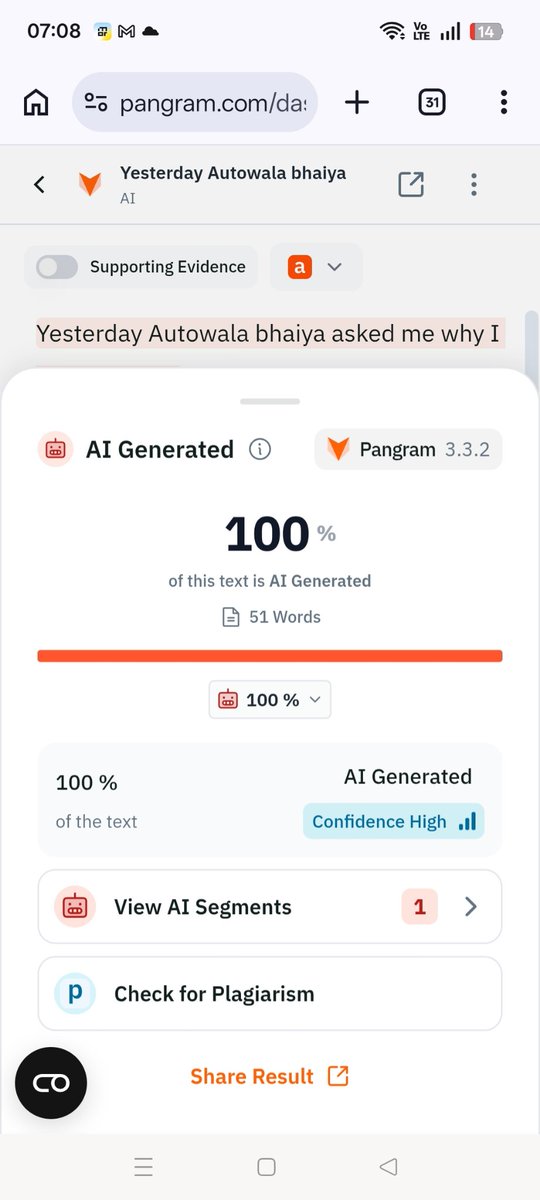
Most of my tweets here are written using an audio dictator, and that is a feature, not a bug. That also helps me keep my writing a little more unfiltered and also helps me write a lot more, because talking is easier than writing and editing.
While am working and shipping to production on backend, is there some cohort based course which can help me learn via real hands-on projects - more deeply about deployment across azure, aws - accelerating my learning on the system design trade-offs side?
crio was one, any others? can I have that learning without a cohort based course
I represented my state in U14/U17 age groups table tennis tournaments & soon learnt that while competing in sports is seen as something noble, it barely makes money even for the most talented folks out there
The TLDR is sports doesn't make money. The best people can do is get a government job.
Ok try to see it this way: everybody I played with who didn't pursue proper engineering or similar paths is not even in a government job. They're likely just teaching a sport in some of these societies and you can say that maybe that is what they like doing for a living. I think they were as smart and driven as I was and I just got lucky that I got into tech or I got into fields which are more prosperous.
This is the point here: similar people, similar background, extremely different outcomes. You could say some of it is just a single variable called "what prosperous field did you pursue?"
I am completing 16 years in the field and let's say I did a graduation of 4 years so it's 20 years from being a teenager. As a teenager all of us were from similar backgrounds. All of us were similarly smart in IQ and hard work. I would argue some of them were more hardworking than I was, more disciplined, and some of them were genuinely very capable of a level of devotion which can put a lot of good craftsmen in our industry to shame.
They were so capable of controlling their impulse. They were so capable of putting in long hours. They were so capable of persisting for months over a single pursuit. It's unreal how competition shaped us. It helped us become better. It helped us believe that a goal is worth months or years of constant pursuit. That growth is real. That what seems magical today is just a lot of hours put into the craft.
Those are very beautiful traits to learn and they had those traits and they leveraged them and learned that pattern of deliberate practise of seeing the exponential curve of learning, reaching a point where it feels like magic. They saw it day in and day out. Yet when you look at business and money most of them didn't make it so well. I always wondered what if they had taken a different path?
In my case my parents, despite their other failures as a parent, definitely did push me in the right direction by not allowing me to continue playing sports and instead shut it down when I became a teenager and pushed me to study and prepare for entrance exams.
I hated them for it initially but life has shown me that it was an infinitely better decision than letting me continue in sports. I am very lucky that they did not risk my career that way.
Another interesting piece here is that a lot of players who even reached higher levels than mine, maybe became India's top 10, actually would have had injuries that pushed them back by decades. There was the risk of a single physical injury ending the game for you. In India apart from cricket almost all other games have very little audience and fame and money that comes with it. At least that was the case till 2000. I think now that is changing and that is good that we are diversifying into n number of sports.
The essence is that sports is a great entertaining event and that is where a lot of people confuse it with some noble pursuit. It is not a noble pursuit. It is a pursuit of a good show that viewers will pay for in some way: the thrill of it, the excitement of it, the joy of watching people compete.
Why it feels unfair is that most people who devote themselves to sports are generally very smart and, more importantly, very disciplined. You cannot achieve a certain level of outcome without a certain level of practise and discipline. That is kind of what makes you strong and fit for a lot of good corporate jobs but it also comes at a cost.
In terms of zero-sum games, the competitive nature of sports often leads to people harbouring a deep scarcity mindset because there are very few winners. Now that is helpful for some business positions but for some it just becomes a liability, especially if you are in a creative field like tech, where it's not about winning. It's about creating something cool or differentiated while believing that many cool things can simultaneously exist.
So I am arguing that if you find good sportsmen and can train them for a particular, say, craft, they can be good employees. The downside though is that a lot of people come to sports because they didn't want to study. They didn't want to put in the hard work but that again depends on the context. Some of them, if they would have been given the chance to study, would have done pretty well but they just weren't from such families or such places.
@shreyas Prestige - brandnames - previous proof of success
I tried to be more less worldly but the subconscious does it's thing
I later try to calibrate simulating their experience in life but that is a minor thing because the subconscious has made the major judgment already
I am working with @sheetalssr to convert the best of my 60k tweets into a book - these are the chapters list - sample - would love to know thoughts of folks who have read me for a while
The 34-Chapter Table of Contents
Prologue: The Apology
Part 1: The Country You're Actually Competing In
1. 25 Million
2. Geography Is Destiny (But Not Forever)
3. The Availability Bias Trap
Part 2: The Low Risk Career Map
4. The One-Variable Career Formula
5. Dev First
6. The PM Trap
7. Brand Names Are Future Money
8. Always Interviewing
Part 3: The Money Lessons You Learn in 30s
9. Salary Growth Beats Investment Returns (Until It Doesn't)
10. The FIRE Miscalculation
11. The Optionality Premium
Part 4: Health Is the Compound Function
12. The Six Months I'd Trade Everything For
13. NSDR and the Art of Slowing Time
14. Sleep, Not Hustle
Part 5: How Advice Actually Works
15. The Principal-Agent Problem in Your DMs
16. Likeable Advice Is Not Effective Advice
17. The Hypothesis Habit
18. Why I Won't Advise You If You Have Under Three Years of Experience
Part 6: Building Conviction Slowly
19. Marination
20. The 6-Year Joke
21. Build It, Don't Borrow It
Part 7: The Long Game (Operational)
22. 50 Mocks Before Your First Interview
23. Open Source as Proof of Work
24. The Trust Pipeline
25. Micro-Circles Over Mass Audiences
Part 8: Low Drama as a Philosophy
26. The Drama Tax
27. Effortless Over Hyper-Intentional
28. Low Intensity Language as Competitive Advantage
Part 9: Slowing Down Time
29. The Pre-7am Tea
30. The Work Station
31. "All We Can Do Is Slow Down Time"
Part 10 This Book Is Not For You It Is For Them
32. Competing Gracefully In 25MM Cohort
33. Don't Make Them Your Project
34. The Passport Question
✨ New launch: more than 2000 product leaders, CxOs, founders have taken my Product Sense + Strategy course. After taking it, many have asked for a self-paced format for their teams
Request priority access for your team via this Google form (takes 2 min):
https://t.co/BhIYfiPHLj
You have to be the one
holding the knife
And I always
respected you for it,
but I couldn’t love you for it
- Dr Palmer to Dr Strange in Multiverse of Madness
Looking for a software that can help get SOC 2 + GDPR compliance done reliably , please share something that you can vouch for in DMs / comments
RT for good karma 🙏
When I interview for a company my objective is always to score the offer first and then judge the company - because my judgement might be an emotional upheaval but can lead to me "self-sabotaging" the interview process;
so even if I am a little annoyed with the process and the experience, I focus hard on making sure I put my best self in the conversation - we can always critique the experience later - but this is the only moment to convince people to pay top dollar for us;
observe don't judge
till you get the offer
📈New milestone: crossed 5000+ students
in the past 3.5 years
over 3 different live courses I’ve taught.
I absolutely love teaching and I often get the question “but Shreyas, don’t you feel the itch to do something that has greater impact than teaching?”
It is a valid question (as in, I don’t blame whoever might be asking or wondering), but it comes from a place of not seeing what I see: thousands of highly talented leaders who, every day, are applying what they’ve learned to their products, their strategies, their proposals, their leadership approach, and their careers.
I don’t do this work primarily for the impact (something I learned only in my 40s: when I do it for love and from a place of mastery in what I do, the impact takes care of itself). But every day, I get notes from students about the staggeringly compounding impact on their companies, teams, and careers. Which means I get to smile every day 🙌
To every student who’s been part of this journey thus far: thank you for your trust, affection, and for sharing your experience 🙏
🆕I am starting to do more Executive Coaching now that some more space has opened up in my personal life. Now coaching 3 founders (this is different from my startup advising work) and I am now opening it up for senior product leaders.
Details are here: https://t.co/dqQxAqILdW
3) A&B (& the exec team) should have understood that a lot of what seemed like “great operations & management” actually hurts early-stage bold initiatives like Zeus. Premature operational optimization can be a very bad thing for early-stage projects in startups & large companies.