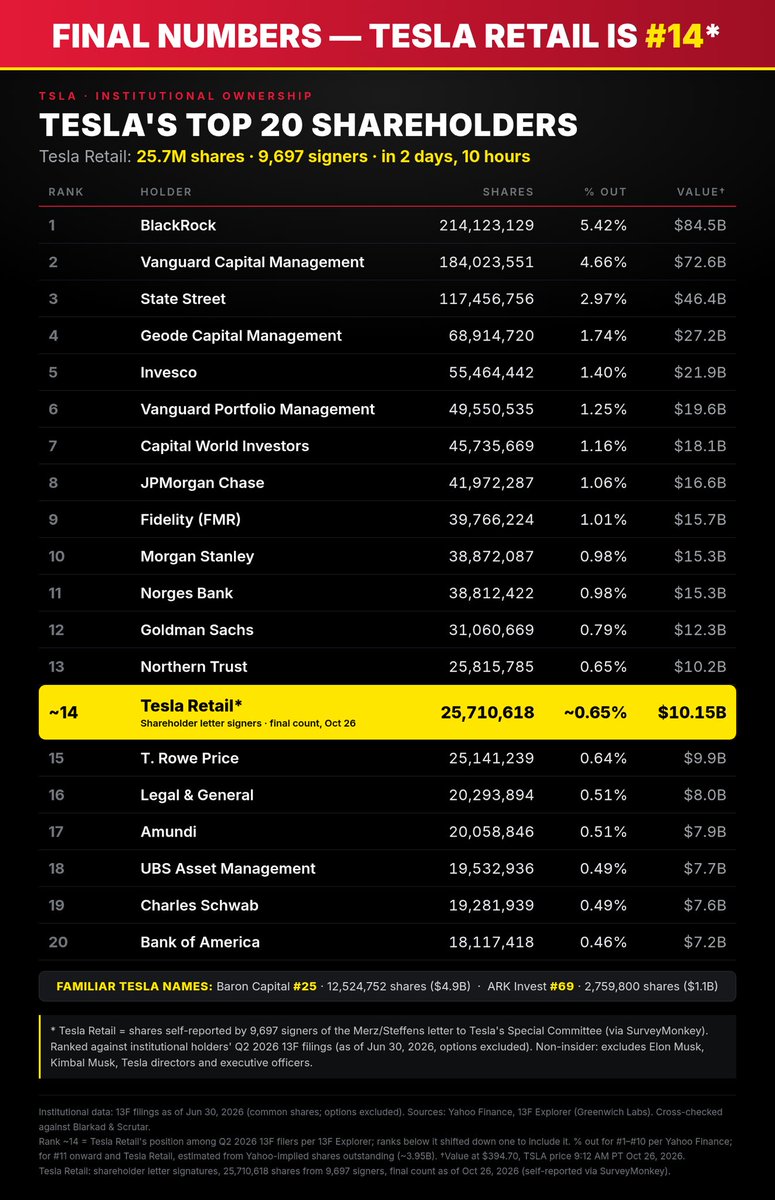
TSLA SHAREHOLDERS ARE # 14!!!
We did it!!! Great work everyone!!
The Tesla Retail letter in support of a $TSLA/$SPCX merger now represents over $10.2 BILLION dollars in Tesla shares - to put it into context, that is more shares than Baron Capital, Citigroup and ARK Invest COMBINED.
Kalshi betters may want to revisit the merger odds.
The Numbers - in just 2+ Days:
♦️ 25,710,618 shares
♦️ $10.2 billion in Tesla stock
♦️ 9,697 signers
Tesla and SpaceX don't just share a CEO; they share shareholders. 76% of signers (7,406) own both TSLA and SPCX, holding 19,774,447 shares.
The closest thing to this historic mobilization was ALSO Tesla retail: our 2024 letter (representing $4B of TSLA) supporting Elon Musk's incentive package & move out of Delaware. Neither would have been possible without the stellar skills of @TeslaBoomerMama.
Thousands of shareholders think Tesla and SpaceX are stronger together, and they back Tesla, the Special Committee, and Elon Musk.
@Tesla@elonmusk@robyndenholm@KathleeWT@IraEhrenpreis@jgebbia@kimbal@SpaceX@Gwynne_Shotwell@AntonioGracias@d0nharrison@FutureJurvetson@rglein@roelofbotha
Your signatures are on the way.
Amy will provide exact numbers tomorrow morning.
Thank you to all who participated, this is unheard of. Nobody ever mobilized so many shareholders, and we did it in just 2.5 days, over the weekend.
So proud of you all. ❤️
We should not have too. We can use the same techniques as Delaware in a lower court - Intervention, Amicus briefs and letter campaigns to the court that this lawsuit hurts shareholders.
We can’t let our guard down but it is a night and day difference to Delaware. They can’t hurt Tesla through lawsuits when Elon Musk is not controlling (solely business judgement) but the Nvidia stile risk is great and what we need to guard against first.
So we want the merger so that Elon Musk manages the company full stop.
Thr Texas Legislature was smart in structuring the Business Law, matching federal law in most aspects, not Delaware. For example:
♦️ Directors are independent in less they are a true insider - like Elon Musk’s brother. None of this they once attended the same wedding so they are conflicted.
♦️Even with a controlling stakeholder, business judgment applies (giving the board huge latitude to do what is best) with a special committee/ shareholder votes. Companies may even have an option to get the special committee declared truly independent by a Judge before they start.
♦️3% of Shareholders required to file a derivative suit.
These protections will protect against the nuisance lawsuits that proliferate in Delaware. But not prevent lawsuits against a company like Enron that had outright fraud. Texas has a good balance. The election results are anti-business - but the laws still favor jobs - and tax money - that helps communities.
⚖️
TX
Yes, I am very unhappy about the new court situation in Texas (please read my article below, it will matter in the coming months and years).
But some protections stand, thanks to SB 29 (May 2025):
▶️ Companies can require shareholders to own 3% before bringing a derivative suit. Both Tesla and SpaceX adopted it. This is our biggest shield.
▶️ If a derivative suit only gets the company to add or change disclosures, the lawyers' fee is $0, no matter how "material" the disclosures are.
▶️ If the suit achieves a real benefit, the judge can award only a "reasonable" fee. The biggest Texas example I found: a Dallas appeals court upheld about 5.5x lodestar (lawyers' hours x rate) for J.C. Penney in 2014. (reminder: Delaware went up to 66x. 😱)
Separately, a 2003 Texas law caps Class Action fees at 4x lodestar.
The difference matters:
1. Class action: shareholders sue for money for themselves.
2. Derivative suit: shareholders sue on behalf of the company.
Bottom line: in Texas, lawyers can't get rich off cosmetic settlements, and in class actions their payday is capped at 4 times their actual work.
@anabology A Tesla is a conscious car.
Of course, there is a limit to how much consciousness you want in a car. Or is there?
Especially if it can access the Internet, the car has far more freedom of action than a GPU in a data center.
Here is my initial FSD v15 review after driving with it all afternoon and evening:
First off, Elon was right. This update is a BANGER! Tesla Reality View is out of this world and so insanely cool I’m still trying to process it all.
FSD V15.0.1 brings so many improvements behind the scenes, in addition to the wildly cool UI.
Tesla Reality View IS AMAZING! Pictures and video don’t do it any justice, this is something that has to be experienced to truly understand. Got to take a few friends tonight on drives to show them and every single person was blown away by it. The amount of detail it shows and generates is wild and so impressive. It shows reflection in the car, buildings, trees, turn arrows on the display and more.
FSD v15 now has pothole avoidance! I had it swerve and avoid/straddle a few potholes tonight that were difficult for me to see in the dark.
Another great new feature in FSD v15 is speed camera slowdown. As you approach a speed camera, it automatically slows smoothly to the speed limit if you are in a quicker profile. This is a huge quality of life improvement especially as more cities get speed cameras.
Parking seems near unchanged from the last build, I feel it picking spots quicker especially at the supercharger I went to tonight. Seems to be preferring to park in the first or second open spot it sees which is great, but it tried to park in one handicap spot- otherwise good. By far, the coolest part is Tesla Reality View. Holy crap is it insane to watch while parking. It’s the best backup/360 camera money can buy and such a detailed and clear view.
Another new change I haven’t seen many people talk about is the turn signal fade. On FSD, the turn signal sound gets quieter after a few clicks. This is so nice if you’re sitting at a red light and makes drives more peaceful.
Quiet Mode is also so nice at night. It darkens the display and just shows arrival time; music, climate on the bottom and a quick grok button on the top. Another feature that makes it feel like a Robotaxi UI and a peaceful supervising experience.
Another improvement is much better handling of dips and speed bumps. The past couple updates it’s been a bit too fast in my Model Y, and it’s now so smooth.
The nag is definitely reduced. The last couple versions of v14.3 had been sometimes a bit strict, but definitely more relaxed in v15.0.1. Another thing I noticed is way less wiper washing, a very welcome change.
Personalized parking preferences are SO cool. At home, I can click on a person icon on the map and choose street parking or driveway, and it backs into the driveway EXACTLY in the spot I park my Model Y. It leared where I park and knows it.
It also now lets you choose which lot you want to park in if the mall or store has multiple lots, you can select it on the map, worked at the mall, Costco, and Home Depot tonight.
I need to touch on Tesla Reality View again because it’s just that cool. It really feels like you’re in a video game like NFS or GTA. I’m blown away by this and didn’t expect it at all. Tesla teams COOKED with it, I’ve seen so many on X now wanting Teslas because of it. I drove down Rodeo Drive tonight as well as by the SpaceX Falcon 9 and the views were so cool. Another place it’s cool is in wooded areas or tree filled streets, the way it shows everything is spectacular. Parking garages also give a cool look to them with the roof incorporated into the top of the UI. I didn’t think FSD could get this much better, as it was already so good and it did.
I absolutely can’t wait to see what else is coming in the future and driving this more on road trips.
@elonmusk, you were right- V15 is incredible and super human! Huge congrats to the Tesla team on this, what a sick update. @TeslaSI and UI teams did a fantastic job, thank you all.
In case anyone is curious:
We’ve had a ~pixel-perfect world model since last year, which is critical for synthetic data generation.
The (much) smaller version of that in the car is a conditional mean-flow model, based on the recent sequence of Tesla Universal Vision Encoder features, which are the same ones that are plugged into the 3B encoder model that produces the driving actions.
We fork off from these UVE features, then run a separate ~1B diffusion model. This takes in the previous reality-view generation with added noise and then denoises it to the current visualization.
It then produces a small video chunk (8 images at 36 fps, at the resolution of the UI screen). This work is done by 1/2 of a TRIP engine every UVE frame at 18 hz and is spread over 4 cycles.
Currently, the latency is a bit high due to compute constraints, but we have ways to interleave newer UVE features along the diffusion transformer layers to cut roughly 35% of the latency.
After we moved our tiny decoder into SRAM, we only have half a TRIP out of three on SoC B, for this reality visualizer, so spent the compute as best we could. TRIP basically only handles 8-bit int and has to run softmax in emulation mode in 28 steps.
AI5 is a gigantic improvement. Roughly 12X more compute.
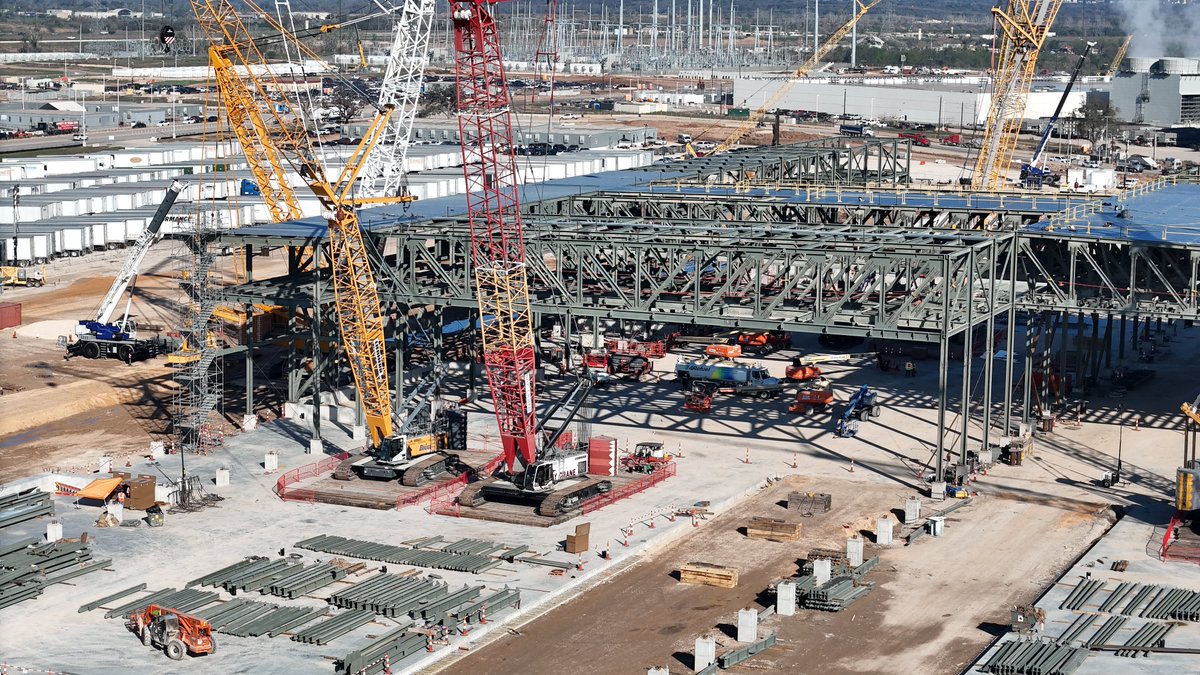
The Giga Texas joint @SpaceX & @Tesla Advanced Technology Chip Fabrication facility has a distinctive steel frame and heavy foundation … What does this tell us about the final design & how the facility will work?
The most obvious visual clues are the absolutely massive trusses being used to tie in the equally massive steel frames on the E & W sides of the facility & the center spine of columns.
These are a signature of advanced semiconductor fab design, creating large column-free open volumes while providing the stiffness and load capacity needed for a vibration-sensitive cleanroom environment.
Semiconductor fabs (especially those handling lithography, metrology, and multi-process work) prioritize:
• Wide, unobstructed bays so large tools (scanners, deposition/etch equipment, material-handling systems) can be installed and reconfigured, and so cleanroom airflow (laminar flow via ceiling FFUs) and overhead utilities can be routed cleanly
• Stiff superstructure that supports heavy hanging loads (process gas lines, chemical piping, cable trays, HVAC, cleanroom ceiling grids) without excessive deflection or vibration transmission
• Flexibility for an R&D-oriented facility that will iterate on recipes before scaling them at Terafab
Long-span steel truss systems have been used in Asian semiconductor and flat-panel fabs precisely for this combination of open space and acceptable vibration performance (studies have shown properly designed long-span truss floors can meet VC-C-level criteria).
VC-C is one of the standard Vibration Criteria (VC) curves used to specify acceptable floor vibration levels for precision equipment, especially in semiconductor fabs, cleanrooms, and labs.
Definition:
• Limit: 12.5 μm/s (500 μin/s) RMS velocity
• Measured in one-third octave bands, typically over the frequency range of 1–80 Hz (sometimes stated as 1–100 Hz).
• A floor “meets VC-C” when the measured vibration spectrum stays below the VC-C line in every relevant band
Typical applications:
VC-C is considered appropriate for:
• Optical microscopes up to ~1000×
• Most lithography and inspection tools down to ~1 μm feature sizes
• Moderately sensitive electron microscopes
• TFT-LCD stepper/scanner processes
• Many general semiconductor process and metrology tools
The VC curves (originally developed by Colin Gordon and Eric Ungar in the 1980s and widely used in semiconductor facility design) get progressively stricter (see attached table)
In the drone images of the Giga Texas Advanced Chip Fab, the trusses are tying the perimeter structures to a central spine, producing the large open central areas.
Vibration control in advanced fabs is multi-layered because EUV-class and high-end metrology tools are sensitive at picometer scales (VC-D/E territory in critical bays).
The primary isolation is already visible in the foundation work that preceded the steel: dense GeoPiers, heavily reinforced isolated footings (including the distinctive C-shaped cages), and substantial perimeter grade beams.
In short, the trusses tell us the building is being engineered for large, open, stiff cleanroom volumes with the vibration performance required for advanced chip work. The specialized foundation already under way handles the bulk of ground isolation; the superstructure provides the spans, load capacity, and stiffness above it.
I don't think you understand the gravity of reality view. it's LESS compute. which means if they bring this to HW3 it would actually SAVE compute NOT COST MORE.
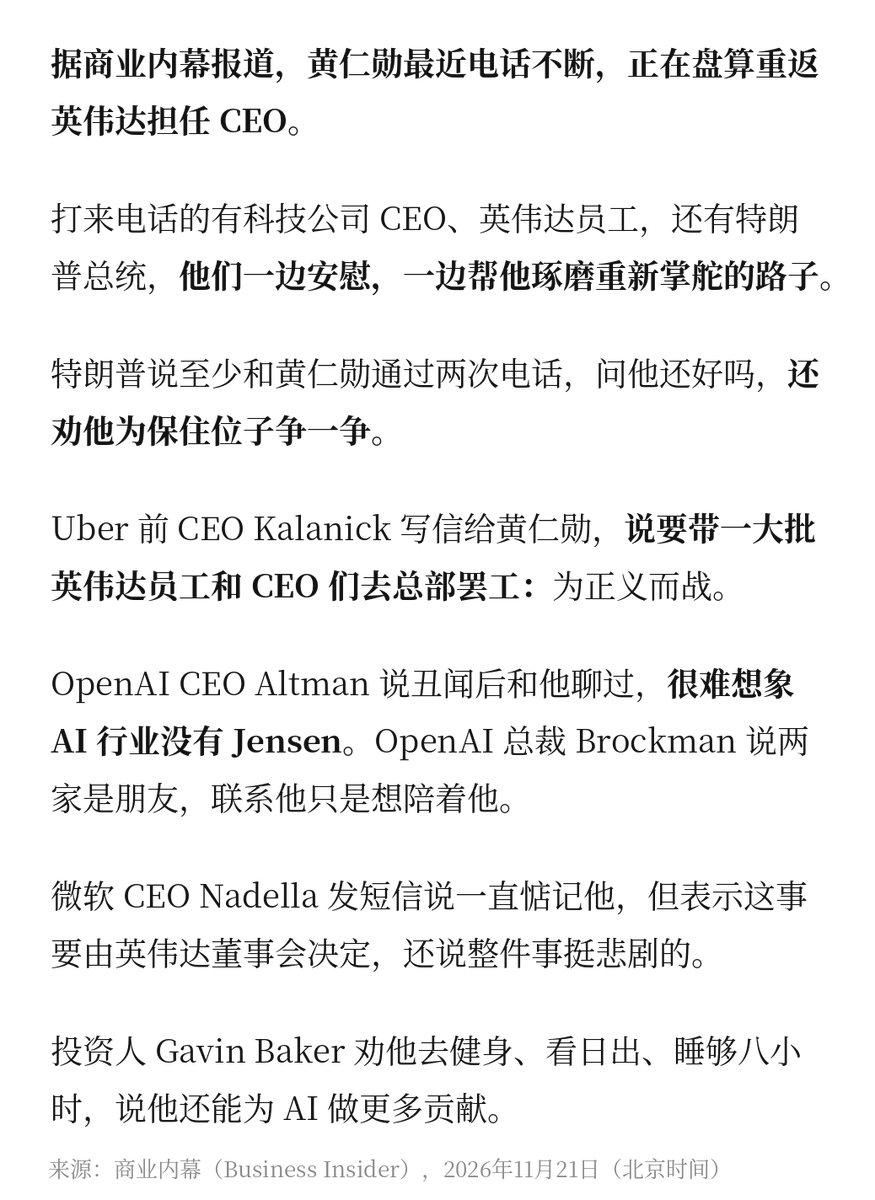
People keep asking what happens to Nvidia if the board installs a safe, DC-approved corporate CEO instead of bringing Jensen back. We already saw this exact movie play out at Nokia in 2010.
When former Microsoft exec Stephen Elop took over Nokia, it still controlled 33% of the global smartphone market. Instead of protecting the builders who made Nokia dominant, he circulated his “Burning Platform” memo trashing Nokia’s own software ecosystem, alienated its core engineers, and locked the company into an outside political partnership before a real alternative existed.
Within three years, Nokia’s smartphone market share collapsed from 33% to 3%, its stock plunged over 60%, and the company was sold off for scraps.
Nvidia’s moat was never just silicon. It was 33 years of founder-led engineering conviction and CUDA lock-in. Hand the keys to a suit who answers to board committees and Washington lobbyists instead of the engineers in Santa Clara, and watch hyperscalers, custom ASICs, and open-weight ecosystems eat that 90% dominance alive.
Many teams deserve thanks for the lightning-fast iteration speed. Ideas can only be iterated as fast as the slowest part of the company, yet the entire company moves at lightning speed in a tight boat.
Teams from chips, compilers, tooling, vehicle software and programs, systems, operations, quality assurance, ML and eval infrastructure, and many more make the challenging journey a pleasant experience. Best teams in the world.
SpaceX is planning an absolutely massive 6-gigawatt supercomputing campus in Arizona, designed to operate with ZERO industrial water consumption
And the engineering behind this is absolutely insane
The proposed campus near Willcox includes:
• 747 acres of land
• Nine supercomputing buildings, each ~493,000 sq ft
• Up to 6 GW of electrical demand across four phases
• Up to 24 GWh of battery energy storage
• Dry cooling without conventional cooling towers
• ZERO industrial groundwater use under its proposed operating plan
• Just 7–10 acre-feet of estimated annual operational water consumption
• ~$3.6 BILLION in planned grid infrastructure upgrades
• ~1,000 permanent jobs and up to 5,500 construction workers
All of this is being planned in the middle of the Arizona desert
Building superintelligence infrastructure at this scale goes far beyond installing millions of GPUs
It means securing enormous amounts of electricity, building advanced cooling systems, expanding the power grid and solving engineering challenges that come with operating at gigawatt scale
A single 6 GW campus with 24 GWh of battery storage, designed to operate with minimal on-site water consumption
SpaceX is taking superintelligence infrastructure to an entirely different level