Excited to share my preprint from @aaronwhiteley lab showing how a bacterial NLR-related protein detects phages through the host chaperone DnaJ! This is one of the few ssRNA phage defense systems identified, and we found an interesting detection mechanism
https://t.co/5PpN8Cr7X2
Big thanks to my mentor @aaronwhiteley, coauthors Sam Ridgeway + Madison Ruchel (superstar undergrads) and @EmilyKibby + Toni Nagy (wonderful bNACHT team) for helping this story come together, and the @baym lab for generously sharing RNA phages!
While there is still a lot to learn about this system, we are excited by the idea of another antiphage system sensing phage indirectly through monitoring the integrity of the host cell, like Retrons guarding RecBCD https://t.co/FGXq9oVqrM.
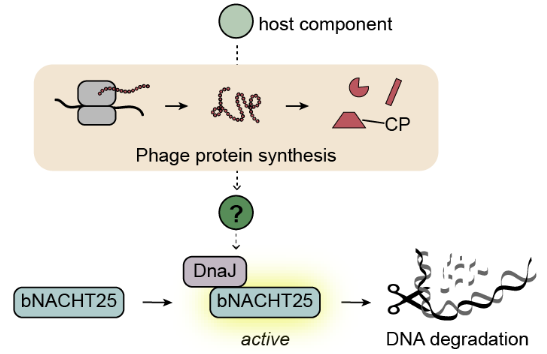
We think that bNACHT25 guards a host component that’s altered upon synthesis of phage proteins, allowing it to interact with DnaJ to activate bNACHT25. It’s fascinating that like some eukaryotic NLRs, immune detection by bacterial NLR homologs can occur through guarding the host.
Excited to share my preprint from @aaronwhiteley lab showing how a bacterial NLR-related protein detects phages through the host chaperone DnaJ! This is one of the few ssRNA phage defense systems identified, and we found an interesting detection mechanism
https://t.co/5PpN8Cr7X2
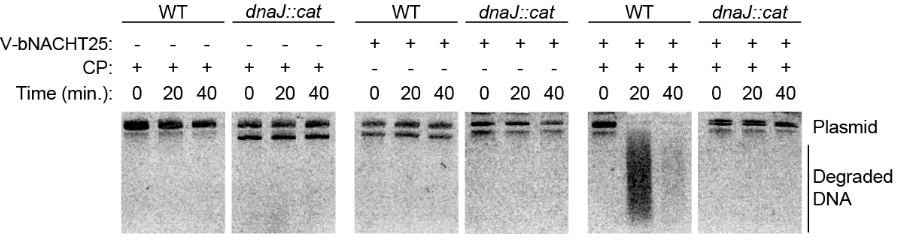
Furthermore, activation of bNACHT25 by MS2 CP also required DnaJ, as we can see that DNA degradation in the CP-bNACHT25 coexpression condition is completely abrogated in a DnaJ knockout. This suggested that DnaJ mediates activation of bNACHT25 by phage proteins.
IP-MS and genetic analyses led to the discovery that activation of bNACHT25 required host DnaJ, an Hsp40 family chaperone involved in protein folding. Phage protection is greatly reduced in the DnaJ knockout (dnaJ::cat)!
While some defense systems directly bind phage protein activators, we found that bNACHT25 is activated indirectly and does not directly bind CP. We searched for host proteins that might be mediating the interaction between phage and bNACHT25.
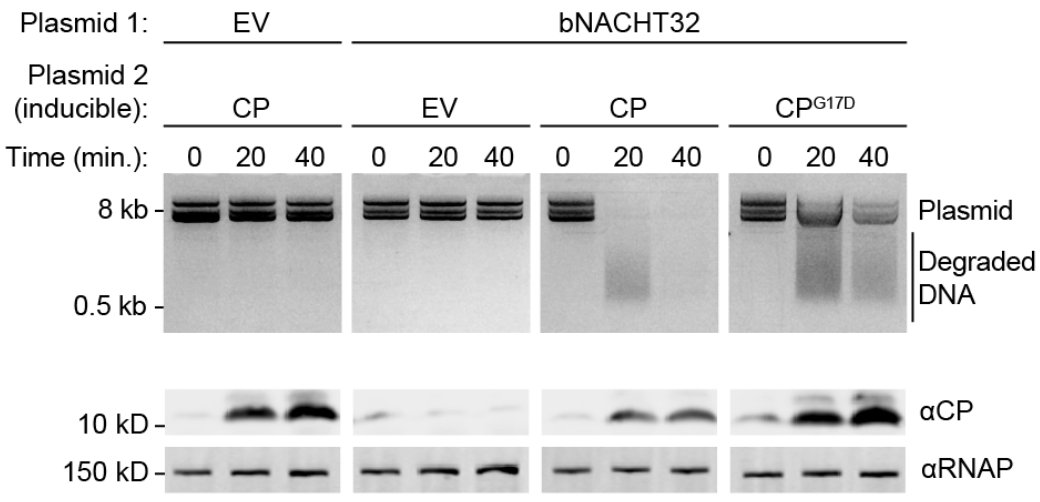
Some of these escapers had mutations in coat protein (CP), and we found that CP was sufficient to activate the DNase effector of bNACHT32 (and the highly similar bNACHT25)! We measure this by observing DNA degradation following coexpression of bNACHT32 and CP.
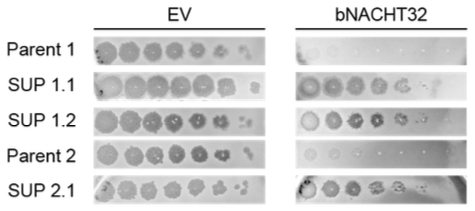
A remarkable characteristic of certain bNACHT (NLR-related) proteins is that they detect RNA phages, like MS2, AND DNA phages like T4—two phages with no proteins in common. We set out to discover the MS2 detection mechanism by finding suppressor phages that could evade defense.
I’m excited to share my PhD work in the @aaronwhiteley lab that I recently had the chance to present at #GRCToxPath! We investigated a widespread and diverse group of phage defense systems related to NLRs with @jivarahasya. Link: https://t.co/FmvazUlgdv See thread for highlights!