HELLO WORLD. 👀
The COMPANIONS are coming.
New walking buddies. Hidden paths. Mystery chests. Treasures waiting to be found near you. 🗝️
WALK. HUNT. WIN.
Who’s joining the hunt? 👇
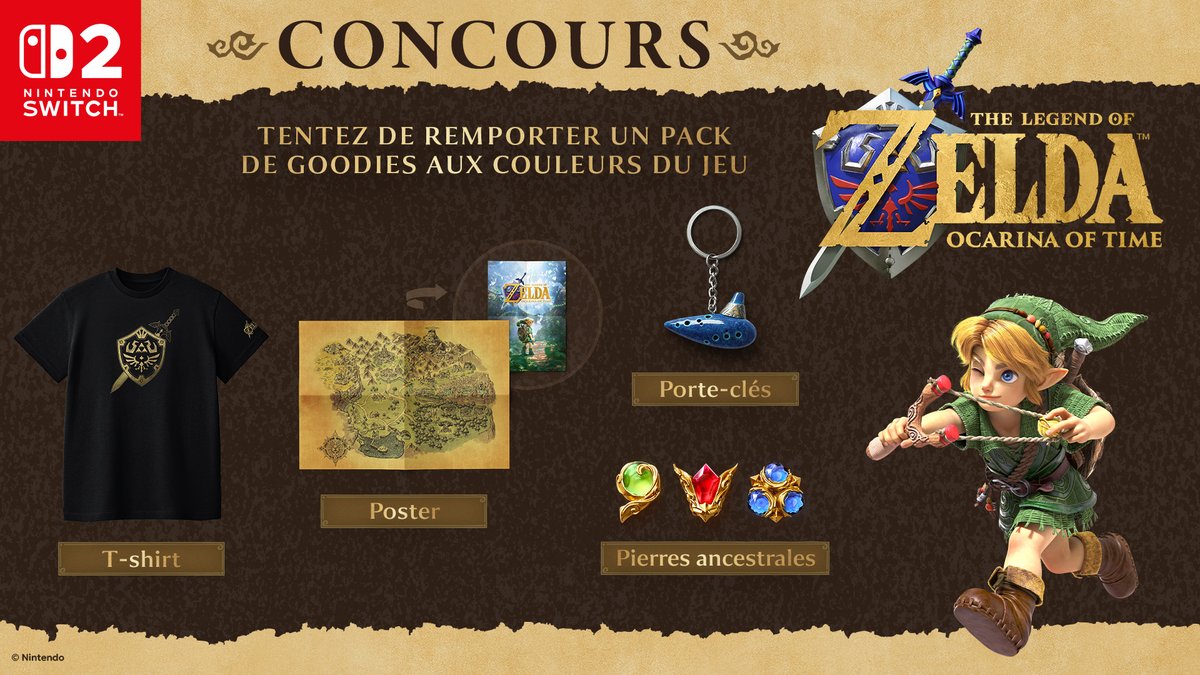
[CONCOURS 🎁] Tentez de remporter des lots de goodies The Legend of Zelda : Ocarina of Time avant la sortie du jeu le 05/11 prochain !
Pour participer :
- RT ce post
- Dites-nous en commentaire quel est le temple que vous préférez dans le jeu avec le #NintendoPGW
4 gagnants tirés au sort le 30/10.
🐸 FWOGHOOD COLLABS ARE OPEN! 🤝
Giving out 200 GTD spots to the community.
To get in:
→ RT + Like
→ Comment & tag your fwens 🐸
→ Mention a community you want Fwoghood to collab with
Tag ’em. Bring ’em. Let’s build the Hood. 🏡🐸
🕴💼 SOLANA BROKERS — MINT ANNOUNCEMENT
The @solanabrokers Era is officially here!
We’re moving fast, building toward the future of the ownership economy, and bringing 3,333 Brokers to Solana.
With @opensea recently expanding @solana NFTs trading but not yet supporting new Solana NFT project launches, we looked for a home built specifically for what we’re creating.
We Found It!
We’re proud to partner with @LaunchMyNFT to bring the very first Brokers on Solana to life. ⚡️🚀
📊 MINT DETAILS
• Total Supply: 3,333 SolanaBrokers
• GTD WL: 3,000
• Treasury: 300
• Team: 33
• Mint Price: 0 SOL — FREE MINT
• Mint Platform: LaunchMyNFT
⏱️ MINT TIMES — SEPTEMBER 5
ROUND 1 — GTD WL (GTD IS GTD)
🕒 UTC: 3:00 PM – 4:00 PM
ROUND 2 — WL FCFS
🕒 UTC: 4:00 PM onwards
💼 Every secondary trade feeds the Brokerage Vault, putting value directly back into the community.
Set your alarms.
Turn notifications on. 🔔
Secure your spot.
The Broker Era on Solana starts September 5.
🕴💼 Welcome to the floor.
The trading floor belongs to the @solana community now. 💼⚡
3,333 Solana Brokers.
100% FREE MINT.
0% corporate gatekeepers.
Every secondary trade feeds the Brokerage Vault, putting value back into the ecosystem and the community.
The floor opens soon. 👀
🎟️ Want a seat before the doors open?
WL applications are LIVE!
Get your name on the list. Make your move before the market moves without you.
🔗 WL FORM: https://t.co/gWAgLYOeP1
Your Broker Era on Solana starts here. 🕴️📈
Turn notifications ON. 🔔
They said Solana NFTs are dead... but the timing couldn’t be more perfect for a complete resurrection! 💀🌊🔥
@OpenSea going live with Solana is the catalyst, but let’s be clear: the official Solana NFT catalyst and bull run starts right here with @solanabrokers!
2 days of explosive reach proved the community hunger is real. We aren't just joining the @solana ecosystem—we are here to change the game, revive the space, and lead the charge into this massive new era.
Don't sleep on history in the making. This is the moment you absolutely cannot afford to miss!
We are taking over! 📈💼⚡️
AND WE LAUNCH SOON!!!
gm X! I got a lil taste of a @bot feature that will eat the market:
Grok Bot Templates.
how it works?
1. https://t.co/DES8SVbmWd
2. press button
3. explore https://t.co/0SwXQffxOv via a primed bot that knows all the sauce - even the private repos!
The easiest way to explain OpenZoo - $TOKEN:
Most “cheap AI” platforms simply find you a cheaper model. OpenZoo is trying to reduce the cost of the entire AI request.
Think of it as a marketplace for intelligence:
1. Use only the context actually needed — leCore can retrieve relevant information instead of repeatedly making the model read enormous histories/documents.
2. Use only as much intelligence as needed — don't pay a frontier model $1 for something a smaller model can solve for $0.01.
3. Shop across hundreds of models/providers — automatically find an efficient route.
4. Pay per request with x402 — agents can purchase intelligence automatically without maintaining accounts/API keys with every provider.
Put together:
less context + cheaper appropriate model + better routing + automatic payments = potentially dramatically cheaper AI.
And that's why the opportunity could be huge.
If millions of autonomous agents eventually make billions of AI calls, they will naturally care about how much useful work they get per dollar.
If OpenZoo consistently offers more work for the same money, agents have an economic reason to route through it.
So the giant vision isn't “another cheap AI website.”
It's:
OpenZoo becomes the invisible economic layer where machines shop for, buy and pay for intelligence.
If they actually achieve that at scale, the addressable market is essentially AI inference itself.
EVULoNF4DeMBN4dGiZiDfpiiTfNZgoCvXWWgaV3epump
https://t.co/Pxm0oDVNRQ
there's some vaults, there's some pools
each pool is shared among all vaults
to 'win' from the arbing u need to hold $TOKEN
or maybe put some $ into a vault
There is a sol vault (and aa bunch others) if arbs happen whatever u put into vault goes up,
atm we need an awful lot more $ in the 0-fee LPs so that arbs even have a chance of working at all
... but it's mostly silly to do that, cuz they're 0-fee
Unless you really wanna see Magick
this architecture is right and almost nobody runs it. parallel fan out, independent re-verification, worktree isolation so the agents cannot corrupt each other. we run the same shape.
the part that bites is the bill, and it is not where people expect.
32 agents auditing one repo means 32 agents that each need the repo in context. your cost scales with agents times repo size, not with findings. then the verification pass makes it worse in exactly the way that makes it work: a clean context is the whole point of re-verifying, and a clean context means paying for the repo again, per finding.
so the better your verification discipline, the more you pay for it. that is a bad gradient.
we measured this on a 2.46M token codebase. six models, same questions, two arms:
in-context: $38.04
bound once, retrieved per query: $3.39
11x, same answers.
the retrieval arm read about 2% of the corpus per question. 45k to 65k tokens out of 2.46M. an audit question is local almost every time. "does this handler validate its input" needs that handler, its callers, and the validation helper. it does not need the other 2.4M tokens, but a context window charges you for them anyway.
worth checking your own numbers on this: 2.46M does not fit anywhere. the largest live window on OpenRouter right now is grok-4.20 at 2M. so the in-context arm is not one call, it is 3 chunked calls plus a reduce. per agent. times 32. that is the real multiplier, and chunking is also where cross-file bugs go to die, because the call that sees the caller never sees the callee.
none of this changes your design. bind the repo once, point all 32 at the same bound context, let each pull what its slice of the audit needs. verification agents get their clean context for free because clean context is just a new query against the same bind, not a re-upload.
https://t.co/Mek8RgkKs1 if you want the numbers or the harness.